DRIFT AUDIO
Listen to this story
Choose a voice, then press play.
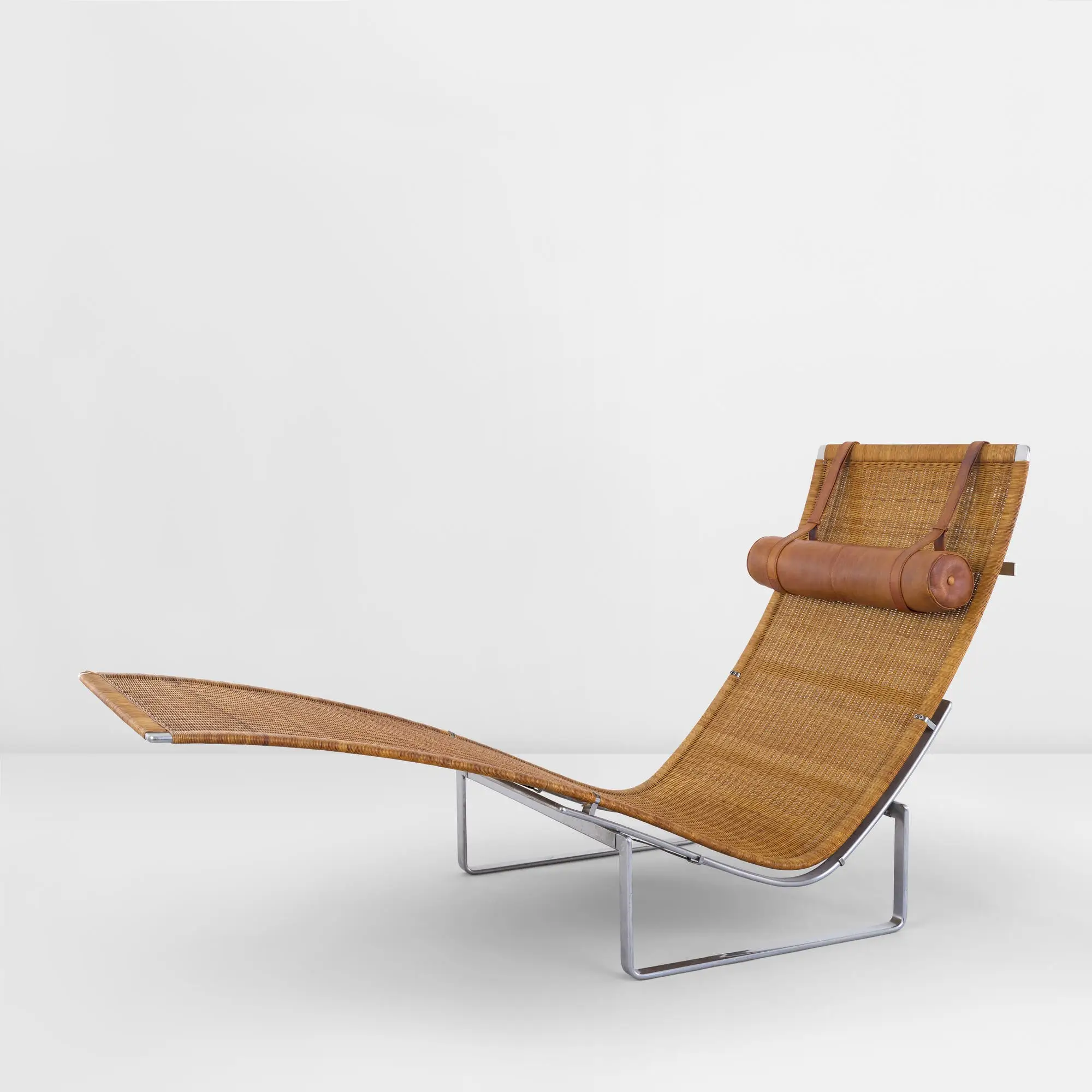
The PK 24, often called the “Hammock” lounge chair, stands as one of the most recognizable and celebrated works of Danish designer Poul Kjærholm (1929–1980). Designed in 1965, this chaise longue embodies a unique synthesis of industrial precision, organic comfort, and minimalist elegance. Suspended between two points on a sculptural stainless steel frame, it offers a sense of weightlessness that evokes relaxation and modernity. Today, it remains in production by Fritz Hansen and holds a prominent place in museum collections, including the Museum of Modern Art (MoMA) in New York.
stir
Poul Kjærholm was born on January 8, 1929, in the small village of Østervrå in northern Jutland, Denmark. He began his career with a traditional apprenticeship as a cabinetmaker, a foundation that instilled in him a deep respect for craftsmanship, materials, and precise joinery. He later studied at the Danish School of Arts and Crafts in Copenhagen (now part of the Royal Danish Academy of Fine Arts), graduating in 1952.
Unlike many of his Danish contemporaries—such as Hans Wegner or Arne Jacobsen, who often emphasized wood—Kjærholm was fascinated by industrial materials, particularly steel. He viewed steel not as a cold, utilitarian substance but as a material worthy of the same artistic respect as wood. He paired its strength and lightness with natural elements like leather, cane (wicker), canvas, and halyard rope, creating pieces that felt both futuristic and warmly human.
Kjærholm’s career was marked by a functionalist yet a flow approach. He lectured at the Royal Danish Academy and became a professor in 1976. His work earned international acclaim, including multiple Grand Prix awards at the Milan Triennale (1957 and 1960), the Lunning Prize (1958), and the Danish ID Prize. Major retrospectives, such as the 2006 exhibition at the Louisiana Museum of Art, cemented his status. His designs are held in collections worldwide, from MoMA to the Victoria and Albert Museum.
Kjærholm connected with manufacturers like E. Kold Christensen (for whom the PK 24 was initially produced) and later Fritz Hansen. His son, Thomas Kjærholm, continues to oversee the archive, ensuring fidelity to the original visions.
gen
The PK 24 emerged in 1965 during a period when Kjærholm was exploring more fluid, organic forms after earlier, stricter geometric experiments like the PK 22 and PK 25. It was initially manufactured by E. Kold Christensen in Copenhagen and has been produced by Fritz Hansen since the early 1980s.
Kjærholm drew inspiration from the Rococo period and traditional French chaise longues, which featured luxurious, curving forms for reclining. However, he reinterpreted this historical typology through a modernist lens, using steel to support a sinuous, flowing seat. He specifically called it the “Hammock Chair” to highlight its unique suspension principle: the body is gently cradled and suspended between two points, creating a stress-melting sensation of weightlessness.
The design reflects Kjærholm’s broader know: “I am especially interested in the relationship between form and materials… I try to create objects that are as simple as possible, but also have a certain elegance.” The PK 24 achieves this by eliminating unnecessary hardware—the seat glides along the frame purely by gravity, adjusting to the user’s position.
flow
The PK 24 measures approximately:
- Height: 85 cm (33.5 inches)
- Width: 67 cm (26.4 inches)
- Depth: 155 cm (61 inches)
- Seat height: 14 cm (5.5 inches)
- Weight: Around 68.5 lbs (31 kg)
The base consists of satin-brushed or polished stainless spring steel, formed into a continuous, elegant curve that provides structural support without visual bulk. The frame is resilient yet flexible, engineered to distribute weight evenly.
The seat is available in handwoven wicker (cane) or full leather upholstery. Wicker versions offer breathability and a natural, textured aesthetic that contrasts beautifully with the cool metal. Leather versions provide a more luxurious, supple feel. A detachable leather headrest with a stainless-steel counterweight allows for easy adjustment, enhancing comfort for different body types and reclining preferences.
One of the chair’s most ingenious aspects is its lack of visible fasteners connecting the seat to the base. The woven or upholstered element rests and slides along the frame, held by gravity and the tension of the materials. This creates a dynamic, responsive seating experience—the chair “hammocks” the user, adapting as one shifts position.
Craftsmanship is paramount. The wicker is meticulously handwoven, requiring skilled artisans. Steel components are precisely bent and finished to achieve flawless curves and a mirror-like or brushed surface that catches light elegantly. Every detail, from the curvature of the frame to the balance of the headrest, reflects Kjærholm’s cabinetmaker roots applied to industrial production.
mat
Kjærholm’s genius lay in material juxtaposition. Steel provides the skeletal strength and view lightness, while natural materials like wicker add warmth, texture, and acoustic softness. Wicker, derived from rattan or cane, is sustainable, durable, and ages gracefully with patina.
Leather options (often aniline-dyed for a natural look) develop character over time. The counterweight headrest mechanism is both functional and sculptural, a small masterpiece of engineering within the larger design.
Production standards remain high. Fritz Hansen emphasizes sustainability and quality, using responsibly sourced materials. The chair’s durability ensures it can last generations with proper care—occasional oiling for leather, cleaning for wicker, and avoiding extreme conditions for the steel.
scope
The PK 24 arrived during the height of mid-century modernism, when Scandinavian design was gaining global prominence for its humanism and functionality. Post-war optimism favored clean lines, new materials, and democratic ideals in design. Kjærholm’s work bridged craft traditions with industrial capability, aligning with the ethos of the era.
The chair’s hammock-like suspension prefigures later ergonomic thinking, prioritizing comfort through form rather than padding. It echoes Eero Saarinen’s and Charles and Ray Eames’ explorations of organic shapes but maintains a distinctly Danish restraint—no excess ornamentation, just pure expression of materials and function.
It has appeared in high-end interiors, films, and exhibitions, symbolizing sophisticated, timeless taste. Auction houses regularly feature vintage examples, with well-preserved pieces commanding high prices (often $10,000–$25,000+ depending on condition and provenance).
extent
The PK 24 contrasts with the more rigid geometry of the PK 22 (a low lounge chair with halyard or leather) or the PK 25 (his 1952 graduation project with a single bent steel element). While earlier works emphasize structure, the PK 24 prioritizes fluidity and bodily interaction. It represents the maturation of his style toward more expressive, sculptural forms while retaining core principles of honesty to materials.
rare
Today, the PK 24 graces minimalist homes, haute hotels, and corporate lounges. Its versatility suits both indoor and (with care) covered outdoor settings. It pairs beautifully with other Scandinavian classics or contemporary pieces, serving as a statement focal point.
For collectors, authenticity is key. Look for proper markings, high-quality steel finishing, and consistent weaving. Reproductions exist, so provenance from authorized dealers like Fritz Hansen or reputable galleries is advisable. Its value appreciates due to limited production, iconic status, and Kjærholm’s growing reputation.
Maintenance tips include protecting from direct sunlight (to prevent fading), regular dusting, and professional restoration for vintage pieces. The chair rewards use—it becomes more comfortable and characterful over time.
know
Kjærholm once noted his interest in construction and materials above all. The PK 24 exemplifies this: every element serves a purpose, yet the whole transcends utility into art. It invites interaction, promoting a relaxed, contemplative posture that aligns with modern desires for wellness and mindfulness in daily life.
In a world of disposable furniture, the PK 24 represents the counter-ideal—timeless, repairable, and built to endure both physically and culturally. It embodies Danish hygge (coziness) through modernist means: comfort without clutter, elegance without ostentation.
leg
Poul Kjærholm passed away in 1980 at age 51, but his influence persists. Designers continue to cite him for his material innovation and restraint. The PK 24, in particular, has inspired interpretations in contemporary furniture, from ergonomic loungers to sculptural art pieces.
Fritz Hansen’s ongoing production keeps the design accessible while maintaining standards. Limited editions and special finishes occasionally appear, delighting enthusiasts.
The chair’s presence in MoMA and other institutions underscores its artistic merit. It is not merely furniture but a cultural artifact representing the best of 20th-century design: innovation rooted in tradition, beauty in simplicity, and human-centered engineering.
endure
In an age of digital overload and fleeting trends, the PK 24 offers a physical antidote—a space to recline, reflect, and reconnect with the body and surroundings. Its hammock suspension provides literal and metaphorical suspension from daily stresses. The interplay of hard steel and soft natural materials mirrors life’s balances: structure and flexibility, strength and vulnerability.
Either in a sleek Manhattan apartment, a Scandinavian summer house, or a design museum, the PK 24 commands attention through quiet confidence. It does not shout; it invites.
fin
The Poul Kjærholm PK 24 Hammock lounge chair is more than a piece of furniture—it is a masterpiece of design that captures the essence of mid-century modernism while transcending its era. From its 1965 conception to its current status as a collectible icon, it showcases Kjærholm’s unparalleled ability to merge industrial materials with organic comfort and sculptural beauty.
Owning or experiencing the PK 24 means participating in a legacy of thoughtful, enduring design. It reminds us that true innovation lies not in complexity but in refined simplicity, where form, function, and materials achieve certain harmony. In the words of those who appreciate it, the PK 24 doesn’t just support the body—it should elevate the spirit.
Related Articles
Joël Andrianomearisoa Finds More Than One Black in a Square of Buttons
In La Guerre des Boutons I, a field of ordinary fasteners turns a modest textile […]