DRIFT AUDIO
Listen to this story
Choose a voice, then press play.
Ron Mueck is one of the most compelling figures in contemporary hyperrealist sculpture. Born Hans Ronald Mueck in Melbourne, Australia, in 1958 to German parents, he emerged from a background in puppetry, model-making, and special effects for film and television. His transition to fine art in the mid-1990s produced works of uncanny realism that conjure profoundly with scale—tiny figures evoking vulnerability or colossal ones confronting viewers with their own physicality. Represented by Thaddaeus Ropac, whose international galleries in London, Paris, Salzburg, Milan, and Seoul provide platforms for his monumental installations, Mueck’s practice continues to captivate audiences worldwide.
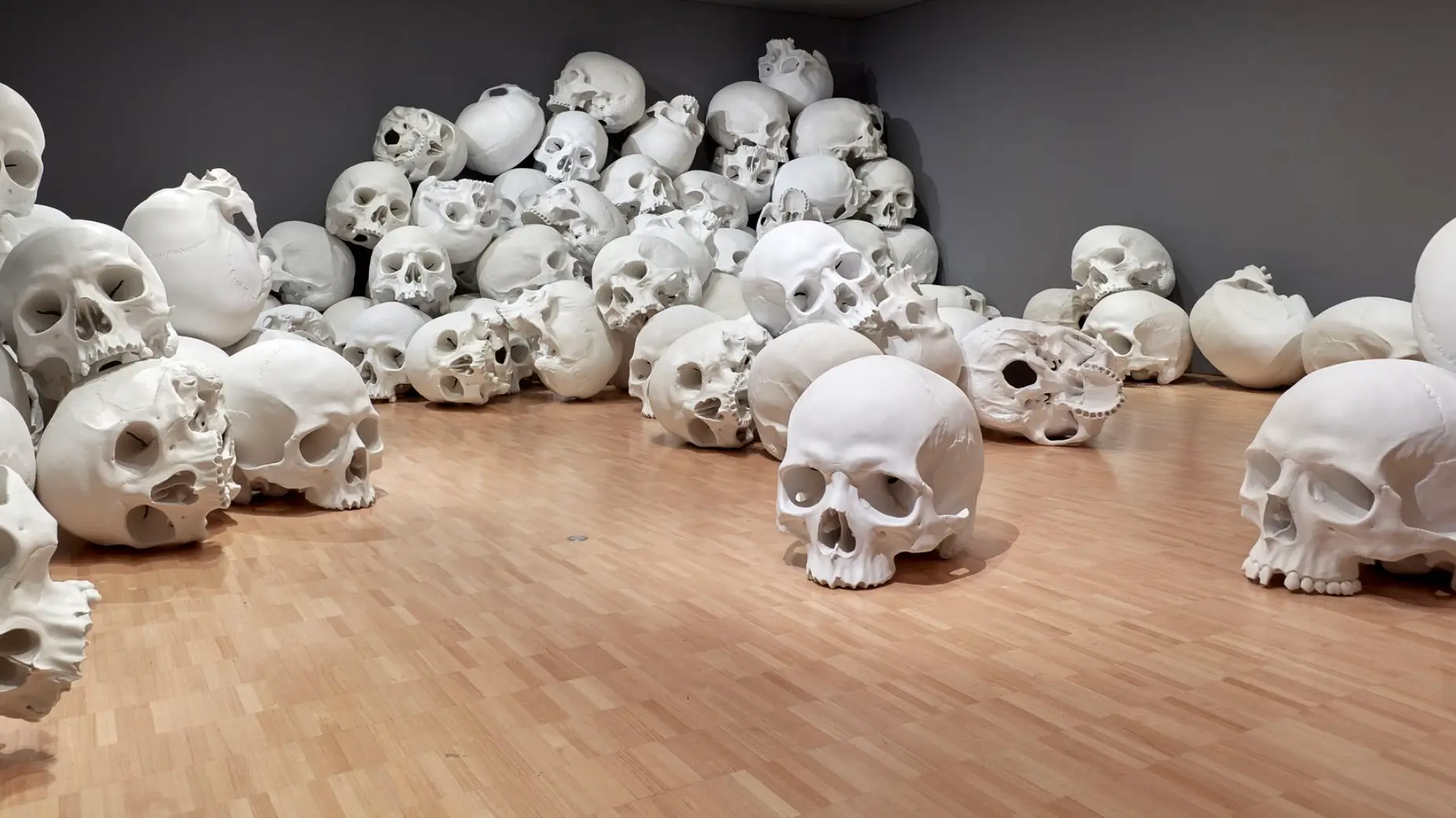
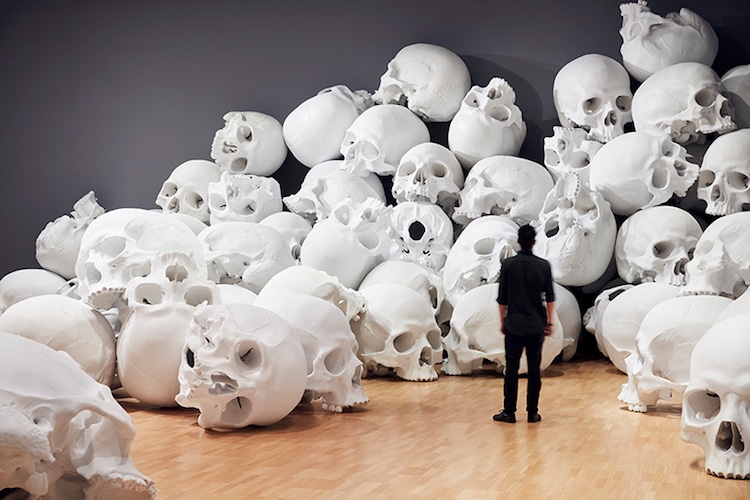
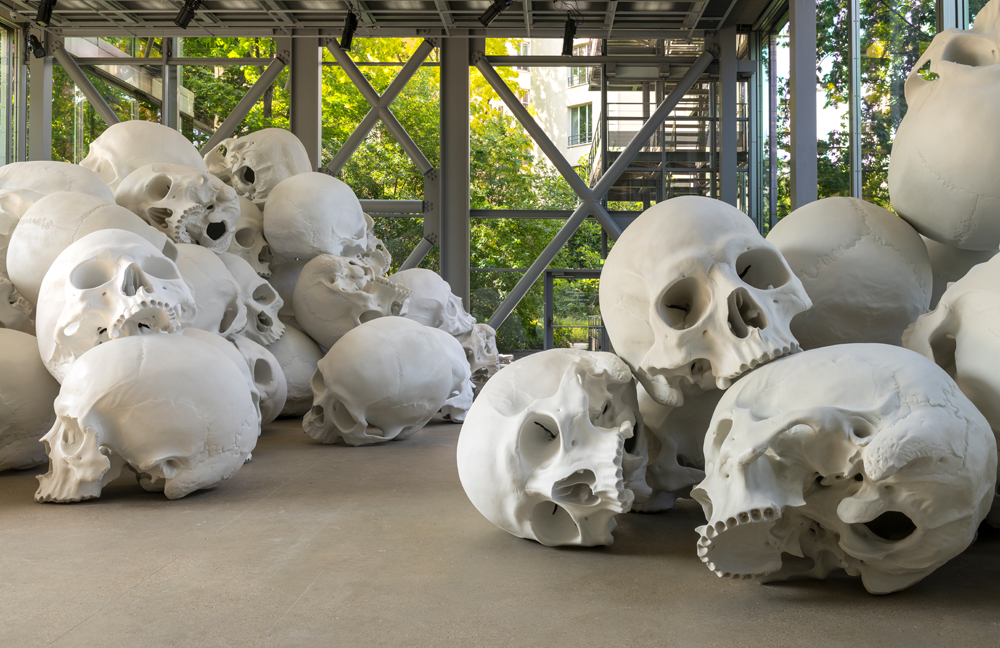
Mass (2016–17), a pivotal work in his oeuvre, stands as his most ambitious creation to date. Commissioned for the inaugural NGV Triennial at the National Gallery of Victoria in Melbourne, it comprises 100 oversized human skulls fabricated in synthetic polymer paint on fibreglass. The installation’s staggering dimensions—approximately 550 x 1487 x 5081.8 cm (over 5 meters high in some configurations, spanning nearly 51 meters in length)—transform the skull, a classic memento mori, into an overwhelming architectural presence.
flow
Mueck’s early career involved crafting detailed models and puppets, including work with Jim Henson’s Creature Shop. His breakthrough came in 1996–97 with Dead Dad, a diminutive, hyperreal sculpture of his deceased father, featured in the landmark Sensation exhibition at the Royal Academy of Arts in London. This piece established his signature approach: meticulous attention to texture, pores, hair, veins, and emotional nuance, combined with deliberate scale manipulation to elicit visceral responses.
By the 2010s, Mueck had expanded his practice to larger scales while maintaining hyperreal fidelity. Mass grew out of an invitation from the NGV. Rather than another figurative human, he turned to the skull—an object he has described as both biologically complex and aesthetically beautiful. Each skull is individually cast and finished with painstaking detail, capturing sutures, teeth, nasal cavities, and the subtle variations of bone structure. The work required extensive technical expertise, involving molds, fiberglass reinforcement, and layered painting to achieve a bone-like yet slightly abstracted pallor.
The title Mass carries multiple resonances: the physical mass and weight of the piled forms, the Catholic liturgical sense of ritual and congregation, and the sheer quantity evoking mass death, genocide, or collective human fate. Installed initially amid the NGV’s gilt-framed 18th-century European paintings, it created a powerful dialogue between historical opulence and raw contemporary confrontation with mortality.
scope
Mueck belongs to a lineage of hyperrealists who emerged in the late 20th century, building on photorealist painting traditions but translating them into three dimensions. Artists like Duane Hanson and George Segal influenced the movement, yet Mueck distinguishes himself through emotional subtlety rather than social commentary alone. His figures often appear caught in private moments—pregnant women, elderly couples, isolated individuals—inviting empathy and self-reflection.
In Mass, the absence of individualized faces shifts focus from personal narrative to universal archetype. The skulls, enlarged to roughly twice life-size or more, lose the intimate familiarity of smaller works and gain an architectural, almost archaeological quality. Viewers confront not a single death but a cataclysmic accumulation. This recalls historical ossuaries (such as the Catacombs of Paris or Sedlec Ossuary in Czechia) and artistic traditions from medieval Danse Macabre to Damien Hirst’s diamond-encrusted skull. Yet Mueck’s version feels uniquely contemporary: clinical yet haunting, stripped of religious iconography while retaining spiritual weight.
Thaddaeus Ropac, with its network spanning London’s Ely House, Paris (Marais and Pantin), Salzburg (Villa Kast and Halle), Milan’s Palazzo Belgioioso, and Seoul’s Fort Hill, has championed Mueck since his first major gallery exhibition there in 2021, 25 Years of Sculpture. The gallery’s ability to handle large-scale works makes it an ideal partner for installations like Mass, which has traveled internationally, adapting to each venue’s architecture.
install
Mass is site-responsive, reconfigured for each exhibition space, which amplifies its impact. At the NGV, it loomed over historical paintings, contrasting vanity and transience. In 2023, it featured prominently at the Fondation Cartier pour l’art contemporain in Paris, where its first showing outside Australia transformed the industrial glass-and-steel architecture into a cavernous chamber of reflection. Piles of skulls rose toward skylights, with natural light conjuring across their surfaces, evoking both a charnel house and a cathedral.
Subsequent presentations include Triennale Milano (2023), where it engaged with Italian Renaissance traditions of vanitas; Museum Voorlinden in the Netherlands; and the National Museum of Modern and Contemporary Art (MMCA) in Seoul in 2025. In Seoul’s tall galleries, the skulls seemed to ascend vertically, creating a ritualistic ascent and inviting contemplation of collective memory in a Korean context marked by historical trauma and rapid modernization.
At each location, the reconfiguration—sometimes towering piles, sometimes more dispersed mounds—alters the viewer’s path and emotional journey. Walking among or beneath them induces a mix of awe, unease, and humility. The sheer repetition underscores anonymity in death while the hyperreal detail humanizes the forms. One can almost imagine the absent flesh, the lives once contained within these crania.
view impression

theme
Mass resonates deeply in an era of global crises—pandemics, wars, climate catastrophe, and mass displacement. It serves as a poignant monument to shared vulnerability. As the NGV notes, it confronts “the atrocity of war, pestilence, a changing climate, floods, fires and famine.” The skull, long a symbol across cultures (from Aztec crystal skulls to European still lifes), here becomes a democratic equalizer: no crowns, no distinctions of status—only the bare architecture of the head.
Scale is central to Mueck’s power. His miniature works make viewers feel godlike or protective; giants make us feel small and observed. In Mass, the colossal skulls dwarf the body, forcing a literal and metaphorical “looking up” or “looking back.” This inverts traditional power dynamics between art and viewer, echoing sublime experiences in nature or architecture (think of the pyramids or Gothic cathedrals). Yet the hyperrealism prevents abstraction; each imperfection in the bone structure reminds us of organic frailty.
Critics have noted the work’s macabre yet oddly beautiful quality. In Paris, reviews described it as “dense macabre” and a “monumental installation composed of gigantic skulls in which death thumbs its grating nose at us.” Others highlight its capacity to evoke awe, shifting perspectives on existence. In Seoul, it prompted reflections on collective memory and cultural amnesia.
Mueck has said he spends significant time on surfaces to capture inner life. In Mass, the surface is the essence—bone as the final, enduring record of humanity. The work invites meditation on legacy: what remains after the flesh, the stories, the struggles?
guru
Creating Mass demanded years of research and fabrication. Mueck’s studio process involves clay modeling, silicone molds, fiberglass casting, and multiple layers of paint and varnish. Each skull required precise anatomical study, balancing scientific accuracy with artistic interpretation. The final pieces are lightweight enough for installation flexibility yet robust for travel. This technical virtuosity aligns with Thaddaeus Ropac’s focus on artists who push material boundaries.
leg
Mass has been met with widespread acclaim, drawing record crowds and sparking public discourse. At the NGV, visitor reactions ranged from awe to discomfort. Its inclusion in major surveys underscores Mueck’s status. Through Thaddaeus Ropac’s exhibitions, such as En Garde in London (2025), audiences continue to encounter his evolving practice alongside iconic pieces.
In a digital age of fleeting images, Mass offers tangible, physical confrontation. It resists easy consumption, demanding time and presence. As climate anxiety and geopolitical tensions mount, its message feels increasingly urgent: remember your mortality, cherish life’s fragility, recognize our shared humanity.
flow
Mueck’s other works—Mother and Child (2003), Still Life (2009), Couple Under an Umbrella (2013), Dark Place (2018), and recent pieces like En Garde (2023)—explore life cycles with equal intensity. Thaddaeus Ropac’s global footprint allows these to reach diverse audiences. The gallery’s historic yet modern spaces (from London’s 18th-century Ely House to Seoul’s contemporary Fort Hill) mirror Mueck’s dialogue between tradition and innovation.
In Salzburg and Milan, exhibitions situate his work within European art history; in Paris and London, they engage contemporary debates; in Seoul, they bridge East-West perspectives on existence.
close
Mass is more than a sculpture installation; it is a profound encounter with the human condition. Through 100 meticulously realized skulls, Ron Mueck confronts viewers with the inevitability of death while celebrating the beauty and complexity of life’s vessel. Its adaptability across Thaddaeus Ropac’s international venues and beyond demonstrates art’s power to transcend borders and contexts.
In an increasingly fragmented world, Mass gathers us in collective reflection. It whispers—or perhaps shouts—that amid life’s chaos, we are all equal in the end: transient, vulnerable, and part of something vastly larger. As we navigate the 21st century’s uncertainties, Mueck’s monumental reminder of our shared finitude offers not despair but a call to presence, empathy, and wonder at the intricate miracle of existence.
From the DRIFT archive: Salomón Huerta’s “Unspoken Ritual”: The Subtle Weight of Intimacy · Francesco Clemente’s Portrait Commission: The Human Gaze, Reimagined for The Coral Collective
Related Articles
Joël Andrianomearisoa Finds More Than One Black in a Square of Buttons
In La Guerre des Boutons I, a field of ordinary fasteners turns a modest textile […]