DRIFT AUDIO
Listen to this story
Choose a voice, then press play.
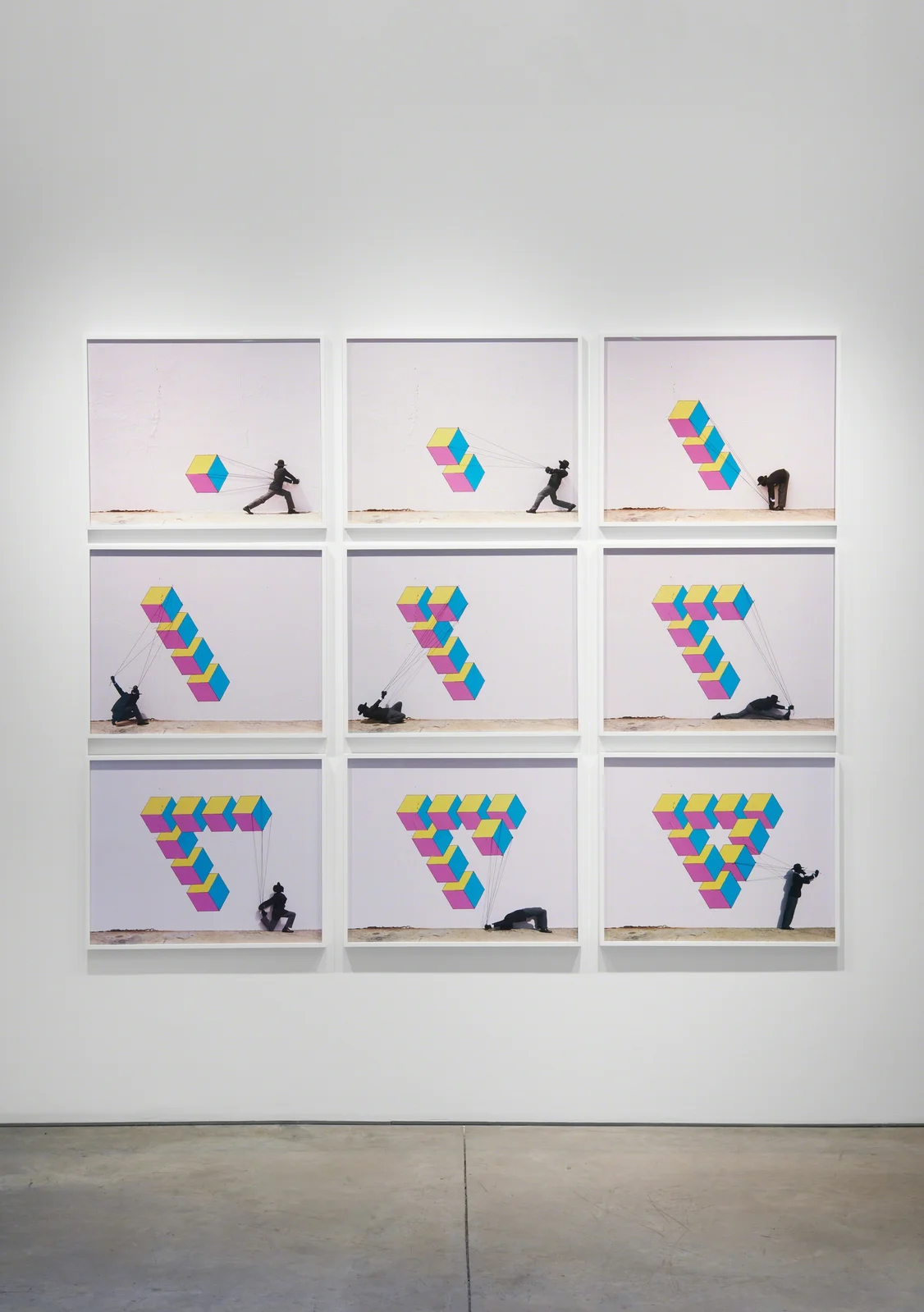
A 2017 C-print by Robin Rhode, titled David, measures 185.8 x 227.8 cm in an edition of five. The numbers lead into a practice built on chalk, walls and a camera.
The tape measure comes first. The 2017 photograph by Robin Rhode that Ocula lists as David measures 185.8 by 227.8 centimetres, or 73 1/4 by 89 3/4 inches, which puts a viewer in front of something close to six feet by seven and a half. It is a C-print, a chromogenic colour print in which the image is built from dye layers during development, and the edition stops at five. In photography an edition number works like a promise: once five impressions exist, the image is closed. For a picture of this size that is a short run, and it frames the work as a scarce object before anyone has looked at what it shows.
Signal. What happened: a 2017 Rhode photograph titled David is catalogued under Lehmann Maupin, with price and avail offered on request instead of published. Exact object: David, 2017, C-print, edition of 5, 185.8 x 227.8 cm (73 1/4 x 89 3/4 inches). When and where: dated 2017 and carried by Lehmann Maupin, whose New York gallery is at 501 West 24th Street. Why it matters: an edition of five at roughly six by seven and a half feet is a compact, wall-scale object, and its specifications are the firmest facts attached to it.
The listing connects the picture to a gallery, a year and a set of measurements, and says nothing about what it depicts. This story therefore stays with what can be established: the practice behind pictures like it, the year on the label, and the road Rhode took to get there.
stir
Rhode was born in Cape Town in 1976 and grew up in Johannesburg, coming of age as South Africa left apartheid behind. Hip-hop, film and sport were shaping youth culture, and painted murals were a familiar way for communities to tell their own stories. He took all of it into his work. In 1997, while still an art student, he began drawing on public walls and performing in front of them. A year later he added a camera, so that every act of drawing came back as a run of stills. He also studied film and drama in Johannesburg from 1996 to 2001, training that shows in how carefully each sequence is staged.
The method is simple to describe and hard to do well. Rhode draws or paints an object on a wall, such as a car, a bicycle or a basketball hoop, and then he or a convincer show out an encounter with it while the camera records each beat. Played in order, the frames behave like a storyboard. Hung side by side in a gallery, they read as a grid of moments. Anyone who knows the motion studies of Eadweard Muybridge will recognise the logic: a body is broken into steps, and the steps are laid out in a row.
The body was the point from the start. Rhode has explained that he grew up in a society where stories were told with the whole body, broadly and with animation, which put gesture at the centre of his work, and that humour became his way of turning a harsh story into a play one. Cartoon logic, slapstick and absurdism all feed in, which is why a drawn bicycle can be ridden by someone pedalling thin air.
The materials stay modest: chalk, charcoal, paint and, on occasion, soap. The setting became more specific in 2011, when Rhode went looking for a new surface and, on a tip from a local hairdresser, found a long, cracked wall on a vacant lot in the Newclare neighbourhood of western Johannesburg. He calls it the Broken Wall, after the crack that runs diagonally across one section. Over roughly seven years he made twenty or more large works there, including pictures starring the performer Kevin Narain. Each painting took a crew of up to sixteen people about two days to finish, was photoed, and was painted over within a day, with creesburg wall ends up on gallery walls in New York, Hong Kong and London.
View this post on Instagram
straddle
The year on David’s label belonged to colour. The pictures Rhode made in 2016 and 2017 form the core of The Geometry of Colour, which ran at Lehmann Maupin in New York from January 18 to March 10, 2018, and which the gallery presented as his case for art as a source of scepticism and spirituality at a time of global division. The pictures also carried a particular weight for him. Rhode said in early 2018 that these would be his last works at the Newclare wall, having announced in a 2017 letter that he was leaving because of the growing security risks around it.
The works trade the monochrome of chalk and charcoal for saturated pigment, and they break each image into panels, so a single picture arrives as a grid of framed C-prints. In Black Friday: 1 Billion, from 2016, a shopping cart serves as a prop for Narain, who wears black with a stocking over his head to flatten himself into a silhouette, while a vermilion cube stands for one billion and is broken down into ever smaller proportions. Under the Sun, from 2017, turns a rising sun into a grid of squares, like oversized pixels, with Narain perched on a car tyre as if adrift in a small boat. The image carries extra weight given that most of Rhode’s crew had never seen the sea.
The geometry was a turn. Where earlier sequences were looser line drawings, the 2016 and 2017 works lean on Minimalist volumes and colour theory, with Josef Albers, Sol LeWitt and Carl Andre named as touchstones. One 2017 work is titled Cuts, After Carl Andre, and another, Lute of Pythagorus, reaches back much further. Rhode has framed the shift as a reach for the universal, a way to hold chaos at bay.
Frustum, also from 2017, shows how far the geometry went. It is built from nine panels, each roughly 55 by 73 centimetres, and measures about 175 by 228 centimetres overall. The title is a shape, the frustum, a cone with its tip sliced off, which Rhode reached by way of the Polish writer Stanisław Lem, whose Cyberiad stories use geometry to talk about bodies and feelings. His own explanation is plain: people are frustums, incomplete and wanting to be made whole, and so are hearts.
Principle of Hope runs longer, with ten framed panels stretching to 382.3 centimetres across. Rhode has said in an interview that its look draws on Endless Steps, a granite staircase sculpture by Max Bill in Ludwigshafen, Germany, which stands for the philosophy of Ernst Bloch and its central idea of hope.
Elsewhere in 2017, the Tel Aviv Museum of Art opened Under the Sun, described as the first exhibition by a South African artist at an Israeli museum, which ran for about four months in its Architecture and Design Wing. Its centrepiece, by one account, was a long metal sculpture that curls in on itself like a wave and answers a touch with ripples of light, a piece that took Rhode roughly four years to realise. Beside it hung photographs: a dark silhouette stretching into different poses against colour blocks that track the hours between sunrise and sunset, and Inverted Cycle, from 2016, in which two masked figures in black and white seem to fight or embrace as the colour wheel turns behind them. Rhode has said he accepts a social reading of such work but does not want it confined to South Africa.
David does not appear among the works listed online for The Geometry of Colour, and Ocula’s record gives no exhibition history for it, so the print’s own story is not documented here.
show
Rhode has lived in Berlin since 2002, though the Johannesburg wall stayed at the centre of the pictures. He represented South Africa at the Venice Biennale twice, in 2005 and again in 2015, and his work is held in public collections that include the Museum of Modern Art in New York.
His 2015 Venice contribution, Blackness Blooms, shows how personal his lines can get. The C-prints, made in 2012 and 2013, take their title from a poem by Don Mattera, the South African poet and activist who was banned, jailed and tortured under apartheid. Rhode seized on the poem’s picture of imprisonment as a starting point, and the series grows from lines and loops extending out of his own body into a quick succession of images.
2015 was also the year he went furthest from the wall. For Performa 15 in New York he made Erwartung, a staged reinterpretation of the one-act monodrama by Arnold Schönberg about a woman searching a dark forest for her lover. Rhode has said he saw in that figure the South African women who lost men to migrant labour, exile or police detention under apartheid, and the performance grew out of that parallel, with a conductor and a soprano working alongside the staging.
Museums had been paying attention for years. The Hayward Gallery in London gave him a solo show in 2008, and in 2013 The Call of Walls at the National Gallery of Victoria in Melbourne paired eleven photographic works with ten animations. The larger surveys came later. Memory Is the Weapon opened at Kunstmuseum Wolfsburg in 2019 and travelled to Austria in 2020. That October, Lehmann Maupin took a solo booth at Frieze London timed to the Wolfsburg opening, where Principle of Hope hung beside new photographs shot in the Judaean Desert in the West Bank. In 2021 Museum Voorlinden in the Netherlands ran a retrospective from April 24 to September 26 covering his work from 2000 onward.
extend
The work did not stand still. Tree of Life, from 2019, sends flowers climbing the buildings of Jericho. In 2020, Power Wall, a two-person show with Nari Ward ran in Hong Kong from April 3 to June 18. The Backyard Is My World, shown at Lehmann Maupin’s London gallery from April 14 to June 6, 2021, gathered photographs and animations made over a decade in a single location, the backyard of Rhode’s family home in Johannesburg, and it was his first London solo show since 2011.
On November 19, 2024, a two-artist show with Rogelio Báez Vega opened in London under the title In Dialogue. The gallery’s current online selection for Rhode runs through Garden Service and Late Harvest, both from 2024, and The Abandoned Garden, from 2025.
Related Articles
Quarry: The Rauschenberg Poster That Opened a Union Print Shop to Artists
A 1979 impression of Robert Rauschenberg’s Quarry carries a 1968 story: a pilot workshop that […]