DRIFT AUDIO
Listen to this story
Choose a voice, then press play.
Inside an eighteenth-century Grand Canal palazzo.
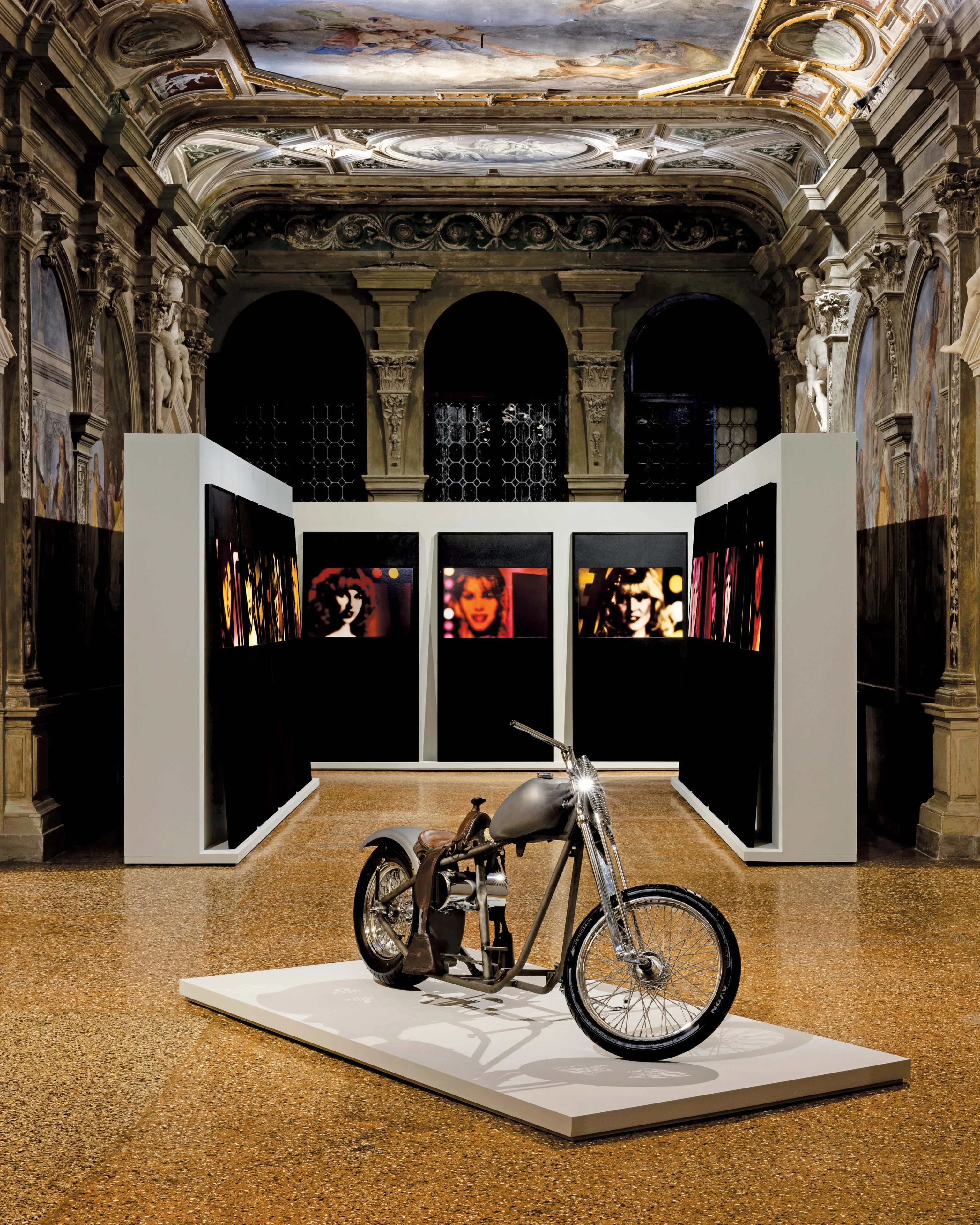
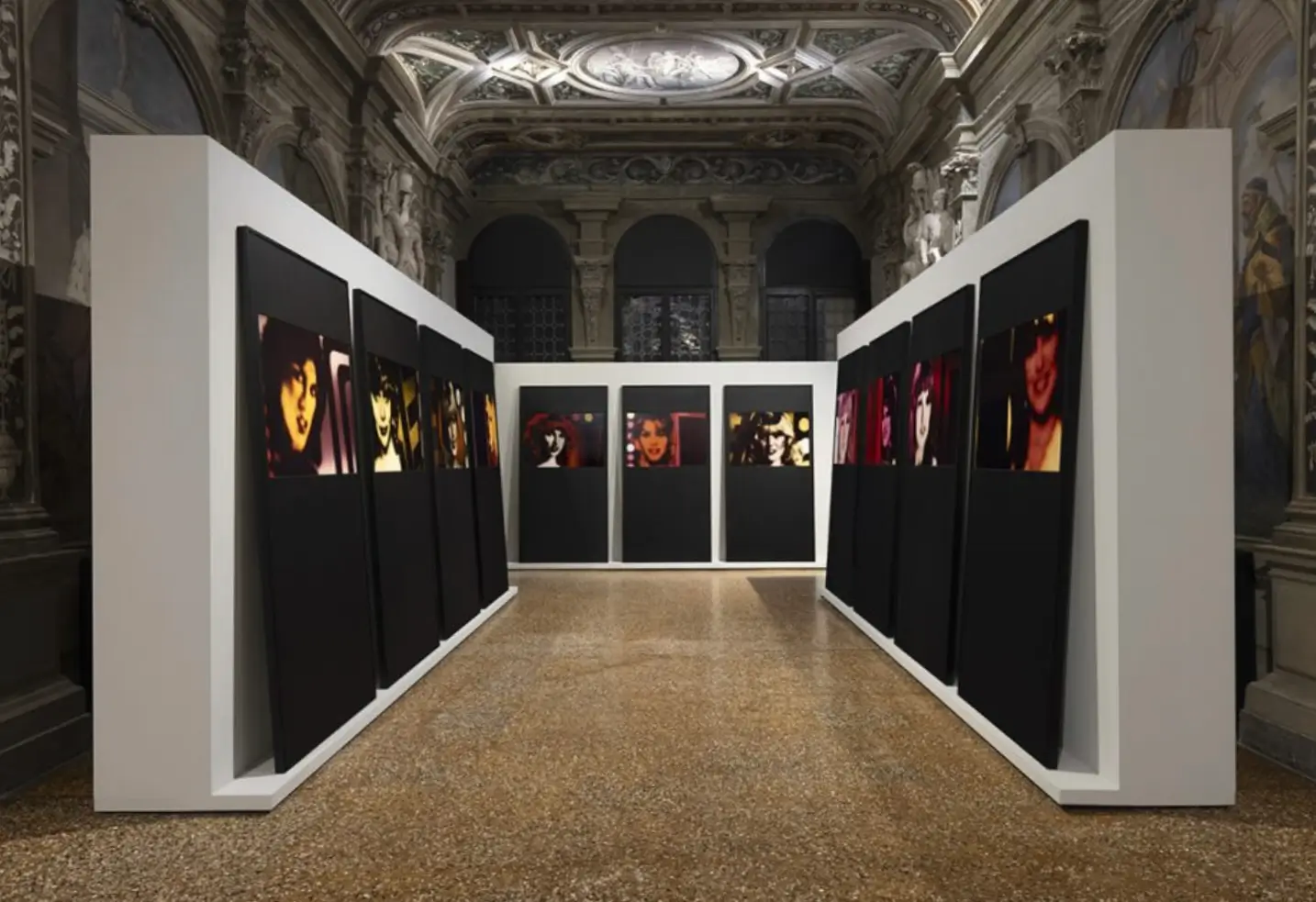
The central room on the first floor of Ca’ Corner della Regina sets two unlikely portraits side by side. One is a set of tall black Plexiglas boxes holding the head-shots of would-be actors that Richard Prince rephotographed in the early 1980s, a series titled The Entertainers. The other is Viriconium, a 2026 sculpture by Arthur Jafa made of aluminum cutouts that include Angela Davis, Billie Holiday and Walt Whitman. Both stand in for their makers rather than depict them, and both are built from faces that belonged to someone else first. That shared habit drives the Fondazione Prada exhibition that opened in Venice on May 9, 2026, in the thick of Biennale season.
Signal. What happened: Fondazione Prada opened a two-person exhibition pairing Arthur Jafa and Richard Prince, the first systematic pairing of their work. Exact object: “Helter Skelter: Arthur Jafa and Richard Prince,” more than fifty works across photo, video, installation, sculpture and painting, plus new pieces from each artist, a zine built from images they traded, and a 436-page catalogue. When and where: May 9 to November 23, 2026, at Ca’ Corner della Regina, Santa Croce 2215, Venice. Source: Fondazione Prada’s exhibition page and its visitor guide. Why it matters: Jafa’s montage of Black American life and Prince’s rephotographed white-male Americana share a method of taking without asking, and the show tests what that method says about the United States.
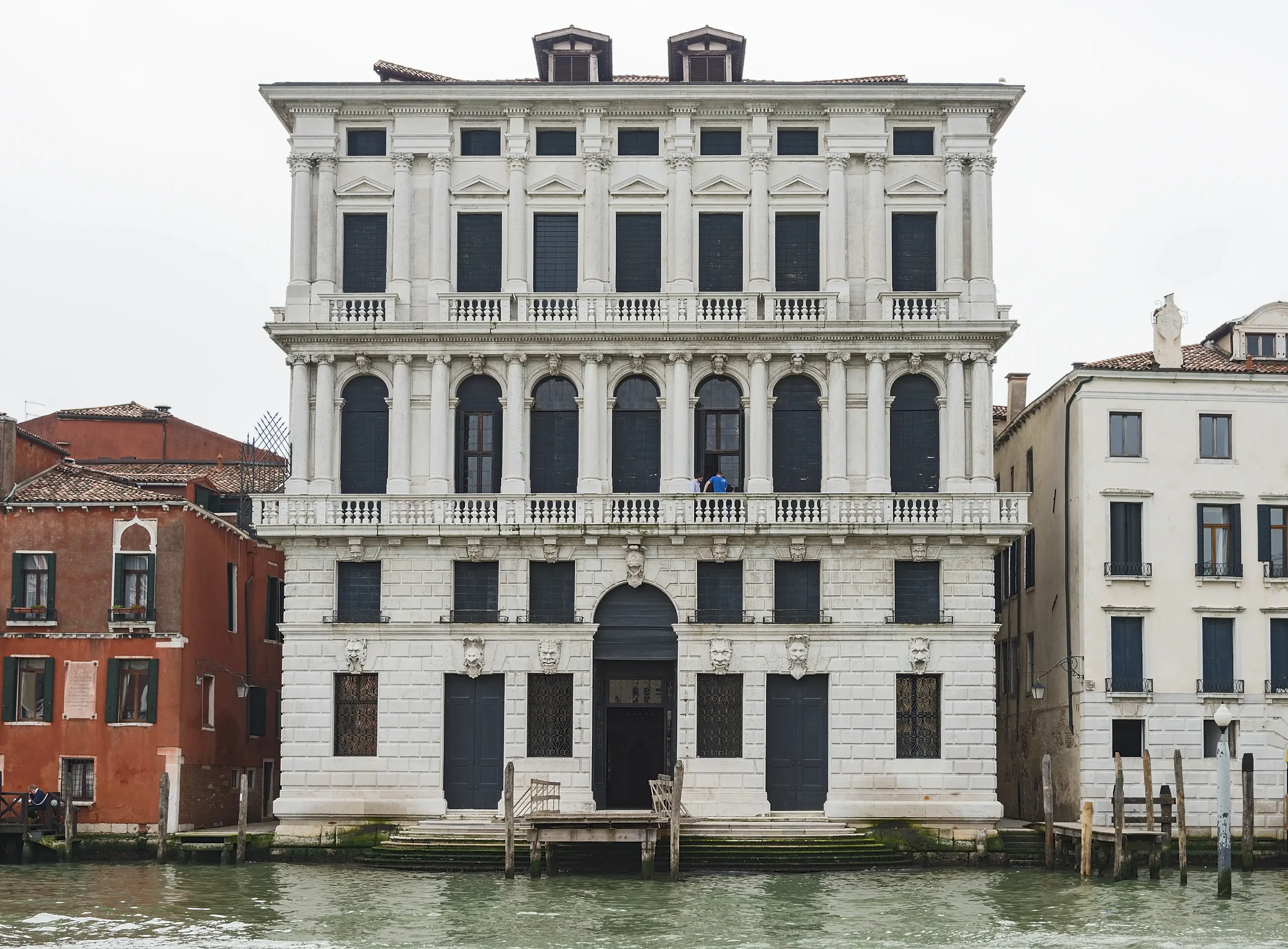
The show runs across the ground and first floors of the palazzo, an eighteenth-century building on the Grand Canal that serves as Fondazione Prada’s Venetian venue. Rooms are built as pairings, so a shared obsession such as cars, sunsets, gender, whiteness or protest turns up in two voices. Nancy Spector curated it, and she knows one of her subjects well, having organized Prince’s 2007 Guggenheim retrospective, Spiritual America. Her premise here is affinity rather than influence: two artists who landed on similar subjects from opposite positions, a Black artist on one side and a white man on the other, inside a country that has long rewarded whiteness and maleness.
two
Jafa, born in 1960 in Tupelo, Mississippi, and now based in Los Angeles, reached the art world by way of cinema. His work as cinematographer on Julie Dash’s Daughters of the Dust (1991) won the Best Cinematography award at Sundance, and he went on to shoot Spike Lee’s Crooklyn (1994). Love Is the Message, The Message Is Death, a seven-minute montage of Black life in America set to Kanye West’s Ultralight Beam, debuted in New York in November 2016 and became the work that made his name in galleries. In 2019 he won the Golden Lion at the 2019 Venice Biennale, the 58th edition of the exhibition.
Prince was born in 1949 in the Panama Canal Zone and is based in New York, where he arrived in 1973 and took a job preparing magazine clippings at Time-Life. The leftovers from that job fed his early practice. From 1977 he rephotographed advertisements and other published images, a method that challenged settled ideas of authorship and ownership, and he built whole series from what magazines supplied: Marlboro cowboys, bikers and their girlfriends, comedians, sunsets, jokes, pulp-novel nurses.
That method has been tested in court. Photographer Patrick Cariou sued Prince over Canal Zone, a 2008 series that reworked images from Cariou’s book Yes, Rasta, and in 2013 the Second Circuit ruled that 25 of the 30 works were transformative fair use. The dispute settled in 2014 before the remaining five works could be reconsidered. Spector’s argument is that Jafa takes in the same spirit: both help themselves to existing pictures without seeking permission and let the act of choosing turn them into art, a lineage she traces to Duchamp’s readymade. Where they part ways is on what ownership means. Jafa has pointed out that Black culture’s relationship to property is tangled up with slavery, when people themselves were owned, so that taking can read as survival rather than theft.
show
The show starts outdoors. In the palazzo’s courtyard, two enormous Prince sculptures from 2006 hang from metal frames like slabs of meat. Folk Songs (Blasting Mats) is built from slashed rubber tires lashed together with cable, the material demolition crews use to contain flying debris and highway crews unroll to catch falling rock. Jafa’s Big Wheel II (2018) answers them: a single tire wrapped in iron chain, its hubcap replaced by abstract medallions 3D-printed from melted metal. It is the second of six Big Wheel sculptures he showed at the 2019 Biennale, and it draws on the monster-truck demonstrations he watched growing up in the Mississippi Delta.
Treated this way, the automobile stops being America’s favorite symbol of escape and speed and becomes an artifact of damage, a relic that still carries the promise of the open road.
Inside, the pairings turn to light. Prince’s Untitled (Sunsets), made in 1981 and 1982, are C-prints of black-and-white figures at pools and beaches, silhouetted against skies of orange, red and yellow. Parents, children and couples splash and sunbathe, yet everything looks dipped in acid, as though about to melt. They hang near Jafa’s Love Is the Message, The Message Is Death, where a close-up of the sun’s molten surface flashes through the montage five times. What that recurring sun means is left open on purpose, and it keeps surfacing in Jafa’s later collages and videos.
Another pairing sets Prince’s Untitled (Girlfriend) photographs against Jafa’s LOML (2022). The Girlfriends, a series Prince began in 1986, come from the reader-submission pages at the back of biker magazines, where men mailed in photos of their partners posed with motorcycles. Prince rephotographed them into pin-ups that feel permanently out of reach. LOML works in a completely different register: blurred black-and-white images of light and static, set to a soundtrack that samples Michael Jackson’s Someone in the Dark, made as a tribute to the writer Greg Tate, a close friend of Jafa’s who died suddenly in 2021. The title is shorthand for “love of my life.”
flow
Back on the first floor, The Entertainers (1982 to 1983) date to the years Prince worked at Time-Life Books. After hours he drifted through Times Square, to adult cinemas and dive bars, where he met performers hoping for a break who mostly ended up in commercials or porn. The head-shots he made of them sit in black Plexiglas boxes that recall the display cases outside adult theaters, in front of faked backdrops of dressing-room mirror lights or marquee signs. He has said the aim was to capture the tawdry beauty of that world, and as with the Girlfriends, he identified with the people he photographed. Prince’s Untitled, dated 2018 to 2020, is catalogued in the same room.
Jafa’s contribution there is Viriconium, a new version of his multipart sculpture ___Array (2020). Its title comes from the decaying future city in M. John Harrison’s science-fiction novels. The cutouts, some of them double-sided, gather figures such as Angela Davis, Billie Holiday and Walt Whitman alongside images from art history and contemporary media, a crowd that crosses race, generation and discipline and resists being read as an exclusively Black pantheon.
The next room turns to gender. Prince’s de Kooning paintings (2006) began when he drew over the pages of a book of Willem de Kooning’s sketches for the Women series of 1950 to 1953, altering anatomy and collaging male figures into the compositions, then enlarged the pages, transferred them to canvas by inkjet and painted over them. The figures come out as intersex, orgiastic monsters. Jafa’s answer, Man Monster-Duffy (2018), is a photographic self-portrait in which he poses as Mary Jones, a Black transgender sex worker of the mid-nineteenth century whom a lithograph of the period labeled a “Man-Monster,” wearing a version of the leather codpiece she was known to wear. Where Prince unsettles the binary of male and female, Jafa adds race to the question of who gets treated as other.
extend
Whiteness gets a room of its own. Jafa’s The White Album (2018), shown at the 2019 Biennale where he won the Golden Lion, assembles found footage into a portrait of white identity as seen from a Black perspective, part indictment of white supremacy, part comedy of white absurdity, part love letter to his allies. Its title borrows from the Beatles album, home to the song Helter Skelter that Charles Manson adopted for his imagined race war. Prince’s counterpart is the White Paintings of the early 1990s, where cartoons and one-liners lifted from humor magazines float in fields of white pigment, evoking a 1950s America where it is always cocktail hour and the jokes carry the era’s prejudices with them.
Protest runs through both bodies of work. Prince came of age amid anti-Vietnam War activism and the civil rights movement. His Protest Paintings (1989 to 1994) are vertical canvases shaped like picket signs but carrying no slogans, which moves attention from any single cause to the form of dissent itself. His recent Untitled (Summer Rain) collages (2022 to 2023) keep the sign shape and fill it with warplanes dropping bombs like rain, with Apocalypse Now and The Doors’ The End as his cited reference. Jafa’s side of that room, which includes I Don’t Care About Your Past, I Just Want Our Love to Last (2018) and LeRage (2017), reflects a practice of refusing to look away from brutality, including images tied to lynchings and police shootings, and accepting the risk of censure that comes with showing them.
Then comes prayer. akingdoncomethas (2018) is Jafa’s montage of televised services from Black megachurches across the country, joining Pentecostal preaching to gospel music before cutting away to wildfires burning in the hills around Los Angeles, with the burning sun from Love Is the Message flickering by. The invented title is read in the exhibition as a nod to end-times belief, the expected apocalypse that ushers in heaven on earth. Jafa is not religious himself. His own position, he has explained, is “I believe in Black people believing.”
fin
Helter Skelter has several lives. It began as the name of a British amusement-park ride, hardened into slang for chaos, and became the title of a 1968 Paul McCartney song on The Beatles, the album known as the White Album. Later that year Manson claimed the phrase for his prediction of an apocalyptic race war between Black and white Americans. In 1992 it was also the title of a Los Angeles exhibition at the Museum of Contemporary Art that left out Black artists. Jafa and Prince took it as one more readymade, an unruly piece of found language, and the show leaves the double meanings tangled rather than sorting them out.
Jafa’s BEN GAZARRA (2024) revisits Martin Scorsese’s Taxi Driver and reworks its climactic massacre, substituting Black actors for the white pimp and johns, a change that echoes an early version of the screenplay, which was revised amid concern over depicting racial violence. It hangs beside Alfred Stieglitz’s 1923 photograph Spiritual America, a bridled horse, whose title Prince borrowed for a 1983 work and again for his Guggenheim retrospective. Both pieces draw out what the stories around them leave unsaid.
Jafa’s SloPEX (2023) shows the scale of his appetite: 841 still images advancing in a slow cascade through history, science, outer space, celebrity, film, music and art, with photographs of carnage beside nineteenth-century minstrel shows in which white performers painted their faces black. Nearby, Mickey Mouse Was a Scorpio (2017) mixes references such as Mickey Mouse and Damballa, and it sits with three Prince paintings from 2008, Abstract Threat, Graduation and It’s All Over, in which pin-up nudes, Rastafarians and de Kooning figures are transferred onto canvas and swallowed by paint.
A 436-page catalogue, designed by Peter Saville with Graphic Thought Facility, accompanies the exhibition. It carries an introduction by Miuccia Prada, an essay by Spector, texts by scholars, curators and writers, and a long conversation between the two artists, who also contributed photographic sections of their own. It is priced at 70 euros. Fondazione Prada states that the exhibition includes scenes of violence, nudity and sexual imagery, and advises adults to weigh that before visiting with minors.
Related Articles
MoMA’s Starry Night BE@RBRICK 1000% Wraps Van Gogh’s Sky Around a 70cm Bear
In 2021 MEDICOM TOY and MoMA printed Van Gogh’s swirling 1889 sky across a 70cm […]