DRIFT AUDIO
Listen to this story
Choose a voice, then press play.
Kartik Kumra spent his college savings on shoe before he spent them on tracking down artisans across India. Five years later his hoodies sell out at Dover Street Market.
Kartik Kumra was a teenager reselling Supreme rel out of Delhi when he first noticed the gap that would eventually define his career. Enrolled at the University of Pennsylvania to study economics, he spent his free time the way a lot of design obsessed twenty somethings do, haunting Dover Street Market and Selfridges and building a mental list of favorite designers, Craig Green and Kiko Kostadinov among them. What nagged at him was more specific than admiration. Nowhere in that world, he has said, did he see anything that actually referenced India’s textile history, despite that history being about as rich and varied as any country’s on earth.
View this post on Instagram
The pandemic gave him the opening to do something about it. Sent home to Delhi when his college campus closed, Kumra took the money he had saved reselling shoe and used it to fund something closer to fieldwork than a business plan: months spent driving across India, often with his mother behind the wheel since he did not yet have a license, tracking down dyers, weavers, embroiderers and wood block printers in whatever region still practiced each technique. He was twenty years old in 2021 when that research turned into a label, Kartik Research, named plainly for what it actually was.
Kumra has been candid that the early dynamic between him and the artisans he approached ran opposite to how it might read from the outside. It was not, by his own description, a young designer swooping in to rescue struggling craftspeople. If anything, the artisans were supporting him, teaching a twenty year old with no formal design training how their techniques actually worked, at a moment when the pandemic had hollowed out much of their regular business anyway and left many of them with more time than orders. That imbalance, an outsider learn from people whose knowledge long predated him, shaped how deliberate Kartik Research now credits the specific regional technique and craft clusters behind each garment rather than fold them into a vague, generic idea of Indian heritage.
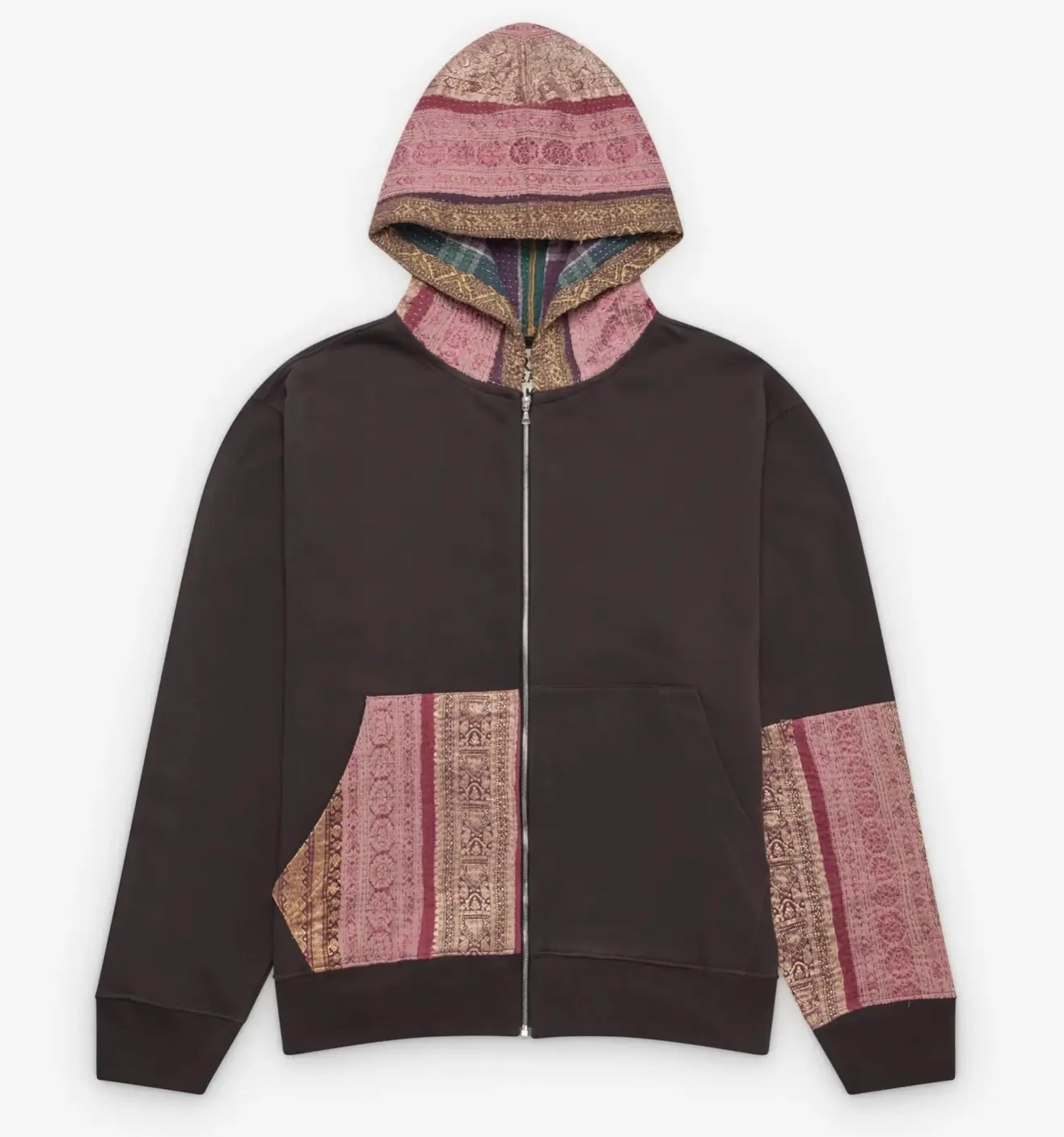
Dark zip-up hoodie detailed with pink and gold patterned textile panels.
eccentric
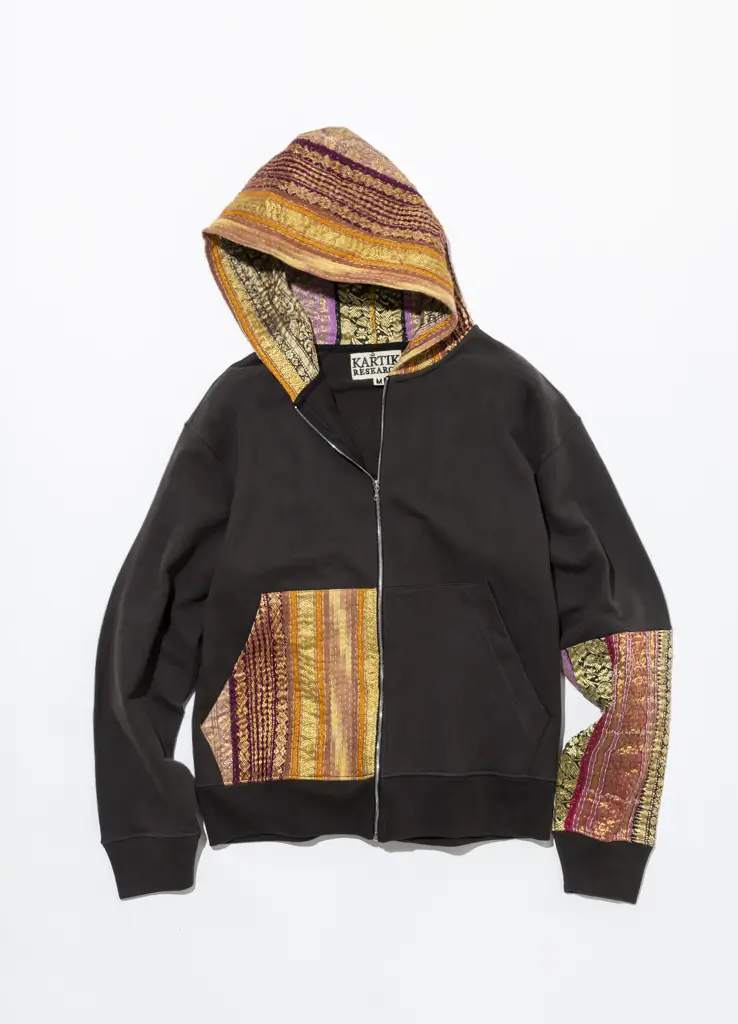
The garment most people encounter first from Kartik Research is the kantha hoodie, and it is worth understanding exactly what that means before calling it a hoodie at all. Kantha is a running stitch tradition from eastern India, historically used to quilt old saris and worn cotton into new layered fabric, and Kumra’s studio builds its hoodies out of genuine vintage kantha textiles rather than a printed approximation of the pattern. Because the source fabric is repurposed rather than manufactured to spec, no two hoodies come out identical: stitch density, tincture blocking and the particular wear pattern of whatever quilt the piece was cut from all vary from one garment to the next, which the brand states outright on its own product pages rather than treating as a marketing flourish.
That refusal to standardize runs through the label’s wider approach to craft, not just the hoodies. Roughly eighty five percent of the textiles Kartik Research uses are developed exclusively for the brand and woven without electricity, according to the label’s own account of its process, a detail Kumra treats less as a sustain talking point than as a basic condition of working with artisans whose looms have never run any other way. Denim gets a similarly specific supply chain: rather than sourcing raw fabric, the brand buys upcycled jeans from a supplier in India who hand sorts through discarded stock looking specifically for Levi’s and Carhartt pieces worth reworking. Knitwear comes from a women run cooperative that Kumra has said grew from thirty knitters to ninety after a photograph of Kendrick Lamar wearing one of the brand’s sweaters circulated, a fairly direct illustration of how quickly demand from outside India can reshape the size of a workshop still operating inside it.
The wool outerwear follows a similarly specific and, at times, genuinely inconvenient supply chain. Kumra has described source of that material from artisans based high enough in the hills that the nearest airport sits a ten hour drive away, a logistical reality he accepts because the wool simply is not available anywhere closer, given how much of India’s climate runs too warm to support that kind of production local. It is the kind of detail that rarely makes it into a product description but says something more honest about the label’s actual operations than any amount of heritage branding could: sourcing decisions here are dictated by where a technique or material genuinely still exists, not by which supplier is easy to reach.
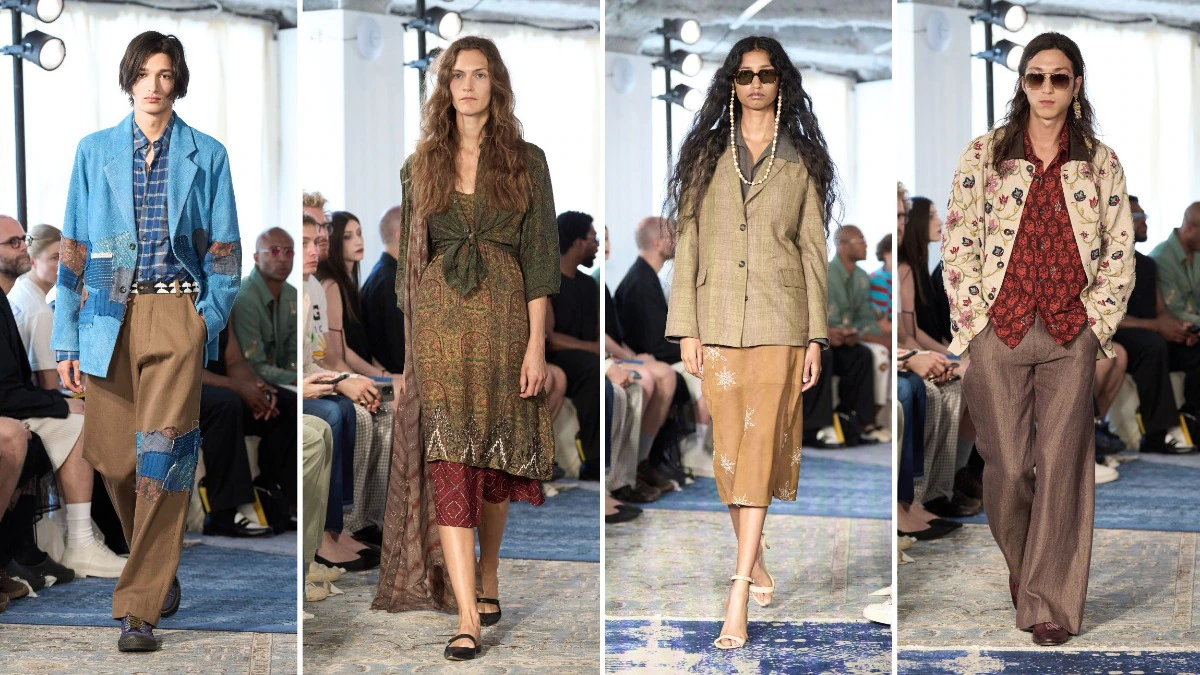
Four runway looks combining relaxed tailoring, patterned fabrics, and patchwork detailing.
transition
Kartik Research’s early growth followed a fairly uneasy path for a brand that now sits on shelves at Dover Street Market Paris and Ginza, SSENSE, Mr Porter and 10 Corso Como Milan. Its first pop up landed in New York in 2022, a year after Kumra founded the company, and it would be another three years before the label made its runway debut proper, showing at Paris Fashion Week in 2025. In between, the label built its reputation the way most genuinely craft driven brands do, slowly and mostly through word of mouth among people who noticed the stitching held up to closer scrutiny than the hype around it suggested.
A connection with British outerwear label Baracuta in September 2024 gave a clear picture of how far Kumra had already come by that point. Baracuta handed over its Harrington jacket, the G9 and G4 models specifically, along with total creative freedom to rework them, and Kumra brought in Godhadi hand quilting artisans from Gujarat, tartan handloom weavers from Himachal Pradesh, and Zardozi hand embroiderers from Uttar Pradesh to reinterpret pieces that had barely changed in decades. The resulting six piece capsule, which also included a cotton hoodie finished with deliberately exposed raw cut seams, was less a typical streetwear connection than a demonstration that regional Indian techniques could sit comfortably on a garment with as fixed an identity as the Harrington.
The recognition has followed at a pace that outstrips most young labels regardless of where they are based. Kumra was a semifinalist for the LVMH Prize in 2023 and made the shortlist again in 2026, was named to Time’s 100 Next list in 2025, and opened Kartik Research’s first Manhattan storefront that same year, following an earlier permanent shop in Delhi.
What makes that trajectory notable is less the speed of it than what it signals about how Western retail and press have started treating Indian craft as a category. For much of fashion’s recent history, Indian textile techniques have tended to enter global collections as raw material for someone else’s vision, a block print or an embroidery style absorbed into a European or American label’s own aesthetic without much attribution attached. Kartik Research inverts that arrangement simply by being an Indian authored brand that international buyers are stocking on its own terms, on the same shelves and at broadly the same price points as the Western labels Kumra grew up admiring. Whether that shift proves durable across the wider industry, or whether Kartik Research remains a notable exception, is a question the LVMH Prize shortlist alone cannot answer, but it is at minimum evidence that the exception exists.
extend
None of this reads as easily as it sounds in a press release, and Kumra has been fairly candid about the friction involved in fetching artisans who have little reason to trust a young designer showing up asking for their time. The block printer behind the label’s loose shirting, the same craftsman used historically by Yohji Yamamoto, reportedly turned Kumra away more than once before agreeing to work with him, worn down mainly by persistence rather than any pitch. Three years later, Kartik Research is now his largest client, providing him steady work across the year rather than the occasional order that regional artisans more typically depend on.
That tension between honoring a craft and actually building a functioning supply chain around it sits at the center of how Kartik Research talks about itself, and it is where the brand’s view gets notably more careful than the average heritage narrative in fashion. Kumra has pushed back specifically against the tendency in Western coverage of Indian craft to lean on nostalgia or, worse, to romanticize the poverty surrounding traditional artisan work, arguing that most existing representation of Indian culture movement skips over how much genuine skill and design intelligence is actually involved. His own approach leans instead on details that read as design decisions rather than heritage signaling: a detachable collar built from three layers of hand embroidered cotton that nods toward the Martin Margiela era of Hermès, or soft tailored suiting that draws more from early 2000s Yohji Yamamoto than from any specifically Indian sil, worked in fabric that could only have come from India.
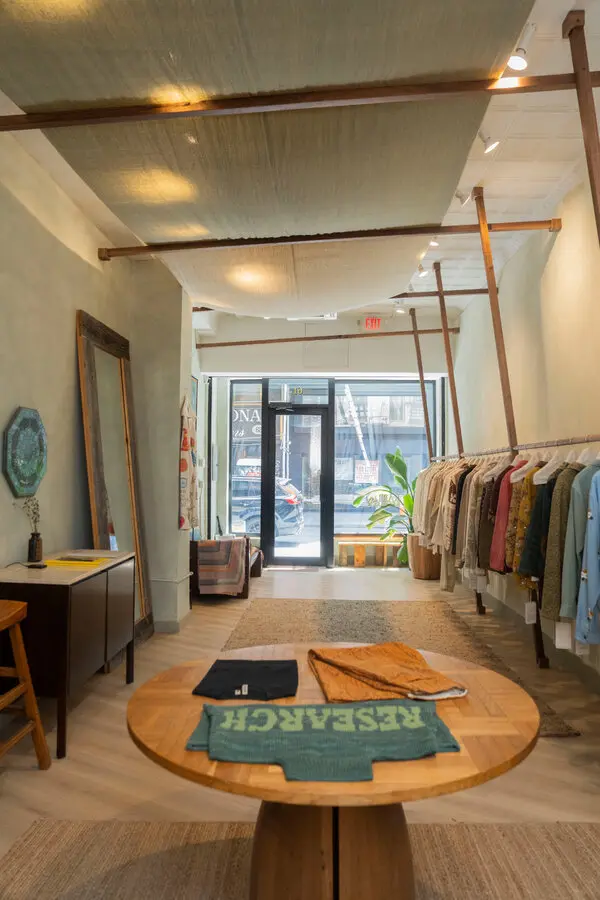
Kartik Research boutique with clothing racks, textile displays, and a central wooden table.
fin
For Autumn Winter 2025, rather than staging another runway show, Kumra published a book called AMDAVAD, an older name for the city of Ahmedabad, to lay out the brand’s design know in something more perm than a twenty minute presentation. He connected with stylist Julie Ragolia through Mr Porter’s mentorship program, who in turn introduced him to photographer Jeremy Everett, and the result project became less a lookbook than an attempt to document how Kartik Research actually wants Indian craft and culture movement to be seen, deliberate steering away from the nostalgia driven framing Kumra has said frustrates him elsewhere in the industry.
That instinct toward permanence extends to Kumra’s stated ambitions for the brand’s physical footprint. Alongside the Delhi and Manhattan stores, he has talked openly about wanting Kartik Research to become the first Indian fashion house with a genuinely global retail presence, frame around a bet that fashion’s center of gravity will look considerable less Eurocentric within a couple of decades. Either that bet pays off at the scale he is describing remains an open question. What is already measurable is smaller and more concrete: a knitting cooperative that has tripled in size, a block printer with steady year round work for the first time in his career, and a hoodie built from a genuinely one of a kind piece of fabric every single time, rather than a pattern run off a thousand times over.
For a brand barely five years old, that combination of measurable craft impression and design cred strong enough to land on shelves next to Craig Green and Kiko Kostadinov, the two labels Kumra name checks as his own early influences, is an unusually complete answer to the gap he first noticed as a teenager reselling shoe. He wanted to find something on those shelves that referenced India’s textile history properly. He ended up building it himself, one differently stitched hoodie at a time.
Related Articles

Fragment and Mammut Bring the Barryvox Back in Glacier Blue
Hiroshi Fujiwara’s second Mammut avalanche beacon leaves the Barryvox S2’s rescue brain untouched and changes […]