DRIFT AUDIO
Listen to this story
Choose a voice, then press play.
recal
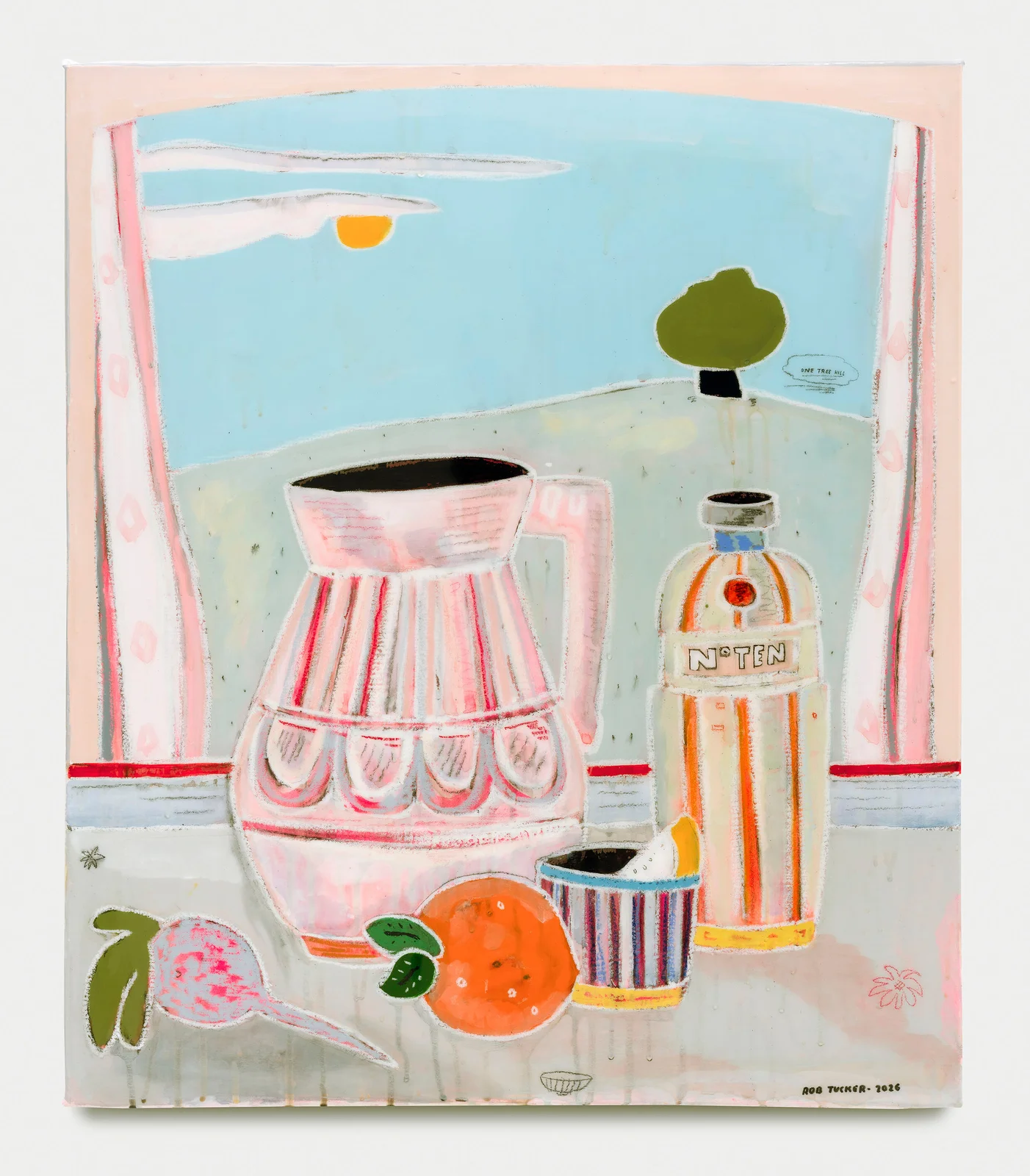
In the contemporary art scene, where digital saturation often clashes with a longing for tangible presence, New Zealand artist Rob Tucker (b. 1987) offers a refreshing counterpoint. His 2026 painting One Tree Hill stands as a luminous example of his evolve practice—blending still life, landscape, and architecture elements into a skittish yet profound exploration of form, tincture, and suspended time. Measuring 70 × 60 cm and executed in acrylic, oil pastel, oil varnish, diluted dye, water pencil, and finished with epoxy resin, this unique work captures the essence of Tucker’s distinctive aesthetic: geometric precision meets exuberant vital.
stir
Born in 1987 and based in Auckland, Rob Tucker has carved a distinctive niche in the global art world. His practice draws inspiration from day scenes—still lifes, architecture, and figurative landscapes—reimagined through simplified geometric shapes, clean lines, and a boldly colorful palette. Influences from David Hockney’s joyful spatial experiments, Henri Matisse’s masterful color orchestration, and Giorgio Morandi’s shh compositional flow are evident, yet Tucker infuses them with a contemporary whimsy and personal New Zealand sensible.
Tucker’s statement reveals his intentional evolution: “Over time, I have refined my style and technique—still lifes and figurative landscapes made with geometric shapes, simplified forms and a colorful palette. Oversized, textured and graphic, my work is an exploration of color and composition. I like to approach my subjects in a playful way, trying to achieve a whimsical, harmonious and light result.” This know resonates throughout One Tree Hill, where the titular Auckland landmark (a volcanic peak with deep cultural significance to Māori and European histories) is abstracted into a harmonious, almost dreamlike composition.
Exhibitions in London, New York, Venice, Los Angeles, and Berlin underscore his rising international profile. Gallery representation by 193 Gallery (with locations in Paris, Venice, and Saint-Tropez) positions his work among collectors seeking accessible yet intellectually engaging contemporary pieces. The 2026 exhibition The Mystical Point of View at 193 Gallery provides a fitting context for One Tree Hill, highlighting themes of perception, place, and transcendence.
flow
One Tree Hill, 2026 exemplifies Tucker’s multifaceted approach. The base layers of acrylic provide vibrant, opaque foundations, while oil pastels and sticks introduce rich texture and spontaneous mark-making. Oil varnish adds depth and luminosity, diluted dyes create subtle washes and gradients, and water pencils allow for precise linear details. The crowning epoxy resin finish seals the composition with a glossy, almost sculpture quality—enhancing color saturation, protecting the surface, and inviting viewers to engage with the work’s tactile presence.
This mixed-media strategy is signature Tucker: it bridges painting and objecthood, making each piece feel both flat and dimensional. The resin finish, in particular, amplifies the “suspended time” quality he seeks, freezing energetic brushwork and pastel strokes in a luminous, durable state. At 70 × 60 cm, the scale feels intimate yet commanding—perfect for domestic or gallery walls where it can reward prolonged viewing. As a unique work, hand-signed by the artist with certificate of authenticity from the gallery (frame not included), it carries the full weight of originality in an era of editions and reproductions.
straddle
The painting reinterprets Auckland’s iconic One Tree Hill (Maungakiekie), a site layered with geological, spirit, and historic meaning. Rather than literal representation, Tucker distills the landscape into geometric planes: rolling forms suggesting the volcanic cone, vertical elements evoking the once-prominent tree (or its symbolic absence), and architecture fragments nodding to surrounding urban context.
Vivid tincture blocking—perhaps warm earth tones contrasted with sky blues and energetic greens—creates a sense of joyful elevation. Bold painted lines intersect softer pastel areas, generating dynamic tension and harmony. The epoxy finish lends a contemporary sheen, making the work feel alive and reflective, much like the ever-changing light on the actual hill.
This abstraction aligns with Tucker’s fascination with space and form. Viewers might sense echoes of Matisse’s cut-outs in the flatness and color joy, Hockney’s playful perspectives in the spatial play, and Morandi’s meditative stillness in the balanced composition. Yet the result is unmistakably Tucker: whimsical, light, and deeply human. It invites contemplation of place—how we inhabit landscapes physical, culture, and emotion—while celebrating the simple pleasure of looking.
extent
One Tree Hill arrives at a moment when figurative and abstracted landscapes are experiencing renewed interest. Amid climate conversations and culture reclamation, works engaging specific places with optimism and coltish stand out. Tucker’s New Zealand perspective adds authenticity; his global exhibitions demonstrate how local stories translate universally.
In the fashion-design-art crossover sphere the Invent Blog often explores, Tucker’s work resonates with current interests in joyful maximalism, craft revival, and hybrid techniques. The resin finish echoes trends in contemporary object-making, where surface treatment becomes integral to meaning. Collectors value such pieces for their versatility—bridging fine art, interior design, and personal narrative.
consider
For collectors and enthusiasts, One Tree Hill offers flexible display options. Hung in a bright living space, it energizes the room with tincture; in a more minimalist setting, it becomes a focal point of vibrancy. The glossy epoxy surface interacts beautifully with natural light, shifting subtly throughout the day.
As a unique painting with gallery-issued certificate, it represents a strong entry or addition to a collection focused on contemporary figurative abstraction. Pricing in Tucker’s market reflects his trajectory—accessible relative to blue-chip names yet positioned for appreciation as his profile grows.
Pairing the work with mid-century furniture, textured textiles, or even complementary ceramics enhances its domestic presence. In gallery or museum contexts, it dialogues effectively with color field traditions and pop-influenced figuration.
fin
Rob Tucker’s One Tree Hill, 2026 exemplifies why his practice matters: it reminds us that art can be simultaneously rigorous and joyful, rooted and transcendent. Through geometric discipline and exuberant tincture, he creates spaces of possible—places where viewers can project their own memories of hills climbed, trees admired, or horizons contemplated.
In a fast-paced world, this painting offers pause. Its materials and finish ensure longevity, mirroring the enduring spirit of the landscapes it abstracts. As Tucker continues to exhibit internationally and refine his voice, works like One Tree Hill solidify his contribution to a contemporary art dialogue that values harmony, whimsy, and human connection.
For those drawn to the intersections of art, design, place, and culture, this piece is an invitation to look closer, feel lighter, and appreciate the geometry underlying our lived experiences. One Tree Hill stands not just as a title, but as a beacon of Tucker’s optimistic view—proof that simplified forms and vivid palettes can carry profound emotion and culture weight.