DRIFT AUDIO
Listen to this story
Choose a voice, then press play.
Ella and Pitr have spent nearly two decades turning rooftops, dams and parking lots into portraits of the people cities tend to overlook. This autumn they open a gallery show in Rennes.
The story Ella and Pitr tell about how they met has the shape of a fable, and they have never seemed in a hurry to smooth it out. On an autumn night in 2007, in Saint Etienne, a mid sized industrial city in central France neither of them has fully left behind, two young artists were separately out pasting posters on the same stretch of wall. Pitr had already spent close to a decade tagging the city under cover of darkness, a solitary habit he was starting to grow tired of. Ella, working in a brighter, more character driven register, was looking for a way to reach people who would never walk into a gallery. A dog barked, the two crossed paths, and they decided almost on the spot to combine forces. That same year they named the partnership Les Papiers Peintres, roughly the paper painters, a nod to the medium they started in: rough Chinese ink drawings on newsprint, pasted up wherever they found a willing wall.
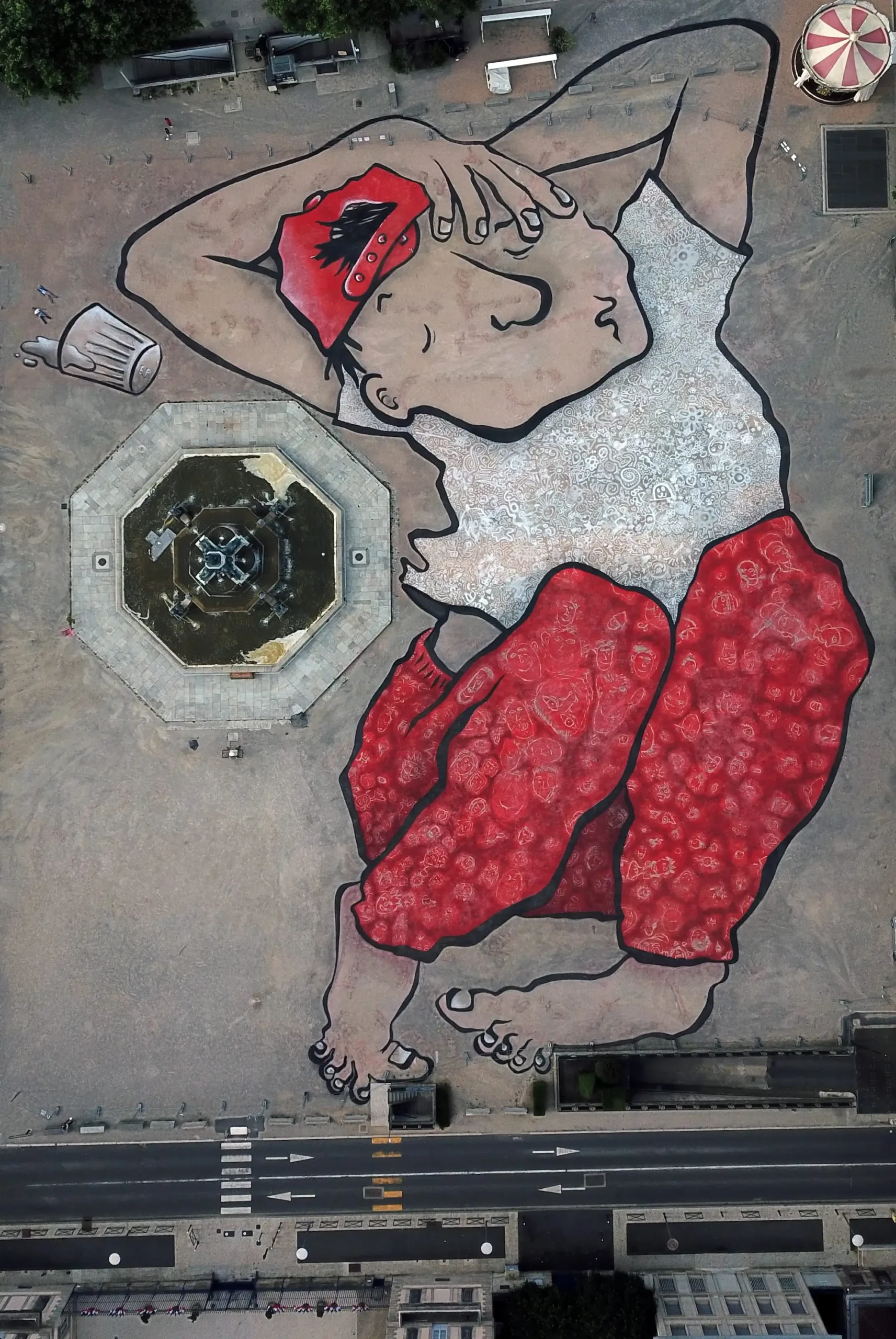
Monumental ground mural by Ella & Pitr depicting a seated figure beside an octagonal fountain.
Two years later, in 2009, the pair snuck their work into an exhibition called Born in the Street at the Fondation Cartier in Paris, uninvited and technically trespassing on their own showing. It worked. Art historian Thomas Schmitt noticed the pieces and pointed the duo toward Le Mur, the well known rotating mural wall in Paris’s Oberkampf neighborhood, and from there Ella and Pitr began experimenting with anamorphosis, the trick of stretching a drawing so it only resolves into a coherent image from one specific angle, or, as it would soon become their signature, only from directly above.
stir
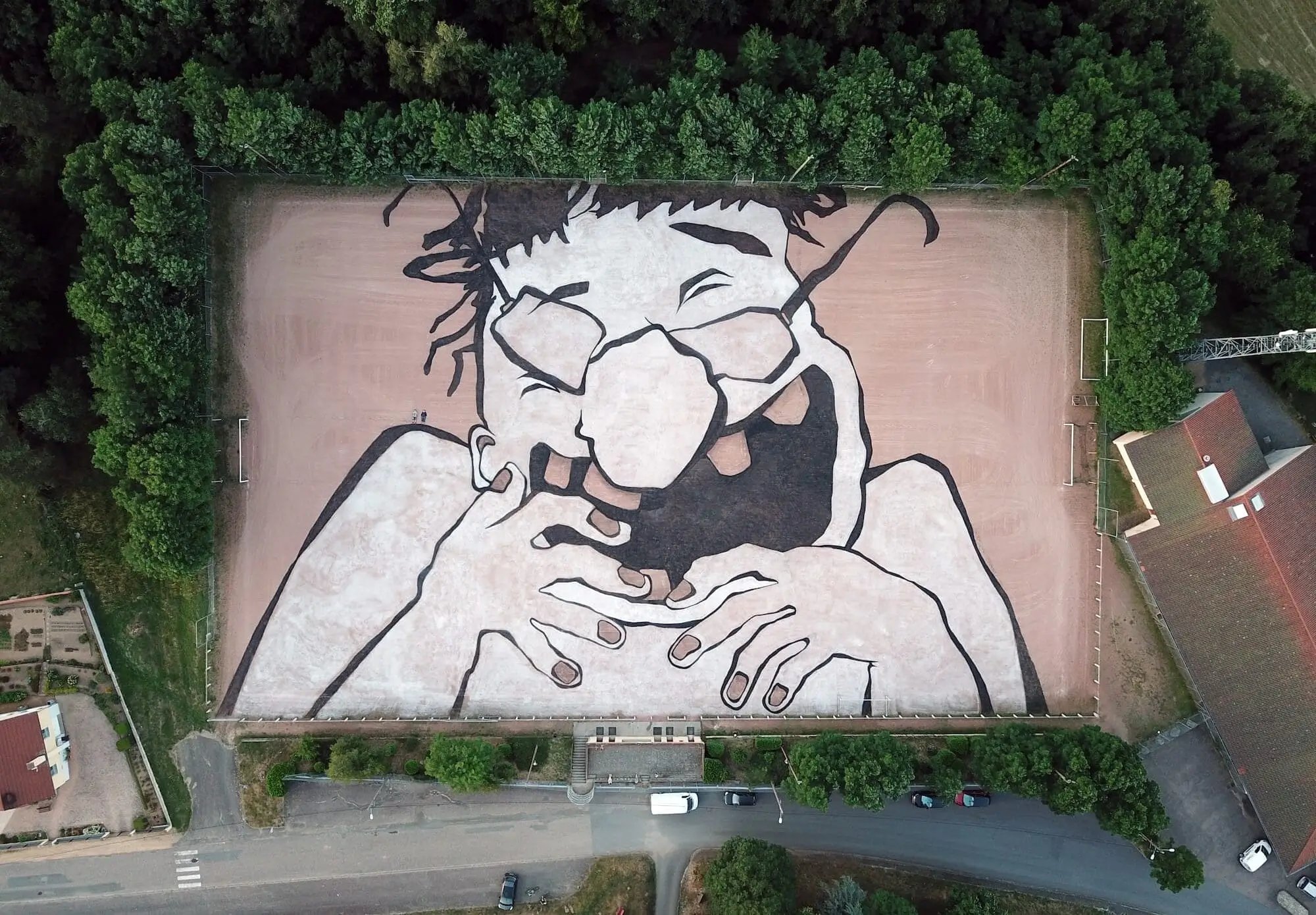
What began as wheat pasted drawings scaled up fast once Ella and Pitr started painting directly onto rooftops, airport runways and open fields rather than pasting paper onto them. By 2013 the pair were producing figures ranging anywhere from 500 to over 20,000 square meters, depending on what surface they were given to work with, and their subject matter had settled into a recognizable cast: sunbathing grandmothers, napping winged boys, children curled up mid dream, all rendered at a scale that makes them legible only from a drone, a low flying plane or, occasionally, the upper floors of a neighboring building.
The high point of that scaling up came in 2015, when Ella and Pitr were commissioned by Norway’s Nuart Festival to paint a rooftop in Stavanger. The result, Lilith and Olaf, covered 21,000 square meters and was, at the time, the largest figurative mural in the world, a record the pair reportedly celebrated the way exhausted people celebrate anything, which is to say they slept for a day and then immediately felt restless enough to want another wall. The piece paired a towering woman with a comically undersized king, a jab at Olaf Tryggvason, the tenth century Norwegian monarch credited with forcibly converting the country to Christianity, whom Ella and Pitr discovered had been born near the site they were painting. Four years later they broke their own record in Paris, covering roughly 25,000 square meters of a peripheral convention center’s rooftop with What Will the Weather Be Tomorrow, an old woman gazing down at traffic on the ring road below, deliberately tucked into an obscure corner of the city rather than a high visibility landmark.
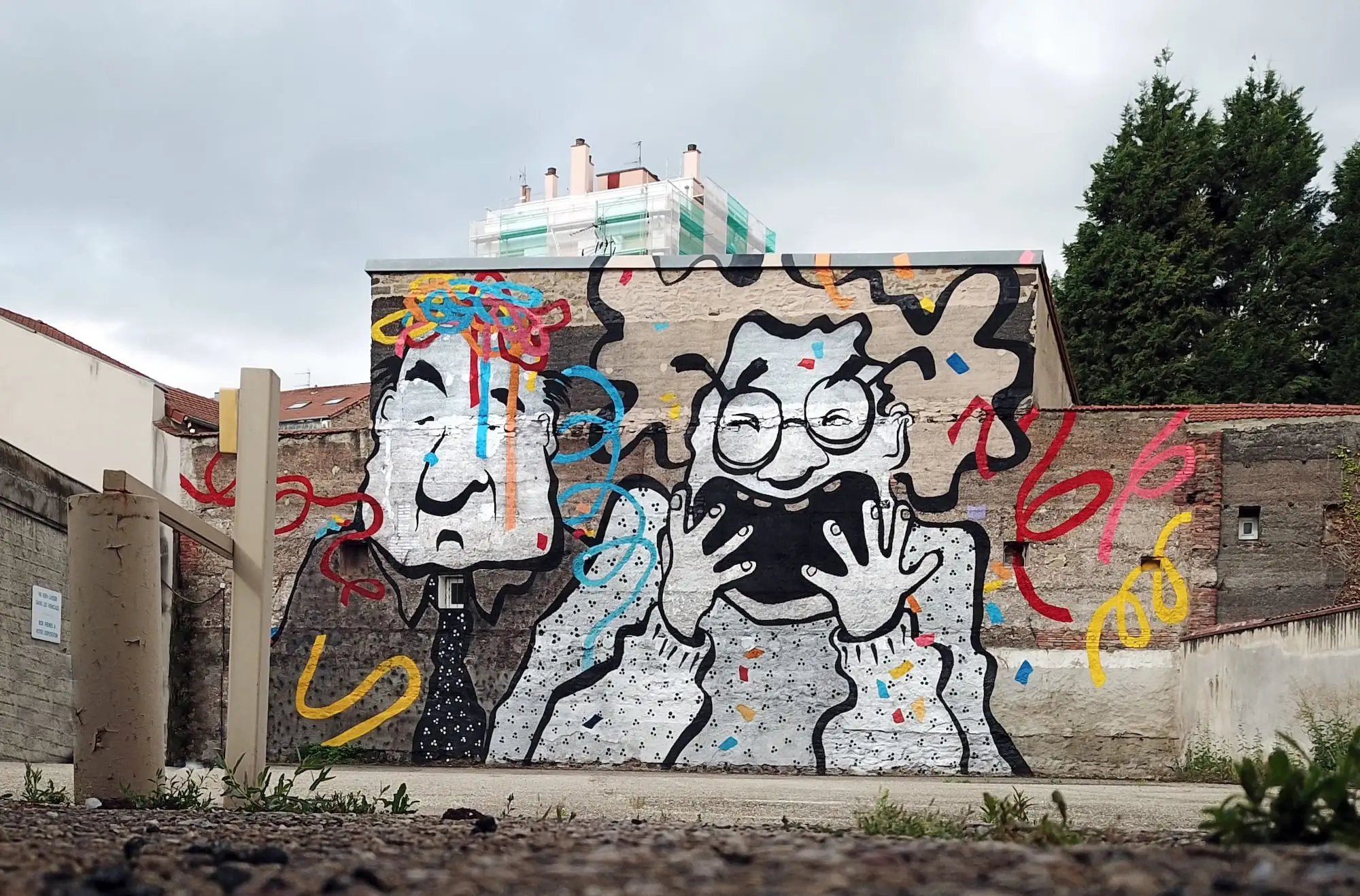
Ella & Pitr mural featuring two expressive figures amid colorful looping lines and confetti.
That restlessness with scale eventually curdled into something closer to skepticism. By the gallery’s own account of the duo’s recent work, Ella and Pitr grew tired of a competition they had effectively been running against themselves, in which size kept outpacing substance, and decided the more interesting move was to return to what first drew them to street art in the first place, its impermanence, and start literally destroying some of their own creations rather than letting them fade on their own schedule.
That shift is worth sitting with, because it runs against almost every incentive a successful muralist eventually faces. Bigger walls draw bigger commissions, bigger commissions draw bigger festival bookings, and most artists who reach the scale Ella and Pitr reached in Norway and Paris tend to keep chasing the next larger surface rather than actively working against their own momentum. Choosing instead to blow up finished pieces, effectively erasing a completed record breaking mural on their own terms rather than waiting for weather or a building’s next paint job to do it for them, reads less like a stunt and more like an argument: that the value in the work was never really about the square footage, and that treating a mural as a monument rather than a moment misses what made the format interesting to begin with.
flow
For all their scale, Ella and Pitr’s murals are rarely about spectacle for its own sake. The pair has repeatedly used its outsized canvases to put historic overlooked figures front and center, quite literally larger than the buildings around them. The elderly and the homeless appear often, positioned on visible urban surfaces rather than tucked away, and in 2017 the duo took on the European refugee crisis directly with a mural called Le Naufrage de Bienvenu, or The Shipwreck of Bienvenu, painted across more than 47 meters of an abandoned dam wall at La Valla en Gier, not far from their home base of Saint Etienne. The dam, built in 1959 and later deemed unsafe for its original purpose, became the backdrop for a solitary figure clutching a small photograph of the very location he appears to have been searching for, an oblique reference to people crossing the Mediterranean in search of somewhere to land. A five person team spent roughly two weeks suspended by rope to complete it.
That instinct toward representing the people a city might rather not look at directly runs through even their gentler, funnier work. A grandmother sunbathing on a rooftop, a man curled protectively around a fountain, two strangers caught mid laugh in a parking lot: none of it reads as satire, and none of it asks to be taken as protest art either. It reads more like a running census of everyone a passerby might otherwise walk past without noticing, rendered at a scale that makes noticing unavoidable, at least from above.
Even the duo’s smaller scale work carries a version of that same instinct. Long before the rooftop commissions, Ella and Pitr developed a practice they call pieces, built around fragments physically torn from a finished outdoor collage. The pair, or sometimes a passerby who happened to be nearby, would be photographed holding the amputated scrap up against a blank canvas for just long enough to capture the shot, briefly reconstructing a complete image that technically no longer exists anywhere in one piece. It is a small, almost private echo of the impermanence built into everything they make outdoors: a poster left on a wall will eventually be rained on, painted over, or peeled away by someone else entirely, and the photograph becomes the only record that the whole thing was ever there at all.
extend
Ella and Pitr have never treated the gallery as a lesser venue, just a different one, and their relationship with representation has been unusually long for street artists of their generation. Jonathan Roze, the gallery owner behind their upcoming Rennes show, first exhibited the pair back in 2012, when they were still a decade away from the international commissions that would make their names recognizable outside France. Their showings since have tracked a parallel practice running alongside the murals: large paper collages, frame fragments physically torn from outdoor pieces and remounted on canvas, and more recently a more abstract body of work called Plis et Replis, or Folds and Folds of Self, which takes the fabric and clothing details from their painted figures and pushes them toward pure pattern and texture rather than narrative.
The gallery relationship also reflects how much ground both sides have covered independently. Roze spent roughly thirteen years working in Paris’s urban art scene, first at Graffiti Art Magazine and later at Galerie Le Feuvre, before relocating to Brittany in early 2025 and opening a standalone Rennes space that April with an inaugural group show pairing Ella and Pitr’s concrete works with ceramics, oil pastels and works on paper from four other artists. By that October the gallery had moved into a permanent home on the Place du Parlement de Bretagne, in the mid of the city.
fin
The gallery has not yet published full details on Points de Suspension, the title translating loosely to ellipsis, or literally points of suspension, a phrase that carries an obvious double meaning for two artists who have spent a decade dangling from ropes off rooftops and dam walls to finish their work. Given the duo’s history with the gallery, the show will likely draw from the same vocabulary that has defined their recent output: fragments pulled from outdoor pieces, paper works, and pieces from the Plis et Replis series, rather than an attempt to recreate the scale of their public murals inside four walls, which would be a fairly literal impossibility given that some of those murals cover more ground than the gallery’s entire building.
What the show does confirm is that neither artist treats the studio and the street as competing commitments. Ella and Pitr have built a career on being found from the air, by drone footage, by satellite imagery, by whoever happens to be looking down from a passing plane. A gallery show asks for the opposite kind of attention, close and stationary, and the fact that the pair keeps returning to that format alongside the murals suggests they see it less as a retreat from the street and more as another wall worth painting.
There is also a practical logic to keeping both practices alive at once. Murals on the scale Ella and Pitr work at are, by design, temporary and largely uncollectible; a rooftop painting cannot be bought, shipped, or hung in a living room, and most of the pair’s largest works have already been repainted over, weathered away, or deliberately destroyed by the artists themselves. The paper works, collages and canvases that pass through galleries like Jonathan Roze’s function as the only physical record collectors can actually hold onto, which makes a show like Points de Suspension less a departure from the outdoor practice than its archive, however loosely kept. For a duo whose largest pieces are already gone by the time most people learn they existed, that distinction between the ephemeral and the collectible may be the whole point.