DRIFT AUDIO
Listen to this story
Choose a voice, then press play.
A unique acrylic from a two week Portobello Road show now circulates through Artsy, tracing back to the week Alec Monopoly’s work first left American soil.
Before he was a name collected by actors and musicians, Alec Monopoly was a New York kid working under the radar, spray painting Rich Uncle Pennybags onto walls and billboards around a city that was not especially welcoming to unsanctioned art. Born Alec Andon, he has said in past interviews that he learned from his mother, an artist herself, and that he eventual walked away from formal art instruction to build his own view lang instead. He shifted his base to Los Angeles in 2006, drawn by a looser attitude toward billboards and outdoor space than New York’s more guarded gallery scene allowed.
The name itself came from that same mascot. Rich Uncle Pennybags, the top hatted figure who tips his hat over a pile of coins on Monopoly board game cards, became the artist’s recurring stand in for a financial system he treated as both target and subject. By his own account the character first surfaced as a jab at the kind of unaccountable wealth epitomized by figures like Bernie Madoff, before it grew into something closer to a personal mascot, reproduced on walls from New York to Los Angeles to Miami. The choice to hide behind that borrowed face, rather than his own, set a pattern he has held to for his entire public career: photographs of Monopoly in the years since almost always show him with his hand or a mask across his mouth, identity withheld even as the work around him became increasingly public.
By the time 2011 arrived, that self taught practice had already produced a recognizable body of work: the mustachioed Monopoly Man, repurposed as a stand in for financial excess, alongside newspaper collage built from old Wall Street Journal pages and sealed under resin. What had not happened yet was an exhibition outside the United States. That changed in June of that year, when a small gallery on Portobello Road in London opened its doors to his first overseas show, a run that would gradual put paintings like Red Jack into circulation on the secondary market. Getting a body of unsanctioned street work into a commercial London gallery was, for an artist still working without a fixed identity attached to his name, a genuine leap rather than a routine step up.
in
Graffik Gallery, tucked into 284 Portobello Road in Notting Hill, had already built a reputation as a serious address for street and urban art, known in particular as a specialist outlet for Banksy works. The gallery gave Monopoly a show titled L.E.G.E.N.D., shorthand for Alec’s London Epic Graffiti Episode New Dawn, running from June 9 through June 23, 2011, with a private view on opening night.
Coverage from the time described a display built around two threads running side by side: a set of painted portraits pulling from pop culture icons including Jack Nicholson, Bob Dylan, and Twiggy, and a larger scale run of Monopoly Man pieces painted directly onto archived Wall Street Journal pages and finished in resin. One write up ahead of the opening framed the gallery itself as a genuine milestone for the city’s street art scene, a space that had, in under two years, become a go to venue for artists moving between spray can and canvas, with a roster that would go on to include names like Grafik Warfare, SNUB23, Dan Baldwin, and Goldie.
The show closed with a farewell party on June 23, complete with a barbecue in the gallery’s outdoor space, framed at the time as a send off for an artist who was, in the words of one listing, leaving London city after a sold out run on both sides of the Atlantic. That framing, sold out and departing, says something about how quickly the show’s reception shifted from novelty to genuine demand: a first time overseas exhibition that closed with organizers describing available appointments for anyone who still wanted to talk with the artist directly, a courtesy usually reserved for shows that have already found their buyers.
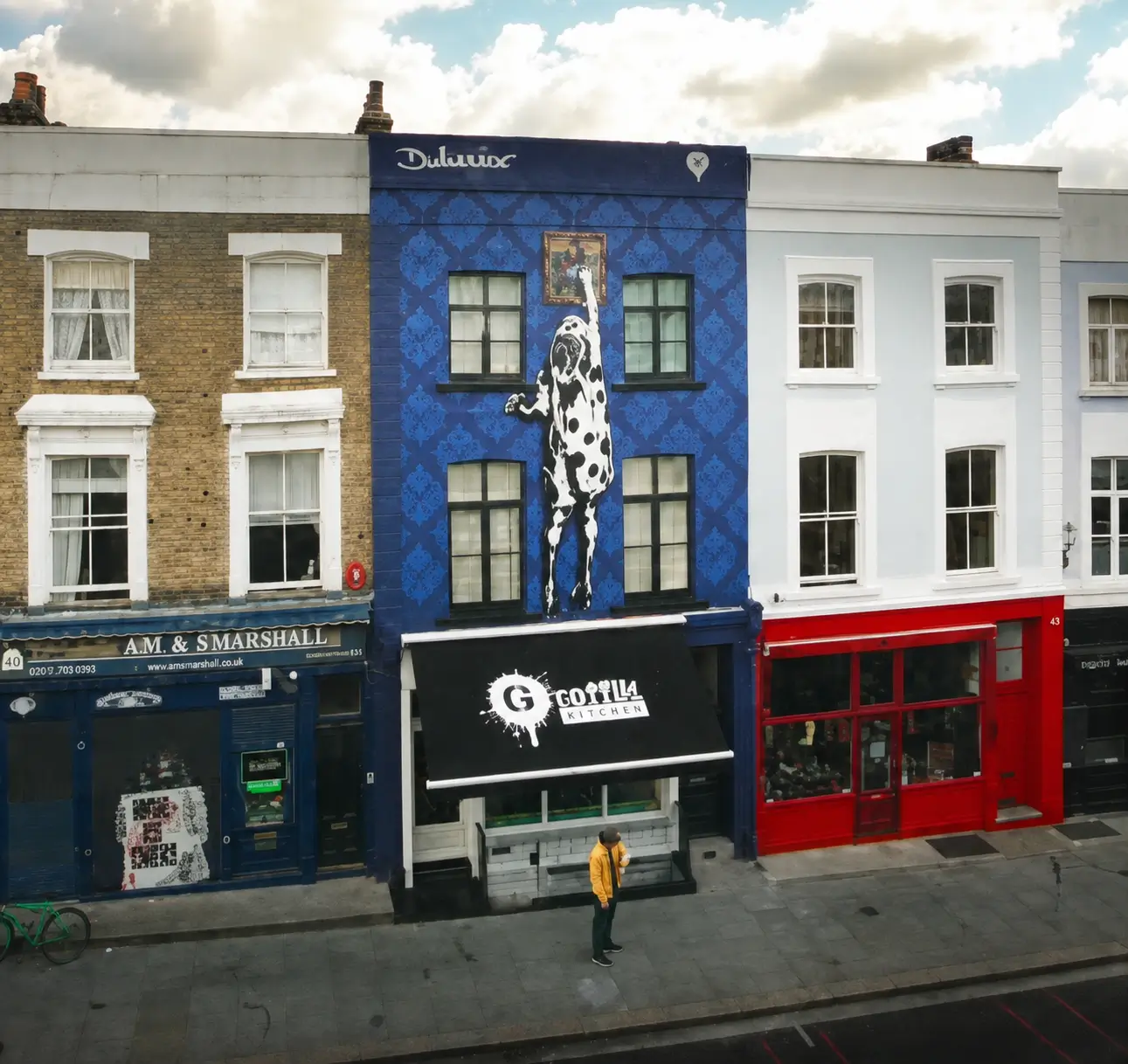
Blue-painted London storefront featuring a large black-and-white cow mural reaching toward a framed artwork above Gorilla Kitchen.
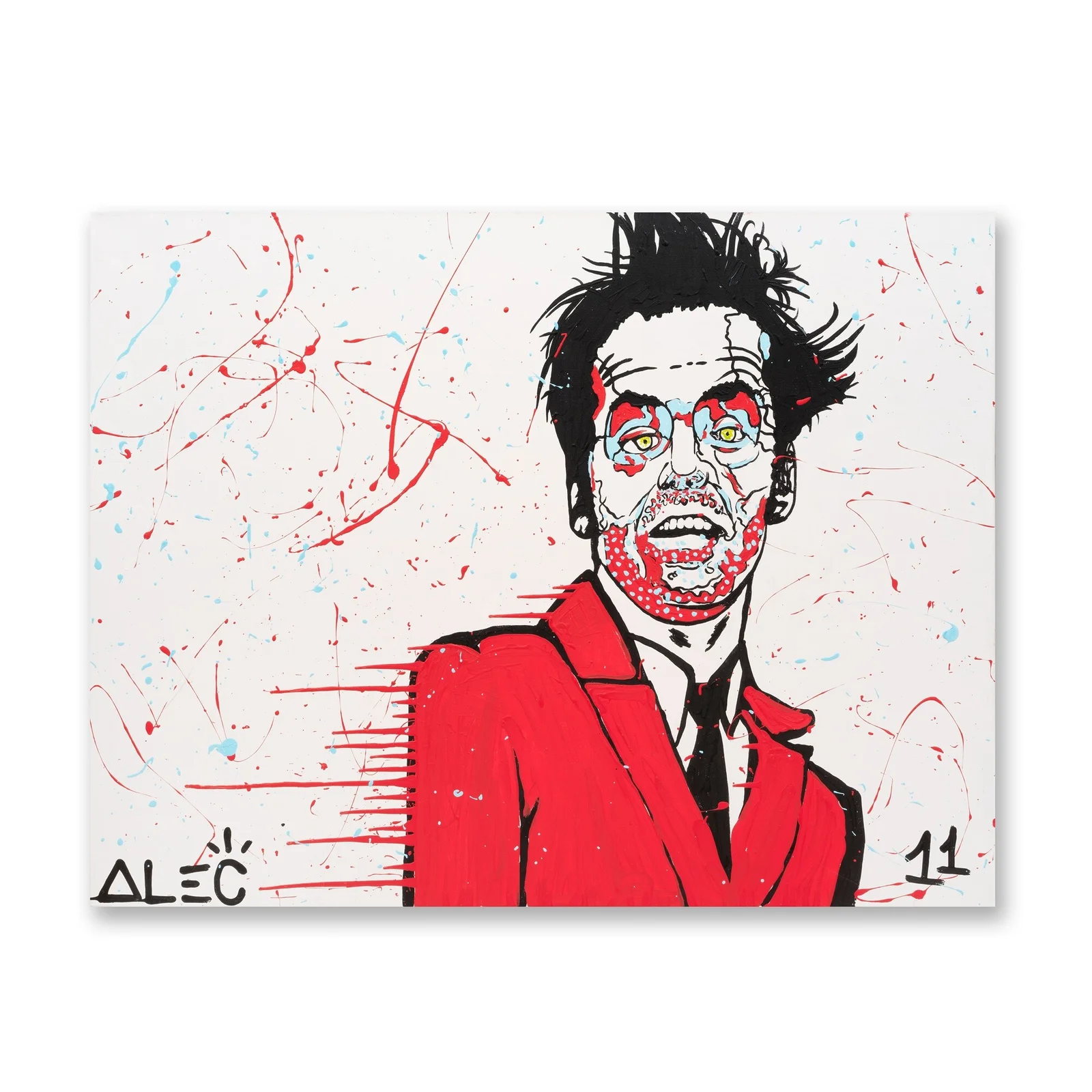
Red Jack is cataloged in auction records as a unique acrylic on canvas, signed and dated 2011, sized at roughly 91 by 122 centimeters, and tied directly back to that Graffik Gallery run. The title’s most plausible reading points to Jack Nicholson, who appears repeatedly across contemporaneous descriptions of the L.E.G.E.N.D. show and across Monopoly’s output from that period more broadly. One period write up on the gallery specifically flagged Monopoly’s pull toward what it called the anti hero personas of Jack Nicholson and Robert De Niro, a fixation distinct from his Monopoly Man work and closer to a straightforward interest in film era masculinity and menace. A separate catalog entry from John Moran Auctioneers, listing a work simply titled Jack Nicholson study, confirms Nicholson was not a one off subject for the artist around that stretch of his career but something closer to a recurring study.
None of the available auction listings for Red Jack spell out the connection to Nicholson in so many words, and it is worth being upfront about that gap rather than presenting it as settled fact. What can be said with confidence is that the painting’s subject sits squarely inside the visual territory the artist was working through at Graffik Gallery that June, and that red, a color he returned to often for its associations with heat, danger, and casino chip glamour, suits a portrait of an actor best known for playing characters who ran hot.
There is a simpler, complementary explanation too. Monopoly built the L.E.G.E.N.D. show around a specific type of screen persona: characters defined by menace, wealth, or both, run through a graffiti artist’s palette of bold, unmixed color rather than the muted tones of traditional portraiture. Nicholson’s most iconic roles, from The Shining’s Jack Torrance to Batman’s Joker, both lean on red as a view sig in their own right, whether through blood, fire, or costume. Painting him in red would have been less a departure from the reference material than a fairly direct translation of it into the artist’s own street derived shorthand.
huh
Unlike some of Monopoly’s better known pieces from the same stretch, which layer spray paint, newsprint, and resin into a single dense surface, Red Jack is recorded simply as acrylic on canvas: no collage element, no resin topcoat noted in the catalog description. That places it closer to a straightforward painted portrait than to the mixed media constructions that define pieces such as ATM Monopoly or the newspaper backed Monopoly Man canvases shown at the same exhibition. The distinction matters for anyone trying to place the work inside his output: it reads less like a statement on financial media and more like a study in likeness and color, built at a moment when the artist was still working out which parts of his graffiti vocabulary would carry over onto stretched canvas.
The designation “unique” in the catalog language is doing real work too. A significant share of Monopoly’s later market runs through screenprints and other editioned formats, some numbered in runs of fifty or more, alongside merchandise style connection that have followed his practice into toys, NFT projects, and watch industry partnerships in the years since. A unique acrylic from a specific dated show carries a different kind of standing inside that market, tied to a single documented exhibition rather than to a print run that can circulate indefinitely. Buyers researching a piece like this one are generally not just buying a Monopoly Man reference or a licensed image; they are buying a one of one object with a paper trail back to a named gallery and a named two week window in June 2011.
That paper trail matters more for early work than for anything made after his practice scaled up. Once collectors, and eventually a screenprint market, entered the picture later in the decade, documentation around individual canvases became more standardized. In 2011, a small Portobello Road gallery run was still close enough to his origins as a wall based artist that a signed and dated acrylic, tied to a specific show rather than a generic studio date, functions almost like an exhibition catalog entry made physical.
exhibit
Fourteen years on, Red Jack now moves through the same channels that carry most of Monopoly’s early canvases: auction houses including Tate Ward Auctions, which has listed the piece with direct reference to its Graffik Gallery origin, alongside a wider secondary market that includes John Moran Auctioneers, Los Angeles Modern Auctions, and Italy’s Pananti Casa D’Aste, the last of which has handled other Monopoly canvases originally placed through London’s Jerome Zodo Gallery. Its current appearance on Artsy’s artist page for Monopoly places it inside a price database and viewing room infrastructure that did not exist in any meaningful way back in 2011, when a two week Portobello Road show was still a genuinely small scale, almost handmade affair.
That shift, from wheatpaste and spray can to auction catalog and price index, tracks closely with what happened to Monopoly’s career more broadly over the following decade. Work that once went up on a wall in the middle of the night began appearing instead in gallery inventories with condition reports and provenance notes attached, Red Jack among them. Auction houses handling his output today range from regional American rooms like Tate Ward and John Moran to Italian specialists like Pananti, evidence of a market that has spread well past the Los Angeles and Miami circuits where his reputation was originally built. Dealers such as 1stDibs and Chairish have separately taken on smaller, earlier pieces, often described with the same “unique,” “signed,” and “certificate of authenticity” lang that accompanies Red Jack’s own listings, a vocabulary that did not exist around his work at all before galleries like Graffik started giving it a formal frame.
fin
The Graffik Gallery show turned out to be an early stop rather than a peak. Later that same year Monopoly opened Can’t Get Out of Jail Free at Miami’s Avant Gallery, and the years that followed brought a group show in Casablanca, a Luxury Tax exhibition split between London’s Mead Carney and Los Angeles’ Park Place, a debut solo museum show at MOCA Bangkok in 2015, a Breaking the Bank on Bond Street show back in London in 2018, and an exhibition at Moscow’s Multimedia Museum the same year. Coverage of his work has run through outlets including Rolling Stone, Billboard, Complex, and Juxtapoz, and collectors linked to his paintings over the years have included figures from film, music, and fashion. He has also crossed into brand partnership work along the way, including a logo commission from Paramount Pictures for its Insurge production label, a pairing that made sense for an artist whose entire visual identity was already built on repurposing corporate and entertainment iconography.
What connects the London gallery show and everything that followed is less a single style than a consistent instinct: take a recognizable face, whether a board game mascot or a three time Academy Award winner, strip it down to bold hue and hard outline, and put it back into circulation somewhere it was not originally meant to be, a wall, a newspaper page, a stretched canvas in a Notting Hill gallery. Red Jack, made in the middle of that instinct rather than at its start or its current end point, is a fairly precise record of where that approach stood in June 2011.
One detail about the artist himself is worth noting for anyone trying to picture the person behind Red Jack: Monopoly has consistently kept his face out of view, covering it with a hand or a mask in the rare instances he appears in public documentation. That practice, consistent since well before the Graffik Gallery show, is part of why coverage of his work tends to center entirely on the paintings themselves rather than on portraits of the artist. Red Jack, a red toned study connected to an actor known for playing men who ran hot, fits that pattern exactly: the work stands in for a maker who has spent his career declining to.
For related context, see Alec Monopoly’s SPACEMAN RICHIE: The Astronaut Dreaming in Graffiti.
n
From the DRIFT archive: Banksy’s Pulp Fiction (2004): Inside the Satire Behind an Iconic Screenprint · Between Walls and Silence: Nuno Viegas’s Street Artist (2018)