Richard Brandao’s Madonna Abstraction

October 20, 2025
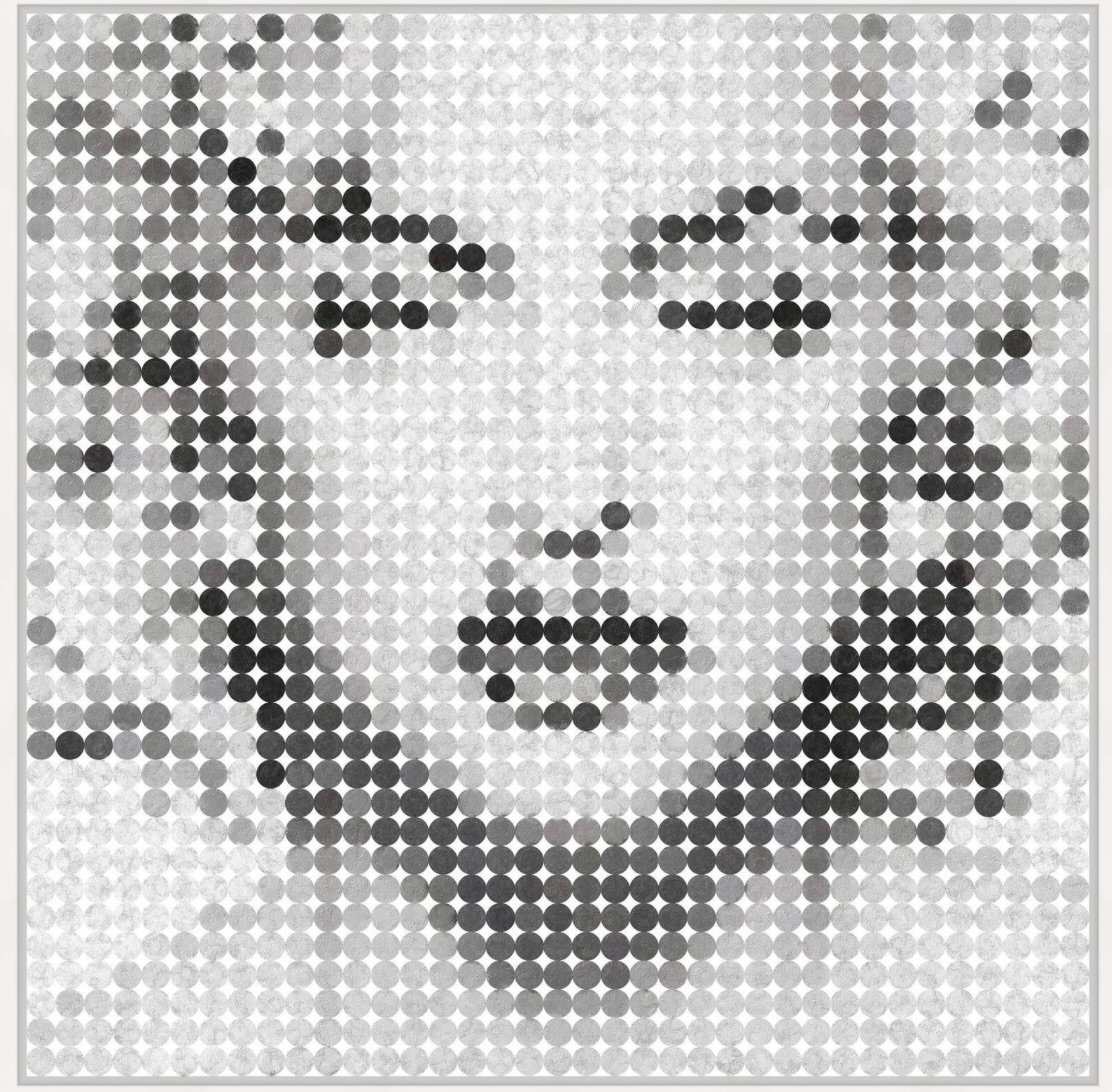
In Madonna, Richard Brandao distills celebrity into geometry. Composed of a vast grid of grayscale circles, this limited edition of 150 signed prints transforms one of the most recognizable faces of modern culture into a meditative field of tone and pattern. The result is both mathematical and devotional—a portrait that blurs the boundaries between icon and algorithm.
Brandao’s work belongs to a lineage that stretches from Seurat’s pointillism to Chuck Close’s pixelated realism, yet it also speaks in the visual language of the digital century. Each circular mark acts as both a data point and a devotional bead, part of a larger rhythm that constructs the human face through absence as much as presence. Up close, the composition appears abstract—an orchestra of neutral dots; from a distance, Madonna’s visage emerges like an apparition.
The choice of subject is not incidental. Madonna, who built her mythology on reinvention and reproduction, becomes an ideal vessel for Brandao’s inquiry into the reproducibility of the image itself. Through the repetition of form, he captures the paradox of modern fame: its intimacy and its distance, its endless visibility and its gradual dissolution into code. The grayscale palette resists nostalgia, refusing the glamour and color associated with pop imagery. Instead, Brandao gives us a ghost—an afterimage of fame suspended in an eternal loop of digital silence.
This visual restraint mirrors a philosophical one. By limiting the edition to 150 prints, each hand-signed, Brandao reclaims the tactile authority of the artist within an infinitely reproducible medium. The act of numbering each print transforms digital abstraction into material objecthood. It is a quiet defiance of algorithmic ubiquity—a reminder that art, even when born of pixels, can retain aura.
Madonna is thus not simply a portrait but a study in cultural translation. The human image, filtered through the logic of screens, becomes both sacred and synthetic. The viewer no longer encounters the person, but the persistence of her presence—a pattern that has outlived performance. Brandao’s Madonna does not sing, pose, or provoke; she endures.
In the end, what lingers is the tension between devotion and detachment. Each circle, precise and impersonal, accumulates into emotion. From mechanical repetition arises grace. Richard Brandao’s Madonna is a quiet revelation: a reminder that even in a world of infinite images, one face can still hold the power to haunt.
Related Articles
Chasing the Sort Sol: Inside Søren Solkær’s Six Year Pursuit of Europe’s Starling Clouds
A Danish portrait photographer spent six years following a bird nobody photographs on purpose, and […]