DRIFT AUDIO
Listen to this story
Choose a voice, then press play.
For its soil-toned Fall/Winter 2026 chapter, the Italian house pairs grime, cloud rap, gallery history and Sixth Generation cinema against its signature white backdrop.
Stone Island has added a second wave of names to its Fall/Winter 2026 edition of “Community as a Form of Research,” the recurring campaign format the Italian house has been building since it first launched for Spring/Summer 2024. This season’s opening contingent, released earlier in the year, paired WNBA champion Breanna Stewart with table tennis world champion Xu Xin, DJ and watch dealer Adrian Douzmanian, filmmaker Nick Love and Seoul-based photographer Simjae. The new group, fakemink, Skepta, Stephen Graham, 3House, Samir Bantal, Monika Sprüth and Jia Zhang-Ke, pulls the cast further afield still, spanning grime, cloud rap, British television, Japanese R&B, architecture, gallery history and arthouse cinema inside a single chapter.
The format hasn’t changed much since the project’s earliest editions, which have previously drawn in names as varied as Oasis’s Liam Gallagher, DJ and producer Peggy Gou, actor and curator Russell Tovey, skateboarder Sage Elsesser, footballer Paolo Maldini, MMA fighter Chito Vera, actor Don Johnson, boxer Oleksandr Usyk and musician A.G. Cook. Each subject is photographed the same way, alone, against a stripped-back white backdrop, wearing pieces from the current collection, with nothing else in the frame to compete with the person and the clothing.
Stylist Max Pearmain returns for this chapter, working again with photographer David Sims, whose portraits have anchored the campaign since its first edition, under the creative direction of Ferdinando Verderi, the Italian-born, New York-based director who oversaw the project’s original launch and has stayed on through each chapter since. The questions each subject answers are once again written by Hans Ulrich Obrist, the Serpentine’s artistic director, who has shaped the campaign’s interview format since its inaugural edition. Each portrait is paired with a short written exchange rather than a straightforward product Q&A, pushing subjects toward personal habits and instincts instead of talking points about the clothes.
The project’s name is meant literally rather than as a marketing flourish. Since its first edition, Stone Island has framed “Community as a Form of Research” as an extension of the same material research that drives its garments: instead of testing fabric treatments in a lab, the campaign treats its own network of convincers, across sport, music, film and design, as a way of researching how the brand’s clothing actually moves through different corners of culture.
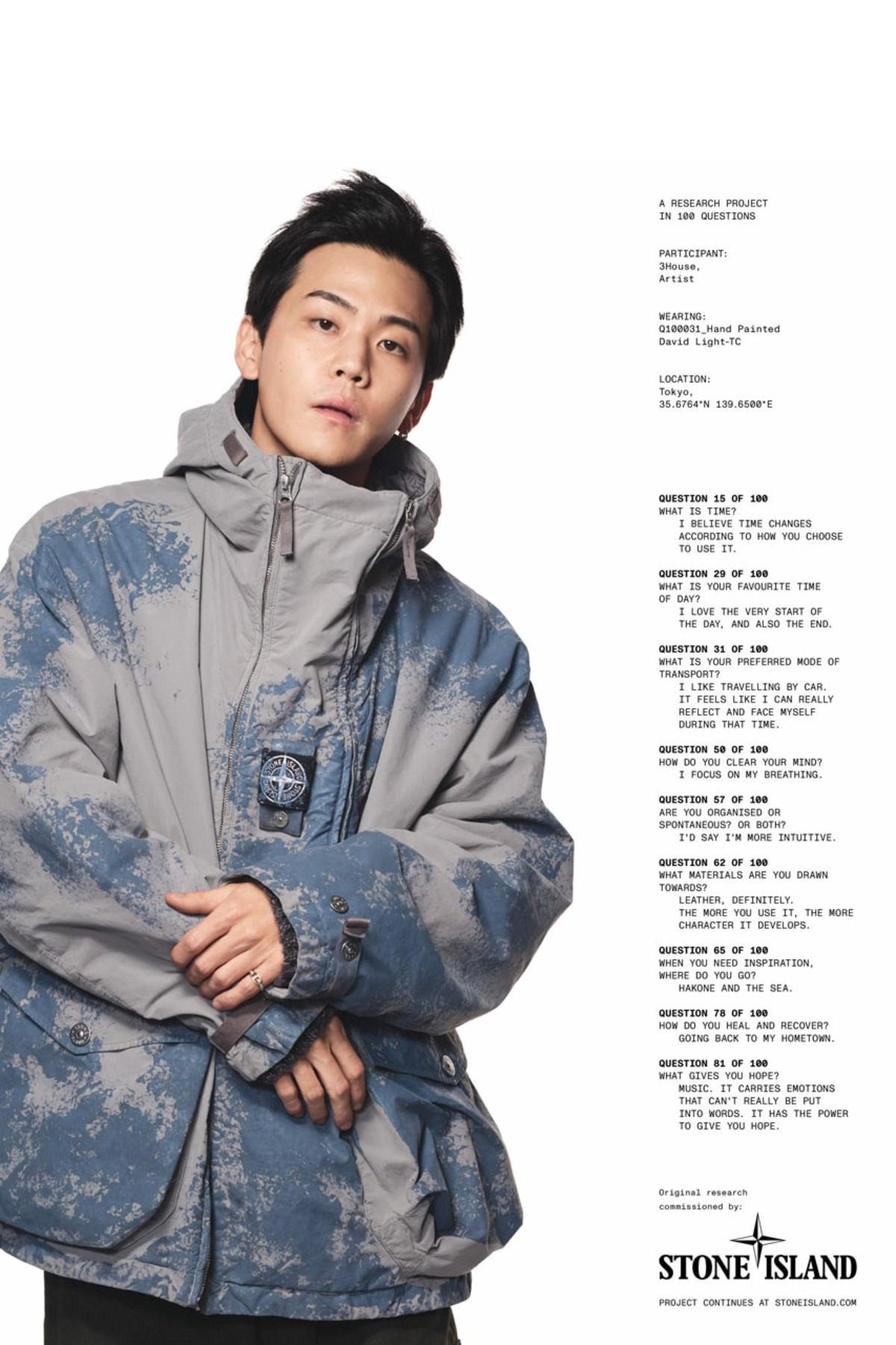
Image credit: David Sims/Stone Island
core
The garments in this chapter come from Stone Island’s Fall/Winter 2026-27 collection, built around the wider idea the brand calls “landscape,” not a single natural or manmade reference but a fluid mix of elements that only makes sense once layered together. This season narrows that idea to one specific element, soil, a focus the brand describes as a grounding force that runs through the collection’s color palette, its choice of materials and the contrasts in texture that show up across both the mainline and the Ghost sub-collection.
That focus had already surfaced in earlier pieces from the same season. The collection’s first release, a series called Lodestar, put Xu Xin in an uneven pigment-dyed nylon anorak that goes through a resin and pigment garment-dye process followed by an enzyme wash, deliberately fading the color in patches for a mottled, weathered look. A separate mineral dyeing technique, seen earlier in the campaign on Simjae’s hooded jacket, uses inorganic pigments derived from industrial iron oxides to give the fabric a chalky, dust-covered finish the brand has compared to the residue left behind by a sandstorm, down to an elbow patch dyed with the same recipe as a nod to the label’s early-1980s archive. It’s the same research-driven approach to fabric, treatment over decoration, that has defined Stone Island since Massimo Osti founded the label in Ravarino, Italy, in 1982, and that has continued since Moncler acquired the brand in 2020.
people
fakemink wears one of the season’s more literal expressions of that resin treatment: a bright orange nylon hooded jacket that gets its glossy, almost lacquered surface from a resin coating heat-pressed onto the fabric after dyeing. It’s a fitting piece for an artist who has built his following on texture and surface as much as sound. Born Vincenzo Camille and raised in Ilford, east London, fakemink released his debut mixtape, “London’s Saviour,” in December 2023, then spent the following year putting out dozens of singles before “Easter Pink” turned into a viral hit in 2025, drawing cosigns from Frank Ocean, Clairo and Yung Lean along the way. That summer, Drake pulled him onstage as a surprise guest at Wireless Festival, a moment that pushed him in front of an audience well beyond the UK underground scene that first embraced him. His debut studio album, “Terrified,” followed on May 22, 2026. Asked by Obrist about his favorite city, fakemink kept it simple: “nowhere on Earth holds a candle to London,” he said.
Skepta takes a more technical route in a heavyweight olive green nylon Oxford jacket, its interior quilted with PrimaLoft-TC insulation. Born Joseph Junior Adenuga in Tottenham, north London, Skepta has spent two decades as one of grime’s defining voices,
View this post on Instagram
rel music independently through his own label, Boy Better Know, since the label’s earliest days. His 2016 album, “Konnichiwa,” a title borrowed from the Japanese word for hello and launched with a party in Tokyo, won the Mercury Prize that year, making him only the second grime artist to take the award after Dizzee Rascal in 2003. He has also built a parallel career in fashion: his own label, MAINS London, launched in 2017 and relaunched with a runway show at London Fashion Week in 2023, alongside sneaker collaborations with Nike and, more recently, Puma. Musically, 2025 and 2026 alone brought collaborations with Fred Again and PlaqueBoyMax, a feature on Playboi Carti’s “Toxic,” and a second volume of Más Tiempo, the house label he runs with fellow Boy Better Know member Jammer.
ghost
Stephen Graham wears a piece from Stone Island’s Ghost line: a lambskin coach jacket finished with a sprayed rubberised coating that keeps the garment in a single monochromatic tone, in keeping with the sub-line’s stripped-back approach to camouflage through color rather than pattern. The Liverpool-born actor arrives at the campaign fresh off the most decorated year of his career. Graham co-created, co-wrote and starred in “Adolescence,” the Netflix miniseries that swept the 2026 Golden Globes and earned him his first British Academy Television Award for leading actor after eight prior nominations, alongside three Primetime Emmy wins for the series. Long before that, he built a career on roles like Combo in “This Is England” and Al Capone in “Boardwalk Empire.”
View this post on Instagram
He also starred in “A Thousand Blows,” Steven Knight’s Victorian-set boxing drama, and continues to run Matriarch Productions, the company he co-founded in 2020 with his wife and creative partner, Hannah Walters. Backstage after his BAFTA win in May, Graham pointed to the show’s impact on its younger viewers as the thing he was proudest of, rather than the trophy itself.
camp
3House, the Tokyo-based R&B and hip-hop artist, wears one of the collection’s most labor-intensive pieces: a lightweight jacket made from Japanese polyester and polyamide yarns that are individually dyed, heat-treated and hand-painted, a process that leaves no two garments quite alike. The approach mirrors 3House’s own career, which has built steadily rather than exploded overnight. His 2018 debut single, “Purple Rain,” led to a run of EPs before his first full album, “SWING A SOUL,” reached number one on Japan’s R&B streaming charts on its June 2023 release. “After Rain,” released the following April, spread well beyond his existing fanbase after going viral, and his second album, “Terminal 3,” arrived in March 2025 to some of the widest attention of his career so far. He has also built a habit of pulling other Japanese artists into his own records, including a recurring collaboration with fellow vocalist Yo-Sea, and has taken his live show to major festival stages across Japan in the years since. His inclusion keeps a Japan-facing thread running through a campaign whose earlier chapter already featured Seoul photographer Simjae and table tennis champion Xu Xin, and it lines up with a season that has otherwise leaned on Japan-market press previews and release notices to fill out its own product details.
fin
The remaining three portraits pull the campaign further from music and acting into architecture, gallery history and cinema. Samir Bantal directs AMO, the research and design studio Rem Koolhaas founded alongside OMA to apply architectural thinking to fields well outside architecture itself. Under Bantal, AMO co-produced “Countryside, The Future,” the Koolhaas-led research exhibition that took over the Guggenheim in 2020, and sustained a years-long collaboration with Virgil Abloh that produced “Figures of Speech,” Abloh’s retrospective at Chicago’s Museum of Contemporary Art. His work at AMO has also stretched into retail and product design well outside architecture in the traditional sense, including a new store concept for the Korean car brand Genesis and design projects for Vodafone.
Monika Sprüth opened her first gallery in Cologne in 1983 and used it, from the start, to push female artists into a market that had mostly overlooked them, giving early platforms to Cindy Sherman, Barbara Kruger, Jenny Holzer and Rosemarie Trockel through a run of all-women exhibitions called Eau de Cologne. That gallery merged with Philomene Magers’s in 1998 to form Sprüth Magers, which now operates spaces in Berlin, London, Los Angeles and New York alongside offices in Cologne, Hong Kong and Seoul.
Jia Zhang-Ke closes out the cast as its lone filmmaker. A leading figure of China’s Sixth Generation, Jia won the Golden Lion at Venice in 2006 for “Still Life” and the best screenplay award at Cannes in 2013 for “A Touch of Sin,” and founded the Pingyao International Film Festival in 2017. His 2024 feature, “Caught by the Tides,” drew on footage he shot over more than two decades to trace China’s transformation through the lens of a single recurring relationship. His most recent work, the short film “Torino Shadow,” premiered in the Cannes Classics section this year, and he is now preparing “Mamma Dunhuang,” a feature reteaming him with longtime collaborators Zhao Tao and Liao Fan through the French production and sales company MK2 Films.
Related Articles

NOT-KARL on Every Screen: Paris Hilton’s Pink Night Inside Karl Lagerfeld’s Saint-Germain Store
One year to the day after Palais de Tokyo, Karl Lagerfeld brought Paris Hilton back […]