

DRIFT AUDIO
Listen to this story
Choose a voice, then press play.
JW Anderson cast real-life couple Dree Hemingway and Nick Delli Santi to front its signature Twisted Denim, choosing unstaged intimacy over posed romance.
The setting is deliberately spare: white brick walls, wooden floors, an old wooden chair, a faded upholstered armchair, and little else to distract from the two people in frame. Photographed by Sam Khoury, whose editorial work has recently run in AnOther Magazine and Rivista Studio, JW Anderson’s new campaign for its Twisted Denim line stars model and actress Dree Hemingway alongside her real-life partner, Nick Delli Santi, marking the first time the pair have been shot together for a fashion campaign.
That choice is doing a lot of work. Rather than leaning on the conventions of typical couple imagery, staged closeness, matching outfits, eye contact held a beat too long, the campaign builds its intimacy from something harder to fabricate: two people who already share a wardrobe and a way of moving through a room together. Khoury shoots the pair with an appealing looseness, almost domestic rather than polished studio finish. Hemingway appears alone in some frames, slightly disheveled and self-possessed, while others show her climbing onto Delli Santi, wrapping around him, or captured close enough that bodies and denim start to read as a single composition. One of the more striking images has her carried around his waist, arms and legs folding the two of them into an almost improbable tangle of limbs and denim washes. The stolen quality of the images, gestures that look observed rather than directed, is the whole point. For a house operating without the marketing budget of the industry’s largest names, casting an actual couple and asking them to simply exist in front of the camera is a way of buying credibility that money alone can’t.
View this post on Instagram
frame
Hemingway’s casting carries its own weight before the clothes even enter the picture. She has modeled and acted since 2009, breaking through with the lead role in Sean Baker’s 2012 film Starlet, and comes from a family whose name doesn’t need much introduction in fashion or literary circles: she is the daughter of actress Mariel Hemingway and the great-granddaughter of Ernest Hemingway. Her modeling career has run parallel to her acting work for over a decade and a half, with campaigns for houses including Valentino and Marc Jacobs sitting alongside film and television credits. More recently, she has moved into television, currently starring as Daryl Hannah in FX’s anthology series Love Story, which dramatizes the relationship between John F. Kennedy Jr. and Carolyn Bessette.
Delli Santi, by contrast, is a newer face to campaign photography, identified in every piece of coverage around this launch primarily through his relationship with Hemingway rather than a separate public profile of his own. That asymmetry is part of what makes the pairing interesting to shoot: one half of the frame arrives with instantly legible fashion credibility, and the other supplies the unrehearsed energy the whole campaign is built around.
flow
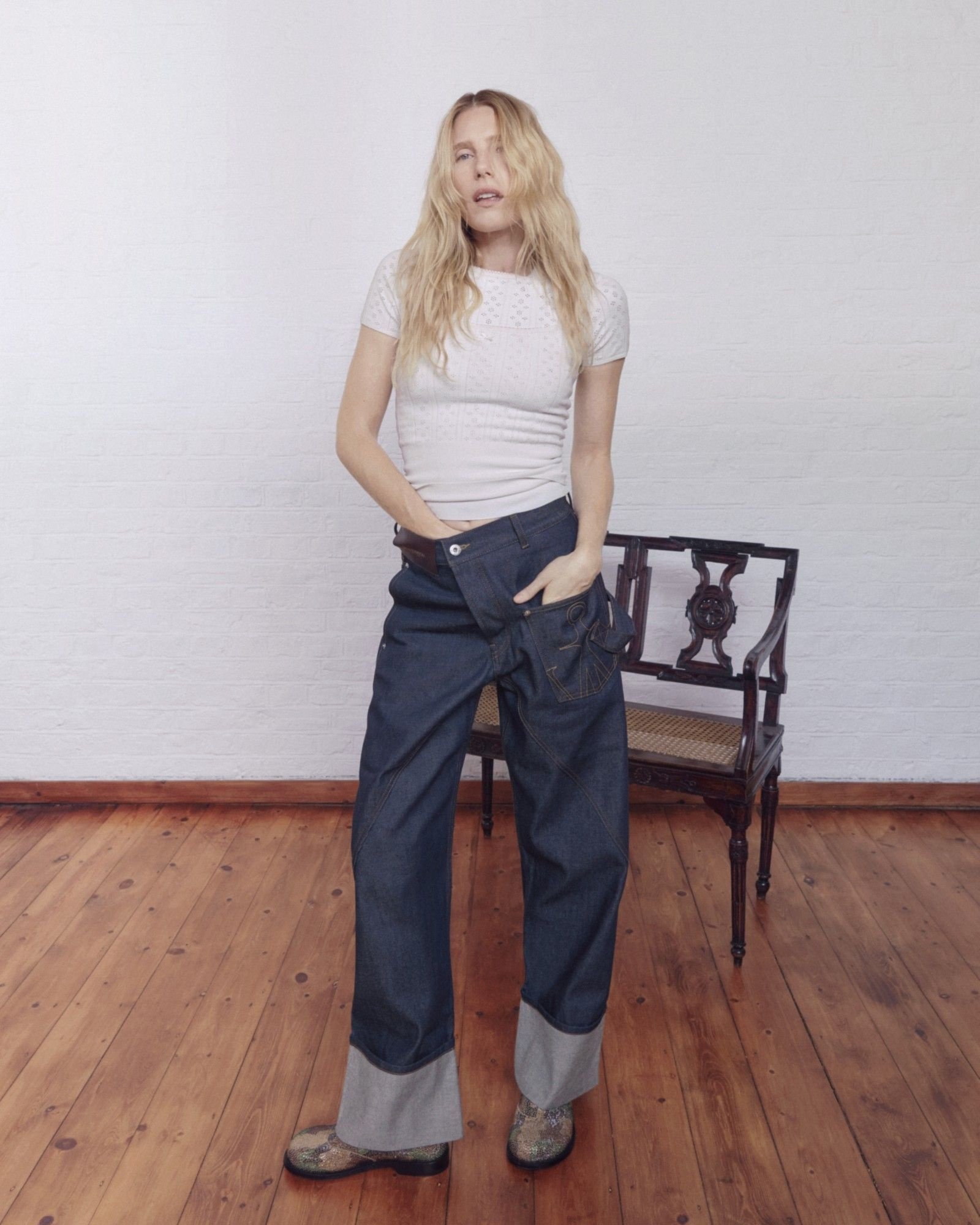
At the center of the collection sits the piece that gives the line its name. JW Anderson’s Twisted Denim, sold at retail under the name Twisted Workwear Jeans, reworks a democratic, universally recognizable garment through a single structural intervention: the front panel is physically twisted, and the leg seams spiral downward to follow that torsion rather than running straight. The result reads as recognizably a pair of jeans from a distance and as something considerably stranger up close, an idiosyncratic silhouette built from a familiar template.
This isn’t a piece invented for the campaign. Twisted Workwear Jeans have appeared across several prior seasons and finishes, including a turn-up cuffed version with a contrasting interior, a dark-wash iteration, and a high-rise wide-leg treatment finished with an anchor motif nodding to Jonathan Anderson’s rural Irish upbringing. Retail pricing across those past releases has generally sat between roughly 550 and 785 dollars or euros depending on region and construction, though pricing for the specific pairs shown in this new campaign wasn’t disclosed at time of writing. What’s changed here isn’t the garment’s core idea so much as the way it’s being presented: as something worn by two people who actually live in their clothes together, rather than modeled in isolation.
Twisted construction itself has become something of a broader fashion moment over the past few seasons, with spiraled seams and off-axis panels showing up across denim from multiple labels chasing a similar sense of movement in a static garment. JW Anderson’s version leans more architectural than most, treating the torsion as a structural statement built into the pattern rather than a surface-level styling trick, which is part of why the silhouette reads as distinctly the house’s own rather than a trend piece borrowed from elsewhere.
let
Rather than show the garment’s name with an elaborate view concept, the campaign leans on the two bodies themselves to make the point: legs cross, arms wrap, torsos overlap, and jeans fold into jeans, so the twisting becomes something the couple physical show rather than something explained to the viewer. It’s a choice that stays playful without tipping into overt sexuality, banking on the idea that visible chemistry between two people who actually have it reads as more persuasive than a staged approximation of desire.
That looseness ends up serving the product too. Close crops on labels, pockets and seams are folded into the same visual rhythm as the more candid shots of the couple rather than breaking away for a separate, obligatory product-shot interlude, so the eye keeps getting pulled back toward the construction even in frames that read, at first glance, as an ordinary pair of jeans. The tension between that modest, apartment-like set and Hemingway’s inherited fashion pedigree does a version of the same work: it gives the campaign cultural weight without needing to announce it.
The full campaign credits list Jonathan Anderson as creative director, Sam Khoury behind the camera, hair by Tommy Stayton, makeup by Kyle Dominic, manicures by Charly Avenell, and the set built by Samuel Pidgen, whose sparse room of white brick and secondhand furniture does most of the campaign’s atmospheric heavy lifting without ever calling attention to itself.
area
Every piece in the line carries a “Made in Japan” mark inside the pocket bag, alongside an oversized leather patch stamped with the JW Anderson logo, metal shank buttons, and a run of orange binding along the interior seams. Those details do double duty. They certify origin, but they also point to a supply chain where the handwork itself is treated as part of the product’s value rather than something to obscure.
Japan’s denim industry has spent decades building a reputation for exactly this kind of rigor, particularly around raw and selvedge fabrications woven on vintage shuttle looms that produce a tighter, more textured cloth than most mass-market denim mills can match. That reputation is part of why a growing number of European luxury houses have shifted at least some denim production there over the past decade, trading speed and scale for a slower process built around smaller mills and specialist finishing techniques. Placing a European luxury house’s most structurally experimental piece inside that production context is its own kind of statement: the twist is Anderson’s idea, but the cotton, the weaving, and the construction run through a tradition that predates the design by generations.
View this post on Instagram
rare
Twisted Denim arrives as one entry in a fairly relentless release calendar for the label. In the same recent stretch, JW Anderson has put out a campaign built around ceramicists, art collectors, writers and actors rather than professional models, unveiled a new sneaker with Italian sportswear brand Diadora built around a nostalgic take on retro sportswear, and released a second collaborative Guinness capsule, “Splits the G,” fronted by Little Simz and Joe Alwyn. The label’s long-running Uniqlo collaboration has stayed active in parallel, having leaned into a Brit-core mood for its most recent autumn/winter installment before returning for spring/summer 2026 with a reworked take on preppy campus dressing. That 17-piece Guinness line, rooted in Irish pub culture and drawing on archival brewery graphics and pub carpet textures, notably includes its own take on the brand’s signature twisted jeans alongside denim chore jackets and dungarees, a reminder that the twist construction functions as something closer to a recurring house language than a one-off idea reserved for a single campaign. Discussing the Guinness project, Anderson described being drawn to the brand’s graphic language for how immediate and culturally loaded it is, while still carrying real refinement, a description that could apply just as easily to the twist running through his denim.
Where those other projects lean into JW Anderson’s more conceptual, art-world-adjacent instincts, Twisted Denim pulls in the opposite direction: fewer ideas layered on top of each other, one product, one couple, one room.
extend
The Twisted Denim campaign lands at a moment when its designer has arguably never had more on his plate. Jonathan Anderson founded JW Anderson in London in 2008, initially focused on menswear before expanding into womenswear two years later, and built the label into a two-time British Fashion Council Designer of the Year winner (menswear and womenswear, both in 2015, a first for any single brand) along the way. LVMH acquired a minority stake in the label in 2013, around the same period Anderson also took on the creative directorship of Loewe, a role he held for more than a decade before stepping down in March 2025.
He didn’t step away from the spotlight for long. By April 2025 he’d been named artistic director of Dior Men, and just two months later that role expanded into creative control of Dior’s womenswear and haute couture lines as well, making him the first person since Christian Dior himself to oversee all three of the house’s main collections simultaneously. His first Dior collection, Dior Men Summer 2026, debuted in Paris on June 27, 2025, followed since by a Dior Cruise 2027 presentation and his first haute couture outing for the house. Between his own label, Dior’s roughly ten collections a year, and an ongoing collaboration with Uniqlo, Anderson is now credited with steering somewhere around eighteen collections annually across three different houses. He has described his own working method less as invention from nothing and more as editing, pulling and recombining existing references into something that reads as new. The Twisted Denim campaign, with its insistence on real rather than performed intimacy, fits that same instinct: taking something as familiar as a pair of jeans and finding an unexpected angle to look at it from.
where
The Twisted Denim collection is available now through JW Anderson’s own website, sold as unisex sizing across the pieces shown in the campaign. Nothing about the rollout suggests a limited or capsule-style drop; rather, it reads as the brand foregrounding an existing sig with a campaign built to make it feel newly personal.
There’s a version of this campaign that would have been easy to make and forgettable: two attractive people in jeans, shot against a neutral wall, selling a sil on the strength of their faces alone. What separates this one is restraint. No prop styling beyond a couple of worn pieces of furniture, no visible direction pushing Hemingway and Delli Santi toward a particular pose or expression, and no attempt to dress up the pitch with a concept bigger than the clothes themselves. Dressing two people who already dress alike, and letting the camera catch them mid-gesture rather than mid-pose, does more for that goal than another studio shot ever could. For a garment built around a single twist in its construction, a campaign willing to leave almost everything else untouched feels like the more honest choice.
Related Articles
NOT-KARL on Every Screen: Paris Hilton’s Pink Night Inside Karl Lagerfeld’s Saint-Germain Store
One year to the day after Palais de Tokyo, Karl Lagerfeld brought Paris Hilton back […]