DRIFT AUDIO
Listen to this story
Choose a voice, then press play.
Light, the Brooklyn studio behind the distraction free Light Phone, has built its first clamshell, and priced it at $299 to actually sell.
For a company that has spent a decade asking people to want less, Light has always had one obvious problem: wanting less has never been cheap. The Light Phone III launched last year at $799, a price that put a genuinely minimalist device in the same bracket as a flagship smartphone loaded with everything it was designed to reject. That math is exactly what the company’s new device is built to undo.
The Light Flip is a clamshell phone that opens for $299 unlocked, or $39 a month over a two year term through Light’s own carrier plan. It is the fourth phone the company has released since it was founded in 2015, and the first to break from the credit card shaped, screen forward form factor that defined the original Light Phone and its successor. Instead of a slab, this one folds shut with a hinge, a move that Light says was less a design flourish than a direct response to what its customers kept describing to the company’s research team.
Co-founder Joe Hollier told TechCrunch that the goal was to take everything the company had already built for its touchscreen phones and repackage it inside a shape people already associate with stepping away from a smartphone. “What we’re doing is offering the same Light Phone experience, the same Light Phone OS with our SDK developer program, all of the tools we already have today: alarm, calculator, calendar,” Hollier said. “It’s kind of the exact same experience, just one is fully tactile, no touch screen, and the other one is a complete touch screen experience.”
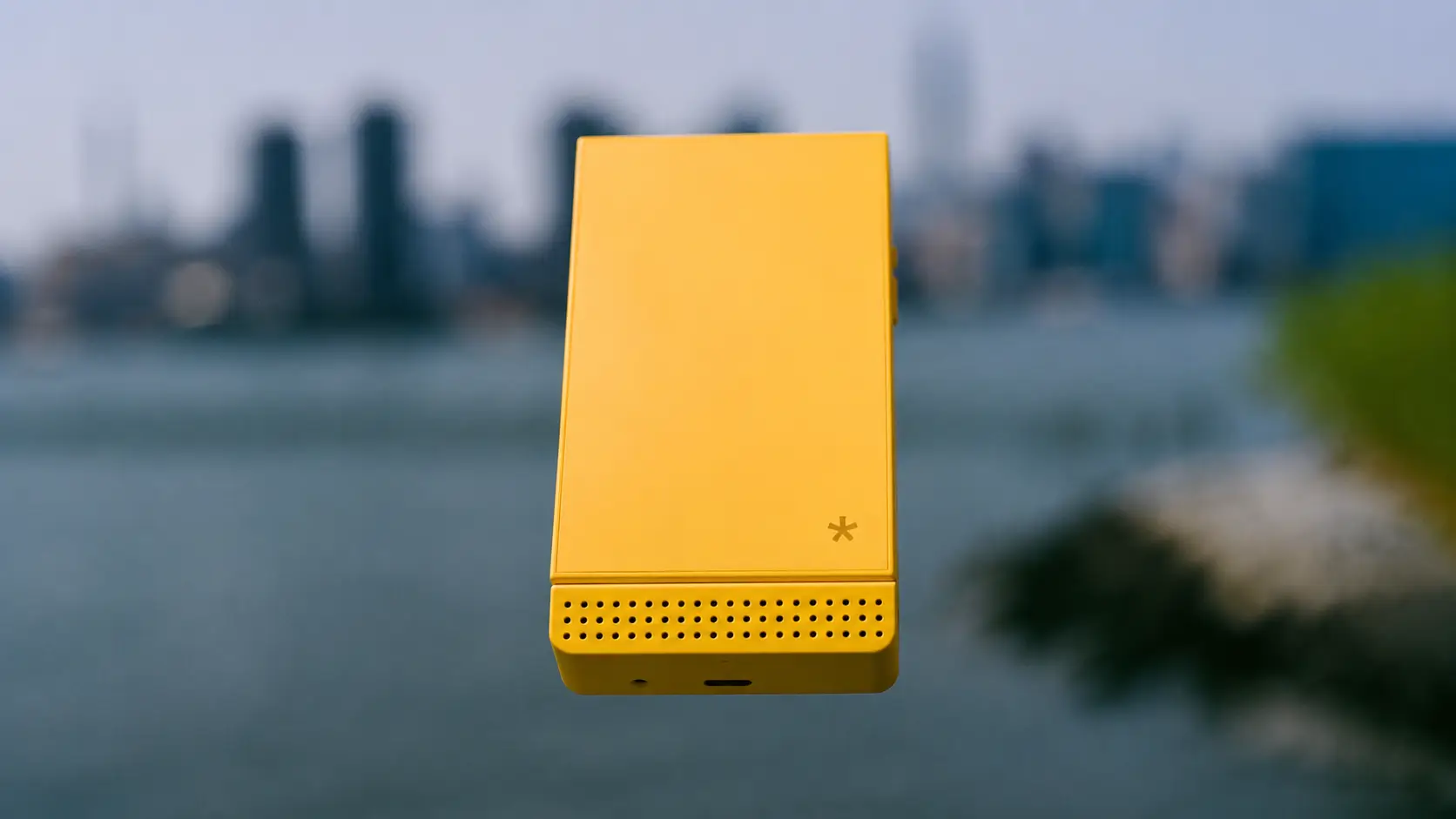
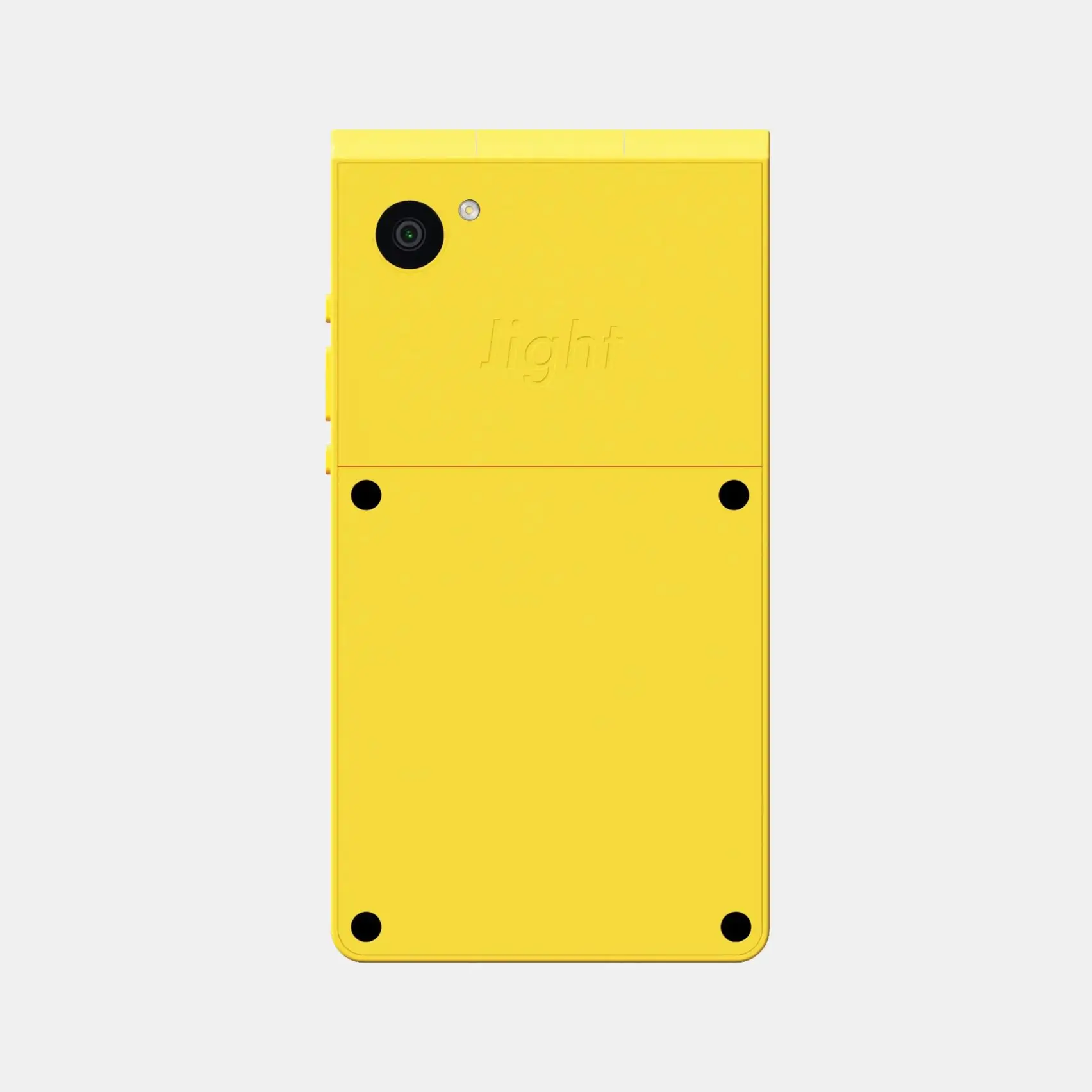
The Light Phone’s bright yellow finish emphasizes its minimalist, distraction-free design against a softly blurred city skyline.
That software layer is LightOS, the company’s proprietary operating system, and it is the actual product Light is selling as much as the hardware around it. There is no browser, no app store, no social feed, and no game to open by accident during a moment of boredom. What is there instead is a small, fixed toolbox: alarm, calculator, calendar, a contacts directory, driving directions, a hotspot function, a music player, notes and voice memos, a podcast app, weather, a two factor authenticator, and a timer. Light also opened a developer program earlier this year so outside programmers can build community made tools for that same toolbox, a quiet acknowledgment that even a stripped down phone benefits from more than one company deciding what belongs on it.
in
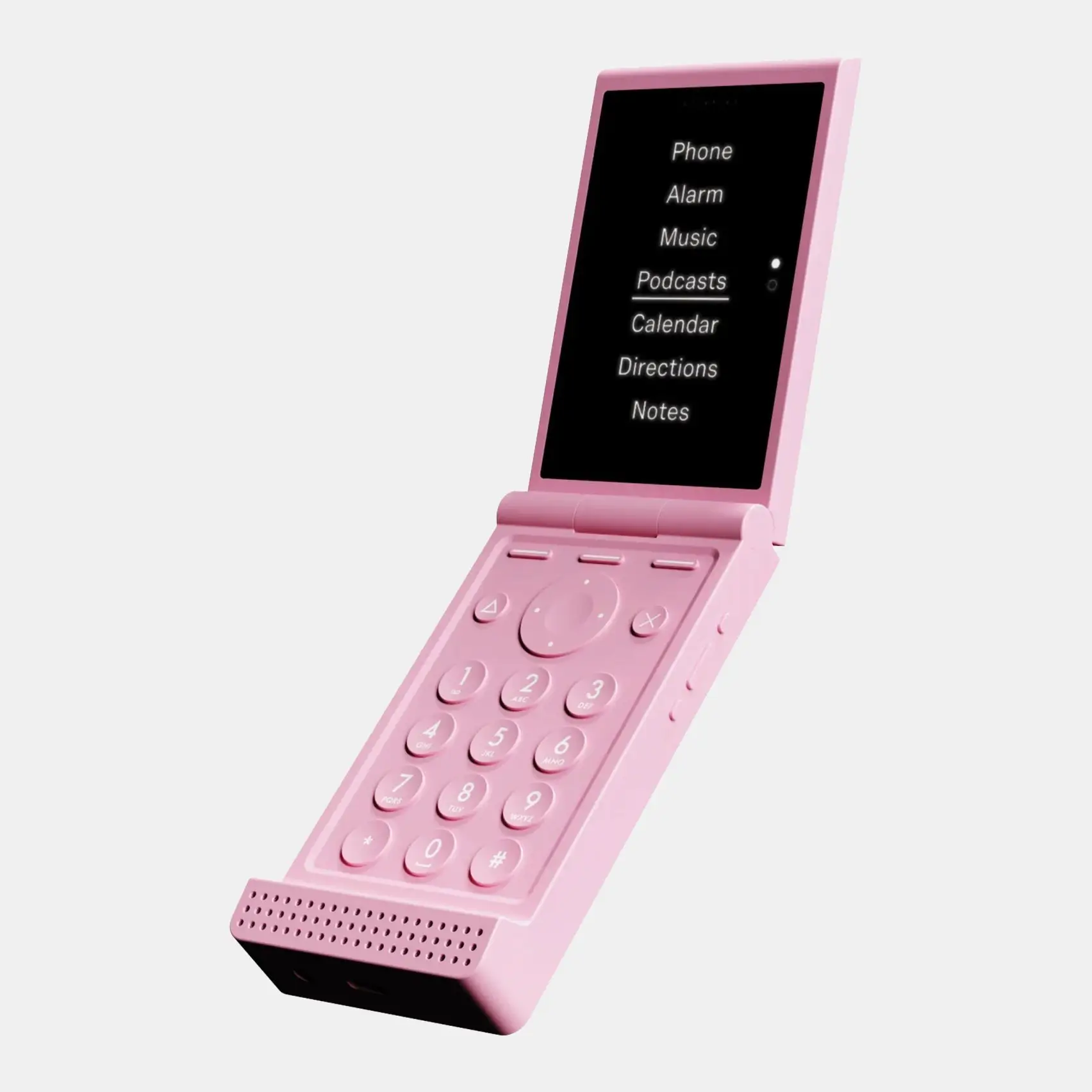
Folded shut, the Light Flip measures 110mm by 58mm by 19mm and weighs 160 grams, dimensions that put it closer to a compact wallet than a modern smartphone. Open it and the entire display budget goes to a single 2.8 inch OLED screen on the inside. There is no second screen on the cover, a decision Light has said came directly from user feedback rather than a cost cutting shortcut. What the cover does have is a small light that glows to signal a notification, plus a rear facing camera, so a user can glance at the outside of a closed phone and know whether anything is waiting without opening it.
That rear camera is a 12 megapixel sensor, and there is no front facing camera at all, a pointed omission for a company whose entire premise is reducing the reasons to look at a screen for yourself. Connectivity runs on both 5G and 4G LTE, the phone charges over USB-C, and it plays music stored locally or downloaded podcasts through either a 3.5mm headphone jack or Bluetooth headphones. It supports both eSIM and a physical Nano SIM, and works across most major US carriers in addition to Light’s own service. A 1800 mAh battery and a MediaTek chipset round out the internals, modest numbers next to a modern smartphone but roughly in line with what a phone this size, running a much lighter operating system, actually needs.
Where the Light Phone III leaned into premium materials, with a metal frame and finishes built to feel closer to a piece of hardware than a gadget, the Flip is made primarily of plastic. That is precisely how Light got the price down as far as it did, since the new phone also drops the NFC reader and selfie camera that came standard on its more expensive sibling. It is, by the company’s own framing, the least expensive way anyone has ever been able to buy into the Light ecosystem.
protean
The material trade off bought Light something it had never offered before: color. Every previous Light Phone shipped in a single, severe black. The Flip comes in six finishes: black, red, yellow, pink, navy blue, and a light grey, a genuine departure for a brand whose visual identity has always leaned closer to a design object than a piece of consumer electronics.
Hollier, discussing the palette with TechCrunch, seemed almost surprised by his own reaction to it. “I thought I was fully QWERTY, but I was having fun with the T9 predictive texting, so I can see myself going flip phone also for the colors,” he said. “Just having a yellow phone gets me so jazzed.” It is a small admission, but a telling one: even the people who built a company around resisting the pull of flashy consumer tech aren’t immune to wanting a phone that looks fun to carry.
The keypad itself is fully tactile, built around T9 predictive typing, the same multi tap input method that defined texting through the 2000s before touchscreens made it obsolete. Light has paired that keypad with modern conveniences the old T9 era never had, including voice to text transcription and voice message recording, plus nine dedicated speed dial slots. The overall form factor is built, in the company’s words, to prioritize calling over typing, a philosophy that runs directly counter to how most people now use a phone.
View this post on Instagram
later
There is a specific irony sitting underneath this launch. Co-founder Kaiwei Tang worked on the original Motorola Razr V3, the phone that effectively defined what a flip phone was supposed to look like for an entire generation. Twenty years later, he is watching customers ask his own company to bring that shape back, and by his own account, the demand caught him off guard.
“We’ve been interviewing young people that use flip phones for a few years,” Tang told TechCrunch, describing a pattern his team kept running into during customer research: members of Generation Z who owned flip phones loved the experience but consistently complained about how poorly the devices were built. “They’re describing the flip phones in negative language, but they stick with it, and they feel proud.” That contradiction, people staying loyal to a product they also criticize, became the opening Light decided to build into.
The company’s read on the moment lines up with what device reviewers have been documenting for a while now. Interest in dumbphones has climbed steadily among both Gen Z and Generation Alpha, driven in part by groups like the so called Luddite Club and by parents looking for a first phone that does not come pre-loaded with the same feeds and games their kids’ devices were meant to replace. Tang’s framing is that neither existing option, cheap and disposable feature phones or fully loaded smartphones squeezed into a folding shell, actually solved what those users were asking for. The Flip is Light’s attempt to sit in the gap between them.
scope
The Light Flip opened for preorder on July 21, and the company is upfront that the wait from order to delivery is a long one: first units are not expected to ship until April 2027. That is an unusually distant horizon for a consumer device, and Light appears to know it creates a real risk of preorder customers losing patience and canceling before a single unit reaches a doorstep.
Its answer is a companion program called “Flip Your Life,” which will send preorder holders biweekly newsletters meant to help ease the transition away from a smartphone before the hardware itself even arrives. It is as much a community building exercise as a marketing one, an attempt to keep people engaged with the idea of the purchase during a gap that would otherwise just feel like dead air.
Financing is part of the pitch too. Light has been testing payment plans through its own carrier service, and recently piloted phone contracts with Noble Mobile, the anti doomscrolling carrier co-founded by Andrew Yang. Under Light’s own two year plan, the Flip runs $39 a month, while the pricier Light Phone III is offered on the same term structure at $59 a month, giving prospective buyers a lower commitment path into either device rather than requiring the full sticker price upfront.
why
Light is not alone in betting on this shape again. The clamshell format has become one of the more visible battlegrounds in the broader digital detox movement, sitting alongside minimalist bar phones from companies like Punkt and Mudita, both of which have built similar reputations selling deliberately limited hardware at prices that have historically run high enough to keep the category niche. What makes the Flip notable inside that landscape is less the shape itself and more the number attached to it: at $299, Light has priced a genuinely distraction resistant phone low enough to function as an impulse purchase, a weekend device, or a first phone handed to a teenager rather than a long considered lifestyle commitment.
That repositioning matters because pricing has always been the quiet argument against the entire minimalist phone category. It is easy to admire the idea of a phone with no browser and no social feed from a distance, and considerably harder to justify paying flagship money for a device that deliberately does less. By building the Flip around plastic instead of metal, and by cutting the NFC reader and front camera that its pricier sibling carries, Light has effectively built a version of its own pitch that does not ask for the same leap of commitment.
Reviewers who cover this category closely have already been circling the same conclusion from a different angle. Coverage of the broader dumbphone resurgence has repeatedly pointed to price as the single biggest thing keeping the movement from spreading past a small, committed audience, since most of the credible options on the market have asked buyers to spend flagship money to get a phone that does less, not more. A $299 clamshell does not solve every objection to that argument, but it removes the one that has stopped the most people from trying.
There is also a generational angle Light is leaning on directly rather than treating as an accident. The company points to both Gen Z and Generation Alpha as the audiences pushing hardest for this shape, a pattern that shows up anecdotally in schoolyards and dorm rooms as much as it does in Light’s own customer interviews. For teenagers and young adults who grew up entirely inside the smartphone era, a flip phone reads less like nostalgia and more like a genuinely new object, something their parents never carried and something none of their peers are handing them defaults for. That is a different kind of appeal than the one Light’s older, more austere phones have traditionally sold to design conscious adults looking to cut down their own screen time, and it may end up being the harder won, more durable market of the two.
n
From the DRIFT archive: PANTONE’s 2026 Color of the Year Takes Shape With Play-Doh and Post-It Editions · Cornell Team Develops Ultrablack: The “Darkest Fabric Ever” That Reflects Close to No Light