DRIFT AUDIO
Listen to this story
Choose a voice, then press play.
An Aug. 5 letter over name, image and likeness rights has turned a jersey number into the biggest offseason nar to come out of Baton Rouge.
On Aug. 5, an attorney representing Jayden Daniels sent a letter to LSU athletic director Verge Ausberry informing the school that it no longer has permission to use the quarterback’s name, image or likeness in any capacity. The letter, written by attorney Adam Kenner and first obtained by ESPN, cites the terms of Daniels’ original NIL agreement with the school, which reportedly allowed LSU to continue using his likeness for 180 days after his final college game before that permission expired.
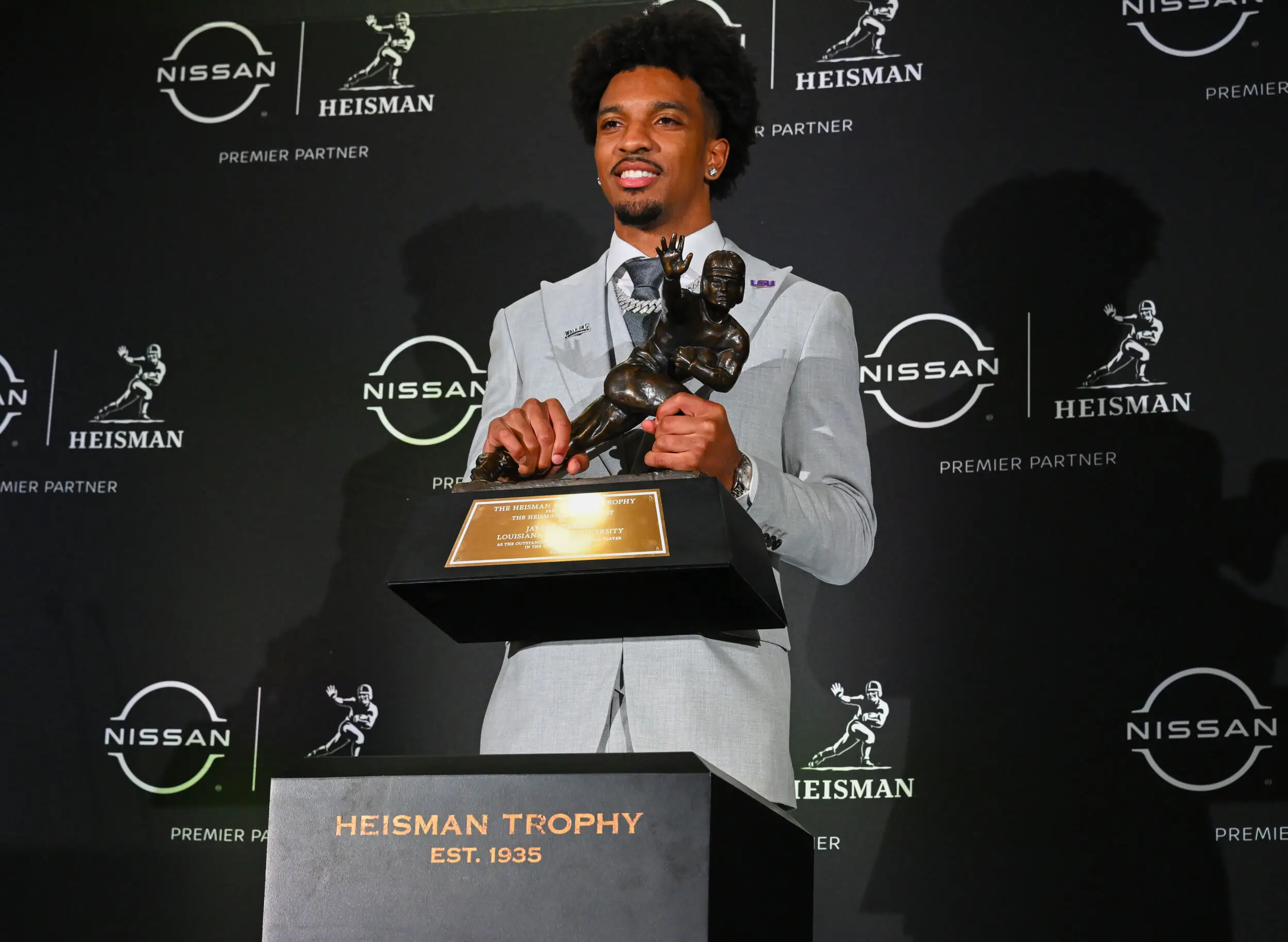
College Football Player Jayden Daniels With The Heisman Trophy At The Heisman Trophy Ceremony.
Daniels has not played a college snap in nearly two years. Since leaving LSU, he has become one of the more productive young quarterbacks in the NFL, taken by Washington with the No. 2 pick in the 2024 draft and named the league’s Offensive Rookie of the Year that same season. None of that success is in dispute here. What is in dispute is a much narrower legal and emotional question: whether a school can keep using a departed player’s name and likeness indefinitely once his original NIL agreement has lapsed, and whether that same school owes him any deference over a number he never formally had retired.
Kenner’s language was blunt. LSU, he wrote, “must immediately cease and desist from any further use, display, publication, distribution, promotion, commercialization, or other exploitation” of Daniels’ NIL, adding that any continued use after the school’s receipt of the letter would be treated as unauthorized. The letter does not, notably, make any legal claim to the jersey number itself. It is strictly about whether LSU can keep trading on Daniels’ name and image in its marketing, merchandise and program materials.
The letter’s existence became public only when ESPN’s Wednesday report surfaced it, more than a week after it was sent. That gap, combined with the timing relative to the jersey controversy brewing in fall camp, is a large part of why the story spread as fast as it did. CBS Sports said it reached out to Kenner directly for comment and had not heard back as of publication, and LSU has not issued its own detailed public response beyond declining to comment on specifics.
huh
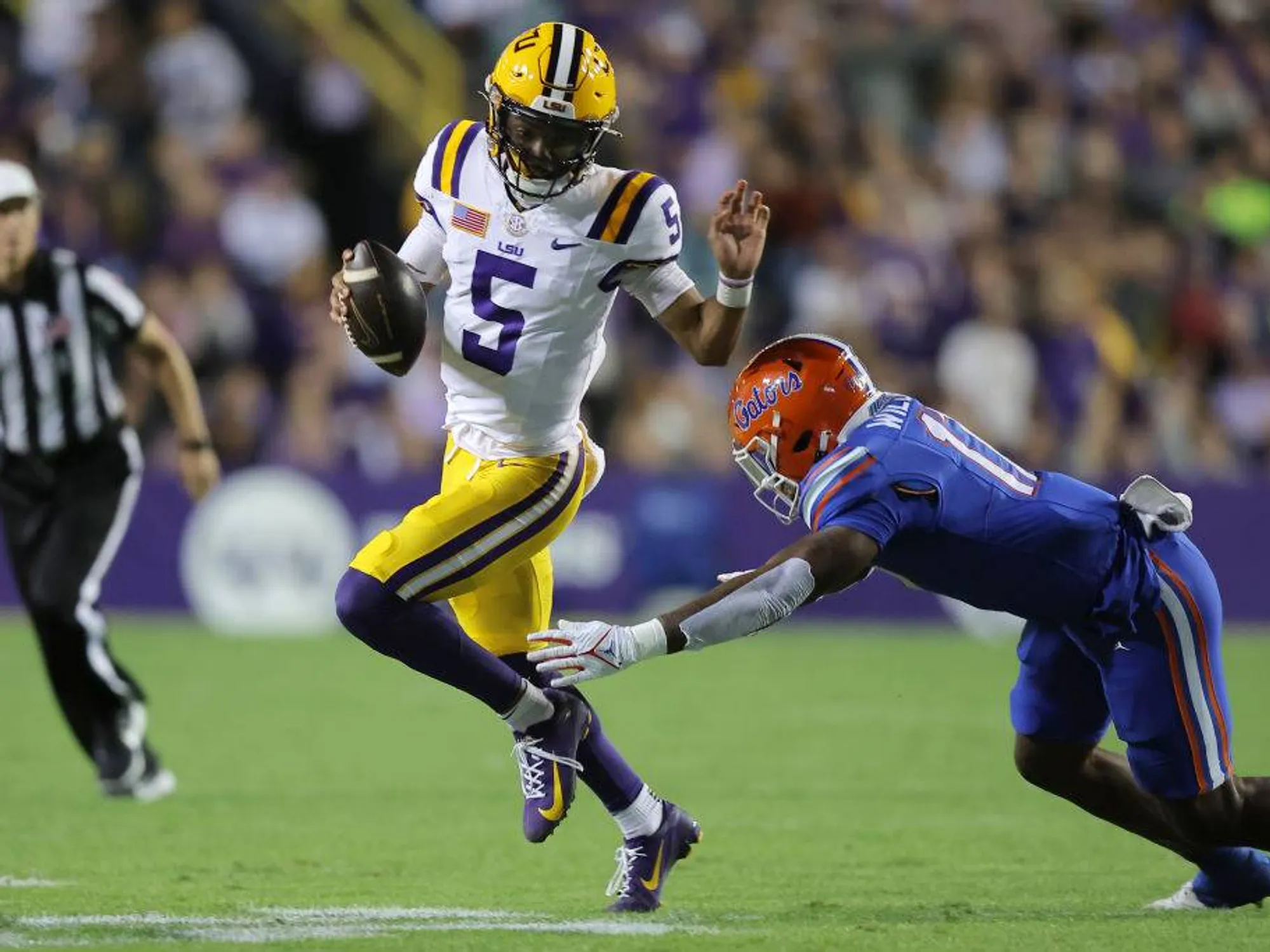
When Daniels wore No. 5 through a season that ended with him becoming the third Heisman Trophy winner in LSU history. He left for the NFL after that season, taken by the Commanders and named the league’s 2024 Offensive Rookie of the Year. LSU never formally retired No. 5. But no player wore it again until this preseason, an informal gap that Daniels’ camp apparently read as its own kind of tribute.
According to a statement from a spokesperson for the Daniels family provided to ESPN, that reading is exactly the source of the frustration. “The Daniels family is deeply disappointed and feels profoundly disrespected by LSU’s decision to give Jayden’s number to another player,” the statement said, adding that Daniels and his family “had every reason to believe that his number would remain a meaningful part of his LSU legacy.”
LSU’s own jersey retirement policy sets a genuinely high bar, and it also draws a distinction that has become central to this whole dispute: a retired jersey is not automatically the same thing as a retired number. Under the school’s bylaws, an athlete must be at least five years removed from competition and have accomplishments that go beyond the standard for LSU’s Athletics Hall of Fame before a jersey can even be nominated for retirement. But LSU has only ever taken a number fully out of circulation once, for Billy Cannon’s No. 20, following his 1959 Heisman season. Other honored football numbers, including Tommy Casanova’s No. 37, Jerry Stovall’s No. 21 and Charles Alexander’s No. 4, remain in active use by current players even though those jerseys were formally retired, and LSU said as recently as this July, when it announced a jersey retirement for a more recent player, that Cannon’s No. 20 is still the only number in program history that can never be worn again. Daniels is roughly two years past his final LSU snap, well short of the five-year nomination window even if his camp wanted to formally pursue retirement, which means No. 5 was, under the letter of LSU’s own rules, always available for reassignment.
flow
The player now wearing the number is sophomore cornerback DJ Pickett, a former five-star recruit who started switching to No. 5 at the beginning of fall practice on Aug. 5, the same day Kenner’s letter went out. Pickett wore No. 3 as a freshman last season, when he recorded three interceptions and 37 total tackles for the Tigers.
Pickett addressed the situation directly with reporters this week. “About the number situation, I’ve worn the number my whole life since I was 4 years old,” he said. “It was a number I was promised, and I wish Jayden the best. Good player, and he did real good here.” His father, Damien Pickett, was more pointed in comments to The Advocate, saying the family had not been told anything by LSU suggesting DJ would need to give the number back and that the controversy has only hardened their resolve. “Honestly, man, this right here makes us want to wear the number more,” Damien Pickett said, adding that head coach Lane Kiffin has been “in full support” of his son throughout.
By Damien Pickett’s account, the family did not learn a cease-and-desist letter existed until ESPN’s report broke on Wednesday night, more than a week after it was actually sent to the school. Pickett is a former five-star recruit, listed at 6-foot-5, who arrived at LSU as one of the highest-rated defensive back signees in the 2025 class, which is part of why coaches on both sides of this dispute describe him as a player worth making an exception for in the first place.
two
Part of what makes the dispute messier is that two separate LSU coaching staffs have weighed in with different versions of how the number ended up on Pickett’s back. Kiffin has said Pickett was promised the chance to wear No. 5 when he signed with LSU in December 2024, a commitment made under former coach Brian Kelly, who was fired the following October after a 34-14 record across four seasons.
Kelly, in his own comments to ESPN, confirm that account but added an important detail: he chose not to actually issue the number to Pickett at the time because Daniels had not signed off on it. “I just wasn’t prepared to do it until we got a full commitment from another Heisman Trophy winner,” Kelly said, drawing a comparison to No. 9, the number worn by another LSU Heisman winner, Joe Burrow. “We didn’t want to issue No. 9, so you can’t treat one differently from the other.” In other words, under Kelly, LSU treated both numbers as informally off-limits out of deference to the players who made them famous. Under Kiffin, that deference appears to have ended.
in
The gap between what people assumed the letter was about and what it actually says has become its own subplot. NFL insider Mike Garafolo wrote on X that the cease-and-desist “is not actually about the jersey number that has caused frustration around his former college,” clarifying that there is no legal claim to the number itself and that the communication is solely about Daniels’ NIL rights. LSU has not publicly connected the two issues either. A school spokesperson declined to comment on the matter when reached this week, and Kenner did not respond to interview requests from multiple outlets.
There’s nothing in the letter about LSU using the No. 5 jersey. There’s no legal claim to the number itself. The communication is solely about Jayden Daniels’ NIL. https://t.co/Tr73AViICB
— Mike Garafolo (@MikeGarafolo) August 13, 2026
challenge
As of this week, nothing has actually changed on the field. Pickett has kept the number through practice, LSU has given no indication it plans to intervene, and the Tigers open their season with the jersey question still technical unresolved on paper even as it appears settled in practice. The bigger open question is what LSU does next regarding Daniels’ NIL restrictions themselves, since the letter’s core legal demand, unlike the jersey dispute that triggered public attention, is the part with actual contractual teeth behind it.
LSU has fully retired only one number in program football history, Cannon’s No. 20, and Daniels remains well outside the eligibility window for even a jersey honor regardless of how this dispute resolves. That leaves the practical stakes sitting almost entirely off the field: whether LSU actually pulls Daniels’ name and image from its marketing materials and program history pages in response to the letter, and either a private resolution, the outcome Daniels himself said he’s hoping for in his Instagram statement, arrives before the Tigers open their season. Neither Daniels’ camp nor LSU has set a public timeline for that, and both sides now have real incentive to move the conversation out of public view. Kenner’s letter did what cease-and-desist letters are designed to do, put the school on formal notice, but it did not, on its own, resolve the far more emotional question that actually made this tell travel: either a number LSU never promised to retire still belonged, in spirit, to the player who wore it into the Heisman ceremony.