
DRIFT AUDIO
Listen to this story
Choose a voice, then press play.
Under Kazu Hiro’s prosthetics and Emmanuel Lubezki’s drained VistaVision frames, Iñárritu stages the apocalypse as farce, and the opening weekend splits the room.
The hair goes first: a few white strands dragged across the scalp in a combover nobody on staff would dare to fix. Then the gut, the cowboy boots, the silk pajamas, the limp, and a Southern drawl that fills every room of a stone mansion hung with hunting trophies. Somewhere under all of it is Tom Cruise, rebuilt by Oscar-winning prosthetic designer Kazu Hiro into Digger Rockwell, the oil baron at the center of Digger, and the effect is closer to demolition than disguise. The most recognizable face of the last forty years has been reduced to a temper, an accent and an ailing white cat named Maggie that Rockwell cradles like the last living thing that still obeys him.
View this post on Instagram
The setup is simple enough to fit on a cocktail napkin, which may be the point. Alejandro G. Iñárritu‘s satirical black comedy, which opened across 3,321 North American theaters on Friday, October 2, follows a tycoon whose drilling in Greenland sets a glacier moving and tips the planet toward an ecological crisis that could escalate into nuclear war. John Goodman’s ailing, autocratic President Compson orders Rockwell to clean up the mess himself, and Rockwell takes the assignment the only way he knows how: as a branding exercise, a chance to be crowned humanity’s rescuer before anyone can finish blaming him for the damage.
Signal. What happened: Alejandro G. Iñárritu’s satirical black comedy Digger, starring Tom Cruise as oil tycoon Digger Rockwell, opened in 3,321 North American theaters on October 2, 2026, after $1.2 million in Thursday previews and a sharply divided critical reception. Exact object: a 129-minute Warner Bros. Pictures and Legendary Pictures release, shot entirely on 35mm VistaVision by Emmanuel Lubezki and presented in IMAX, Dolby Cinema and dedicated VistaVision screenings. When and where: in theaters across North America, the UK and Ireland from October 2, Mexico from October 1, select international markets from September 30, and Japan from October 9 through Towa Pictures and Toho. Source: Warner Bros.’ official rel materials, Deadline’s preview figures and Japanese distributor announcements. Why it matters: it is the first film out of Cruise’s Warner Bros. partnership and the biggest departure from his action-hero persona in years, and it is tracking toward his softest opening since 2007.

length
Iñárritu has said the character arrived long before the story did. He began carrying Rockwell around after finishing The Revenant in 2015, he explained in a video message shown to press, and spent the next ten years searching less for a plot than for the right register to tell it in. By 2019 he was talking it through with Cruise, who was shooting Top Gun: Maverick at the time and had admired the director since catching Amores perros on its first release in 2000. Rather than mailing over a screenplay, Iñárritu sat with his star across several days and read the script aloud to him.
Then another film intervened. Bardo, False Chronicle of a Handful of Truths, Iñárritu’s sprawling Mexico City reverie, took priority, and Digger did not formally surface until February 2024, when Cruise was confirmed in the lead as part of his strategic partnership with Warner Bros. Pictures, with Legendary Pictures attached to produce. The screenplay is credited to Iñárritu, Mexican playwright Sabina Berman, and his Birdman co-writers Alexander Dinelaris and Nicolás Giacobone, from a story Iñárritu developed with Berman and the English playwright Jez Butterworth.
Principal photography began at Pinewood Studios on November 7, 2024, under the working title Judy, and ran roughly six months, pausing for two days in March 2025 while Goodman underwent hip surgery. The format choice is the tell. Emmanuel Lubezki, reunited with Iñárritu after Birdman and The Revenant, shot the entire film on 35mm VistaVision, the double-width, sideways-running negative system Paramount introduced in 1954, fitted with Leitz Cine lenses. It is a format built for grandeur, and here it is pointed at a man in a bathrobe. Warner Bros.’ official production notes list a bench that reads like an Iñárritu reunion: editors Stephen Mirrione and Conor O’Neill, costume designer Jacqueline West, makeup and hair designer Alessandro Bertolazzi, production designers Dennis Gassner and Richard Johnson, and casting director Francine Maisler. The newcomer is composer Cosmo Sheldrake, scoring his first feature.
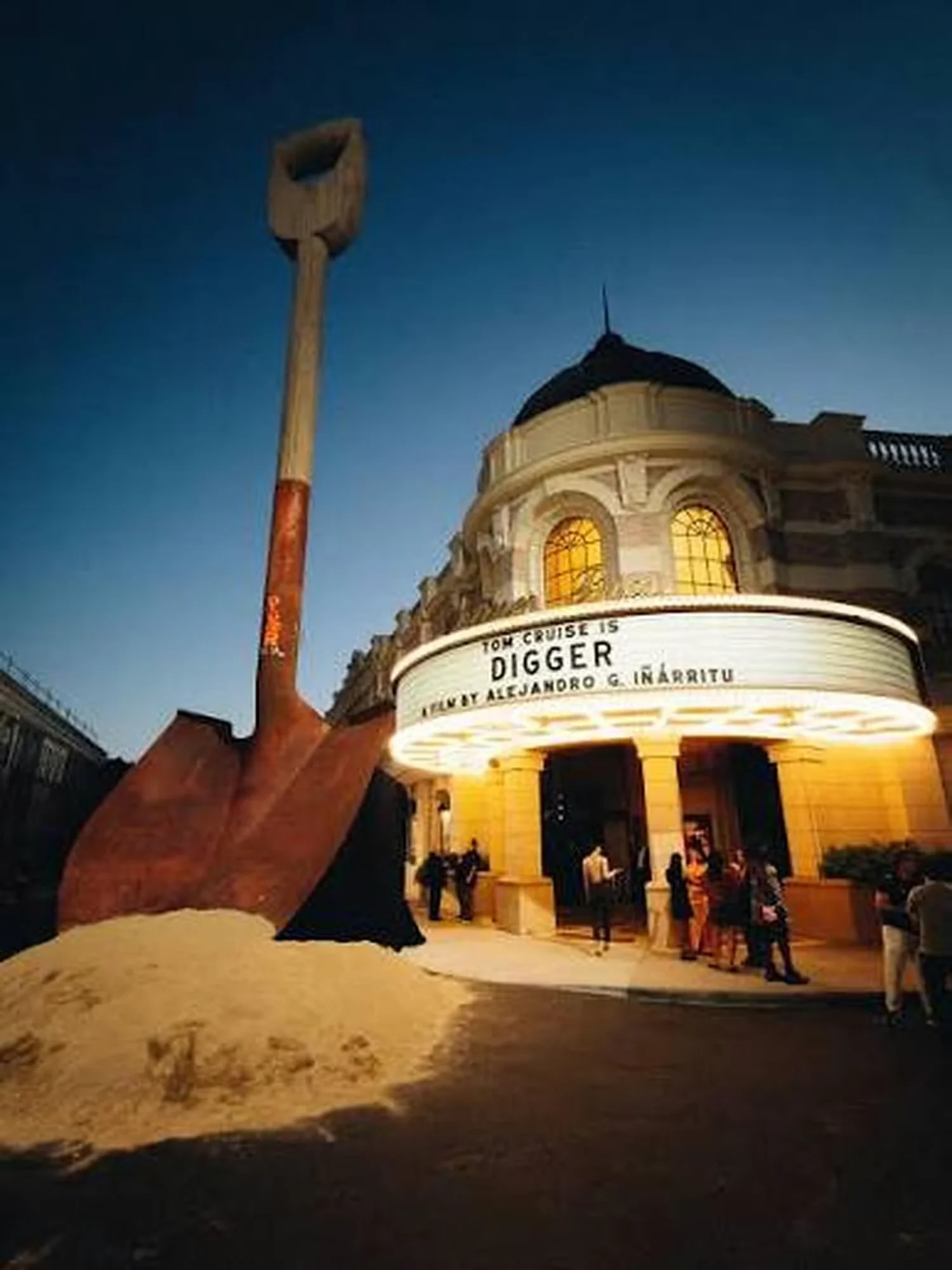
Iñárritu summed up the project to Empire in four words: “The disaster is us.” The line frames the whole enterprise as a mirror rather than a monster movie, and it goes some way toward explaining why the first teaser sold the film not with spectacle but with Cruise, in boots and athletic shorts, dancing around a carpeted living room with a shovel and tightrope-walking along a seaside railing.
score
For the better part of a decade, Cruise has occupied a role that extends well past any single character: the man who saves things. He saved the world repeatedly as Ethan Hunt, and with Top Gun: Maverick in 2022 he was widely credited with helping rescue the theatrical business itself, pulling audiences back into cinemas after the pandemic shutdowns. Digger takes that reputation and turns it over like soil. Here he plays the reason the world needs saving, and a man who treats the rescue mainly as an opportunity for good press.
Iñárritu has run this play before. In Birdman, he cast Michael Keaton, a former Batman, as a faded actor haunted by the superhero role that made him famous, and the friction between the performer’s real history and the character’s fiction did half of the film’s work. Digger applies the same pressure at a far larger scale. When the culture’s designated rescuer shows up as the cause of the catastrophe, the casting becomes part of the argument, and the joke lands somewhere between the screen and the audience’s memory of every Cruise poster in the lobby.
The obvious ancestor is Dr. Strangelove, Stanley Kubrick’s 1964 farce about the end of the world being settled by a few men in a war room, and several critics have reached for it. A more useful comparison may sit inside Cruise’s own filmography. His best work away from the action machine has tended to turn his intensity against a character’s vanity: the seminar-stage huckster Frank T.J. Mackey in Magnolia, the foul-mouthed studio boss Les Grossman in Tropic Thunder. Rockwell belongs to that lineage, a man whose charisma is real and whose judgment is ruinous.
@warnerbros
Tom Cruise is DIGGER: “Let’s f***ing go!” Only in theaters October 2026.
♬ original sound – Warner Bros.
Around him, Iñárritu has stacked an ensemble built for friction. Riz Ahmed plays Ganesh, a scientist attached to the President whom Rockwell, against all odds, takes a liking to. Sandra Hüller is Emma Rockwell, his half-sister and business partner. Michael Stuhlbarg plays the Vice President, Jesse Plemons plays a figure named Kenny, and Sophie Wilde, Emma D’Arcy, Burn Gorman, Robert John Burke and Pip Torrens round out a cast that circles Rockwell like debris around a collapsing star. One sequence drew particular attention after press screenings, in which Rockwell pleads his case before a United Nations-style assembly whose delegates, dressed in pistachio green, are furious about what he has done to the planet.
split
The film’s public life began on September 22 with a Royal Premiere in London, where the Prince and Princess of Wales turned out alongside Cruise, Iñárritu and the cast, and where Cruise described Rockwell as “totally outrageous” and unlike anyone he had played before. When the review embargo lifted, the consensus that emerged was that there was no consensus.
Admirers called it Cruise’s best performance since Magnolia and one of the most conceptually reckless studio pictures in years. Variety’s chief awards editor, Clayton Davis, said he respected the swing, singling out Goodman, Wilde and the return of Lubezki behind the camera. Detractors found the satire muddled, the tone abrasive and, most damning for a comedy, the jokes thin, with a few arguing that the film shares its protagonist’s conviction that it is the smartest presence in any room. Almost nobody disputes the commitment of the lead performance. The argument is over whether the structure built around it can carry the weight.
That split is familiar territory for Iñárritu, who has a long habit of folding his own critics into his films. Birdman made a theater critic its most immovable antagonist. Bardo handed its filmmaker hero an old colleague who accuses him, to his face, of pretension. Digger, by the account of several reviews, goes further than either.
nar
Roughly half an hour in, Digger pulls back a curtain. The Rockwell saga is not unfolding in real time. It is being performed, a reconstruction staged by a company of actors moving through a vast, theater-like complex of sets, in a future where the collapse has already happened and Digger Rockwell is remembered as the man most responsible for it. Cruise, it turns out, is playing an actor who is playing Digger, and Sophie Wilde is the director trying to hold the production together.
Read backward, many of the film’s surface choices click into place. The chalky, desaturated look Lubezki gives the opening stretch reads less like a fashionable gray grade than like stage light falling on stage makeup. The delegates in pistachio green look less like a political body than a chorus. Even the combover starts to feel like a costume department’s best guess at a historical villain, which, inside the fiction, is exactly what it is.
The device has divided critics as sharply as everything else. One German review argued that the surprise burns off quickly and adds little, pointing to a moment in which Cruise’s actor asks his director whether a scene is meant to be funny, a question the reviewer said the audience keeps asking too. Other critics read the structure as the film’s real thesis: a defense of farce and satire as tools for processing a tragedy too large to look at head-on.
fin
The early numbers are rough. Digger took in $1.2 million from Thursday previews that began at 2 p.m., and Deadline’s Friday-night projection, as relayed by Forbes, put its opening weekend near $10 million, which would be Cruise’s weakest debut since the 2007 war drama Lions for Lambs opened to $6 million. That is a hard figure for a film carrying a reported $125 million production budget, a number some later reports have pushed considerably higher. For comparison, One Battle After Another, an earlier Warner Bros. bet on a filmmaker with a free hand, earned $3.1 million in previews in September 2025 on its way to a $22 million opening.
Related Articles
Netflix Eyes Lionsgate: How Michael’s Record Box Office is Supercharging the Studio’s Stock
index Lionsgate Jumps on Netflix Acquisition Rumors Why Lionsgate Is the Asset Worth Watching Right […]