
DRIFT AUDIO
Listen to this story
Choose a voice, then press play.
Xiaomi’s electric precision driver. Two torques, 24 bits, a 59 gram aluminium body. The 2019 iF winner was the larger cordless. This one is the small job.
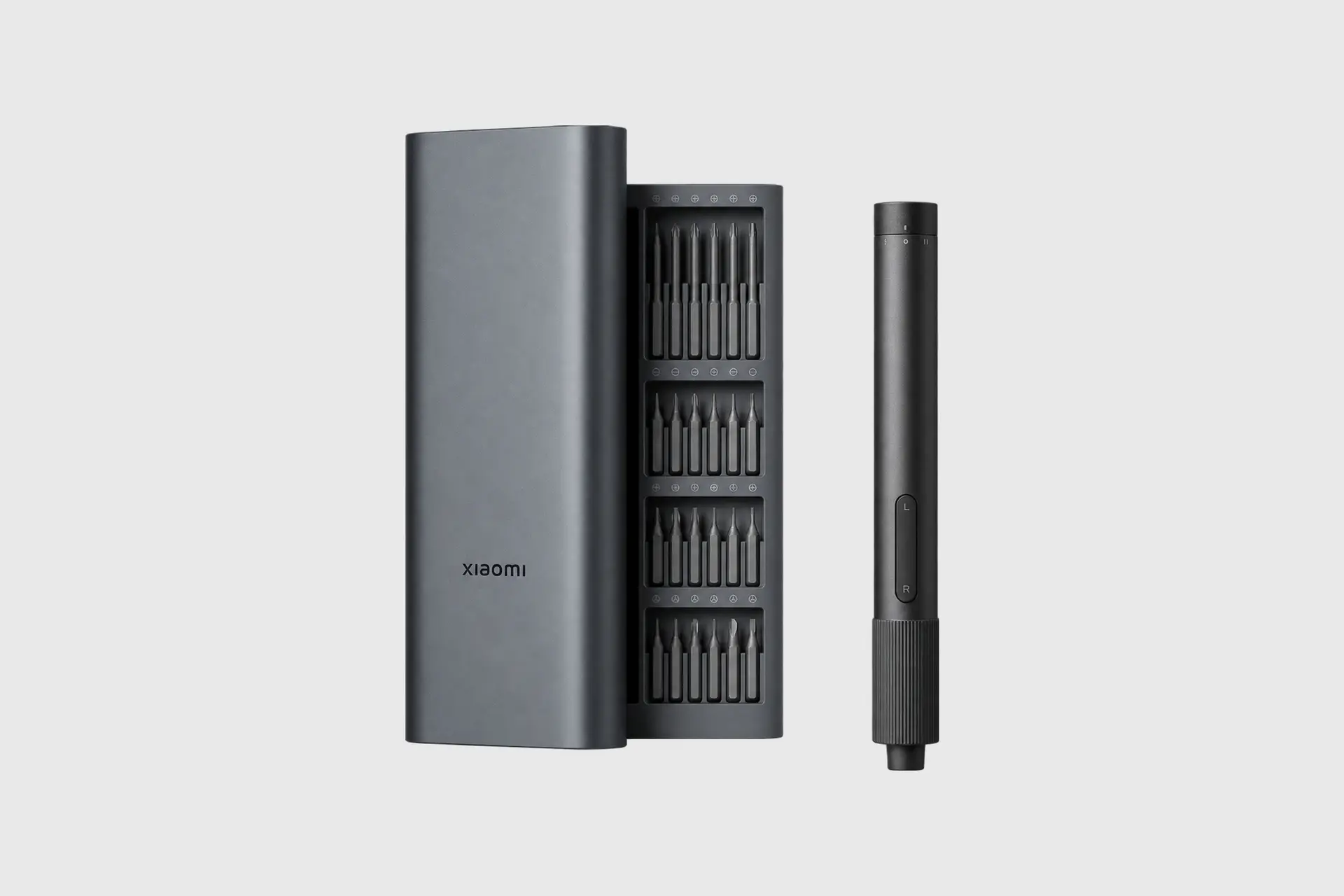
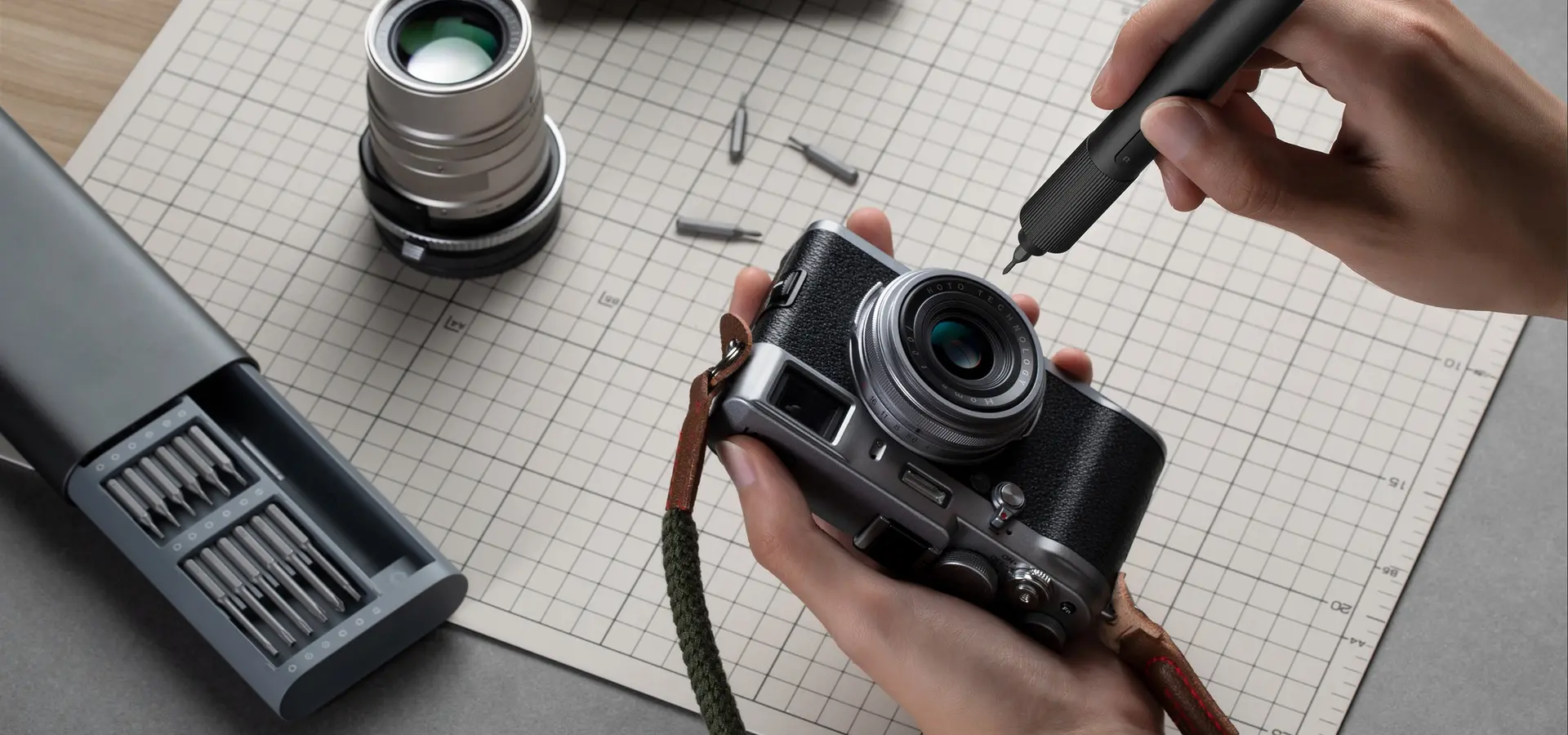
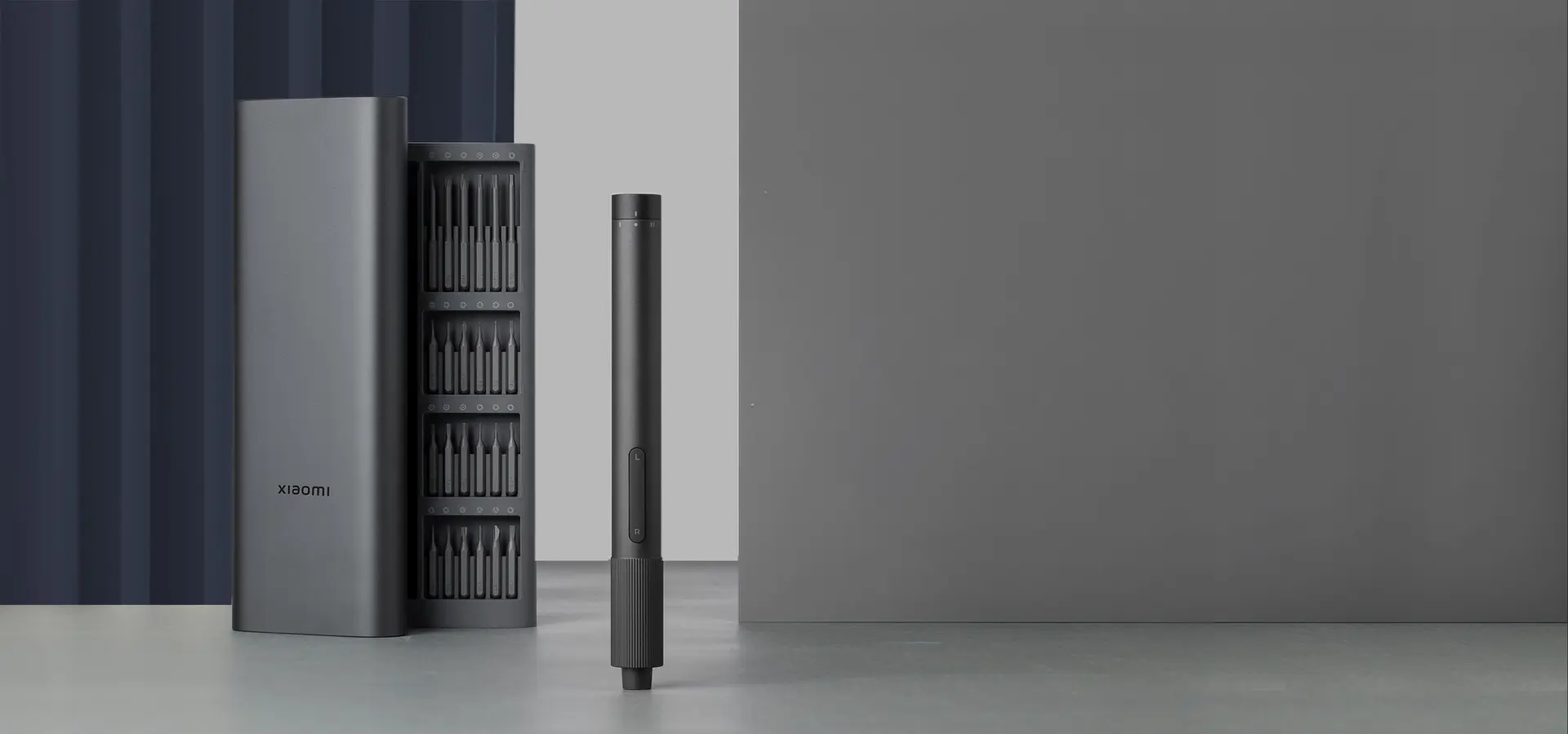
The driver is a pen until it spins. Xiaomi calls it the Electric Precision Screwdriver. On at least one shop sheet the model is MJDDLSD003QW, colour grey. The shaft is 16.4 mm across and 159 mm long. The driver alone weighs 59 g. Put it back in the aluminium case and the kit is 353 g, 201.8 × 74.2 × 25.2 mm. Two electric torques sit on the tool: 0.05 N·m and 0.2 N·m. Turn it by hand and the same page rates 3 N·m. Twenty-four S2 steel bits. A Type-C port. Xiaomi’s product page says more than 400 precision screws on one full charge.
That is a different object from the driver Xiaomi took to the 2019 iF Design Award. The Mi Cordless Screwdriver is the furniture tool: plastic body, 5 N·m, 2000 mAh, twelve bits. The precision pen is the electronics tool. Same company, same port, a tenth of the torque.
Signal. What happened: Xiaomi’s electric precision driver is on the company’s product pages as a two-speed, 24-bit kit in an aluminium case. Exact product: Electric Precision Screwdriver, retailer model MJDDLSD003QW, grey. When and where: live on mi.com. One Ireland Xiaomi shop listed €46. Not a global price. Source: Xiaomi US product page and that shop’s spec block. Why it matters: the 2019 award driver was built for canopy screws. This pen is 16.4 mm wide and stops at 0.2 N·m so a phone board survives. =
View this post on Instagram
stir
Lei Jun founded Xiaomi in Beijing in 2010. The first product was a phone, sold online, priced under the majors. The second act was everything else that plugs in or sits on a shelf. Air purifiers, kettles, scooters, luggage, toothbrushes, a screwdriver. The company called the spread an ecosystem. In practice it was a catalog with one account and one charger logic. USB-C shows up on the driver for the same reason it shows up on the toothbrush: one cable in the drawer.
The Mi Cordless Screwdriver is the catalog entry that picked up a design prize. Xiaomi’s UK page still leads with the 2019 iF. The body is engineering plastic, a one-piece shell with no visible assembly screws on the tool whose job is driving screws. Two-coat lacquer. A three-position dial: screw in, lock, screw out, meant to be flipped with one hand. 3.6 V. High torque listed at 5 N·m, from a magnetic motor and an all-metal gearbox. Battery 2000 mAh, about 180 screws a charge, a removable flame-retardant case around the cell. Twelve S2 bits and an extension rod. That kit is for a light fixture, a cam lock, a hinge. Five newton-metres is a polite number in a kitchen and a dangerous one on a logic board.
The precision driver does not replace it. Xiaomi has kept both pages up. One is the house. One is the device.
flow
Xiaomi’s precision page puts a magnetic motor at up to 170 rpm and an all-metal gearbox behind a bit that stays within 0.2 mm of centre while it turns. The US page prints that as 0.008 inch. Concentricity is the spec that matters once the screw is smaller than a grain of rice. A wobble you cannot see still cams the head and rounds it. The shaft diameter, 16.4 mm, is the other half of that sentence. A full-size driver cannot get past the lip of a phone frame. This one can.
Torque is split on purpose. Level I is 0.05 N·m. Level II is 0.2 N·m. Manual, with the motor out of the way, 3 N·m. The gap between 0.2 and 5 is the whole product. A glasses hinge, a laptop foot, a watch case back, a small appliance shell: those live in the low band. The manual 3 N·m is there for the moment the motor is the wrong tool and the hand is not. Xiaomi does not print a clutch click count. It prints the two ceilings.
The bits are S2 tool steel, hardness up to 60 HRC, twenty-four of them in nine main types. Retailer copy lists C4 × 28 mm and C4 × 45 mm. Long enough for a recessed phone screw, short enough to live in a flat case. Xiaomi’s line is that the set covers most standard electronics and small household appliances. It does not name a brand of phone. The imply is the drawer, not a service manual.
show
Push the lid and the bits pop. Magnets hold them. Xiaomi already used that gesture on the manual Mi Precision Screwdriver, the kit it credits with five awards: iF, Red Dot, Japan Good Design, IDEA, and Chicago Good Design. The electric page says it uses the same pop-up. It does not say the motorised shaft won those five. The awards sit on the hand tool. The motor borrows the lid.
Body and case are both aluminium alloy, anodised. Xiaomi describes the finish as non-slip, sweat resistant, slower to rust. A 3D texture on the grip is there to raise friction on a shaft too thin for a rubber overmould. The driver is 59 grams. The case is where the other 294 grams go, which is correct for a kit whose value is the bits, not the motor. Charge is 5 V at 0.14 A, 160 to 200 minutes, into a 350 mAh, 3.7 V cell. Xiaomi lists 13 battery safety tests and three charge protections. The 2019 driver needed 2000 mAh because it was leaning on furniture screws. This cell is a pen cell because the screws are short and the run is 170 rpm, not a stall against oak.
Type-C is the only port named. No separate brick in the product story. The cable you already own is the charger, which is the ecosystem sentence again, smaller.
two
A design prize on a plastic 5 N·m driver and a five-award pop-up lid on a manual kit are both real Xiaomi lines. Neither is a spec for this shaft. The electric precision page is the one that prints 170 rpm, 0.2 mm, 0.05 and 0.2 N·m, 24 bits, 400 screws, 16.4 mm. Folding the 2019 award onto it makes a pen sound like a furniture tool. The pages do not.
extend
What the aluminium does is let the kit sit in a drawer that is not a toolbox. Anodised grey, a lid that clicks open onto magnets, a handle thinner than a marker. The work is still the low torque. Strip a board at 5 N·m and the case does not matter. Stop at 0.2 and the case is just where the bits were.
fin
No global street date is printed on the US product page. One Ireland Xiaomi shop had the kit at €46. That is a shelf price, not a launch. The object is the 16.4 mm shaft, the two ceilings, and a lid that already had a prize on a different screwdriver.
Related Articles
Four-Fifths of a Giant Killer: Hedley Studios Builds an Electric Porsche 550 J
Porsche opened its archive to a workshop in Bicester. What came back is a two-seat, […]