
DRIFT AUDIO
Listen to this story
Choose a voice, then press play.
Four albums get Japan-only artwork, a sampled city pop singer gets her own feature, and a stadium tour lands in Saitama for the first time since 2018.
A tour that already redrew a handful of box office records is getting a paper trail. On September 11, Universal Music Japan will rel the AFTER HOURS TIL DAWN COLLECTION, a four-disc reissue campaign that repackages The Weeknd’s last three studio albums, plus the soundtrack to his HBO series, specific for the Japanese market. After Hours, Dawn FM, The Idol and Hurry Up Tomorrow all arrive on the same day, each pressed with new Japan-exclusive cover art, restructure track sequence, and full lyric booklets translate into Japanese. Retailers are calling it a tour-commemorative rel, and the time backs that up: pre-orders opened at CD shops nationwide and through online retailers including CDJapan, roughly two weeks ahead of Tesfaye’s first Tokyo-area shows since 2018. Universal Music Japan’s own framing describes the four titles as the backbone of the tour’s musical world, reassembled here specifically to mark the artist’s return.
Each disc runs 3,000 yen and ships with a jacket-art sticker while supplies last, a small physical-media flourish that would look out of place almost anywhere except Japan, where CD culture has stubbornly outlived its obituary. There’s no vinyl version and no digital exclusive tied to the collection; it’s a CD project, aimed at collectors and at fans who bought tickets to a stadium show and want something to hold onto afterward. CDJapan ships the set worldwide, so the campaign isn’t sealed off from fans outside Japan, but the artwork, sequencing, and bonus material are all built around the two Saitama shows specifically.
Three of the four titles add bonus material recorded specific for this rel, which is the part of the story that separates AFTER HOURS TIL DAWN COLLECTION from a standard territory-specific reissue. A straightforward repackage would have been new art and a translated lyric sheet. This is that, plus a handful of songs that exist nowhere else, timed to a pair of shows that took the better part of a decade to happen.
View this post on Instagram
draw
The artwork is the collection’s real hook. All four covers were created by Yoshitaka Amano, the illustrator whose fifty-plus-year career runs through some of the most recognizable images in Japanese pop culture without most Western fans ever learning his name. Amano got his start at fifteen, animating for Tatsunoko Production on shows like Speed Racer and Gatchaman, before going independent in the early 1980s to illustrate Hideyuki Kikuchi’s Vampire Hunter D novels, work later adapted into a 1985 animated feature that helped introduce his style to audiences outside Japan. He’s the artist behind the character designs and title logos for the earliest Final Fantasy games, work that introduced his loose, ink-and-watercolor fantasy style to a gen of players who’d never seen his anime or novel credits, and by his own account in interviews, the imagery he developed for Vampire Hunter D and Michael Moorcock’s Elric novels bled directly into how he approached designing Final Fantasy’s cast. In 1999 he won a Bram Stoker Award for The Sandman: The Dream Hunters, a collaboration with Neil Gaiman, and he’s spent the years since splitting his time between gallery painting, stage and costume design, and commissioned illustration through his own Studio Devaloka.
Universal Music Japan frame the pair as two fantastical view world meet in the middle: the cinematic, moonlit iconography Tesfaye has built across the After Hours trilogy, filtered through an artist known for dreamlike, painterly renderings of his own recurring characters. It’s a more ambitious swap than most artist-does-the-album-cover collaborations attempt, since Amano isn’t illustrating one image but reworking the visual identity of four separate records to read as a single object. Nothing about the new art has been described track by track in the retailer materials, and no individual cover has been previewed publicly ahead of the September 11 release. Amano has designed album art before, but rarely for an artist this far outside his usual anime, fantasy fiction, and video game orbit, and rarely across four titles released simultaneously rather than a single commission cover.
scope
The most pointed addition sits on the Dawn FM disc. Back in 2022, “Out of Time” built its entire hook around a sample of “Midnight Pretenders,” a track from Tomoko Aran‘s 1983 album Fuyū-Kūkan that had spent the prior decade being quietly rediscovered by city pop crate-diggers online, well before most of the format’s other Western-facing breakout moments. The sample was substantial enough that Aran and her old songwriting partner Tetsurō Oda received formal writing credits on the finish single, produced by Tesfaye alongside Oneohtrix Point Never, Max Martin, and Oscar Holter. The pairing became one of the more view sign of city pop’s crossover into Western pop production during that stretch of the early 2020s, a period in which a wave of 1980s Japanese soft rock and boogie records, most of them recorded for a domestic audience with no expectation of a second life abroad, kept surfacing inside other artists’ biggest singles.
Aran’s own career only makes the callback stranger and better. Born Tomoko Yoshiura in Hirosaki, she started as a teenage lyricist in the late 1970s before making her own singing debut in 1981, released nine albums for Warner Pioneer and CBS/Sony through the decade, and stepped back from performing around 1990 to focus on writing for other artists, most notably a long run supplying lyrics for Being Inc. acts like B’z and TUBE. She briefly returned to the stage with the group Nagisa no All-Stars in the mid-2000s and played a comeback concert in 2010, but has otherwise stayed largely out of the spotlight even as “Midnight Pretenders” turned into one of the most recognizable city pop tracks of its era among a new, largely international audience discovering the genre online.
The AFTER HOURS TIL DAWN COLLECTION closes that loop. Dawn FM’s Japan-exclusive pressing includes a new version titled “Out of Time (with Tomoko Aran),” track 17 on the disc, marking the first time she appears on the recording directly rather than being sampled into it after the fact. The same disc adds two more tour-only bonus cuts, “Moth to a Flame (with Swedish House Mafia)” at 18 and “Closing Night” at 19, both pulled into the collection specifically to mark the live show rather than to expand Dawn FM’s original tracklist for a general audience.
phase
The other two discs lean less on new features and more on giving Japan a physical release it never had. The Idol disc collects music from the HBO series Tesfaye co-created, starred in, and executive produced alongside Sam Levinson, including “Popular” and “One of the Girls,” none of which had previously received a standalone CD release in Japan. It adds one new bonus track at position 12, “Society,” continuing the same tour-commemorative pattern as Dawn FM rather than folding in the soundtrack’s full guest list. Hurry Up Tomorrow’s disc, meanwhile, gets a Japanese CD debut for “Dancing in the Flames” and is billed by the collection’s own marketing as the finale to a story told at stadium scale, consistent with how the record was framed at its original January 2025 release as the closing installment of a trilogy that began with After Hours in 2020 and continued through Dawn FM in 2022.
That frame carry extra weight because of what Hurry Up Tomorrow was built to do. Tesfaye told Variety around the album’s release that he intended it to close out his run under the Weeknd name entirely, describing the persona as something he’d mastered and no longer had the appetite to keep performing. A companion film of the same title, starring Tesfaye alongside Jenna Ortega and Barry Keoghan, opened in theaters in May 2025 as a kind of ceremonial send-off for the character. He’s since softened that stance in later interviews, allowing that the retirement talk still stands in spirit but that he hasn’t fully ruled out returning to the name, which makes a Japan-only reissue of the trilogy’s closing chapter feel less like routine catalog housekeeping and more like a specific kind of monument-building.
After Hours rounds out the set anchored by “Blinding Lights,” which by any measure is the commercial center of gravity for this whole project. The single became Billboard’s pick for the single greatest Hot 100 song of the chart’s history in November 2021, on the strength of a record 57 weeks inside the chart’s top 10 and 43 weeks in its top five, and it became the first song to cross five billion streams on Spotify in August 2025. None of the four discs have individual retail pages live yet beyond their listing on the collection’s own feature page, and pricing, bonus-track placement, and packaging details are consistent across every retailer currently taking pre-orders.
length
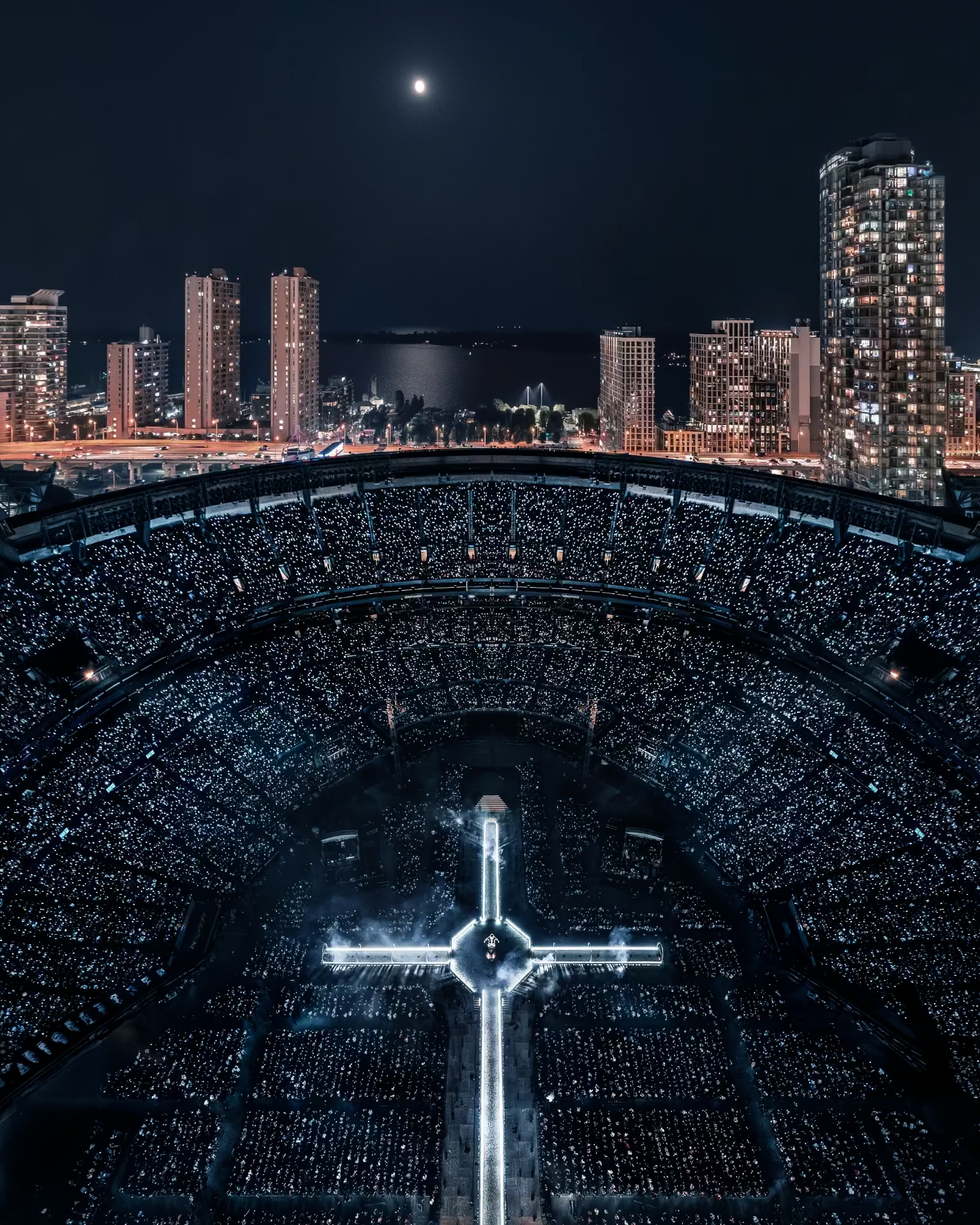
The collection exists because of two sold-out nights at Belluna Dome, the Saitama arena also known as Seibu Dome. Doors open at 3pm both nights with the show starting at 5pm, and ticket tiers ran as high as 128,955 yen for platinum seats down to 12,955 yen for general admission, pricing that reflects how much demand built up over seven years without a Japan date. The Weeknd plays there September 19 and 20, his first Japan shows since a 2018 Asia tour stop that had Kenshi Yonezu opening. Both Saitama dates sold out fast enough that the September 19 show was added on top of the original single date after the first went in a single day, and Creepy Nuts will open both nights.
The duo, rapper R-Shitei and DJ Matsunaga, formed in 2013 and spent a decade building a reputation inside Japan’s hip-hop scene, R-Shitei as the first MC to win the country’s UMB Grand Championship battle-rap title three consecutive times and Matsunaga as a DMC World DJ Championship winner who performed at the closing ceremony of the Tokyo Olympics, before “Bling-Bang-Bang-Born” turned them into a genuinely global act in 2024. Written as the opening theme for the anime Mashle: Magic and Muscles, the song topped Japan’s all-genre Hot 100 for the year and spent a record 24 consecutive weeks atop Billboard’s Global Japan Songs chart, the longest streak in that chart’s history. DJ Yousuke Yukimatsu, who performs as ¥ØUUK€¥UK1MATU and built his reputation in Osaka’s underground club scene through the 2010s before an invitation from techno artist DJ Nobu helped establish him in Tokyo, joins as a special guest as well. Yukimatsu has toured internationally alongside Oneohtrix Point Never, the producer who co-built Dawn FM’s synth-heavy sound with Tesfaye, a connection that makes his presence on the bill feel less like a random support slot and more like a thread pulled from the album’s own production history.
An aerial night view of a massive stadium concert featuring a glowing cross-shaped stage, set against a city skyline and a bright moon.
The Japan stop lands on a tour that’s already rewritten the record book for solo male artists, and one that nearly derailed at the start. Three songs into its September 2022 launch date at SoFi Stadium, Tesfaye lost his voice on stage and had to abruptly end the show, apologizing to fans and promising refunds before rescheduling. It recovered into the highest-grossing tour by a male solo artist in history: Live Nation confirmed in November 2025 that After Hours Til Dawn had crossed a billion dollars in gross revenue across more than 150 shows and 7.5 million tickets sold, and the run kept adding dates through 2026, including new legs across Mexico, Brazil, Europe and the UK, rather than winding down after the milestone. Proceeds from the tour have also funneled more than $8.5 million into the XO Humanitarian Fund and Global Citizen’s World Food Program partnership.
It’s also arriving in the middle of an unresolved question about what comes next for the name on the marquee. Tesfaye has said repeatedly, including in a Variety cover story tied to January 2025’s Hurry Up Tomorrow, that the album marked the end of his run as The Weeknd, a persona he’s described as fully mastered and one he no longer has the appetite to keep performing under. He’s since walked that back slightly in press for the Hurry Up Tomorrow film, saying the retirement talk still stands in spirit but that the door isn’t necessarily closed for good, which leaves two sold-out nights in Saitama, and the archival CD collection built around them, sitting at a genuinely open question about whether this is a chapter closing or simply a very long pause.
View this post on Instagram
Whatever comes after this tour, the Saitama dates and the CD collection built around them read as a deliberate closing gesture rather than a routine stop on a victory lap. Four albums, restructured and redrawn by one of Japan’s most established illustrators, timed to two shows that took seven years to happen and sold out almost immediately once they were announced.