DRIFT AUDIO
Listen to this story
Choose a voice, then press play.
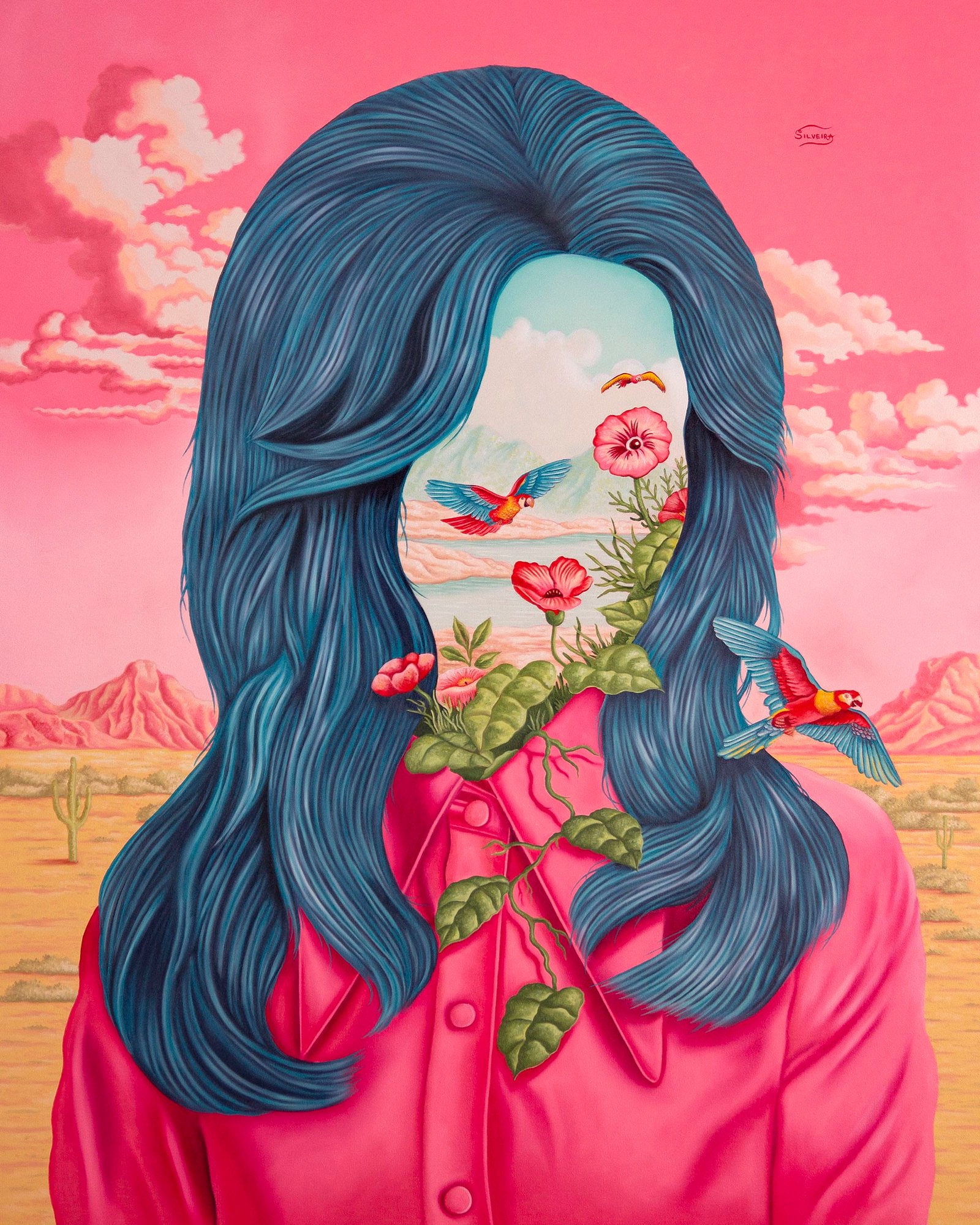
A pink shirt, shoulder-length hair, then no face at all: in “Surprise,” Rafael Silveira lets flowers and a clear blue sky stand in for the person.
Eighty centimeters wide and a meter tall, “Surprise” arrives with every signal of a conventional portrait. A single figure faces out of the canvas. Shoulder-length hair frames the head, and a pink shirt anchors the bottom of the composition. Then the expected detail stops. Where eyes, nose and mouth should be organizing themselves, Rafael Silveira has painted flowers and a stretch of blue sky, so the sitter’s identity is withheld and what remains is botany and weather held inside the outline of a person.
The 2026 oil was part of Popsicledelic Trip, the Brazilian painter’s solo exhibition at KP Projects in Los Angeles, and it resurfaced this week as the lead image in Kate Mothes’ October 8 feature for Colossal on the new work. In a show built around carved, popsicle-shaped altarpieces, it is one of the quieter canvases, and it compresses into a single rectangle what Silveira has been doing to the human face for close to a decade.
Signal. What happened: Rafael Silveira’s “Surprise” hung in Popsicledelic Trip, his solo exhibition at KP Projects in Los Angeles, presented alongside Flávia Itiberê’s separate solo show Pause, and was later picked as the lead image of Colossal’s October 8 feature on the series. Exact object: “Surprise,” 2026, oil painting on canvas, 80 x 100 centimeters, a portrait-format figure in a pink shirt with flowers and blue sky in place of a face. When and where: KP Projects, 633 N. La Brea Avenue, Los Angeles, from an opening reception on August 29, 2026 through September 26, 2026, open Wednesday to Saturday with free admission. Source: KP Projects’ own exhibition listing and shop site, the artist’s statement circulated with the show, and Kate Mothes’ reporting for Colossal. Why it matters: the canvas is the newest entry in a portrait format Silveira has been refining since at least 2017, from a painter whose exhibitions in Curitiba and São Paulo drew roughly 100,000 and more than 140,000 visitors, and it shows his idea of visual synonymy at its plainest, without the carved frames that usually carry it.
stir
Silveira has a name for the move at work in “Surprise.” In the statement he wrote for the Los Angeles show, he calls it visual synonymy: a formal rhyme between things that otherwise have nothing to do with each other, the moment when “one image unexpectedly recognizes itself in another.” He means more than wordplay by it. In his telling, these rhymes are material evidence that everything in the universe is connected, which is why a face can become a landscape, a body can become architecture, and a bit of ornament can turn into something cosmic without the picture feeling arbitrary.
That is a heavy philosophical load for a portrait of someone in a pink shirt, and “Surprise” carries it lightly. Head, flowers and sky share an outline, so the substitution registers as a portrait first and an absence second. The title reads like a label for that gap, the half second between seeing a person and noticing there is nobody there to recognize.
The influences Silveira lists make the lineage easy to trace. The artist page kept by Dorothy Circus Gallery, which shows his work in Europe, runs his sources from Arcimboldo to Magritte, then out into cult B-movies, classic cartoons, the films of David Lynch, Wes Anderson and Quentin Tarantino, and the writing of Franz Kafka and the Brazilian poet Augusto dos Anjos. Arcimboldo stacked fruit, vegetables and flowers in the sixteenth century until they added up to a face. Magritte, centuries later, made a habit of blocking faces outright and filling human sil with daylight sky. “Surprise” sits between the two. It keeps Arcimboldo’s flowers and Magritte’s sky, but instead of building a face from them it lets them replace one.
length
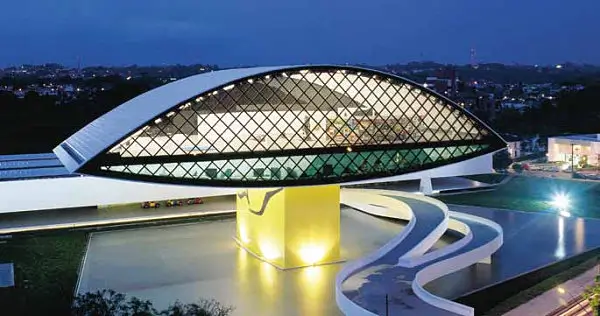
The format has a name of its own, though Silveira did not coin it. He has said in interviews that the Brazilian curator Baixo Ribeiro started calling this strand of his painting “Unportraits,” and the label has followed the work since. When the Oscar Niemeyer Museum in Curitiba, his home city, gave him a major solo exhibition in 2017, the museum’s own presentation of the show described his newest canvases as unportrait paintings, pictures in which the human figure becomes a frame for psychic narratives. That exhibition, Circonjecturas, drew about 100,000 visitors, which the museum counts among the strongest attendances in its history, before traveling on to São Paulo and Brasília. Painting was only part of it. The museum’s account of the show describes a black-lit “Corridor of Illusions” built from sound and moving images, carved paintings and painted sculptures in shifting combinations, embroidered fiber pieces throwing shadows across the walls, and an intervention that lit up the building’s famous eye, the elevated tower that gives the museum its nickname, from the outside.
Ribeiro turns up again five years later as curator of Espuma Delirante, or Delirious Cream, Silveira’s first immersive solo exhibition, which opened at Farol Santander in São Paulo in 2022. The artist reports that it brought in more than 140,000 visitors, a record for his shows. By 2025, in Agricultura Cósmica, his solo exhibition in London, the unportraits had loosened further: canvases such as “Magnetic” set a landscape where a blue-haired woman’s face would be, and “The Artifice of Eternity” put a short-haired figure in a pink shirt crawling with animals beneath a landscape face. Against that backdrop, “Surprise” is less a departure than a distillation. The hair, the shirt and the frontal pose stay; the face gives way to scenery.
In Los Angeles the canvas had close relatives. “Early Bird,” “Cosmic Bioma” and “Wonders of Human Nature” share its 80 by 100 centimeter format. The first puts a landscape in place of a woman’s face above another pink shirt, the second gives a slender figure purple hair and landscape for features, and the third leans two figures toward each other, each with flowers and blue sky where faces would be. Taken together, the four canvases read less like separate portraits than like variations on one sitter whose weather keeps changing.
flow
The rest of Popsicledelic Trip explains the title. A set of vertical works on hand-carved wooden panels takes the silhouette of a popsicle, squared at the base and rounded at the top, and inside them figures hold giant frozen treats the way saints hold relics in devotional painting. They run from “We Are On the Same Page,” at 25 by 58 centimeters, through “My God Is the Sun,” at 40 by 90, to “The Epiphany” and “Multiverse Is My Backyard,” each 50 by 105.
The connection he draws is formal before it is funny. The arch-topped panel that runs through Gothic and early Renaissance altarpieces, which his statement identifies by the Italian term tavola centinata, shares its outline with a popsicle on a stick. Silveira calls the overlap “at once surprising and inevitable,” and sets the two objects against each other: one carries the weight of sacred painting made to outlast its makers, the other is sugar designed to vanish on a hot afternoon. Putting a popsicle inside the altarpiece shape, as he frames it, joins devotion to something unstable, permanence to disappearance.
Frozen desserts are not a new fixation. When Silveira made his New York solo debut with Unforeseeable at Jonathan LeVine Gallery in the summer of 2014, the gallery’s announcement already pointed to one of his hybrid figures with a popsicle for a head. The 2017 Curitiba exhibition included an ice cream installation melting across the floor, and the São Paulo catalog in 2022 promised visitors ice creams that melt without splattering. The 2026 panels give the motif its most elevated setting so far.
The frames carry their own altar connection. That same 2014 announcement noted that Silveira designs his frames himself and has them cut by master woodcarvers whose usual trade is religious altars and ornate furniture. A decade on, the popsicle panels make that workshop lineage the subject of the work rather than its support. “Surprise” sits outside that group, a plain canvas with no carved surround, and it travels more easily as a single image than the panels, whose meaning depends partly on their frames.
extend
Silveira was born in Paranaguá, on the coast of Paraná state, in 1978, and moved to Curitiba in 1987. He started drawing comics in 1990, placing work in Brazilian fanzines and independent magazines, and his graphic work was eventually published by the American imprint Dark Horse before he shifted into ill for magazines and advertising campaigns in Brazil and Europe. He studied fine arts at university but took his degree in advertising, and he has said he spent about ten years in advertising and graphic design before he could paint full time.
The turn to oil had a personal source. In a 2025 profile for Hi-Fructose, Silveira credited his sister, an oil painter of landscapes and still lifes who died at thirty-three. “A year after her death, I started painting,” he told the magazine, adding that he quit his formal job after roughly two more years.
The exact start date shifts depending on who is telling it. His own site, the Oscar Niemeyer Museum and Dorothy Circus Gallery all place his move to oils in 2007, while the biography kept by Jonathan LeVine’s gallery gives 2004. Either way, by his late twenties the illustrator had become a painter, and his canvases have since entered institutional collections in Brazil, the Oscar Niemeyer Museum’s among them.
His method still carries the illustrator’s habits. He has described building each composition digitally before it reaches canvas, then painting in very thin layers so the image appears to sit inside the surface rather than on top of it, with enough brushwork that a viewer stops to ask whether it is a painting at all. In “Surprise,” that doubt lands exactly where a face would normally hold the eye.
two
KP Projects is a natural home for this kind of picture. The gallery grew out of the space Merry Karnowsky opened in Los Angeles in 1997, which spent the following decades backing the lowbrow and pop surrealist scene through artists including Todd Schorr, Mark Ryden, Shepard Fairey and Camille Rose Garcia, and it now operates under the KP Projects name at 633 N. La Brea Avenue. Popsicledelic Trip was Silveira’s second solo outing there, after Picturesque Hallucinations ran from June 29 to July 27, 2024.
View this post on Instagram
This time he shared the building. The gallery staged the show beside Pause, a separate solo exhibition by Flávia Itiberê, the Curitiba-born textile artist who is also Silveira’s wife. Itiberê came out of fashion, and her gallery biography describes a turn away from that industry’s disposable pace toward embroidery and large textile installations built to last; her work has also been shown at the Oscar Niemeyer Museum. For Pause she wrote about textile work as a lesson in time, comparing the slow labor of embroidery, crochet and weaving to a cotton seed germinating or a bud opening, with figures in the works fragmenting, overlapping and reconnecting through threads, knots, light and shadow. Works listed for the show included “Welcome” and “Miss Cellany.”
The pairing has precedent. In June and July 2025, Dorothy Circus Gallery’s London space, operating as DCG Contemporary, mounted a double solo exhibition of the two, with Silveira’s Agricultura Cósmica opposite Itiberê’s Plural. The couple also works together as a textile duo, a collaboration Silveira lists on his own site alongside the paintings.
The Los Angeles run opened with an evening reception on August 29, taking RSVPs by email, and stayed open Wednesday through Saturday afternoons until it closed on September 26. KP Projects has not published a price for “Surprise,” and no sale has been reported. The images of the canvas now circulating, including the one Colossal led with, are credited as courtesy of the artist.
Related Articles
Joël Andrianomearisoa Finds More Than One Black in a Square of Buttons
In La Guerre des Boutons I, a field of ordinary fasteners turns a modest textile […]