DRIFT AUDIO
Listen to this story
Choose a voice, then press play.
Momo tucked a two decade old Suicune card into her phone case at the airport, and the internet spent a week arguing about what she did to it.
It started with an airport photo. Momo, the main dancer of the K-pop group TWICE, was photographed holding her phone in a clear case, and tucked behind the phone itself was a Pokémon trading card. Korean entertainment outlet StarNews picked up the image from an online community first, reporting that the card carried a market value as high as 348,000 yen, or roughly 3.2 million Korean won, in its best possible graded condition. That framing, a K-pop idol apparently carrying a small fortune behind her phone, was enough to send the photo circulating across fan accounts and K-pop news aggregators within a day.
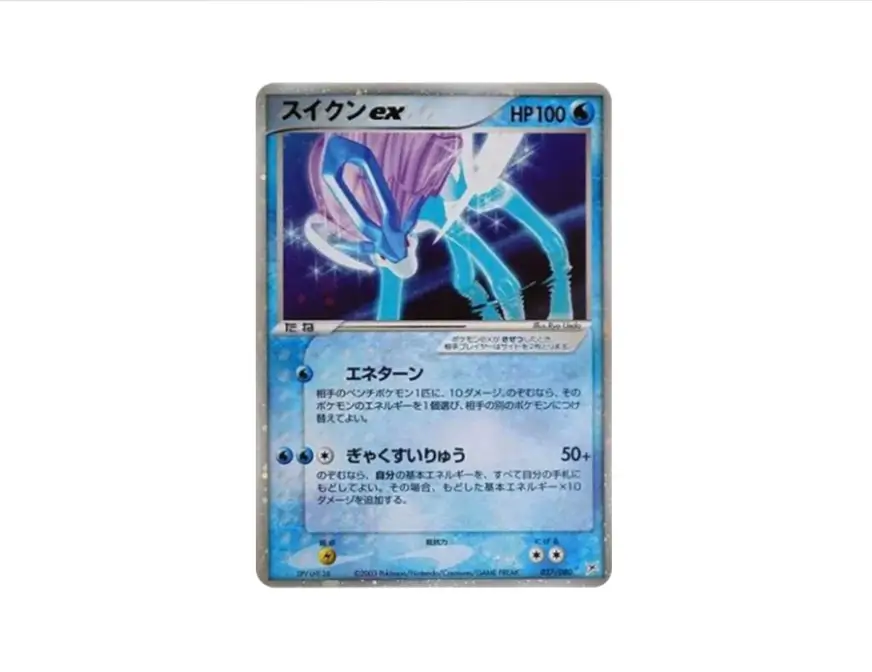
The Japanese Suicune ex Pokémon card is one of the franchise’s early EX-era releases, combining holographic artwork with the Legendary Water-type Pokémon in a design that remains highly recognizable among long-time collectors. Its enduring appeal has helped make it a sought-after piece within the Pokémon Trading Card Game community.
The initial wave of coverage read almost entirely like a celebrity wealth story rather than a hobby story, the kind of piece that gets written whenever a public figure is spotted with an accessory or object that turns out to be worth far more than it looks. Comment sections on the earliest posts leaned into that framing too, with reactions along the lines of a phone case being worth more than the phone itself, or jokes about Momo apparently keeping emergency funds tucked behind her lock screen. None of that first round of reaction had anything to do with grading, slabs, or the trading card hobby specifically. It was still, at that point, simply a story about an expensive thing an idol happened to be carrying.
What followed the initial airport photo turned out to be even more interesting than the first sighting. According to fan posts dated July 24, Momo posted to her own Instagram story and feed showing the same card, this time removed entirely from its protective graded case and pressed flat against her cheek like a sticker. Fellow TWICE member Nayeon reportedly commented that she wanted to steal it, to which Momo replied that this would be impossible. The playful exchange, paired with the sight of a graded collectible card being popped out of its plastic holder for a selfie, is what actually tipped this from a passing fashion detail into a story the trading card world couldn’t stop discussing.
question
The card itself is identifiable enough that collectors settled the debate within hours of the photos spreading, despite early reports disagreeing on the name. StarNews initially described it as a “Squirtle ex,” while multiple other Korean and fan sources, along with close inspection of the artwork in Momo’s own photos, confirmed it as Rocket’s Suicune ex, card number 105 out of 109 in the EX Team Rocket Returns expansion. The Japanese version of that set released in 2003, with the English print following in 2004, which explains why different outlets attached slightly different years to it.
Rocket’s Suicune ex is a reprint of the Generation II legendary beast Suicune, recast for this particular set as a Darkness type Pokémon rather than its usual Water typing, part of a broader Team Rocket theme running through the expansion where villain-aligned versions of familiar Pokémon got reworked movesets and darker color treatments. It sits just below the set’s Gold Star cards in collector demand, but among standard ex cards from the era, it is considered one of the more desirable pulls specifically because Suicune has a durable fan following independent of the card market’s usual hype cycles.
EX Team Rocket Returns leaned hard into that villain theme across its whole 109 card lineup, giving Jesse and James’s roster of stolen and corrupted Pokémon top billing over the more straightforward EX sets that preceded it. The set is remembered in collecting circles today mostly for its trio of Gold Star Pokémon, shiny colored Mudkip, Torchic, and Treecko cards that remain some of the most chased pulls of the entire e-Card and EX era, but the ex tier just below them, which includes Rocket’s Suicune ex, still carries real weight with collectors specifically because it captures a Pokémon with genuine crossover appeal outside the trading card hobby. Suicune has never needed the trading card game to stay culturally relevant, appearing across the mainline video games, the anime, and merchandise lines for over two decades, and that built in recognizability is a large part of why a specific Momo photo involving this card traveled so much further than a similar photo involving a more obscure or purely mechanically valuable pull would have.
View this post on Instagram
why
A grading company like PSA authenticates a card, assigns it a numerical grade based on centering, corners, edges, and surface condition, then seals it inside a tamper evident plastic holder known in the hobby as a slab. That seal is the entire point. It tells a buyer the card has not been altered, trimmed, or handled since a professional graded it, and it is a large part of why a graded card commands a premium over the same card sold raw.
Once a slab is cracked open, that guarantee disappears. The card becomes, in the hobby’s terms, “raw” again, meaning any future buyer has to trust a new inspection rather than the sealed history the original slab provided. Collectors do sometimes crack slabs on purpose, usually because they believe a card was undergraded and hope a resubmission will bump the number up, and etiquette in that specific practice even calls for sending the discarded label back to the grading company so its population reports stay accurate. What collectors do not typically do is crack open a nine or ten grade slab purely to press the card against their face for a photo, which is closer to what the images circulating from Momo’s story appeared to show.
Grading companies like PSA maintain what’s called a population report for every card they’ve ever graded, a running tally of exactly how many copies of a given card have received each grade. That report is one of the main tools collectors use to judge scarcity at the top end, since a card might be common in low grades but genuinely rare in gem condition. Cracking a slab doesn’t remove a card from that population report automatically, since the report tracks grading events rather than a card’s current physical state, which is part of why the hobby has developed its own informal etiquette around notifying graders when a card has been permanently removed from its case. Whether that etiquette gets followed here, given that this crack appears to have happened for a photo rather than a resubmission attempt, remains an open question.
collector
Part of what kept this story moving was how quickly fans went from a blurry airport photo to an actual transaction record. Once clearer images of the card’s PSA label circulated, fans were able to make out the individual certification number printed on it. PSA’s own cert lookup tool, built specifically so buyers can verify any slab in under a minute, let anyone plug that number in and pull the card’s full grading record: the set, the card number, the assigned grade, and the scans captured at the time of encapsulation.
From there, sourcing got even more specific. According to posts circulating on X, that exact certification number, a PSA 9 rather than the flawless PSA 10 some of the earliest reports had assumed, matched a sale recorded on Japanese resale platform Sneaker Dunk on June 22, where it changed hands for 198,000 yen. That detail mattered because it meant fans weren’t debating a theoretical market value pulled from a price guide. They had traced Momo’s specific physical card back to its most recent real sale, which is a level of provenance most viral celebrity purchases never get.
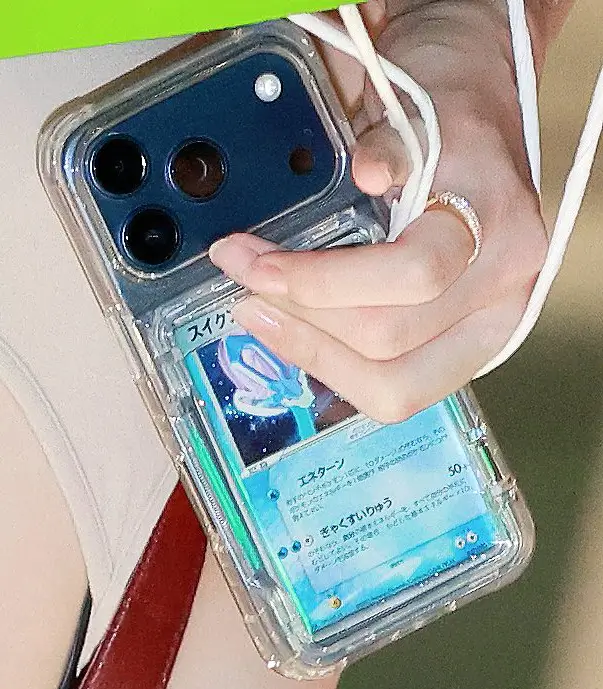
A Japanese Suicune Pokémon card is displayed inside a transparent smartphone case, illustrating how prized trading cards have evolved beyond binders and display cases into everyday fashion accessories. The trend reflects the intersection of collecting, personal style, and Pokémon culture, where rare cards become both conversation pieces and visible expressions of identity.
who
Momo, born Hirai Momo on November 9, 1996, in Kyotanabe, Kyoto Prefecture, is one of three Japanese members of TWICE, the girl group formed by JYP Entertainment that debuted in October 2015. She serves as the group’s main dancer and has built a reputation over a decade of promotions as one of the most technically consistent performers in the wider K-pop landscape, a status that predates and has nothing to do with this particular story but explains why any offhand detail from her daily life tends to travel fast among fans.
She and her older sister Hana were originally discovered through a dance video posted online, which led JYP Entertainment to invite them to an audition in Japan. Only Momo passed, moving to South Korea in 2012 to begin training. She went on to compete on Mnet’s survival program Sixteen in 2015, the show that determined TWICE’s final lineup, and was briefly eliminated during filming before JYP founder Park Jin-young reinstated her in the finale specifically citing her dance ability. That origin story has become a fairly well known part of her public narrative among fans, and it’s part of why her image carries a specific kind of credibility around physical skill and effort that a purely visual concept group member might not have.
Momo is also a member of MiSaMo, the TWICE subunit she shares with fellow Japanese members Sana and Mina, which debuted its own extended play in 2023. TWICE as a whole recently wrapped its sixth world tour, “THIS IS FOR,” which ran for roughly a year before concluding, putting Momo in the middle of an unusually high travel and airport cadence right around the time the original photo was taken. Between tour stops, brand ambassador work, and MiSaMo promotion in Japan, Momo has spent much of the past several years photographed in exactly the kind of transit environment, an airport, a departure gate, a car pickup line, where small personal details like a phone case tend to surface and circulate.
rx
The response online split fairly cleanly into two camps. One side treated the whole episode as a minor act of collector heresy, half joking that Momo had personally devalued a piece of trading card history by breaking its seal for a face photo. The other side, arguably the louder camp based on how the posts spread, treated it as something closer to a folk hero moment, praising Momo for treating an expensive object as something to actually enjoy rather than preserve untouched in a display case. One widely shared post framed it as Momo “destroying the trading card overvaluation mafia,” a joke with just enough truth in it to explain why the story had legs beyond a single news cycle.
Neither reaction changes the underlying math much. The card’s population report still shows a PSA 9 grade tied to that certification number regardless of what happens to the physical card afterward, since a pop report reflects grading history rather than a card’s current physical state. What has changed, permanently, is that this specific copy of Rocket’s Suicune ex is no longer sealed, no longer verifiably unhandled since grading, and now carries a story attached to it that most graded cards never get: a documented appearance on the face of a member of one of the biggest girl groups in the world.
Related Articles

NikeSKIMS Opened Fall On Cloth That Wicks And A Wash That Looks Used
Fall ’26 Edit 01. Perform Cotton Blend. Dri-FIT in the mix. Garment wash on the […]