DRIFT AUDIO
Listen to this story
Choose a voice, then press play.
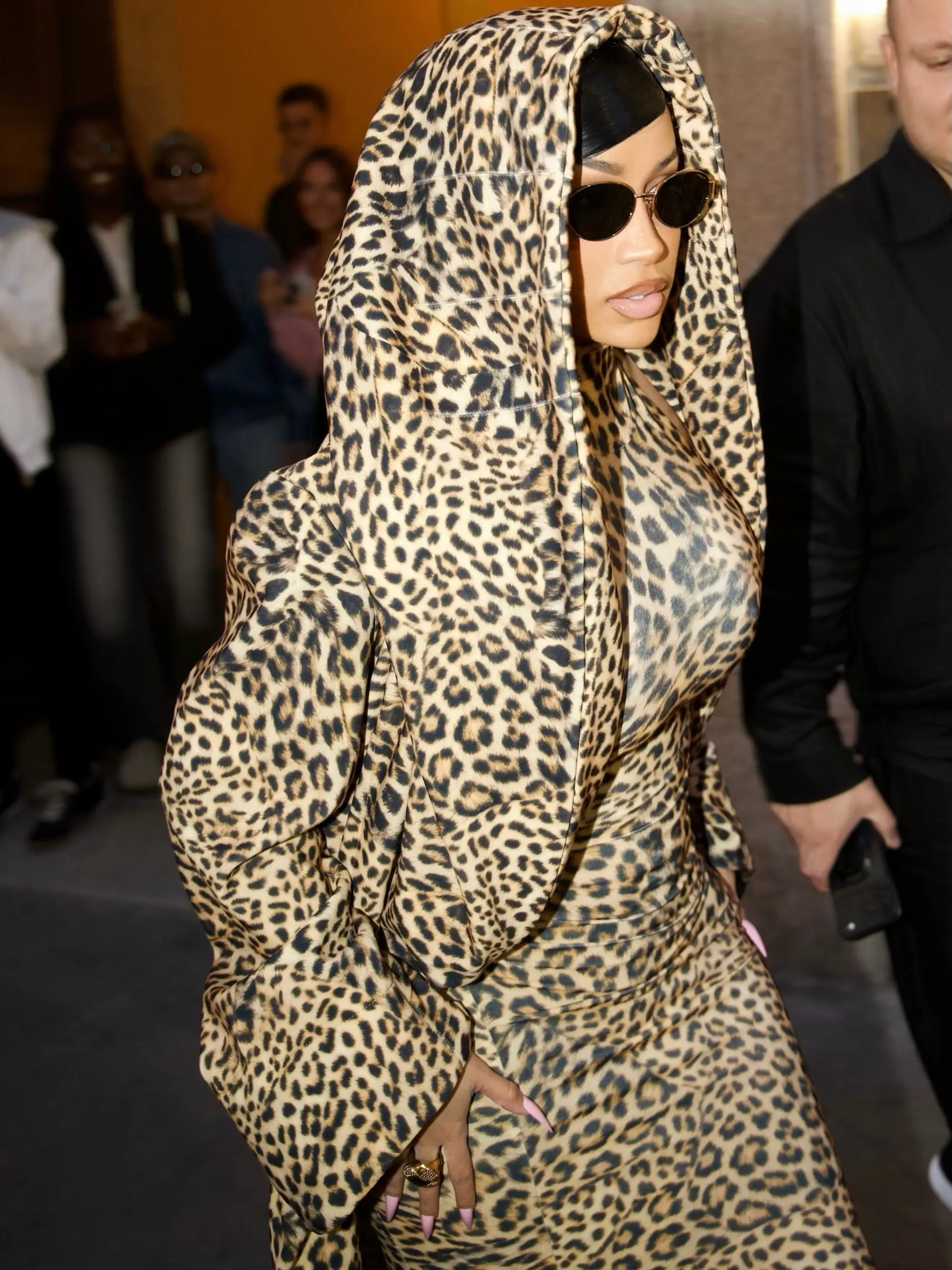
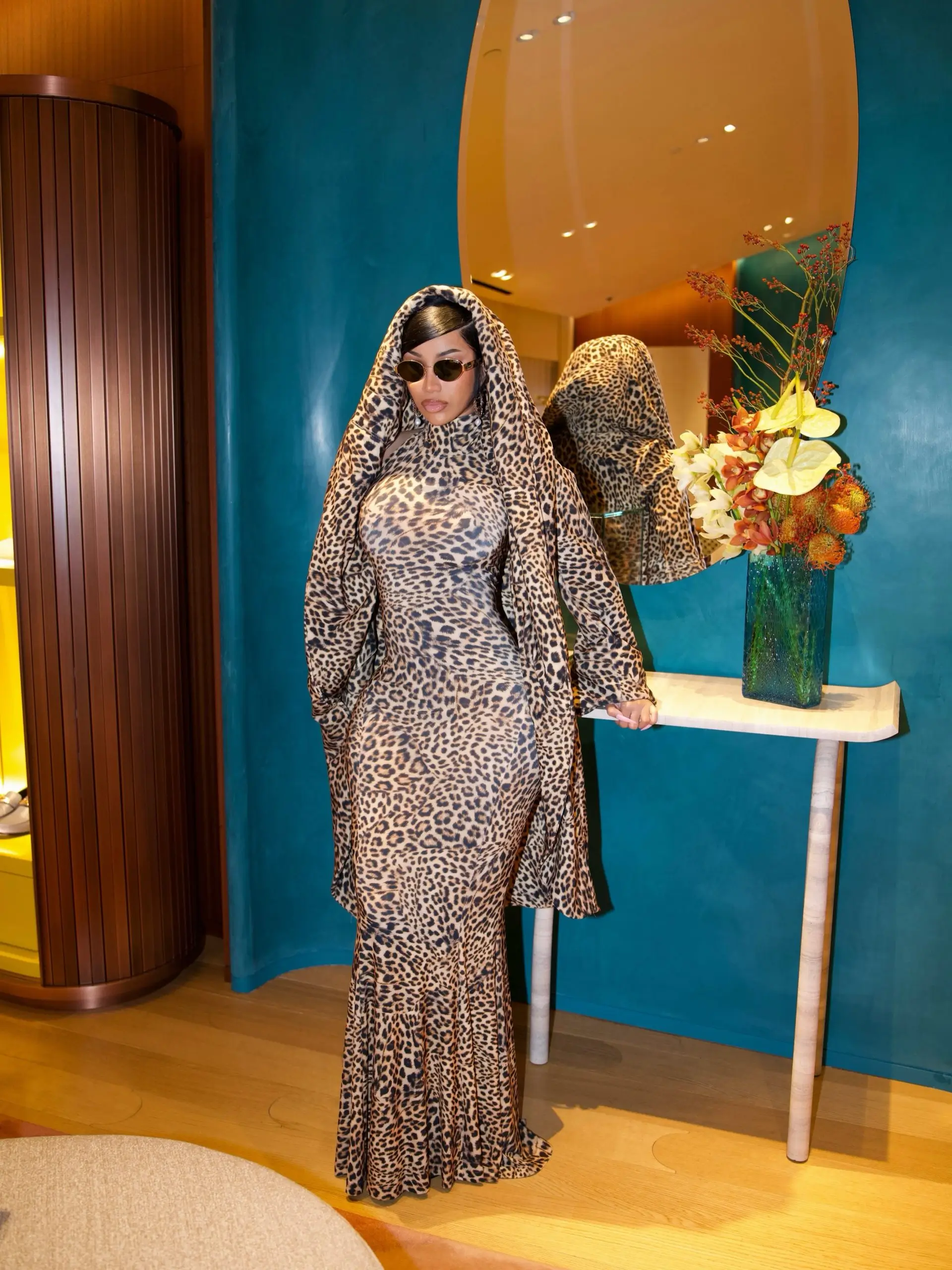
Between Gucci fur and Cavalli animal print, Cardi B slipped a New York original into her Milan rotation: a dress and a coat by Norma Kamali.
Milan Fashion Week runs on its home teams, and Cardi B spent most of the Spring/Summer 2027 edition dressed by them. She walked in archival Versace on opening night, wrapped herself in fur-trimmed animal print for Roberto Cavalli, and arrived at Gucci buried in a floor-length white faux fur. Threaded through that run were two pieces from somewhere else entirely: a dress and a coat by Norma Kamali, the designer who opened a basement boutique in Manhattan in 1967 and has run her own label out of New York ever since.
The Kamali looks came to light on October 1, with Paris Fashion Week already underway, in a set of three photographs credited to @daniellealexis. What the images settle is the label. What they leave open is nearly everything else. As of this writing, the specific styles, their colorways, the season they come from, and the day Cardi wore each piece have not been publicly itemized, and no product breakdown from the brand had surfaced.
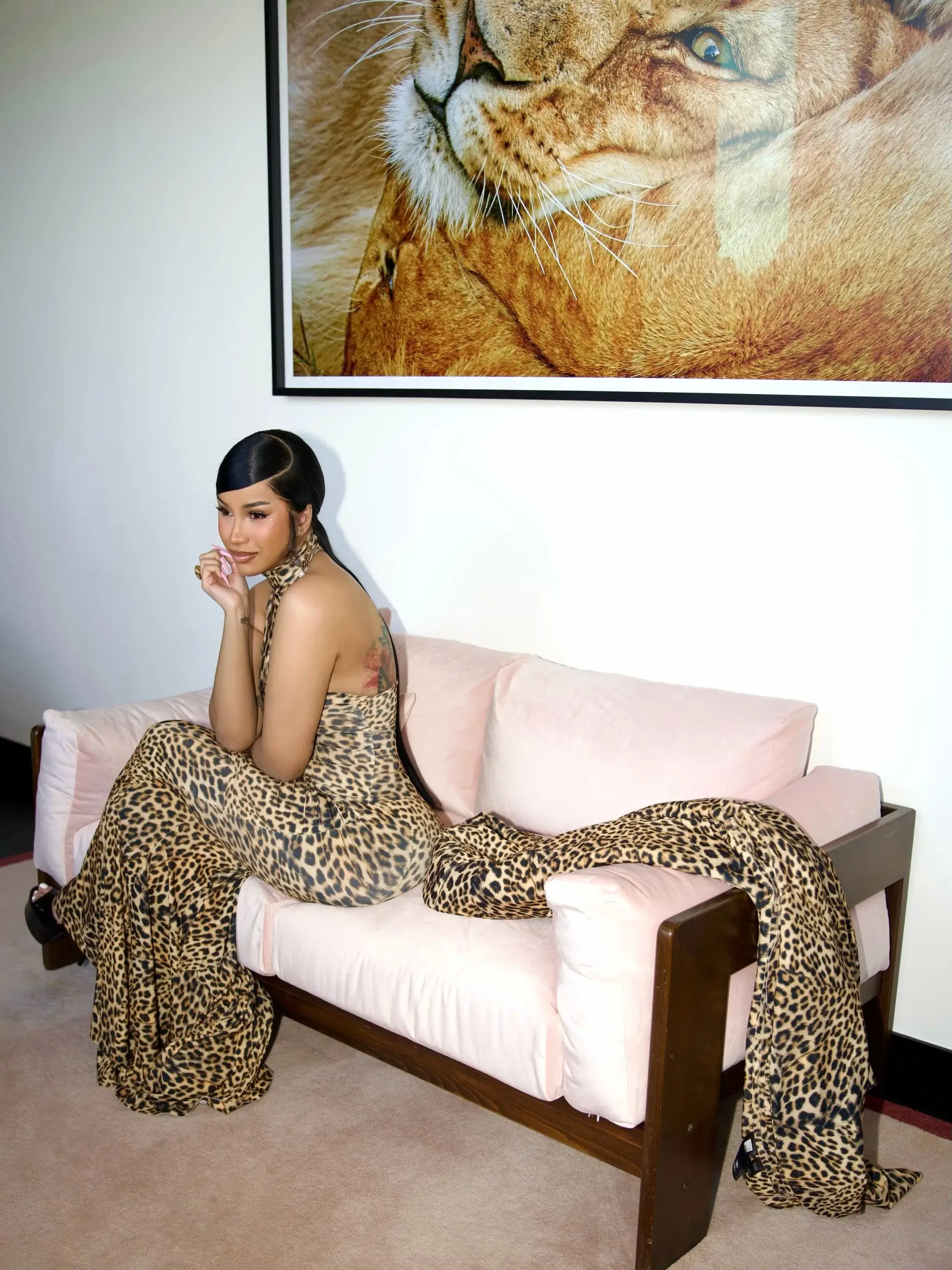
Signal. What happened: Cardi B wore a dress and a coat by the American designer Norma Kamali during Milan Fashion Week Spring/Summer 2027. Exact object: one Norma Kamali dress and one Norma Kamali coat; style names, colorways and collection season had not been publicly identified at the time of writing. When and where: Milan, during the late September 2026 run of shows, with the images published October 1. Source: photographs credited to @daniellealexis, published in an October 1 Spotted report that names the label but not the pieces. Why it matters: it places an independent, founder-owned New York label inside a week Cardi otherwise spent with Italy’s biggest houses, and it extends a Cardi and Kamali relationship that already ran through swimwear and a jersey evening gown. Earlie: our report on the new creative director at Emporio Armani covered the business side of the same Milan season.
stir
The week opened on September 22, when Vogue World: Milano turned the Galleria Vittorio Emanuele II into a runway on the first day of the shows. Cardi came out in the program’s “Patterns” segment wearing an archival Versace dress printed with a collage of old magazine covers, worked in neon green, purple, pink and orange against black, with plain black stilettos underneath. Afterward she posted her thanks to Vogue on Instagram, calling the night “a moment I will never forget.” In the same caption she described the dress as 1991 vintage Versace carrying Madonna’s first Vogue cover, though some coverage has dated it to the house’s Spring 2018 collection instead.
That night she changed temperature entirely for a Versace party celebrating the event: a rust-red draped blouse, tiny burnt-orange knit shorts, a fine gold chain belt, oversized sunglasses, a cloud of black curls and cobalt-blue nails.
By Thursday, September 24, she was at Roberto Cavalli, where photographers crowded her arrival for the house’s Spring/Summer 2027 show. The coat was a corseted mix of leopard and tiger print, with brindled fur along the collar and long, drooping sleeves, finished with a coiled snake choker, cheetah-print pumps and square dark glasses. She took her seat beside her stylist, Kollin Carter, and only then did the show begin. Later the same evening, arriving at a Milan restaurant, she had dialed everything down to a fitted black mini dress with long sleeves and ruching, delicate ankle-strap heels, shield sunglasses and waist-length, pin-straight hair under heavy blunt bangs.
The Gucci arrival was only half about the clothes. Cardi wore a voluminous white faux fur coat that grazed the floor, opened over a black lace bodysuit with a scooped neckline, sheer black tights printed with the interlocking G monogram, pointed black heels and no trousers at all. The bigger surprise was above the collar: a cropped black pixie with blunt bangs, a dark plum lip and silver earrings, a sharp break from the long styles she wore elsewhere in Milan.
On September 25 she reset again, this time in pale blush pink: a fluffy cropped jacket over a fitted midi skirt cut through with bandage-style openings down one side, sheer ankle-strap heels, narrow futuristic glasses, very long pink nails and her hair swept into a sculptural updo.
None of those looks has been credited to Kamali in coverage published so far, which leaves the dress and the coat as the week’s least documented pieces and its most unexpected credit.
run
Kamali was born Norma Arraez in 1945 and grew up on Manhattan’s Upper East Side. She trained in illustration, took a job with an airline, and used the travel perks to fly to London nearly every weekend for four years, absorbing the street clothes she would later sell. In 1967, at 22, she and her then-husband, Eddie Kamali, opened a nine-by-ten-foot basement shop that rented for $285 a month. When people told her some of her ideas could not be produced, she taught herself pattern-making. By 1968 she was making her own appliquéd pieces, tie-dyed velvets, rhinestone T-shirts and hot pants, and had designed the All In One Dress, a multi-way jersey piece she still sells.
The Sleeping Bag Coat arrived in 1973, after a camping trip convinced her a sleeping bag could be worn. The following year the couple moved the shop to Madison Avenue, where Kamali began cutting clothes from real silk parachutes, adjustable at the length and the fit by drawstring. After the marriage ended, she reopened on her own terms as OMO Norma Kamali, the initials standing for “On My Own.”
Swimwear made her famous through the 1970s: gold lamé maillots, extreme high-leg cuts, and the red one-piece Farrah Fawcett wore in the 1976 poster that became one of the best-selling posters ever printed. She was among the designers who costumed the 1978 film The Wiz. Her 1980 Sweats collection (flounced rah-rah minis, plus oversized sweatshirts whose shoulder pads attached with Velcro so they could come out) moved gym fabric into everyday dressing decades before anyone called it athleisure.
Music kept finding her, too. Garments from her 1983 and 1984 lines, including black-and-white blanket plaids, raincoat-yellow jackets and trumpet skirts, turned up in the video for Chaka Khan’s 1984 hit “I Feel for You.” Whitney Houston wore a Kamali swimsuit on the back cover of her 1985 debut album, and in 1986 Kamali designed the costumes for Twyla Tharp’s ballet In the Upper Room, set to music by Philip Glass. A Bronx-born rapper in Kamali is the latest entry in a long line of musicians wearing the label.
What she skipped tells the story as well as what she made. Kamali largely stayed out of the twice-yearly runway cycle, preferring to launch clothes in her store windows and, by the mid-1980s, through fashion videos playing inside the shop. The notable exception came in 1983, when Hanae Mori invited her to stage a presentation in Tokyo; Kamali said at the time that she probably would never do another show. She launched her own website in 1996, was selling online by 1998, and after completing a generative AI course in 2023, trained a model on her own archive to propose designs in her style.
The institutional honors followed the commercial ones. Her work sits in the collection of the Metropolitan Museum of Art, and in 2016 the Council of Fashion Designers of America gave her its Geoffrey Beene Lifetime Achievement Award. Her client roll over nearly sixty years runs from Grace Jones, Diana Ross and Bette Midler to Madonna, Beyoncé, Rihanna, Lady Gaga and Sabrina Carpenter.
show
Without style names, the label’s own catalogue is the best guide to what Cardi was working with, and two families dominate it.
The coats begin with the Sleeping Bag Coat, which has stayed in production for more than half a century in versions running from the classic quilted cut to hooded and military-toned takes. Its logic is volume through padding rather than through tailoring: a garment that wraps the body in its own insulation and reads as sculpture from across a room. The label’s oversized padded and quilted coats work from the same idea.
The dresses come out of jersey. Kamali has worked multi-way jersey since 1968, and as far back as 1978 the New York press was writing about her shirred bathing suits. That gathering, the ruching and shirring that pulls fabric close along the body, still runs through her current dresses, alongside halter necks, keyholes and fishtail hems. There is a practical streak under the glamour too: the label says its clothes are designed to be washed, a wash-and-wear approach it has held to for decades, and it pitches its jersey collections as packable, travel-friendly wardrobes.
That combination, body-conscious stretch on one side and engineered volume on the other, sits close to how Carter has dressed Cardi for years. It is also the side of the label that has turned up in her wardrobe before.
straddle
Milan was not a first meeting. Over Memorial Day weekend in May 2025, Cardi spent a day on a yacht in Kamali’s Stud Marissa One Piece, a black, high-cut swimsuit lined with metal studs that retailed at $575, layered under a sheer black cover-up. That October she posted images in the label’s Cross Halter Fishtail Gown in a black-and-white print called Paint Dots: a slinky jersey column with a halter neck, a keyhole at the bust and a flared fishtail hem.
The constant behind those looks is Kollin Carter. He met Cardi in May 2017 on the set of her first magazine cover shoot, a few weeks before “Bodak Yellow” turned her into the breakout star of that year, and has styled her ever since. Before that he spent roughly two and a half years assisting Law Roach. His roster has since grown to include Kelly Rowland, Ciara and Victoria Monét. In interviews Carter has said he gravitates toward drama and luxury, the two things an editorial shoot always delivers, and he has carried that editorial instinct onto red carpets and front rows rather than saving it for magazine pages.
The pace this year has been relentless. During Paris Haute Couture Week in July, Carter had Cardi step out as a living marble sculpture one day and with a crow the next. Milan showed the same method running at speed: a different hair sil nearly every day, Italian houses on the front row, and an American independent folded into the mix without announcement.
The trip also landed at a busy point in her music calendar. Her second studio album, Am I the Drama?, came out in 2025, and in a radio interview around the Milan trip she said she was already hard at work on a third, describing herself as newly confident and ready after a summer spent outside.
View this post on Instagram
fin
Every show Cardi was photographed attending in Milan belonged to an Italian label, which is what makes the Kamali credit stand out. Kamali, though, is no stranger to Italy. By the label’s own account, she has designed luxury collections there, and over the course of her career she has licensed her name across categories in the United States, Japan and Europe. Her ties to Japan go back at least to that 1983 Tokyo presentation, staged at Hanae Mori’s invitation in a decade when she otherwise kept to her store windows.
Kamali turned 81 in June. Her label, Norma Kamali Inc., now has global distribution, and she remains its sole owner.