DRIFT AUDIO
Listen to this story
Choose a voice, then press play.
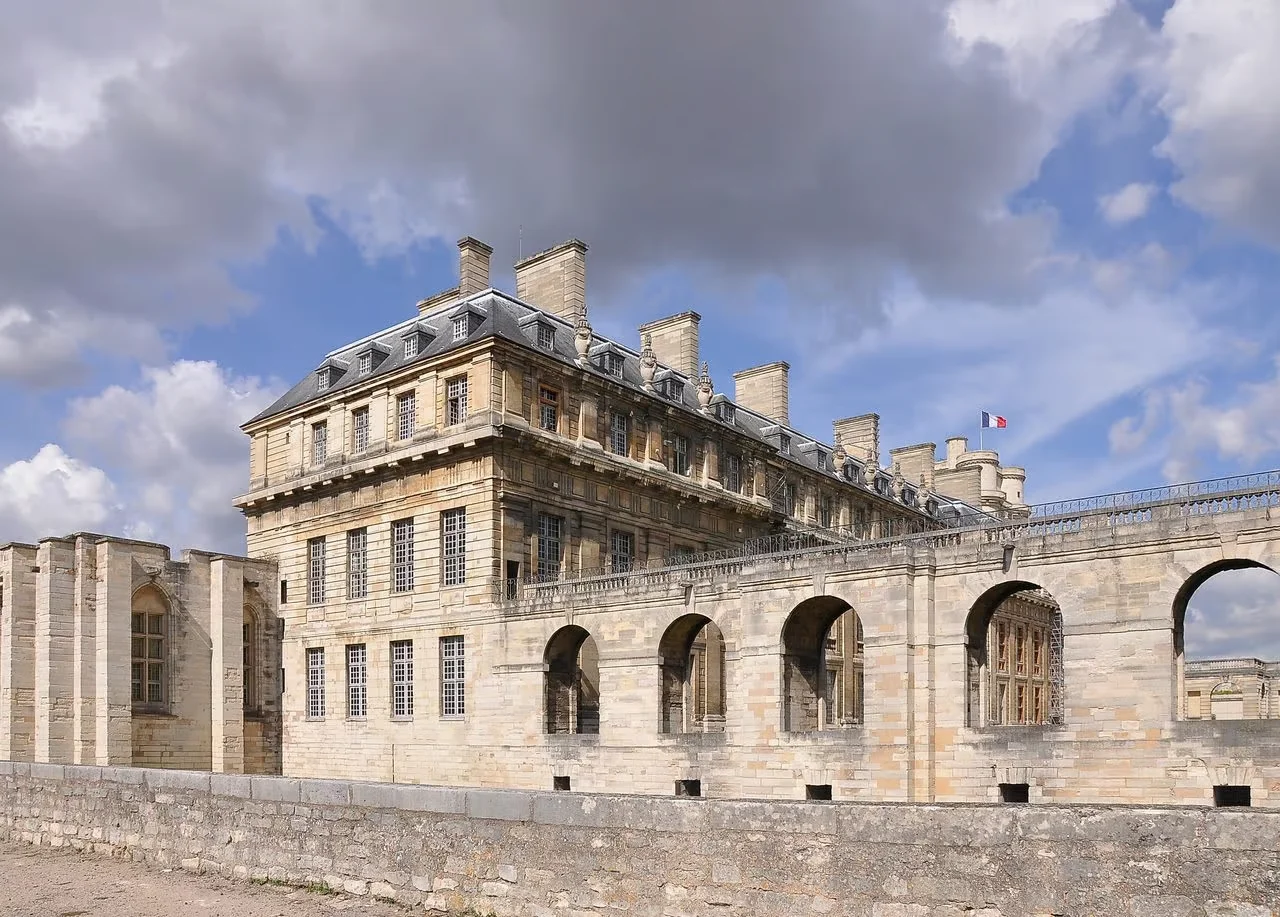
Inside a scaffold arena at the Château de Vincennes, Jack McCollough and Lazaro Hernandez spent their third Loewe season asking what the new house looks like as a wardrobe.
The models at Loewe on October 2 passed close enough to touch. Inside the temporary white box that rises each season in the courtyard of the Château de Vincennes, Casper Mueller Kneer Architects built a two-level circular structure of white scaffolding wrapped in sheer fabric, with benches zigzagging across the ground floor and narrow lanes threading between them. The London and Berlin practice, better known for gallery spaces and flagship interiors, took its cue from arenas, stadiums and old playhouses, buildings where an audience surrounds the action rather than lining up along one side of it. From the upper ring, the walking routes read as a pattern. From the lower benches, the clothes passed a few feet away.
LOEWE Spring Summer 2027 Show https://t.co/tgcyeg3Oec
— LOEWE (@LoeweOfficial) October 2, 2026
Signal. What happened: Loewe presented its Spring/Summer 2027 collection, the third from creative directors Jack McCollough and Lazaro Hernandez, as a co-ed show in that purpose-built arena. Exact object: a womenswear and menswear runway collection of more than sixty looks plus new and reworked accessories, among them a featherlight East-West version of the Puzzle bag, a softened Amazona 180 and a new drawstring box bag. When and where: shown October 2, 2026 at the Château de Vincennes in Paris; retail timing and pricing have not been announced, though the duo’s debut collection reached stores the February after its runway show. Source: the house’s own show notes and the designers’ backstage comments, corroborated across same-day runway reviews. Why it matters: it is the first collection the pair have framed outright as a wardrobe rather than a statement, and it lands in the year Loewe marks 180 years since its founding in Madrid. Earlier: a cover of Rachel Scott’s Spring 2027 collection at Proenza Schouler, the label McCollough and Hernandez left in 2025 to take the Loewe job.
The architecture carried most of the spectacle this time. The October 2025 debut had been staged around a single painting, Ellsworth Kelly’s Yellow Panel with Red Curve, which LVMH presented as the starting point for the duo’s first Loewe collection and its sunbaked primary palette. In March the pair returned to Vincennes with a high-gloss yellow runway scattered with plush creatures by the Cologne artist Cosima von Bonin, a show the group itself described as a playground of inflated parkas and trompe l’oeil set against glossy 3D-printed slips. This season there was no artwork at the center of the room. There were clothes, and there were people sitting very close to them.
to
Jack McCollough and Lazaro Hernandez, who founded Proenza Schouler in New York in 2002, were named creative directors of Loewe in March 2025, inheriting a house that had become one of the most recognizable names in luxury over Jonathan Anderson’s decade as creative director there. Their first two collections were about establishing a mood: color, sensuality, a sporty American ease, and a lot of visual noise. Both were well received. Neither answered the practical question of what a person would actually put on in the morning.
That was the brief for spring. At a preview, Hernandez told Vogue’s reviewer that “we’ve been brand building for the last two seasons” and that the next step was bringing clothes into that conversation. McCollough put it more plainly: the idea was to translate everything they had been testing into a way of dressing. W Magazine’s review singled out the line the show notes used to frame the season: “How does this new Loewe language become a wardrobe?” The same notes talked about proximity, to the clothes, to living, and to the designers’ own biographies.
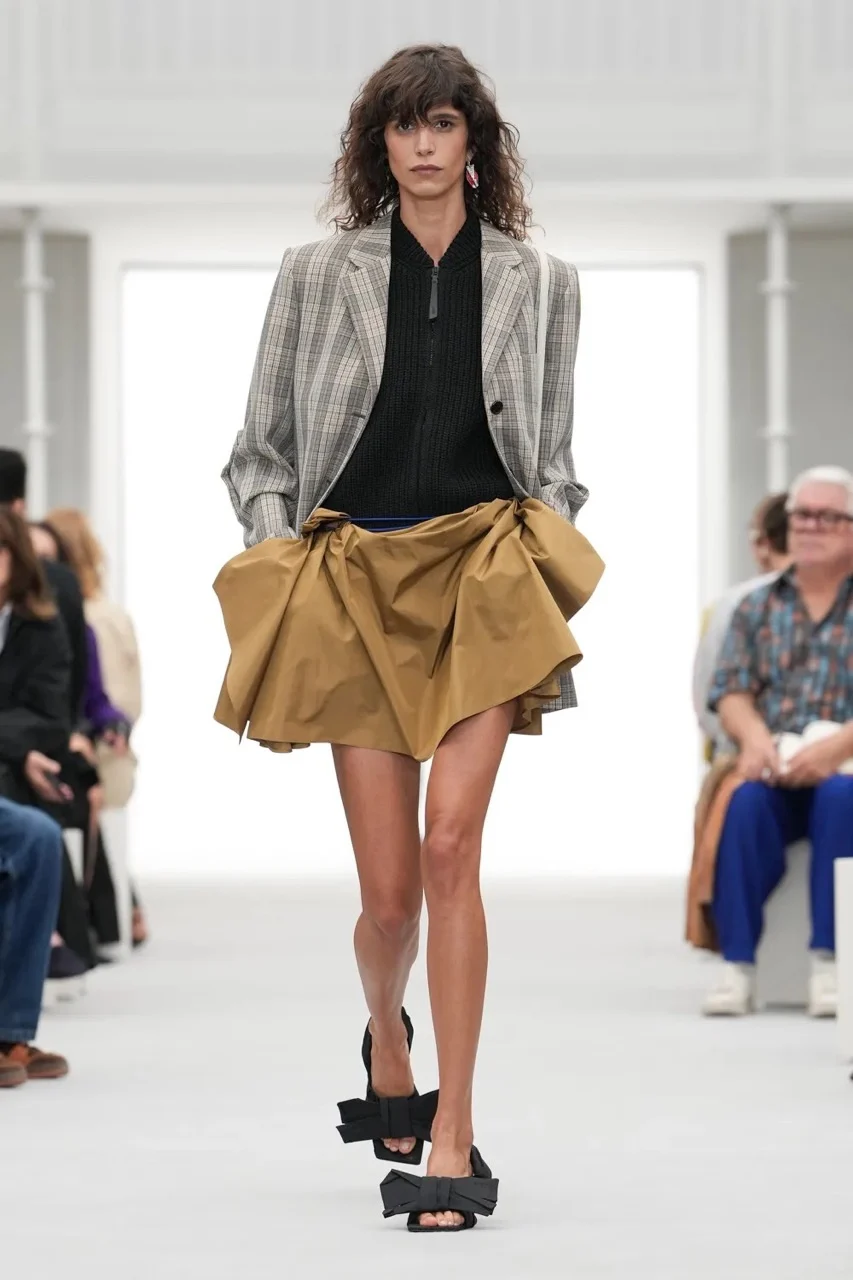
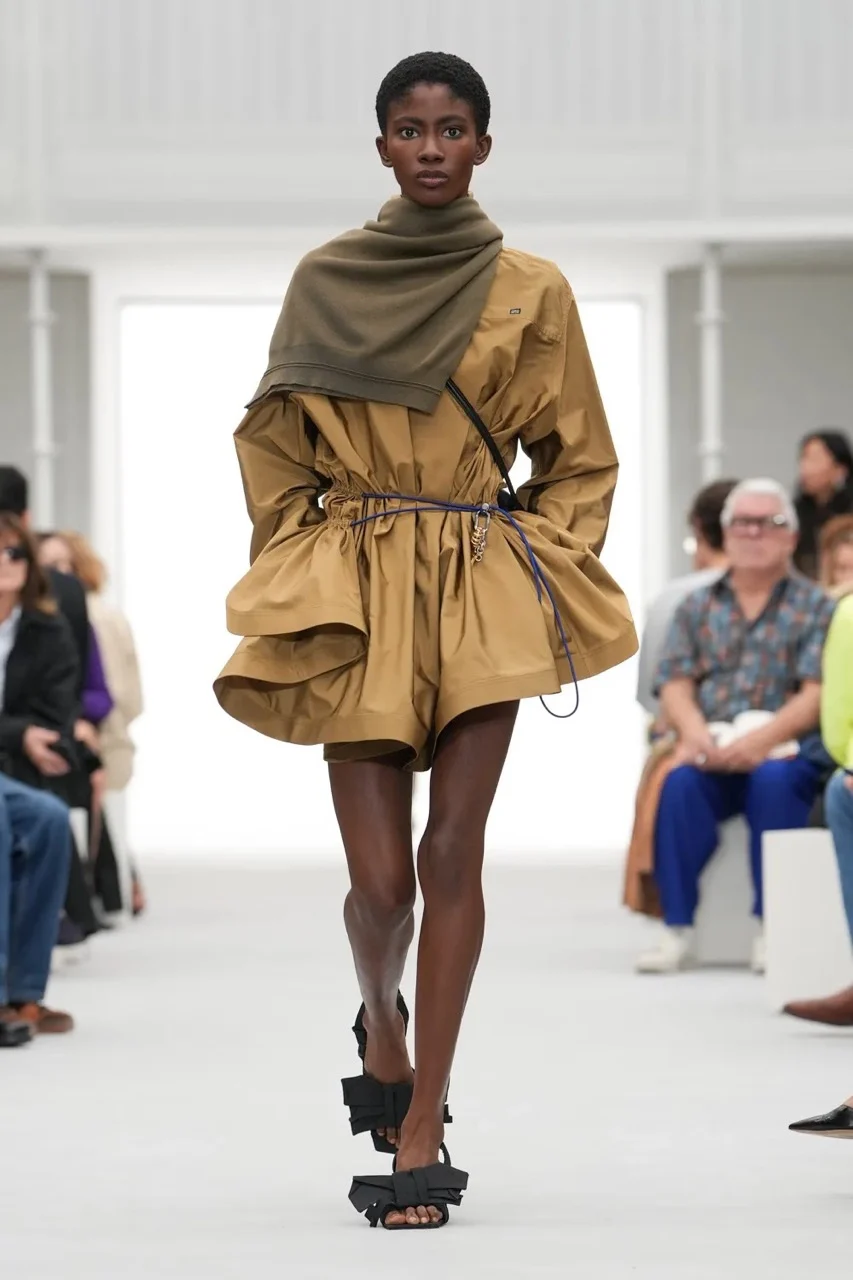
The answer was built on recognizable categories: sport coats, zip-front knits, polos, trenches, leather jackets, striped shirts and slip dresses. What changed was the treatment, and much of it happened in the workshop.
flow
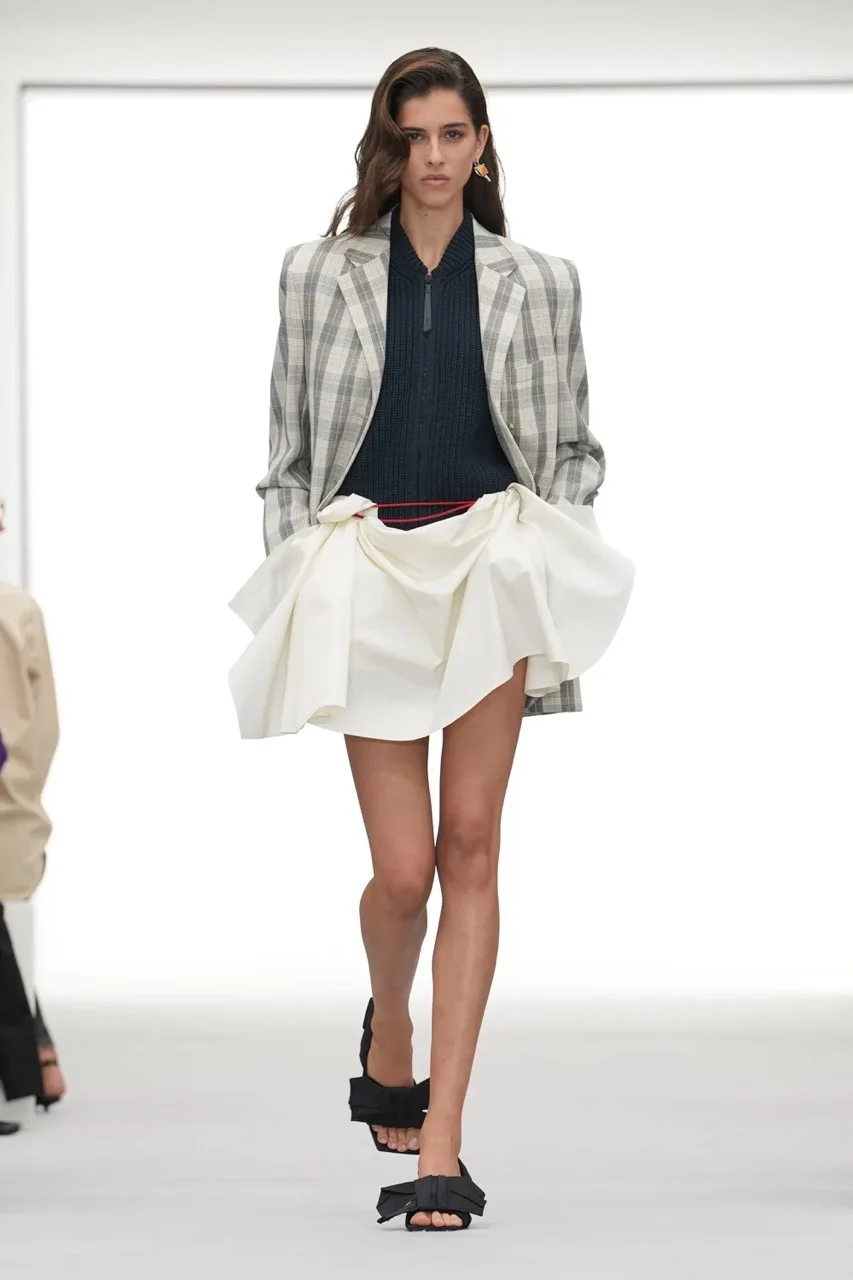
The opening look set the terms. An oversized grey and cream check blazer went over a navy zip-up knit and a gathered ivory skirt, cinched at the hip with a red bungee-style cord. The skirt looked like a crumpled napkin, and it was meant to: the designers modeled it on cloth they had studied in paintings by Francisco de Zurbarán and Diego Velázquez at the Museo del Prado in Madrid in Loewe’s home city. Seventeenth-century Spanish painting, filtered through a weekend outfit, is about as tidy a summary of the season as the clothes allowed.
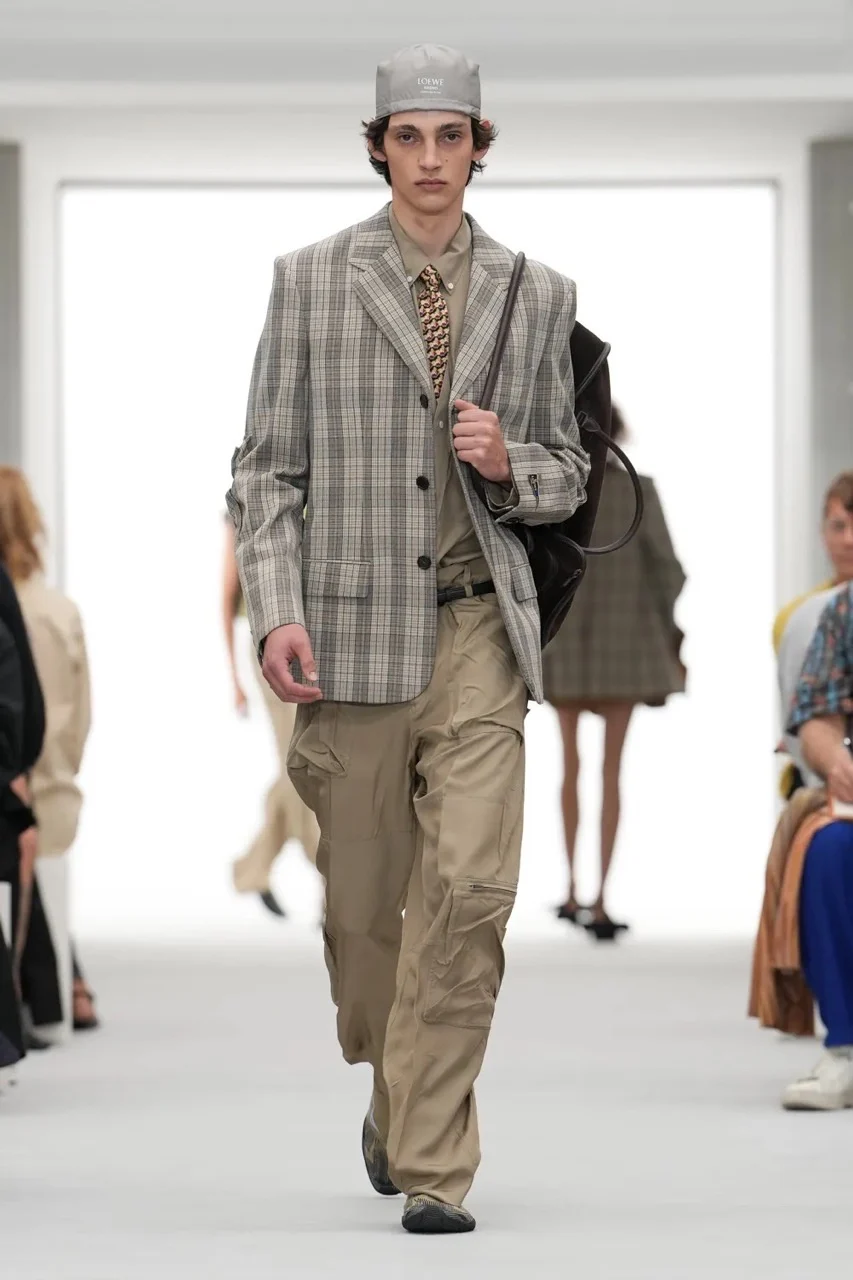
The weekend in question was distinctly New England. Rattling off the personal material in play, McCollough cited “our New England youth, our kind of ’90s spirit,” remarks that WWD weighed against Loewe’s Spanish roots in its review of a collection juggling 180 years of history. McCollough spent formative school years outside Boston, and the pair have long kept a house in the Berkshires. That background showed up in the archetypes: polo shirts, sport coats, boat shoes, a backwards baseball cap.
View this post on Instagram
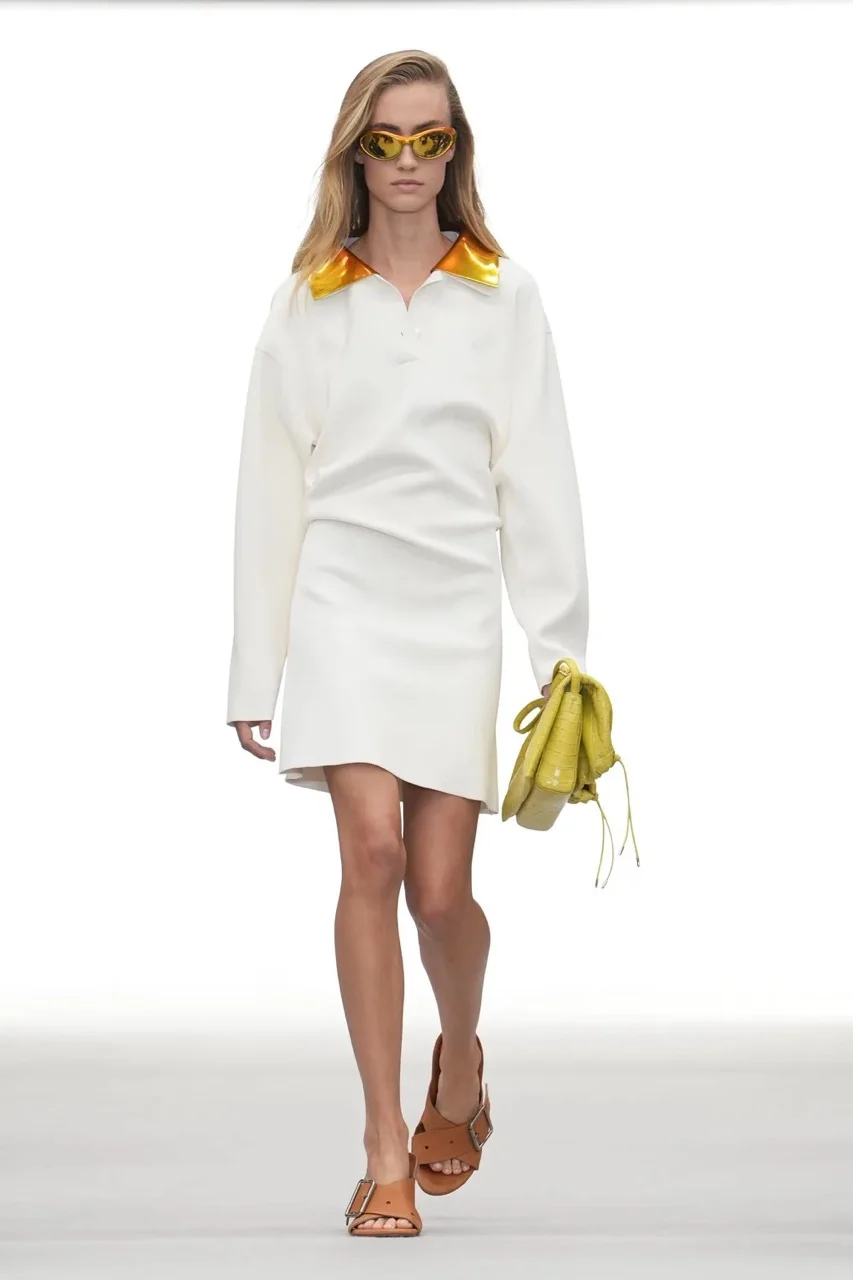
Then the archetypes were knocked slightly off their axis. Polos were cut so they buttoned at the back. Trench coats and knits grew collars cast in glossy resin, the material of sunglass frames, and ivory and chocolate polo dresses came with gold and flame-gradient versions of the same collar, worn with mirrored shades. Boat shoes arrived with brightly colored laces. The backwards caps, pulled tight to the skull, were worn by men and women alike, and some of them carried the house’s recently developed double-L monogram or its block-letter logo.
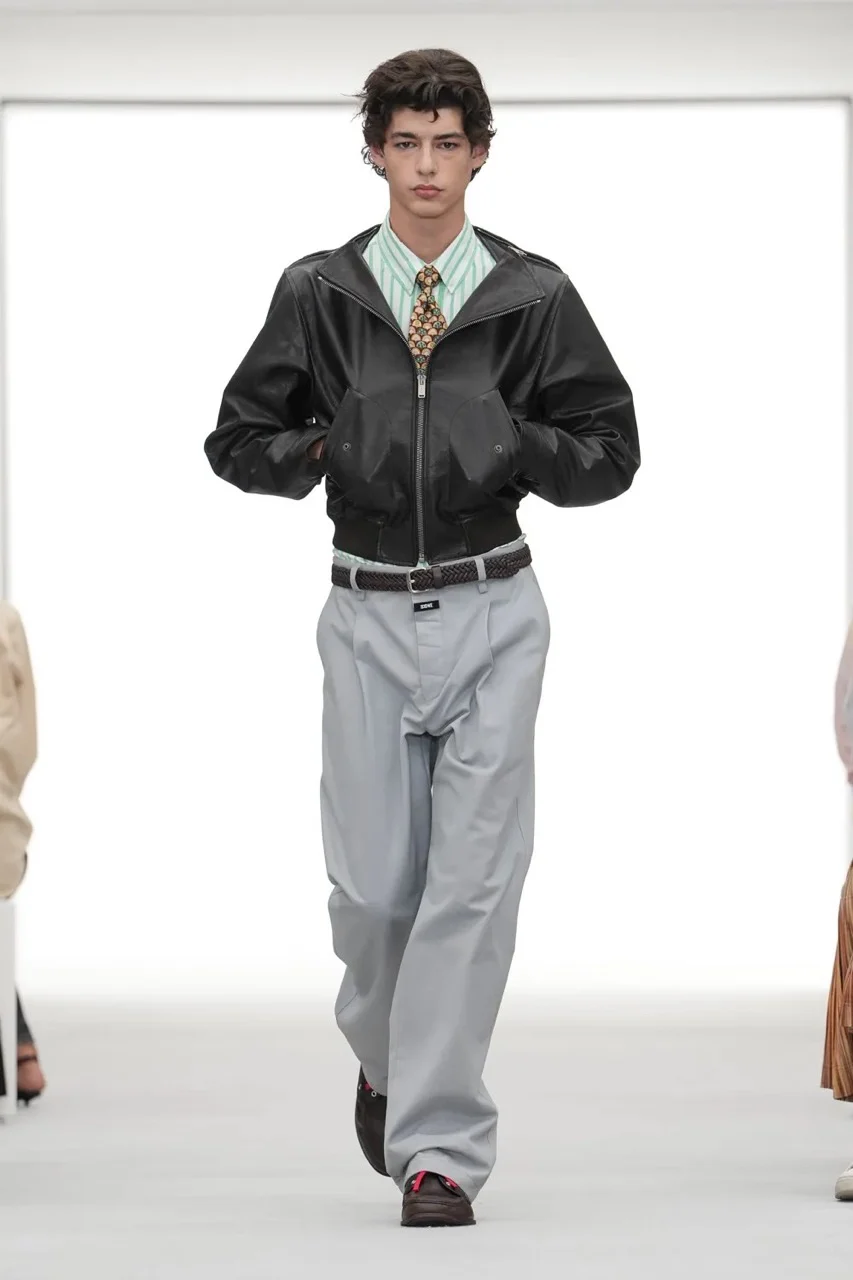
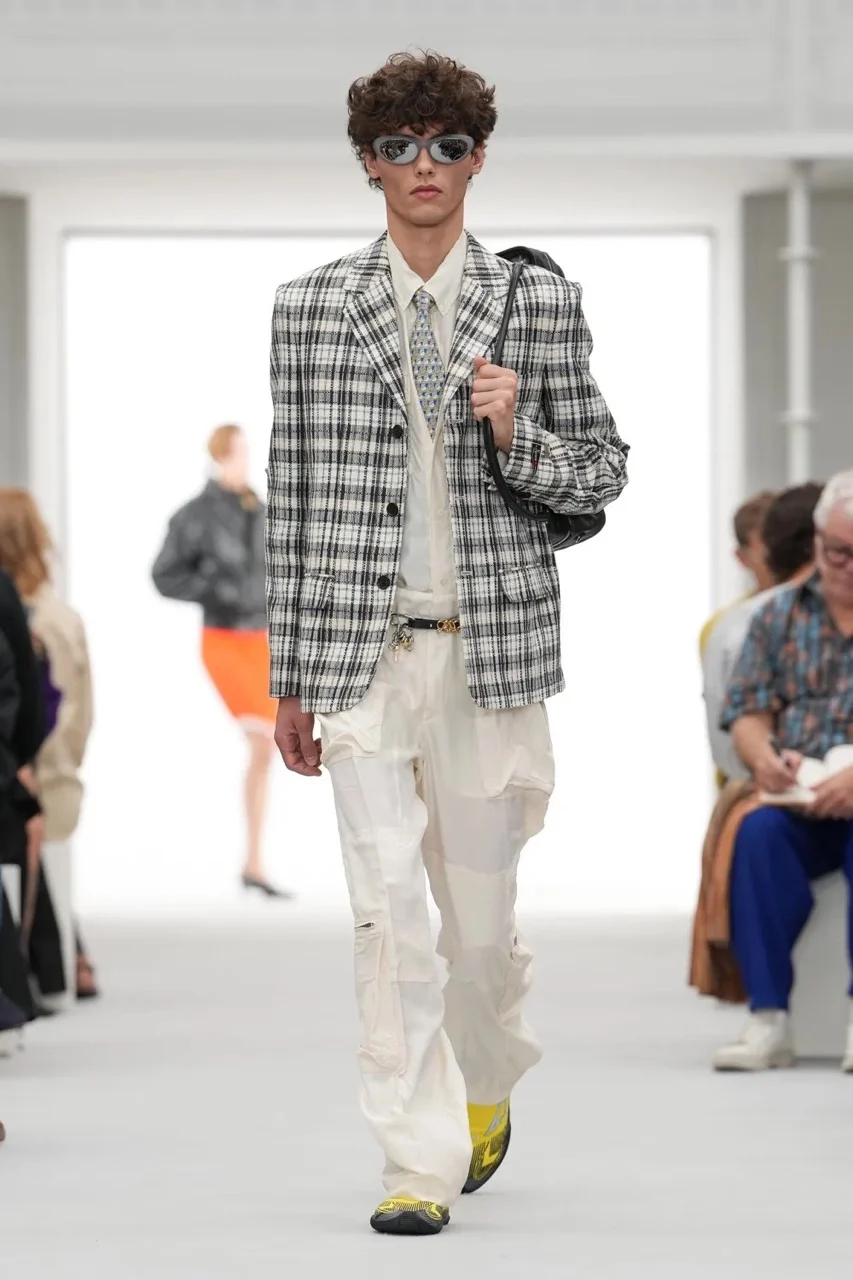
For men, the prep reference ran into something more Iberian. Crisp striped shirts and sporty anoraks were tucked into high-waisted trousers that buttoned well above the navel, with a cut that recalled a bullfighter’s trousers more than a pair of khakis. Leather bombers bristled with pockets and zips. One look layered red chinos over floral pajama-style trousers, and sweaters were worn back to front, the same reversal applied to the polos. Backstage, Hernandez summed up the mix as “the old world and the new world” coming together.
show
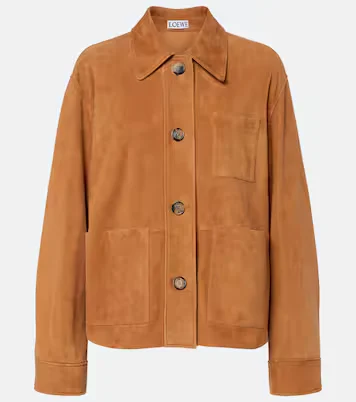
Loewe began in 1846 as a leather workshop in Madrid and has been wholly owned by LVMH since 1996. Its history includes a detail McCollough and Hernandez clearly enjoyed: the company did not make a garment until 1960, and that first garment was a suede blazer. They brought it back. A pair of understated suede jackets modeled on that original appeared on the runway, one of them in caramel worn with cobalt tights and sandals hung with charms. A longer caramel suede piece, somewhere between a shirt coat and a dress, extended the idea.
Most of the leatherwork was harder to spot, which seemed to be the point. Striped jackets with the easy shape of a cotton Harrington, and shirt dresses with a summer-cottage ease, were in fact cut from summer-weight skived leather, shaved thin enough to drape like cloth. The same skiving technique was used to create tincture blocking across contrasting leathers. Short trapeze dresses were molded from plongé nappa.
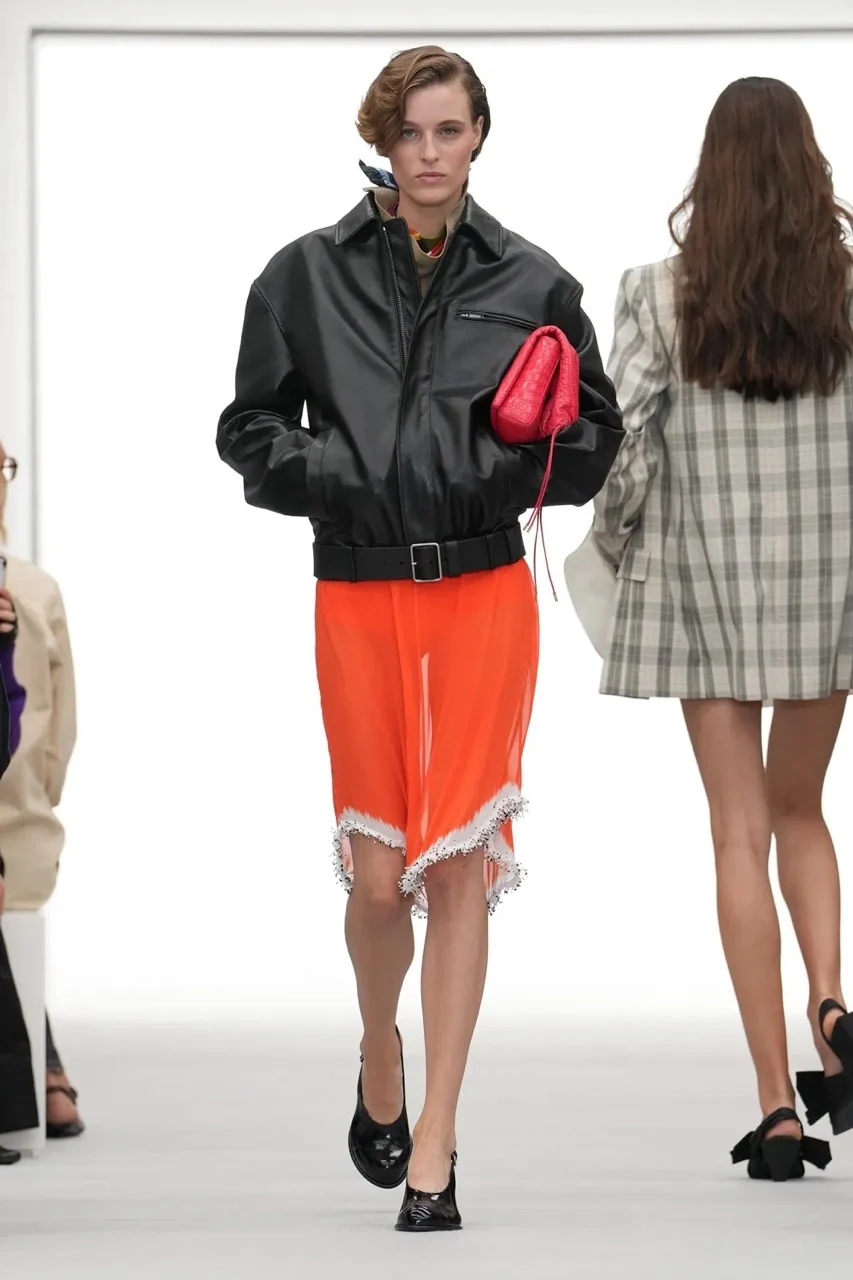
Elsewhere the material was allowed to look like itself. Cropped bombers in chocolate brown and black were belted with thick leather straps over sheer skirts finished with beaded hems. Zip-front leather jackets came with a soft, draped layer of leather falling over the front like a scarf, styled with utilitarian cargo trousers. It is the kind of jacket the house has long been known for, made looser.
straddle
The most delicate pieces in the show came from outside the atelier. The designers worked with Cécile Feilchenfeldt, a French textile artist and finalist for the 2025 Loewe Foundation Craft Prize, on a run of sheer striped dresses and shirts in sunshine yellow, coral and powder blue, finished with fringes of glass beads. Some of the bead-fringed slip dresses were cut long and loose like basketball jerseys. One model wore a marigold wig made of beads.
Her route to the runway ran through that prize, which Anderson founded in 2016 as a nod to the company’s workshop origins. The 2025 edition, exhibited in Madrid and won by the Japanese ceramicist Kunimasa Aoki, shortlisted thirty works from roughly 4,600 entries across 133 countries and regions. Feilchenfeldt’s finalist piece, made in collaboration with a design studio, was an insulating textile made from byssus, the fine filament mussels use to anchor themselves, once known as sea silk. Bringing a finalist straight onto the runway ties the prize Anderson created to the clothes his successors are making.
The bead work spread beyond those dresses. A plain marled grey sweatshirt, the most ordinary garment imaginable, was covered entirely in seed-bead embroidery and turned into a showpiece. Polo-neck sweaters were paired with microbeaded knit skirts made by an artisan the designers met through the prize. Silk scarves were stitched in as trims at the hems of trousers and the necklines of dresses, and black slip dresses came edged with scarf panels.
Flowers took over toward the end. Floral cut-out dresses in white and bright yellow were worn with bow-trimmed mules in matching colors, and the closing passage brought green and tangerine pieces, a pair of jade shorts among them, covered in dimensional floral embroidery. For anyone who followed the designers’ first label, the blooms recalled the bold Hawaiian florals of Proenza Schouler’s spring 2012 collection, a reminder that the duo’s own archive is part of the material they are now working with.
scope
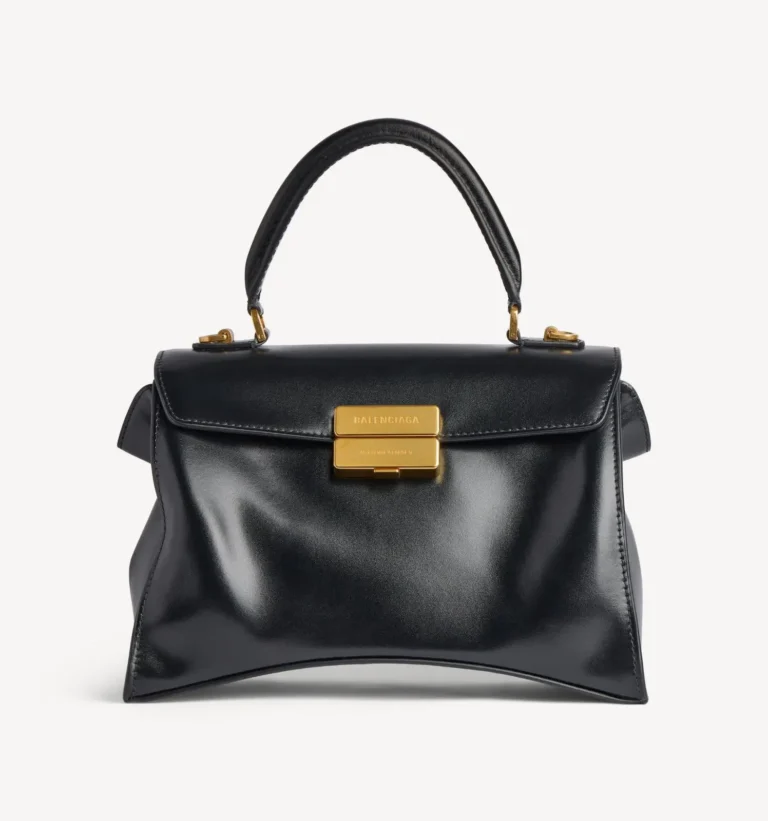
For a house that began as a leather workshop, the accessories carried real news. McCollough and Hernandez made their first pass at the Puzzle, the geometric bag that was Anderson’s first design for Loewe and a fixture of the house ever since. Their version is long and narrow, an East-West shape in ultralight leather that can be clutched or carried from a slim shoulder strap, shown in smooth leather and croc-embossed finishes. It builds on an idea already in the archive: Anderson’s spring 2025 collection introduced a Puzzle in feather-light nappa months before his departure. Reports on the new bag’s name differ slightly, with the house’s notes pointing to a Puzzle Featherlight Charm.
There was a wholly new silhouette too. The Pasito, as one bag specialist reported it is called, combines the slouch of a drawstring dust bag with the rigid walls of a box bag, and was carried both tucked under the arm and over the shoulder. A soft messenger closed with a cord that reworked the classic Loewe knot, and drawstring clutches turned up alongside croc-embossed bags in lime, coral and green. Their debut-season reworking of a house icon, the Amazona 180 introduced on their first runway with a single top handle and a slouchy body, returned in an even more relaxed, supple leather.
Footwear leaned into the same mix of polish and play. Strappy sandals were hung with charm-like trinkets and layered over tights in black, blue and red, a clear vote in the socks-and-sandals debate. Kitten-heel mules were punched with diamond-shaped cutouts, and sculptural slingbacks carried layered fabric and oversize bows. Bright pink flats, bow mules, barefoot-style running shoes and those brightly laced boat shoes covered the more casual end.
hint
The first reactions split along a predictable line. The craft and the sense of ease drew consistent praise, and the collection read as calmer and more distilled than the two before it. The reservations were narrower: some reviewers felt the logos were leaned on harder than a house with this much workmanship needs, and others said the portrait of the Loewe man and woman is still a sketch.
The timing frames all of it. In Loewe’s 180th anniversary year, the question of how much archive a new team should carry forward is sharper than usual. McCollough and Hernandez have answered by picking specific objects rather than invoking heritage in general: a 1960 suede blazer, a geometric bag, a knot, a seventeenth-century painting in the Prado. Around those fixed points, the rest of the collection was free to be as American and as casual as the designers wanted.
They are still early in the job, three collections in. The Spring/Summer 2027 collection has no announced retail date yet. Their debut collection went on sale the February after it was shown, a pattern that would put this one in stores early next year, sixty-seven years after Loewe made its first garment.
Related Articles
Yang Zi Follows a Magnolia Win With the Givenchy House Ambassador Role in China
Less than three months after her first Magnolia Award, Yang Zi is Givenchy’s House Ambassador […]