DRIFT AUDIO
Listen to this story
Choose a voice, then press play.
Nicole Kidman wore Pieter Mulier’s first Atelier Versace look to the Los Angeles premiere of “Practical Magic 2,” the earliest public glimpse yet of the house’s new era.
Nicole Kidman wore the first public design from Pieter Mulier‘s new job at Versace to the Los Angeles premiere of “Practical Magic 2” on August 31, an evening that, on paper, was just one stop on a monthslong press tour for a film that doesn’t open until September 18. Off paper, it was the first time anyone outside the house’s Milan studio had seen a stitch of what its new chief creative officer is planning, four months before he even starts the job in any creative capacity and roughly half a year before his first runway show.
Mulier’s appointment was confirmed in February, effective July 1, and the conventional path would have had the industry wait for an actual collection to see what he does with the house. Instead, the look arrived shh. Mulier posted it himself to his personal Instagram stories rather than through any official Versace channel, letting Kidman’s red carpet moment do the introducing for him. The logic behind that choice isn’t new, and it isn’t unique to Versace. Dressing a recognizable actress for a premiere lets a house test a look’s reception in real time, in comments and in the next morning’s coverage, without the weight that comes with unveiling an entire debut collection under a new designer’s own name. It also buys Mulier something he’s going to need: time. His first runway show isn’t expected until early 2027, which means Versace will sit out the Spring Summer 2027 season entirely next month, an unusually long runway silence for a house of its size and view.
The choice also reads differently set against what Kidman wore earlier in the same press tour. At the film’s London premiere, she stepped out in a custom Chanel gown. For Los Angeles, she switched houses and registers entirely, trading Chanel’s polish for something considerably darker, sheerer, and more exposed, and in doing so became, whether she intended it or not, the first face of a new Versace chapter.
Industry coverage of the moment has largely converged on the same read of the strategy: a red carpet debut like this one lets a house lean on the visibility of a major star and generate genuine social media buzz, while also quietly lowering the temperature on a first collection that would otherwise arrive under enormous scrutiny. It functions as a kind of test balloon, a way to gauge sentiment before a single stitch of an actual runway show exists. For a designer stepping into a house that has burned through two creative directors in under two years, tempering expectations before he’s even clocked in for his first day isn’t a small consideration.
in
The gown itself is built entirely from black hand intarsia lace, its asymmetrical skirt giving it an uneven hemline that shifts the silhouette from one side to the other. Kidman paired it with a matching lace choker and, per WWD’s footwear coverage, a pair of embroidered Manolo Blahnik pumps, a more specific detail than the plain black stilettos some outlets initially reported.
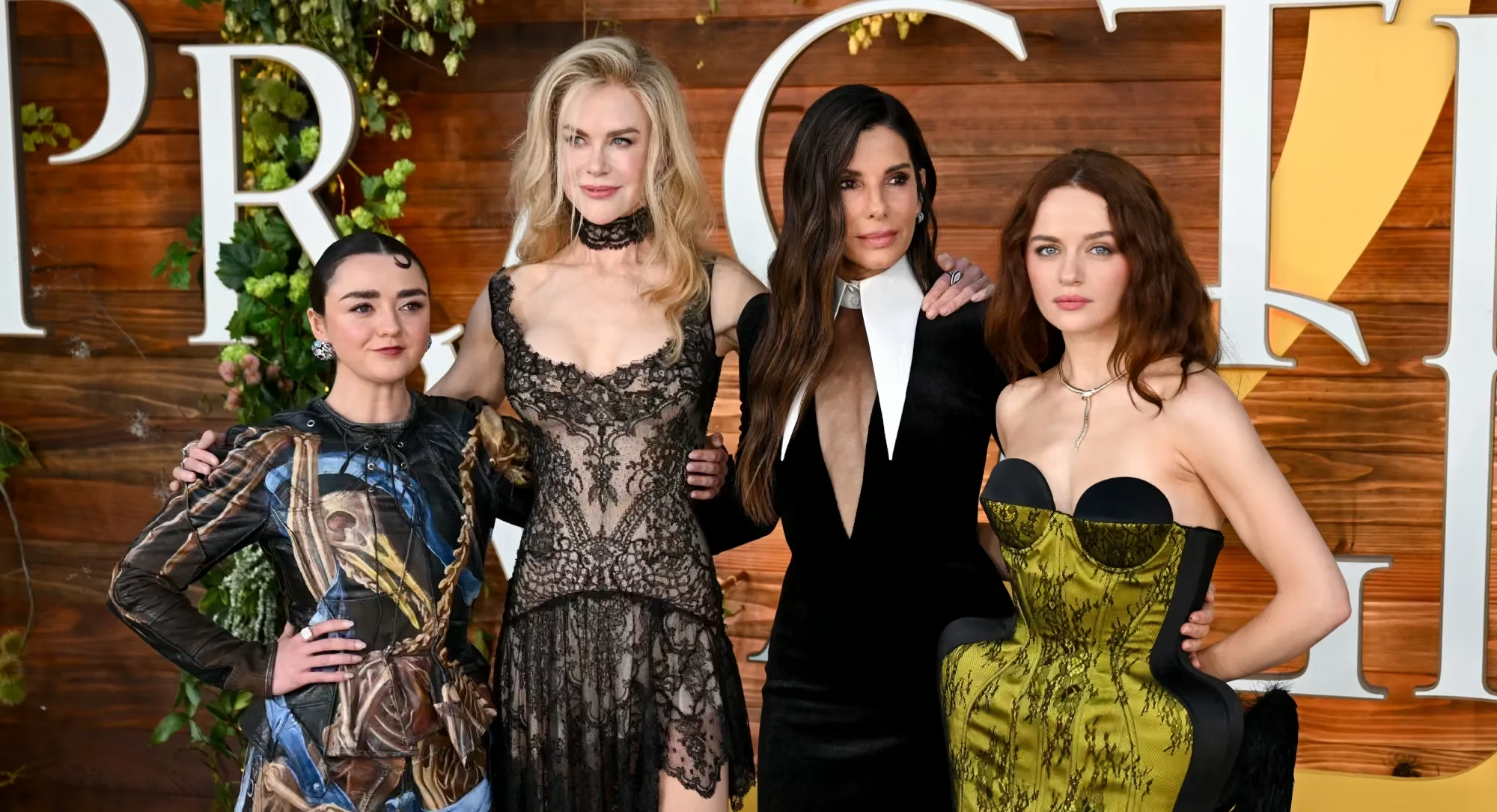
Four actresses posing together on a red carpet in front of a wooden backdrop with large white letters and greenery.
The styling lines up with the role Kidman was there to promote. She reprises Gillian Owens, one half of the witch sister pairing at the center of Practical Magic 2, opposite Sandra Bullock‘s Sally Owens. The lace and the choker read as a fairly direct nod to the character’s world without tipping into literal costume, a look several outlets described as fitting for a witch relaxing at home rather than casting a spell in public.
It’s worth being honest about how little this single look actually reveals about Mulier’s Versace. Coverage of the moment has been careful to note that one red carpet piece, made for one specific client and one specific occasion, is not a preview of a full collection. What’s confirmed is narrow and specific: the lace, the asymmetry, the choker, the shoes. Everything else about what Mulier’s Versace will look like in practice, which silhouettes he’ll favor, how far he’ll lean into the house’s archive of chainmail and Medusa hardware versus something quieter, remains, for now, entirely a matter of speculation.
The premiere itself supplied its own small piece of trivia for fans of the original: the Owens family house at the center of the franchise was reportedly rebuilt for the sequel, a detail that surfaced alongside coverage of Kidman’s dress and underlines how much weight this particular press tour is carrying, for a franchise revival and for a fashion house both. Kidman wasn’t the only cast member making a fashion statement that night either; Joey King arrived in a romantic lace look of her own, and Maisie Williams recreated an outfit Sandra Bullock wore to a 2006 premiere, though neither moment carried the same industry significance as a sitting Versace chief creative officer’s first public design.
two
Mulier’s own path to this moment runs almost entirely through one relationship. Belgian by birth, he studied architecture and design at Brussels’s Institut Saint Luc before being noticed by fellow Belgian designer Raf Simons at a graduate judging in 2003. He joined Simons’s own label soon after, then followed him as a right hand collaborator through a run of major creative director appointments: Jil Sander from 2005 to 2012, then Christian Dior as design director from 2012 to 2015, a period captured in the 2014 documentary “Dior and I,” where Mulier appears on screen as Simons’s calm, largely unflappable second. Their partner continued through Simons’s run as global creative director of Calvin Klein, where Mulier held the same title, working across menswear, womenswear, denim, and underwear categories in a relationship that, by that point, had lasted more than fifteen years.
For most of those years, Mulier worked entirely out of public view. Vogue Singapore once described him bluntly as a behind-the-scenes designer, someone whose CV, spanning menswear, couture, sportswear, and denim, was better known to industry insiders than to the wider public. That chapter ended in 2018, when PVH shut down Simons’s runway collection at Calvin Klein and Simons departed the company. Mulier has since described the sheer volume of product the role demanded, several drops a year across every category, as something that left him disillusioned, questioning who was actual buying it all. He stepped away from the industry afterward for a stretch, without any certainty he would return to design at all.
built
He did return, in February 2021, when Alaïa‘s then chief executive Myriam Serrano named him the house’s first creative director since founder Azzedine Alaïa’s 2017 death. It was, on its face, an unlikely fit for a designer who had spent nearly two decades as someone else’s collaborator rather than a name of his own. Mulier has since said that what convinced him was simply handling the house’s own archive piece by piece, describing the process of discovering each Alaïa garment as something closer to genuine surprise than research. The scale of the job suited him too: where Calvin Klein meant coordinating with several hundred people across a season, Alaïa let nearly everything pass through his own hands.
View this post on Instagram
Mulier’s first Alaïa collection showed for Spring Summer 2022, and over five years he built a genuine reputation there, one industry coverage has since characterized as a period of real stylistic renewal paired with considerable commercial growth for a house that had spent years without a single creative lead. He was respected enough within the industry that Naomi Campbell, long one of Azzedine Alaïa’s own muses, personally honored him at the CFDA Awards in the fall of 2025 for his stewardship of the house’s legacy. He showed his final Alaïa collection in Paris in early March 2026, days after Versace’s move was confirmed. He described it in the show notes not as a personal farewell but as a tribute to the people who had worked alongside him, and the audience included both Simons and current Chanel creative director Matthieu Blazy, two of the designers who have shaped his career most directly. Reviews framed the show as less reinvention than completion, a quiet, architecture precise closing chapter for a five year run that had genuinely revived a house left without a single creative director for three years running.
stance
Versace, meanwhile, had already been through more change in the eighteen months before Mulier’s arrival than most houses see in a decade. Donatella Versace, who had led the house creatively since her brother Gianni’s murder in 1997, stepped back in March 2025 into a new chief brand ambassador role focused on philanthropy. Dario Vitale, previously design director at Miu Miu under Miuccia Prada for close to fifteen years, was named her successor that April, becoming only the third creative director in Versace’s history after Gianni and Donatella themselves.
Vitale’s tenure lasted eight months. His only collection for the house, shown that September, was well reviewed, praised by Vogue as fun and audacious. But on December 2, 2025, Prada Group completed its 1.375 billion dollar cash acquisition of Versace from Capri Holdings, a deal first announced the previous April, and two days later Versace confirmed Vitale would leave the brand entirely, by mutual agreement, effective December 12. CEO Emmanuel Gintzburger oversaw the creative team in the interim while a permanent successor was found, a search that reportedly reached far beyond Versace’s own ranks given the scale of the transition already underway.
The acquisition itself was one of the larger stories in luxury that year regardless of who ended up designing the clothes. It returned Versace, founded in Milan by Gianni Versace in 1978, to Italian ownership after nearly a decade under the American group Capri Holdings, and positioned Prada Group as a more direct competitor to LVMH and Kering, the two conglomerates that have long dominated the upper end of European fashion. Losing a creative director just two days after the ink dried only added to the sense that Versace’s next chapter would be written on Prada’s terms rather than picking up wherever Vitale had left off.
That successor turned out to be Mulier, announced on February 5, 2026 as chief creative officer effective July 1, reporting directly to Lorenzo Bertelli, Versace’s executive chairman and the son of Miuccia Prada and Patrizio Bertelli, positioned as the eventual heir to Prada Group itself. “We identified Pieter Mulier as the right person for the brand,” Bertelli said in the official announcement, framing the choice as one made during the acquisition process itself rather than after.
look
Bertelli laid out more of that plan during a Prada Group earnings call in early March, alongside the rel of the group’s 2025 annual results. Mulier’s first runway show, he confirmed, is scheduled for early 2027, with Versace using the intervening months for what the house has described publicly as analysis and development rather than any public output, Bertelli notably declined to specify whether that debut would be ready to wear or haute couture. The same call confirmed the planned relaunch of Atelier Versace, the house’s dormant haute couture line, alongside the discontinuation of the Versace Jeans Couture line and unspecified sub-brands within its ready-to-wear business. Prada Group CEO Andrea Guerra described the coming period as a reposition phase, supporting higher quality full price sales and more selective distribution, while caution that the investment required could weigh on the group’s margins through 2026 before paying off in later years.
Versace generated roughly 684 million euros in net revenue in 2025, inside a Prada Group that logged its fifth consecutive year of growth and now counts Prada, Miu Miu, Church’s, Car Shoe, and Versace itself among its holdings. It’s a scale that gives Mulier real resources to work with, and real pressure to eventually show a return on what Prada paid for the house. Until his actual runway debut arrives, Kidman’s lace gown, and whatever red carpet moments follow it between now and early 2027, will remain the only public evidence of where he intends to take Versace next.
Related Articles
Medusa at Twelve: Versace’s Fall Winter 2026 Watches Hold the House Line
A blue guilloché dial, a Medusa at twelve and a 38 by 49 mm steel case lead Versace's Fall Winter 2026 watches, out while the house waits on its next…