DRIFT AUDIO
Listen to this story
Choose a voice, then press play.
Alley Cats arrives on Netflix with foul mouths and a surprising conscience, and six weeks in, critics still can’t agree on which one wins.
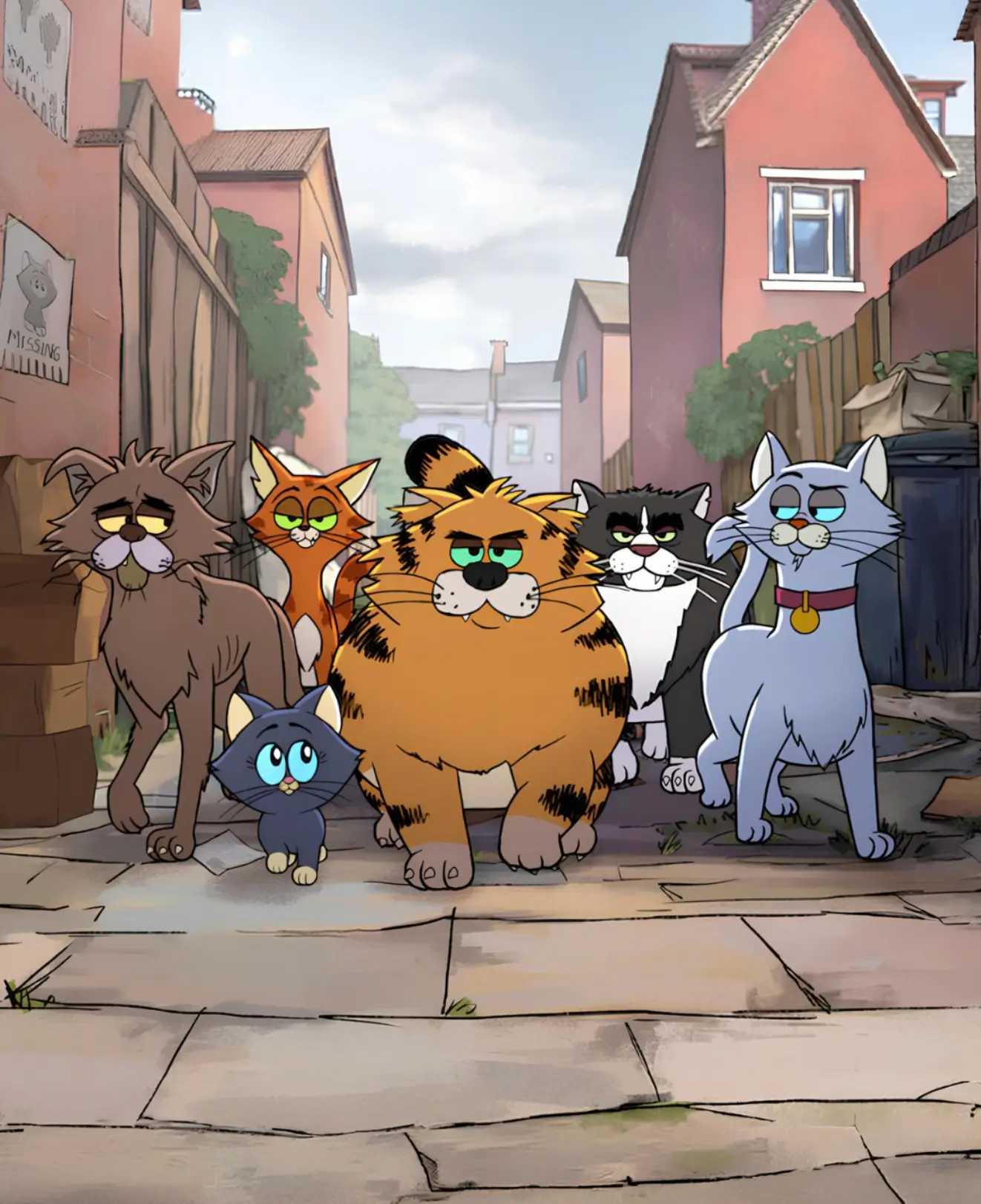
A derelict rowhouse in London holds five cats who have given up on almost everything except each other. That is the entire premise of Alley Cats, the six-episode animated series Ricky Gervais made for Netflix, and it is a testament to how little plot the show needs that its central question turns out to be one of the oldest in comedy: how much of a person’s cruelty is armor, and what happens when the armor slips.
stir
Gus, an overweight orange tabby voiced by Gervais himself, spends his days doing the bare minimum required to stay alive. He wakes up, gets distracted, does something destructive, eats part of something he probably shouldn’t, gives up on the day’s one stated goal, and sleeps for most of what remains. His crew mirrors him: Fang (Andrew Brooke), a tuxedo cat perpetually spoiling for a fight; Puke (David Earl), a feral Havana Brown with no filter; Ponce (Tom Basden), a Chartreux who fancies himself above the other three; and Olive (Diane Morgan), Gus’s dim, deadpan half-sister. They squat together, watch a reality show called Thick and Single, and comment on the human world outside their walls with the detachment of creatures who have already decided none of it is their problem.
That detachment is the joke, at first. The cats trade insults about bodies and instincts with the rhythm of a pub argument that has been running for years. But the show, produced by Blink Industries, the animation house behind Don’t Hug Me I’m Scared and Dead End: Paranormal Park, keeps interrupting its own bit. A cemetery mousing trip turns into the discovery of an abandoned kitten. A riot on the news becomes an excuse for the gang to lash out at a stranger, and the fallout lands heavier than the setup promised. Gus’s ailing mother gets a subplot that several critics found rushed, but its presence at all tells you what kind of show this is trying to be underneath the crude exterior: something closer to a hangout sitcom about mortality than a shock-comedy romp.
Nine Lives, Zero Fucks!
Alley Cats on Netflix August 7 pic.twitter.com/RVKGQS8ZC5— Ricky Gervais (@rickygervais) June 22, 2026
huh
The production choice that most shapes the finished show is one viewers never see. Gervais and the cast recorded every line of dialogue together in the same room before a single frame of animation existed, a reversal of how most animated comedies are built. He told them, “Don’t do cartoon voices. Talk as you normally do,” aim for a naturalism that survives the transfer from human to feline in a way that’s genuinely unusual for the format. The cast, which reunites Gervais with longtime collaborators including Kerry Godliman and Jo Hartley, improvised and bounced lines off each other the way a live studio audience sitcom might, which is fitting given that Gervais has named Porridge, Cheers, and Only Fools and Horses as his reference points rather than any prior animated comedy.
Tang Heng, previously a production designer on the Kung Fu Panda films, built a London that looks lived-in rather than cartoonish, all damp brick and sodium streetlight. Elliot Dear co-directs alongside Gervais, and the choice pays off in small moments more than big set pieces: a held shot on Gus’s face after a joke lands wrong, a pause before Olive says something that turns out to be sadder than it sounded. None of it undoes the show’s commitment to vulgarity. It just means the vulgarity has somewhere to land.
That production method also explains something about the show’s rhythm that separates it from most adult animation. Series built around scripted jokes tend to move in punchlines, one beat resolving cleanly before the next begins. Alley Cats moves more like an overheard conversation between people, or cats, who have known each other too long to bother finishing their sentences. Characters talk over one another, abandon threats halfway through, circle back to arguments from earlier in the episode without explanation. It’s a specific kind of naturalism that only works because the cast wasn’t performing to a blank page in a booth alone. Whether that naturalism reads as loose and lived-in or simply undisciplined has become its own small fault line in how the show has been received, with several critics noting that scenes which feel spontaneous on a first watch can feel unstructured on a second.
View this post on Instagram
split
Alley Cats premiered on August 7 and immediately became one of Netflix’s most-watched titles that week in the UK, even as reviews arrived overwhelmingly negative. Its Rotten Tomatoes critic score settled at 20 percent from early notices, making it the worst-reviewed project of Gervais’s career across film and television, worse even than his 2016 feature Special Correspondents. The most common complaint was familiarity: that Gervais had simply restaged his usual provocations with whiskers attached, trading human insecurity for feline insecurity without finding much new to say about either.
Critic Brian Tallerico argued the show’s central failure was one of attention, writing that real “comedy requires interest in something other than yourself” and suggesting Gervais hadn’t found that interest here. Others were kinder to the show’s craft while cool on its jokes. Variety called the season an “enjoyably low-key binge” despite finding it thinner than it wanted to be, and noted that the show’s six sub-20-minute episodes leave little room for its heavier ideas to breathe. Even the season’s warmest notice, a three-out-of-five from The Times critic Carol Midgley, came with a caveat that the show only really works once it stops trying so hard to shock.
What almost none of the reviews disputed, whatever score they landed on, was that Alley Cats is a stranger and sadder show than its marketing suggested. Netflix sold it on chaos: strays causing trouble on the street, a tagline promising nine lives and zero scruples. What audiences got instead was closer to a bittersweet character study wearing chaos as a disguise, and the disguise seems to be what a lot of critics couldn’t get past.
The audience numbers tell a slightly different story than the critic scores do, and the gap between the two is itself part of the conversation around the show. Alley Cats debuted high on Netflix’s own daily chart of most-watched titles globally and topped the UK chart in its first week, a performance that sits awkwardly next to a Tomatometer score in the low twenties. Early audience ratings on Rotten Tomatoes have been mixed rather than uniformly warm, settling in the low-to-mid forties by most counts, which suggests general viewers are also split rather than simply overruling the critics. It’s the kind of divide that tends to follow Gervais specifically: a creator whose fans and detractors have spent years arguing over whether his provocations are the point or the obstacle, and Alley Cats has mostly imported that argument into a new format rather than resolving it.
View this post on Instagram
tempo
The clearest evidence of that disguise is the storyline that runs underneath the whole season: a lost kitten the gang finds on a hunting trip and, almost against their own instincts, decides to help find her way home. It is the one plot thread every review, positive or scathing, singles out as doing something the rest of the show doesn’t quite manage. The gang’s efforts keep getting derailed by their own dysfunction, which is the joke, but the derailing starts to feel less like slapstick and more like avoidance the longer it goes on. These are characters who have organized their entire lives around not caring about anything, confronted with a creature who needs them to care.
Gus’s arc bends hardest around this. The character who opens the season describing his life’s ambition as getting through the day, killing something, and sleeping for fourteen hours is, by the season’s back half, the one most invested in getting the kitten home safely. Gervais has been candid that the whole project began with a fascination that has nothing to do with comedy at all: an interest in cats as the only animals that domesticated themselves, choosing proximity to humans on their own terms rather than being tamed into it. That idea, of a creature that chose closeness while insisting it hadn’t, sits underneath Alley Cats more than any individual joke does.
fin
Gervais has built two decades of work, from The Office through After Life, around characters who use humor as a defense mechanism against feeling too much. Alley Cats is the most literal version of that idea he has made yet, if only because it strips away the human context that usually softens it. A cat gang bickering about who’s tougher than whom, refusing to admit that any of them are scared of anything, is the same emotional architecture as a British sitcom about office life or grief, just with the metaphor made physical. Gervais has said publicly that “we’re all going to die soon and there’s no sequel,” and that all anyone can do is make the most of the time in between. Gus and his crew choose to spend that time pretending they don’t know it, which is its own kind of answer to the same problem.
That’s the reflection sitting underneath a show that, on its surface, is mostly about cats swearing at each other. The insults, the posturing, the studied indifference to a chaotic world outside the rowhouse walls: none of it is really about apathy. It’s about what people, and apparently cats, build to avoid admitting how much they actually want to be needed by something. When the kitten arrives and the gang can’t quite bring themselves to walk away from her, the show briefly drops its own performance long enough to show what was underneath it the whole time.
It’s worth noting how thin the margin is between the version of Alley Cats that critics dismissed and the version a smaller group found genuinely moving. The jokes about hunger, violence, and bodily functions are the same jokes in both readings. What changes is how much patience a viewer brings to the gaps between them, the pauses Dear and Gervais built into the animation precisely so something quieter could surface there. A show this compressed, six episodes running under twenty minutes apiece, doesn’t have much room to earn that shift in tone, and the split verdict suggests it earned it for some viewers and not others rather than failing or succeeding outright.
Whether that moment justifies six episodes of crude jokes to get there is exactly the question critics have spent the past week arguing about, and it’s unlikely to be settled soon. Alley Cats has been renewed for nothing yet, its first season sitting on Netflix with a startling gap between its audience numbers and its critical reception, and whether Gervais gets the chance to push the idea further remains, like most things in the show itself, undecided.
From the DRIFT archive: Netflix House Opens Its Doors: Streaming Meets Reality · Wizdom 2025 at Cipriani Wall Street: An Experiential Moment in Cloud Culture
Related Articles

Song Hye Kyo Signs With Bottega Veneta
In February 2020 she sat front row in Milan holding a gold-linked Chain Pouch. This […]