DRIFT AUDIO
Listen to this story
Choose a voice, then press play.
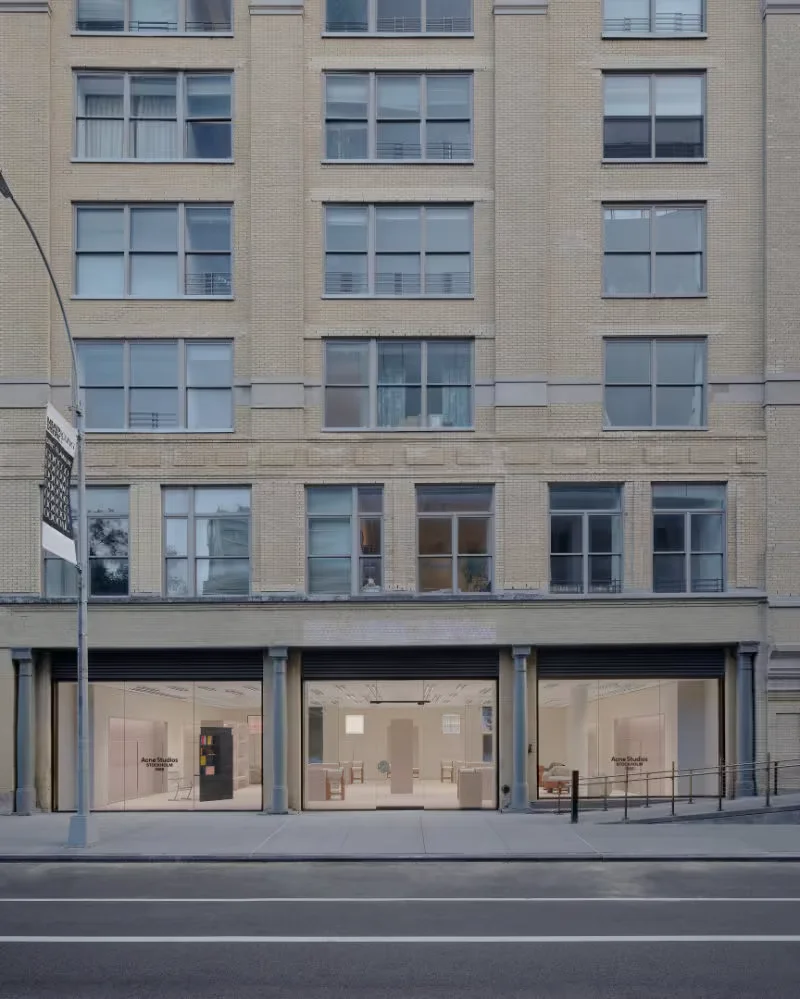
Across from the Whitney, Acne Studios’ newest store trades a sales floor for something closer to a living room.
Acne Studios has taken a storefront at 82 Gansevoort Street, a block that puts the Swedish house inside one of the most concentrated stretches of art, fashion, and design real estate in New York. The High Line runs along one side of the building. The Whitney Museum of American Art, Renzo Piano‘s cantilevered addition to the neighborhood’s skyline, sits directly across the street. Few retail addresses in the city come with that kind of built-in audience: gallery visitors leaving the museum, tourists working their way down the elevated park, and residents of a district that has spent the past year filling back in with names like Bang & Olufsen and fragrance house Amouage, according to WWD‘s own reporting on the neighborhood’s retail comeback, alongside longer-standing anchors like Chelsea Market and the Standard Hotel.
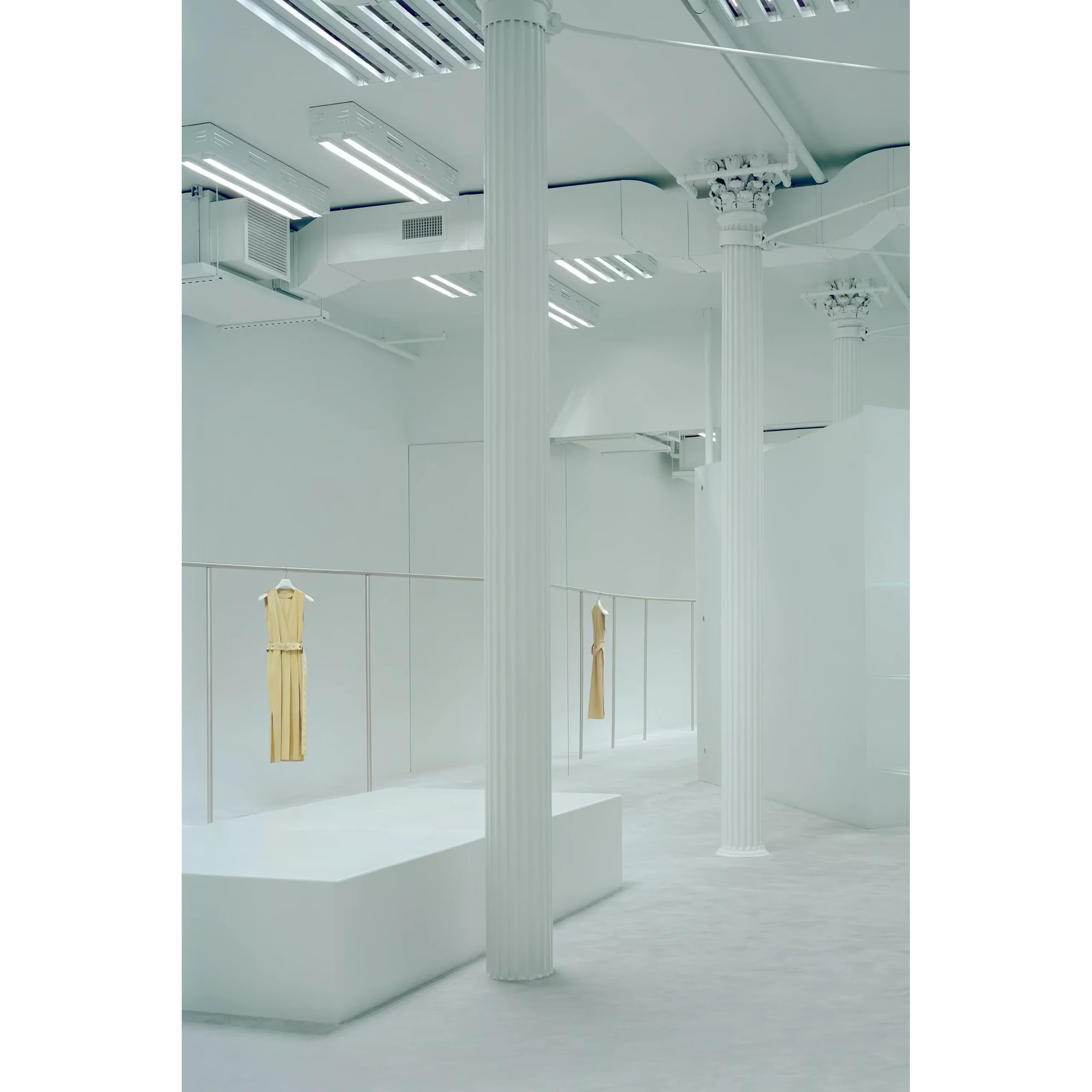
The interior of the Acne Studios flagship store at 33 Greene Street in New York, featuring a bright, all-white, industrial-chic design with fluted columns, metal fixtures, and minimalist clothing racks.
The store joins Acne Studios’ existing Greene Street flagship in SoHo rather than replace it, give the brand a second, quite different kind of New York address. Where the SoHo store sits deep inside a dense retail corridor, the Gansevoort Street location behave more like a freestanding building, with sightlines out toward the Hudson and up toward the park. That openness became the starting point for everything that follow inside.
The park itself is only about fifteen years old in its current form. The High Line began as a 1930s elevated freight line built to keep delivery trains off the street, fell out of use by the 1980s, and was headed for demolition before a nonprofit called Friends of the High Line fought to save and convert it instead. Its first stretch, running from Gansevoort Street north to West 20th Street, opened to the public in 2009. Acne Studios’ new store sits at the southern end of that same stretch, close enough to the park’s original starting point that the two projects, one a fashion store, one a public park, share almost the same address by coincidence of timing rather than design.
stir
It is easy to forget, walking the High Line today, that the Meatpacking District spent most of the twentieth century as exactly what its name says: a working meat market, all loading docks, cobblestones, and refrigerated warehouses, well after dark most of the surrounding city had gone quiet. The elevated freight line that eventual became the High Line was built in the 1930s to keep those same delivery trains off the street, and the neighborhood didn’t begin its shift toward gallery, hotels, and flagship stores until the line itself was threatened with demolition and, instead, turned into a park.
That history is part of why a fashion house moving in beside the High Line reads as more than a real estate decision. The cobblestones are still there under some of the sidewalks. The Whitney itself, founded in 1930 by sculptor and patron Gertrude Vanderbilt Whitney and originally housed uptown, relocated to its current Renzo Piano building at 99 Gansevoort Street in 2015, conceived from the start as an anchor for exactly this kind of neighborhood transformation. Acne Studios’ own choice of material for the new store, discussed below, is a direct response to that same industrial memory rather than an attempt to paper over it.
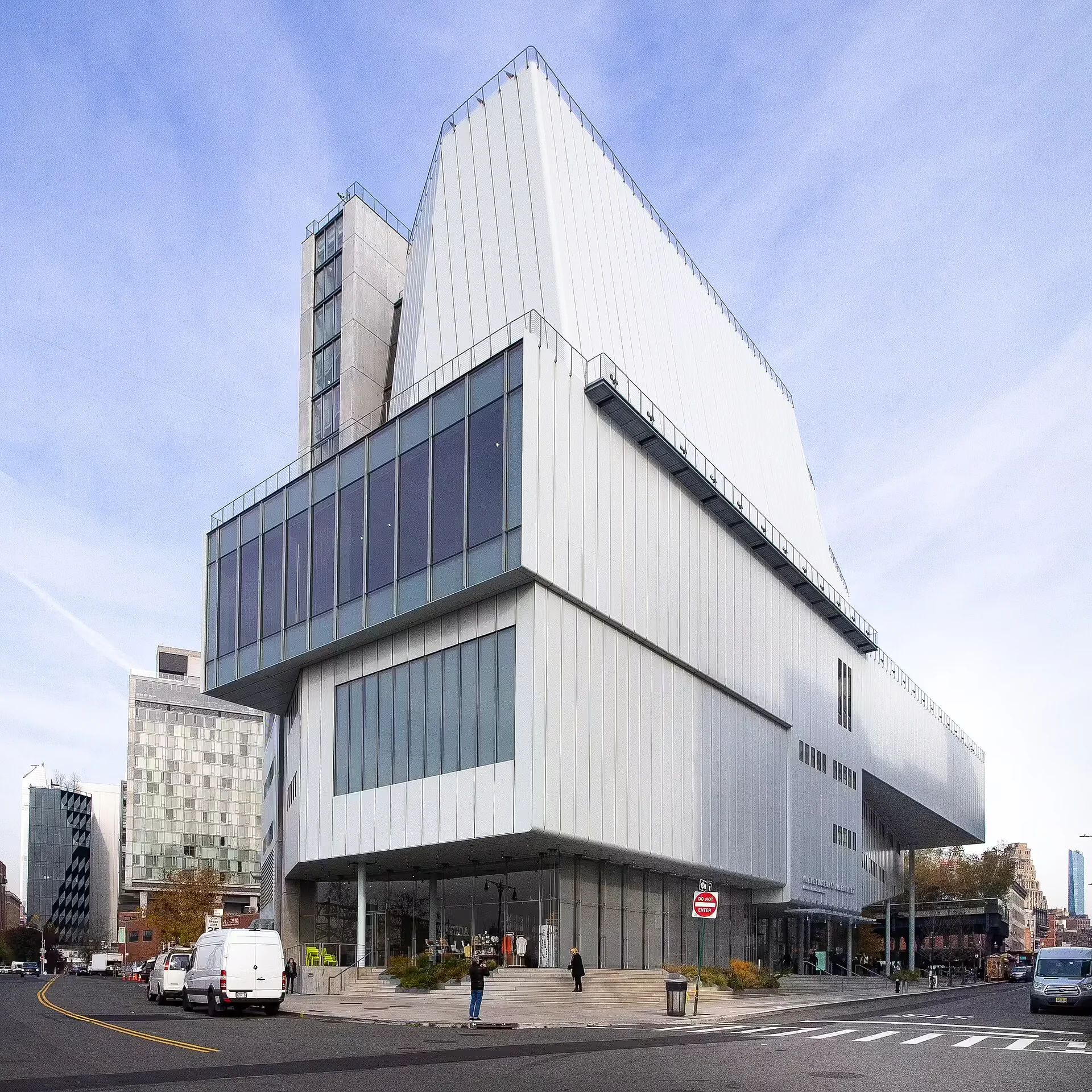
The Whitney Museum of American Art in New York City, a modern building with a white, asymmetrical facade designed by Renzo Piano, viewed from the street corner.
arrive
The brand behind the store started out as something other than a clothing label. Acne Studios grew out of ACNE, a Stockholm creative collective founded in 1996 by Jonny Johansson and three collaborators, working across film, graphic design, and advertising before clothing entered the picture at all. Johansson made a hundred pairs of raw denim jeans with red contrast stitching in 1997 and gave them to friends; the response was strong enough that a full ready-to-wear collection followed within a year, and the fashion side eventually spun off as its own company in 2006. That background, an interest in photography, architecture, and publishing that predates the clothes themselves, is why Acne Studios has never treated stores as simple containers for product. The brand also produces its own magazines, furniture, books, and exhibitions, and the Gansevoort Street store, with its library and its living-room furniture, is as much an extension of that multidisciplinary identity as it is a place to buy a jacket.
straddle
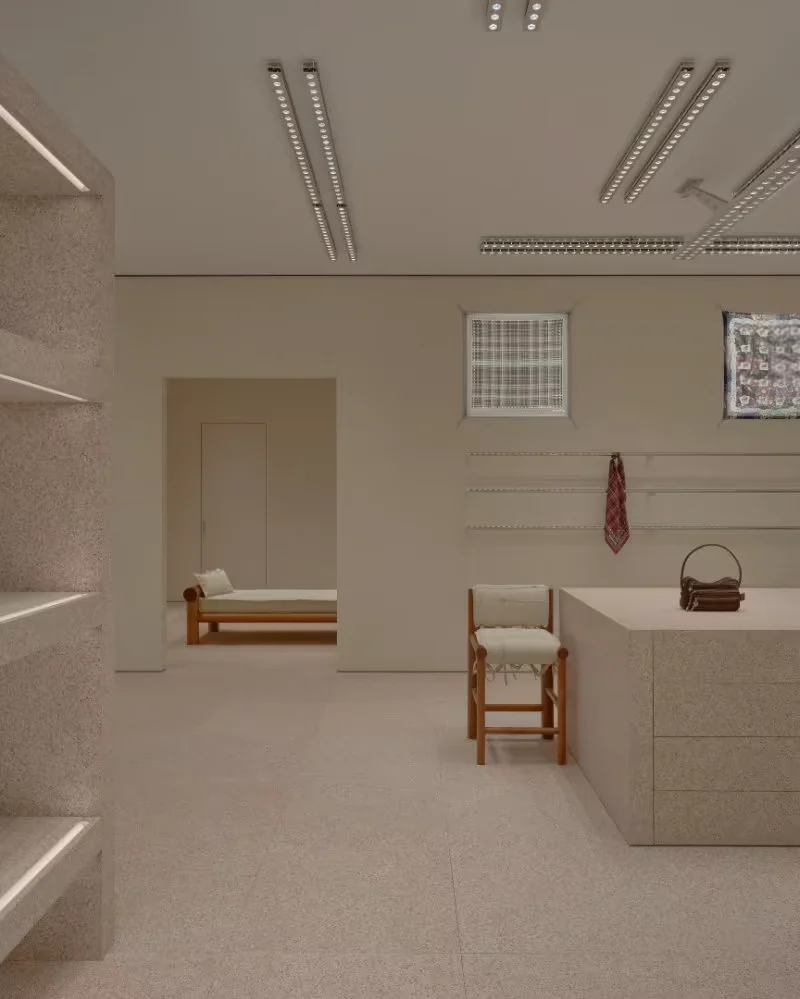
The building’s face is almost entirely glass, floor to ceiling, an approach Jonny Johansson and longtime architectural convincer Halleroed have used before but rarely at this scale. Inside, the plan reads as a grid: fixtures, seating areas, and display cases run along clean sightlines that let someone on the sidewalk take in nearly the entire ground floor without stepping inside. Monolithic columns interrupt that grid at intervals, some wrapped in stone, others sheathed in mirror, a pairing that leans toward the blunt geometry of American minimalism, closer in spirit to Donald Judd‘s boxes or Richard Serra‘s steel than to conventional retail fixtures.
It is a deliberate reversal of the sealed-box logic that governs most flagship stores, where a heavy facade and controlled sightlines exist to build anticipation before a customer ever steps through the door. Here, that anticipation has been traded for legibility. What’s inside the store is visible from the street, and what’s happening on the street, High Line foot traffic, Whitney crowds spilling out for coffee, becomes part of the store’s own backdrop rather than something kept at a distance.
flow
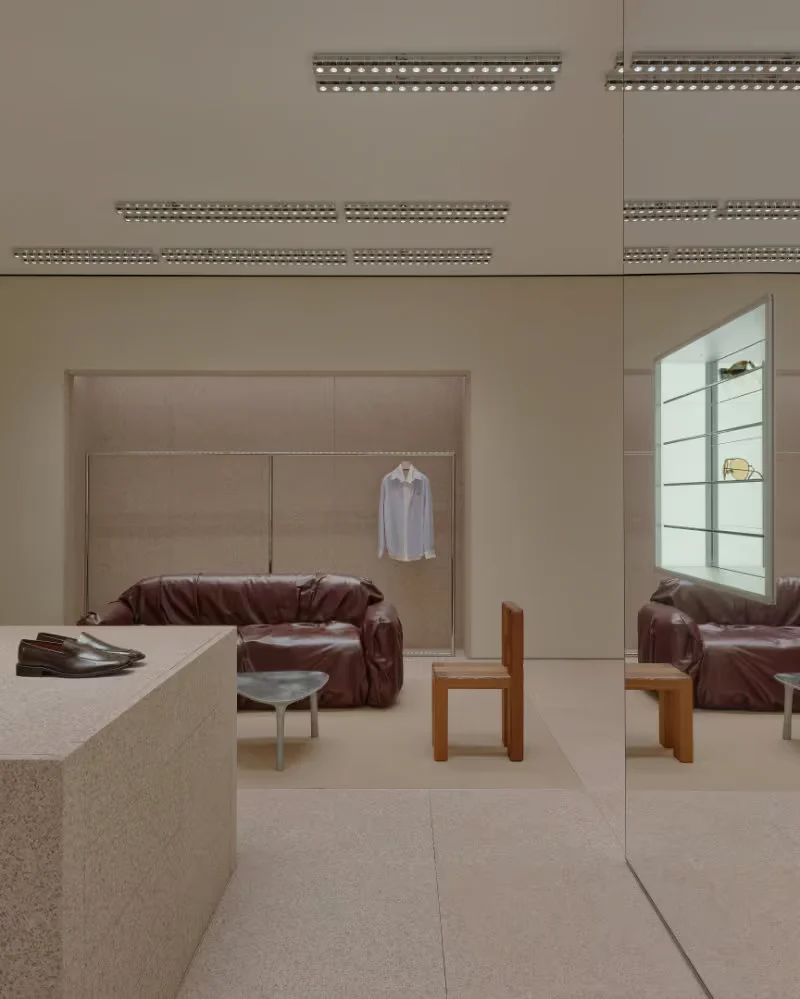
Stone runs through nearly every surface at Gansevoort Street: floors, columns, sections of wall. It’s Acne Studios’ now-familiar pink granite, the material that has anchored the brand’s stores from a recently reopened Beijing flagship to its Tokyo Aoyama location, but the New York version has been given a rough, flamed finish rather than the smoother surface seen at some of the brand’s other addresses. Flaming stone, a process that exposes granite to intense heat until the surface cracks and roughens, is more commonly used to make paving slip-resistant than to finish a retail interior. Here it does double duty: the treatment intensifies the material’s pink cast, and it reads as a direct nod to the neighborhood’s own industrial history, a district of loading docks and meat lockers long before it became a gallery row.
The choice fits a broader pattern in how Halleroed has handled Acne Studios’ stores over the past decade. The same pink granite recurs from city to city, but its finish, and the materials it’s paired against, shifts with the address, smoother and paired with anodized pink metal in Beijing, rougher and paired with steel and mirror on Gansevoort Street.
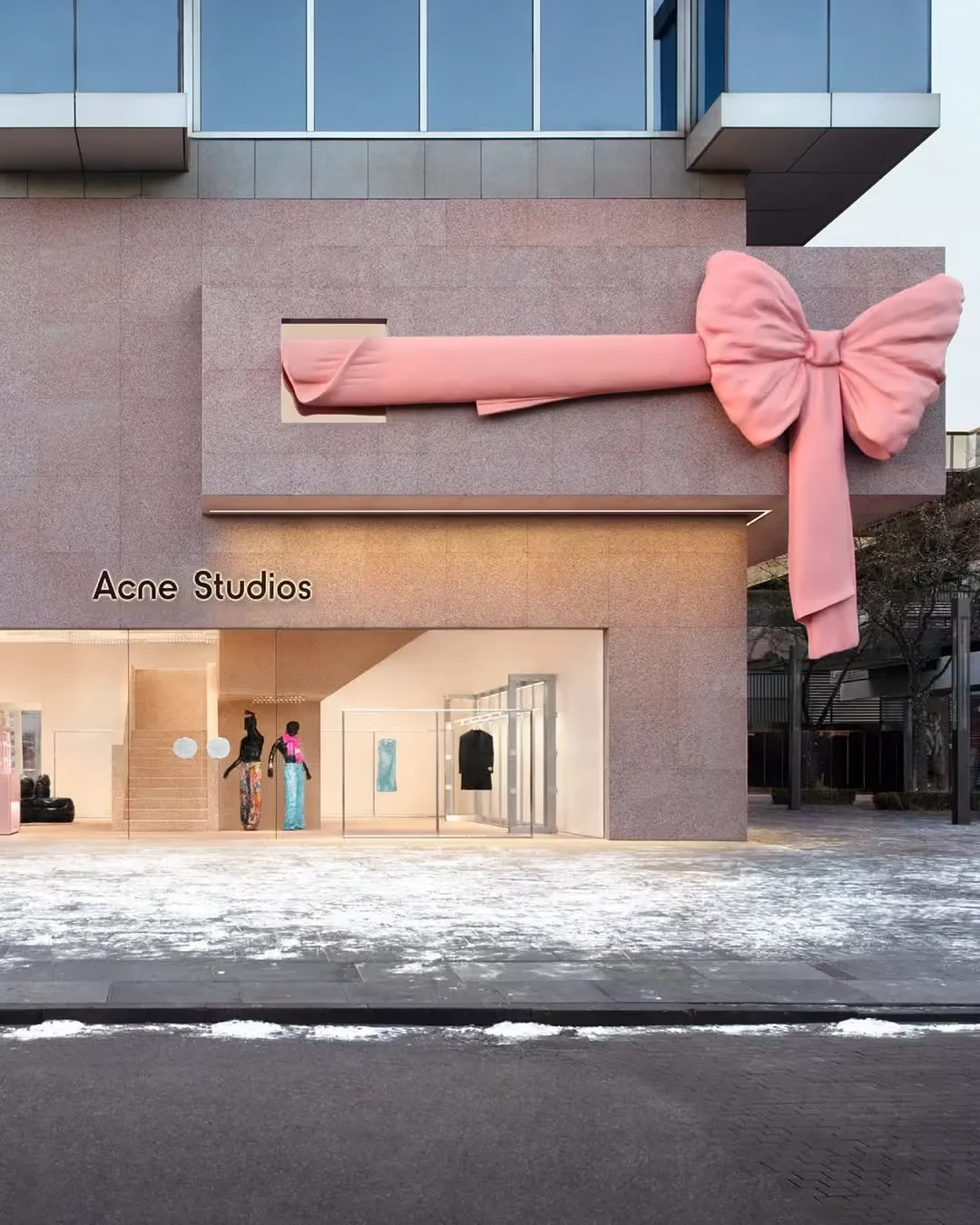
The exterior of an Acne Studios store featuring a massive, oversized pink bow sculpture wrap around the building’s facade, with the brand’s name display above the entrance.
length
Halleroed, the Stockholm studio led by Christian and Ruxandra Halleröd, has designed Acne Studios stores for roughly ten years now, a run that has come to define how the brand’s retail spaces look and feel worldwide, from Tokyo and Beijing to Kuala Lumpur and Vancouver’s Oakridge Park. Christian Halleröd trained as a cabinetmaker before founding the studio in 1998, and its work on Acne Studios has grown out of what its founders describe as a close, personal relationship with Johansson rather than a conventional client-architect arrangement, the kind of familiarity that lets a store’s furniture reference a brand’s own design codes instead of simply displaying them.
That relationship shows in how consistent, and how varied, the results are. Every Acne Studios store built by Halleroed over the past decade shares the same underlying vocabulary: pink granite, sculptural furniture, a mix of hard architecture and soft seating. None of them look identical. The Gansevoort Street store’s grid layout and glass facade are specific to this site, shaped by the width of the block and the presence of the High Line and the Whitney across the street, rather than a template dropped into a new city.
Acne Studios is far from Halleroed’s only client. The studio has also built stores and spaces for Byredo, Totême, and streetwear label Axel Arigato, work that has earned it a Decorator of the Year title from ELLE Decoration’s Swedish design awards and a shortlist for Dezeen’s own interior designer of the year. But the Acne Studios relationship is the studio’s longest-running and most view, the project that made pink granite and monolithic columns as recognizable a Halleroed signature as they are an Acne Studios one.
View this post on Instagram
build
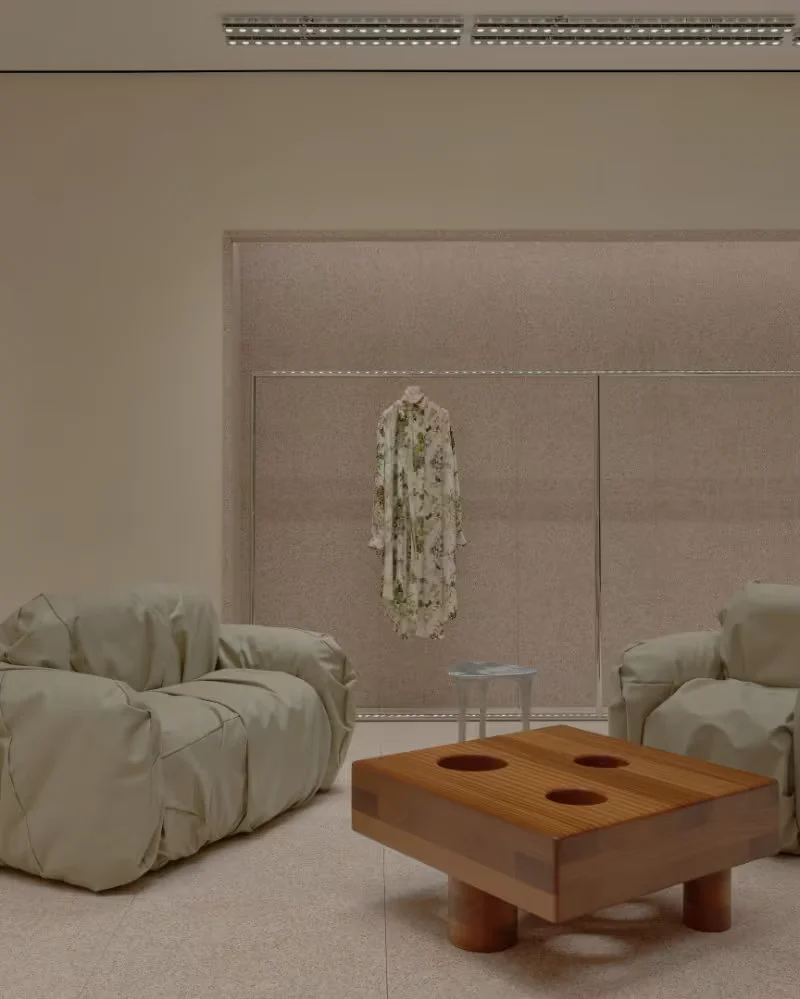
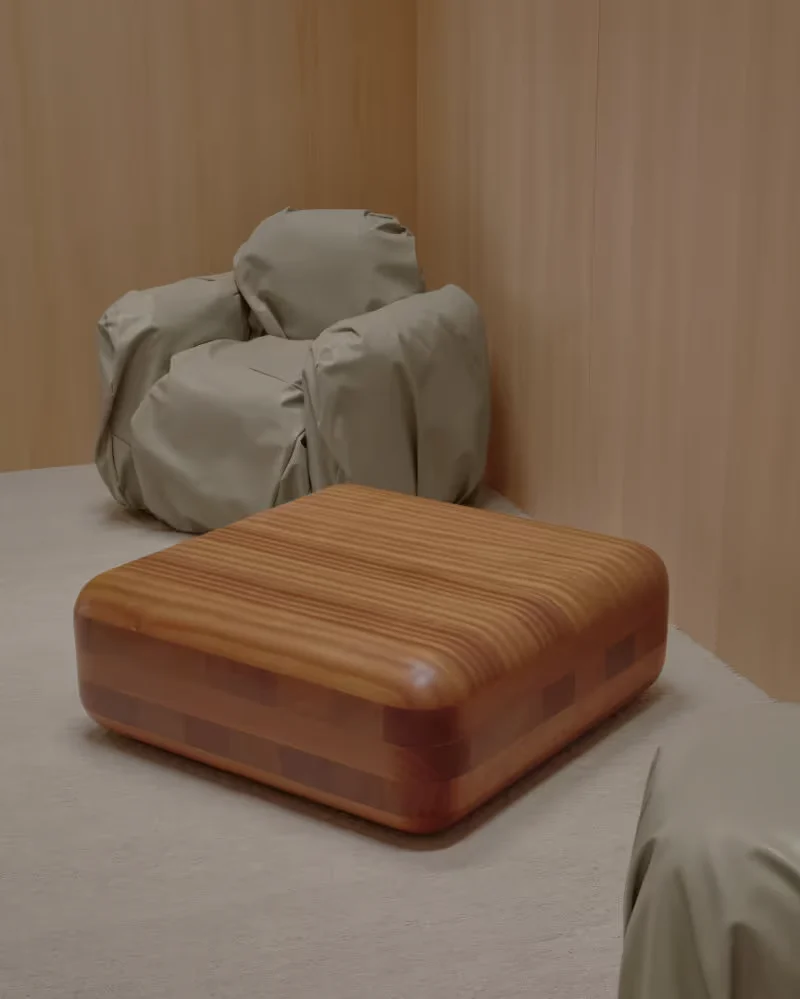
Furniture designer Max Lamb, a frequent Acne Studios convincer since at least the brand’s Madison Avenue store, fill the space with undulating leather sofas and armchairs, their curved sil a deliberate counterpoint to the grid’s straight lines. Wooden stools, low chairs, and daybeds are scatter through the store the way they might be arrange in an actual home, rather than stage as product displays along a wall.
Lamb was born in Cornwall in 1980 and train in three-dimensional design at Northumbria University before completing a master’s in design products at London’s Royal College of Art in 2006, then spend a year design for Tom Dixon before opening his own studio. His early reputation was built on unusual, almost primitive processes, pour molten pewter direct into sand molds, carve stools from single logs, cast furniture from volcanic rock, all approaches that treat a material’s own behavior as the starting point for a design rather than an obstacle to it. That same sensible, exhibited in full at his 2015 “Exercises in Seating” show during Milan Design Week, has made him one of the few designers whose work recurs across nearly every Acne Studios location worldwide, adapting his material lang, leather here, tie-dyed fabric in Chengdu, patchwork weave in Tokyo, to whatever a given store calls for.
Soft pink carpeting runs underfoot, taking the edge off a material palette that is otherwise stone, steel, and glass. The effect softens the store’s more severe geometry without diluting it, and it gives customers an actual reason to sit down rather than move through quickly, a deliberate departure from the fast-turnover logic of a conventional boutique floor.
scope
A street-facing library is arguable the space’s most unusual element, stocked with a rotating selection of art and fashion titles alongside the newest issue of Acne Paper, the brand’s own culture magazine, first launched in 2005 and revived in recent years after a run of dormant seasons. Position so it’s visible through the glass facade, the library invites people to sit and browse without buying anything, an idea closer to an independent bookstore or a members’ club than to a fashion retailer’s usual front window.
It is also a format Acne Studios has used before, including at its Acne Paper library space at the Palais Royal in Paris, and it underlines how much of the brand’s activity outside of clothing, publishing, furniture, gallery exhibitions, has become part of how its stores themselves get built and furnish. The magazine, and the library built around it, function less as marketing than as one more room in the house.
View this post on Instagram
sum
For now, the Gansevoort Street location is carrying pieces from Acne Studios’ Spring/Summer 2026 and Fall/Winter 2026 collections, spanning ready-to-wear, footwear, and accessor, according to Culted‘s own report on the opening. The clothes, in other words, are still the point. But the building around them is doing something most retail architecture doesn’t bother trying: making an argument for why a shopper should stay past the length of a transaction.
The store is open now, a new fixture on a block that already had a museum and a park, and, as of this month, a fashion house’s idea of what a living room looks like when it’s built out of pink granite and glass.
Related Articles

Spotify Let Parents Omit Nursery Rhymes Out Of The Taste File
15 September 2026. Toggle off kids and family music. Wrapped, Discover Weekly, Daily Mix. Retroactive. […]