DRIFT AUDIO
Listen to this story
Choose a voice, then press play.
Rachel Scott staged her second Proenza Schouler show inside the building that first sold the label, decades before it became a museum.
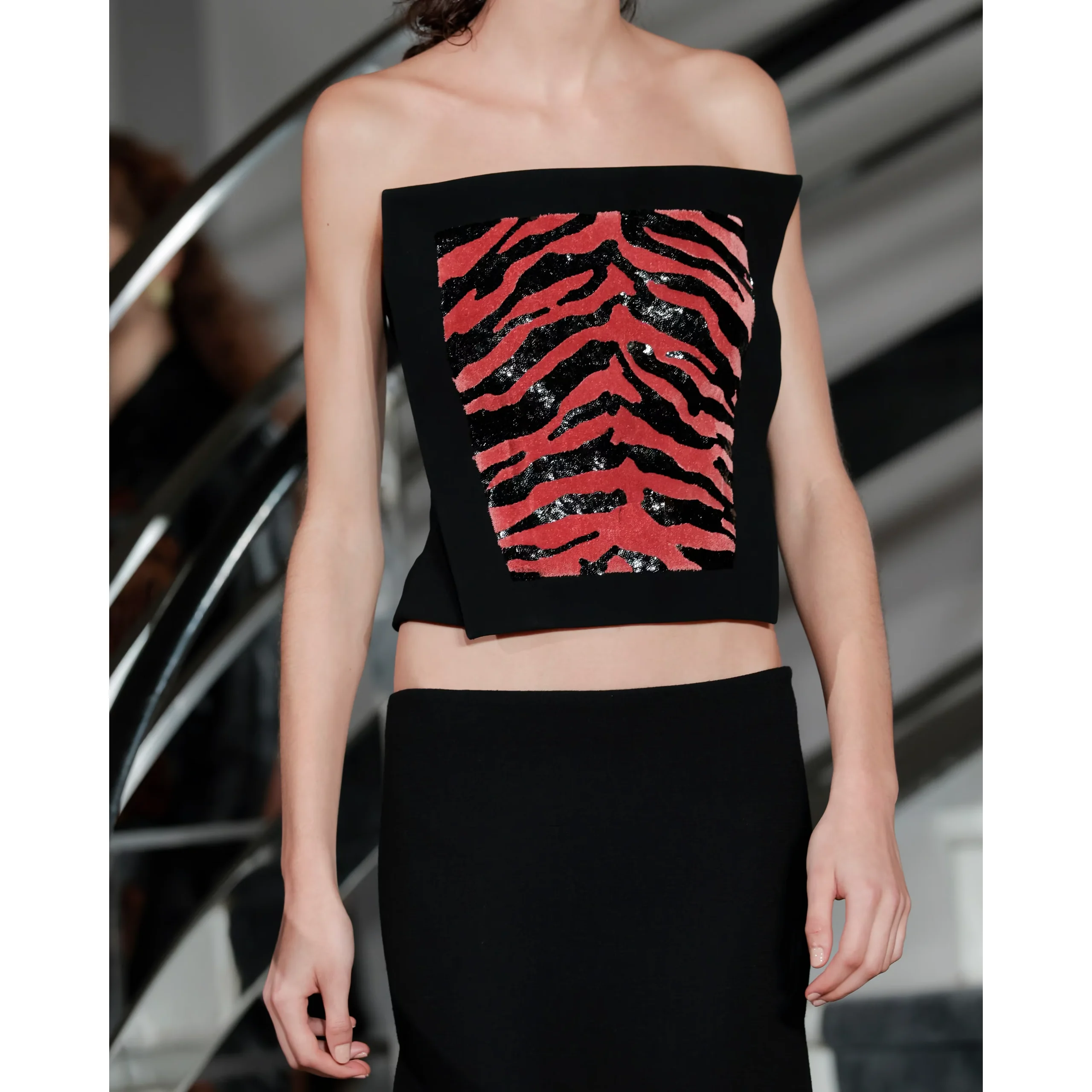
On September 10, Proenza Schouler showed its Spring 2027 collection at 150 West 17th Street, a six-story building most New Yorkers have spent the last two decades knowing as the Rubin Museum. Before that, the address belonged to Barneys New York, and it was Barneys that bought Jack McCollough and Lazaro Hernandez‘s entire senior thesis collection out of Parsons School of Design in 2002, effectively launching Proenza Schouler before the label had a name recognizable outside a critique room. The Rubin closed the building in October 2024 and sold it, but the original six-story spiral staircase survived the conversion from department store to museum, and survived again for Rachel Scott‘s second runway collection as the house’s creative director, sending models down through a space that has now outlived three separate identities.
View this post on Instagram
The venue wasn’t incidental. Scott has spent a year assemble a version of Proenza Schouler that acknowledges its own history without repeating it, and opening her second show in the building where the brand effectively began put a fine point on the project. Her February debut worked more like a foundation: sharp tailor, restrain volumes, a chance to prove she understood the house’s vocab before she started bending it. It also arrived to a somewhat guarded reception at the time; one Italian trade outlet noted that a snow-and-ice New York morning had taken some of the heat out of what should have been one of the season’s hottest tickets. Spring 2027 gave Scott a chance to answer that with more assurance rather than more restraint, and the invitation hinted at the shift ahead of time, an acidic yellow image with its dark markings blurred nearly past recognition, familiar but not quite, by WWD’s account of the run-up to the show.
stir
Vintage PS1 bags, sourced on eBay, sat on the front row as a kind of visual footnote to what would come out on the bag front later in the show. Bureau Betak produced the staging, Marika-Ella Ames styled, Julia Lange cast, and the show ran to a live score by Taul Katz and Jon Nellen with a solo harpist woven through it.
Scott had already signed off on one earlier Proenza Schouler collection, Spring 2026, working alongside the label’s in-house studio before her appointment as creative director became official in September 2025. That made Spring 2027 her second full collection under her own name, arriving seven months after her February runway debut and the first for which she’d had a complete calendar year, rather than a matter of weeks, to work out what the house’s next chapter should look like.

A black and white architectural rendering of a white spiral staircase structure within a minimalist, geometric interior space.
flow
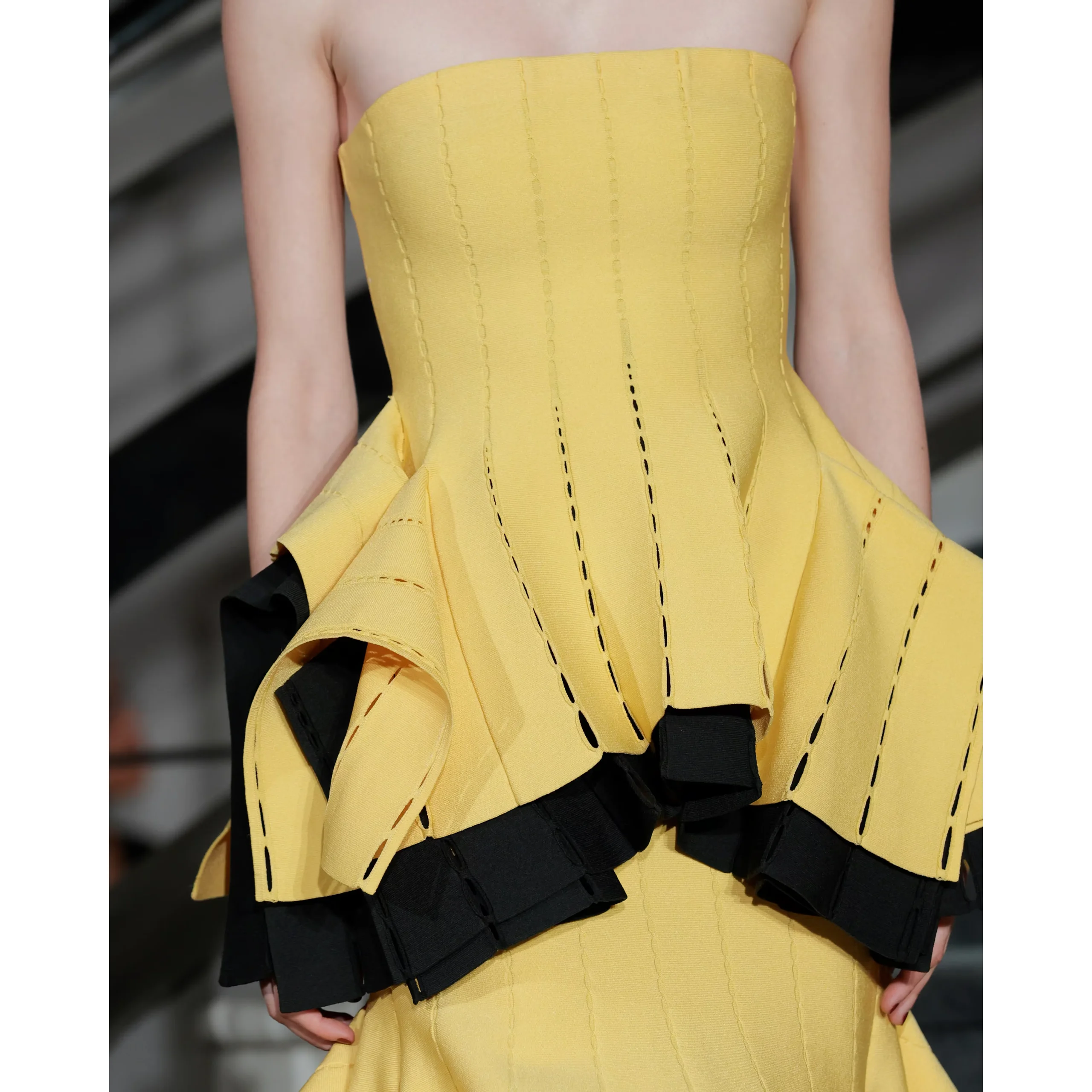
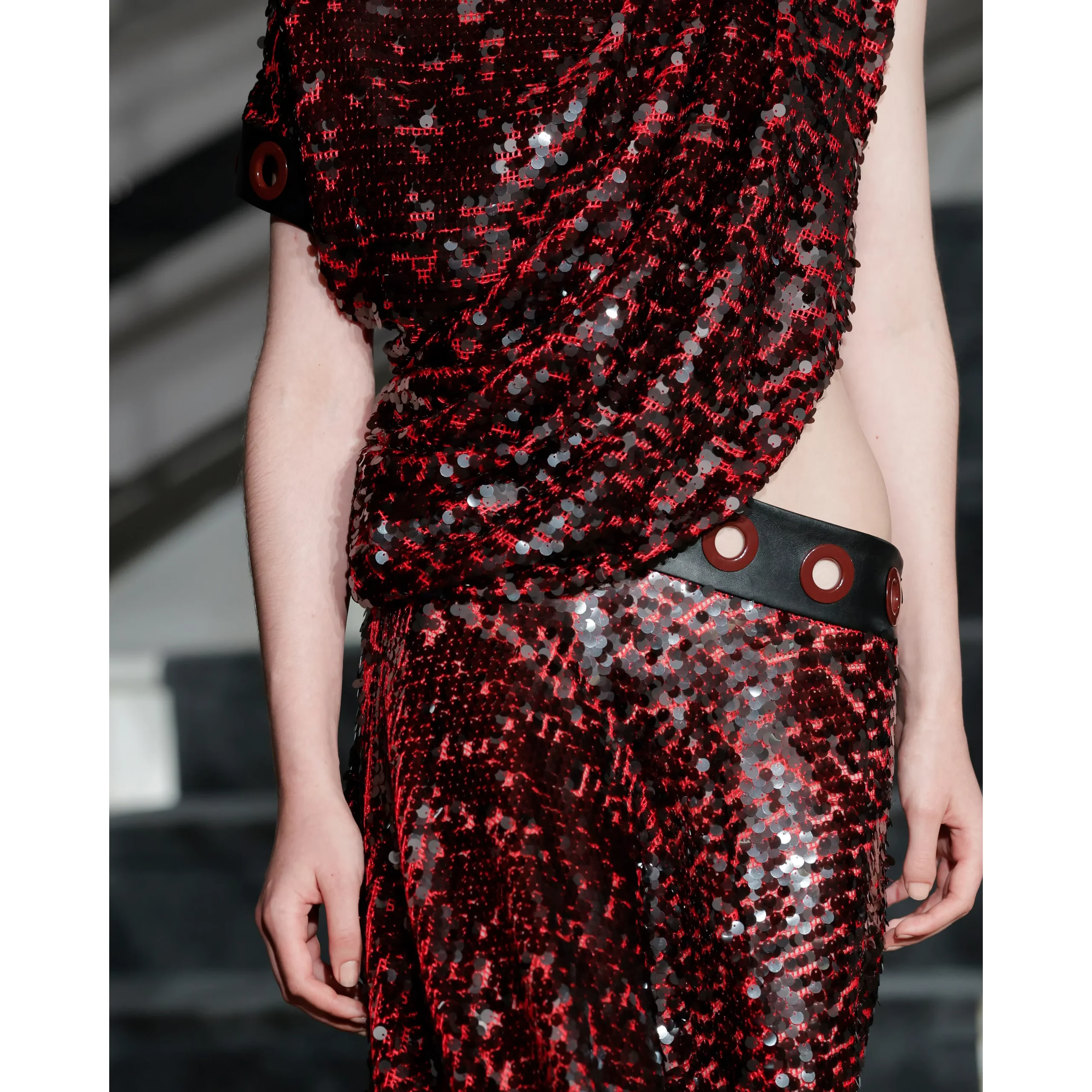
Proenza Schouler’s tailoring has always started at the shoulder, and Scott kept that instinct largely intact, but let it argue with a softer, curvier line through the hip that pulled much of the collection’s silhouette out of straight verticality. Dresses skimmed the body in some places and built volume in others: cowls dropped low across the back, flanges kicked out from a seam, pleats gathered where the fabric had no obligation to lie flat. A chrome yellow pointelle cardigan swelled gently at the waist rather than cinching it. A seafoam strapless dress held close through the torso before breaking into a cascade of articulated flounces at the hem. Diaphanous overlays scattered with pale sequins let flashes of yellow show through from underneath, a small trick that read as spontaneous rather than engineered.
Color did a lot of the collection’s talking. The house’s habitual black and cream carried the base layer, but it kept getting interrupted: chrome yellow, coral, sky blue, and a saturated seafoam ran through dresses, separates, and velvet suiting rendered in hues far brighter than the tailored neutrals Proenza Schouler has favored in past seasons. None of it was matched for conventional harmony. The palette worked because the silhouette gave each color room to sit next to the others rather than compete with them.
The clothes carried Scott’s stated logic directly. “The clothes don’t wear her. There’s a space for her,” she told WWDbackstage, describing an approach to construction that let a garment move somewhat independently of the body inside it rather than shaping that body into a fixed line. It’s the same idea she’s voiced about the Proenza woman more broadly: a wardrobe built for a life that moves between registers over the course of a single day, where a gown can turn casual and a plain piece can carry straight through into evening without changing.
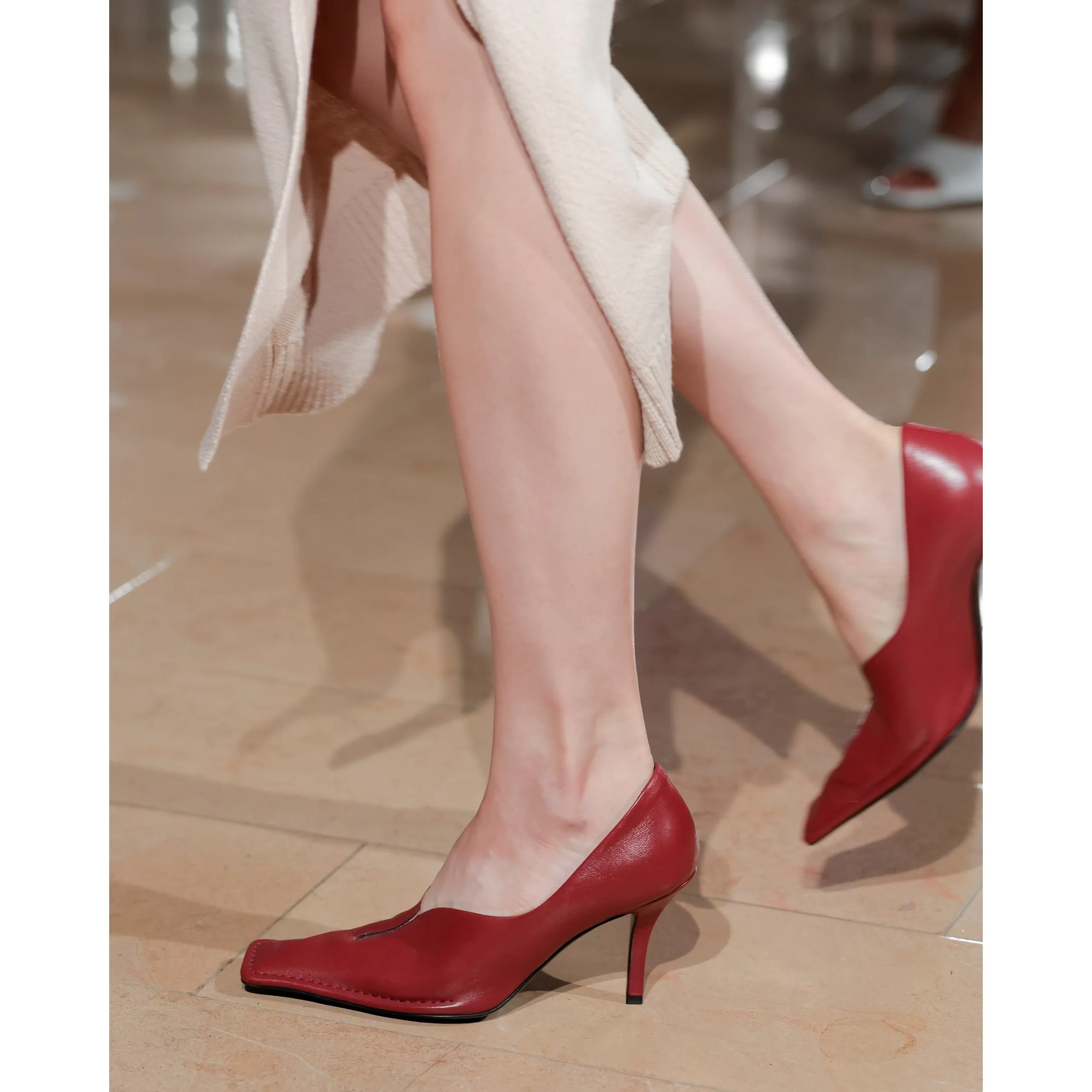
That logic dissolved the line between formal and casual across the runway itself. Slinky, asymmetrically draped gowns went out with flat sandals rather than heels, undercutting any read of the pieces as strictly eveningwear. Buttons sat left undone in places, skirts and dresses twirled loosely rather than snapping back into shape, and the overall effect skewed toward clothes that looked lived in rather than pinned into position for a single walk down a runway.
return
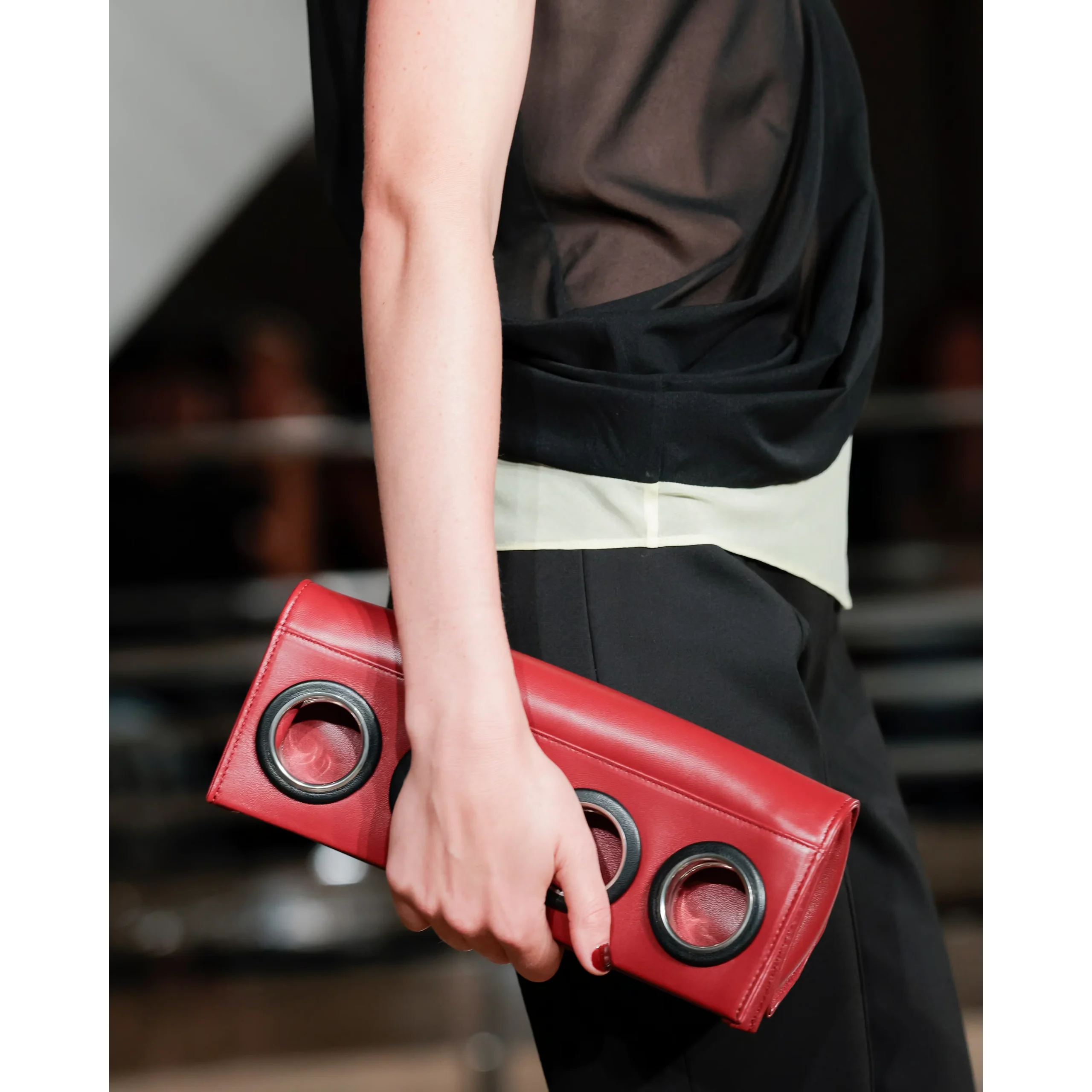
Alongside the runway collection, Proenza Schouler used Spring 2027 to reintroduce its most recognizable accessory. The original PS1 launched in 2008, a messenger-shaped satchel with exposed hardware and a raw-edged flap that became closely associated with the tail end of the 2000s, carried by Mary-Kate Olsen, Kirsten Dunst, and Leighton Meester until it read less like a handbag and more like a generational marker. For Spring 2027, Scott worked with Reed Krakoff, a two-time CFDA Accessories Designer of the Year and Coach’s former president and executive creative director, on a redesign she’s calling the PS1 Walker, named for the brand’s original studio address on Walker Street in SoHo.
The Walker keeps the messenger silhouette, the silver hardware, and the signature flip-lock closure, but softens nearly everything else. The rigid top handle folds into a slouchier shoulder strap. The once-raw front flap simplifies into a cleaner facade, with the diamond tab that used to sit proud on the original now traced only as an outline in heavy track stitching. The leather itself is softer and less structured than the original’s stiffer hide. “The PS1 changed the game, but Walker is for her now,” Scott said of the redesign, framing the new bag less as a replacement than as an update aimed at how the house’s customer actually moves through her day now, nearly two decades on from the original’s debut.
Krakoff’s involvement leaned toward restraint rather than reinvention. “Reed instinctively knew what to leave alone,” Scott said of the collaboration, a comment that lines up with how conservative the redesign actually is next to the original PS1’s proportions. The Walker arrives in three sizes (a $1,650 mini, a $2,090 medium, and a $2,590 large) starting in January 2027, in a color range that spans black, white, and tan alongside chrome yellow and a soft sky blue, plus several suede finishes, all made in Italy.
Bringing the PS1 back at all is its own kind of statement about what Scott thinks the house needs right now. The original bag did as much as any single collection to define Proenza Schouler’s cultural footprint in its first decade. Reviving it under new creative direction, in a form soft enough to read as current rather than nostalgic, gives Scott a product that can carry brand recognition into stores while her runway work is still finding its footing with reviewers.
The timing also puts the Walker inside a broader pattern jure out across accessories right now, where houses are reaching back into their own 2000s archives for sil that can be softened and resold to a customer who wasn’t necessarily shopping the first time around. The PS1 Walker’s combination of a recognizable shape, relaxed construction, and a wider price ladder across three sizes reads as a fairly direct response to that same appetite, rather than a coincidence of timing.
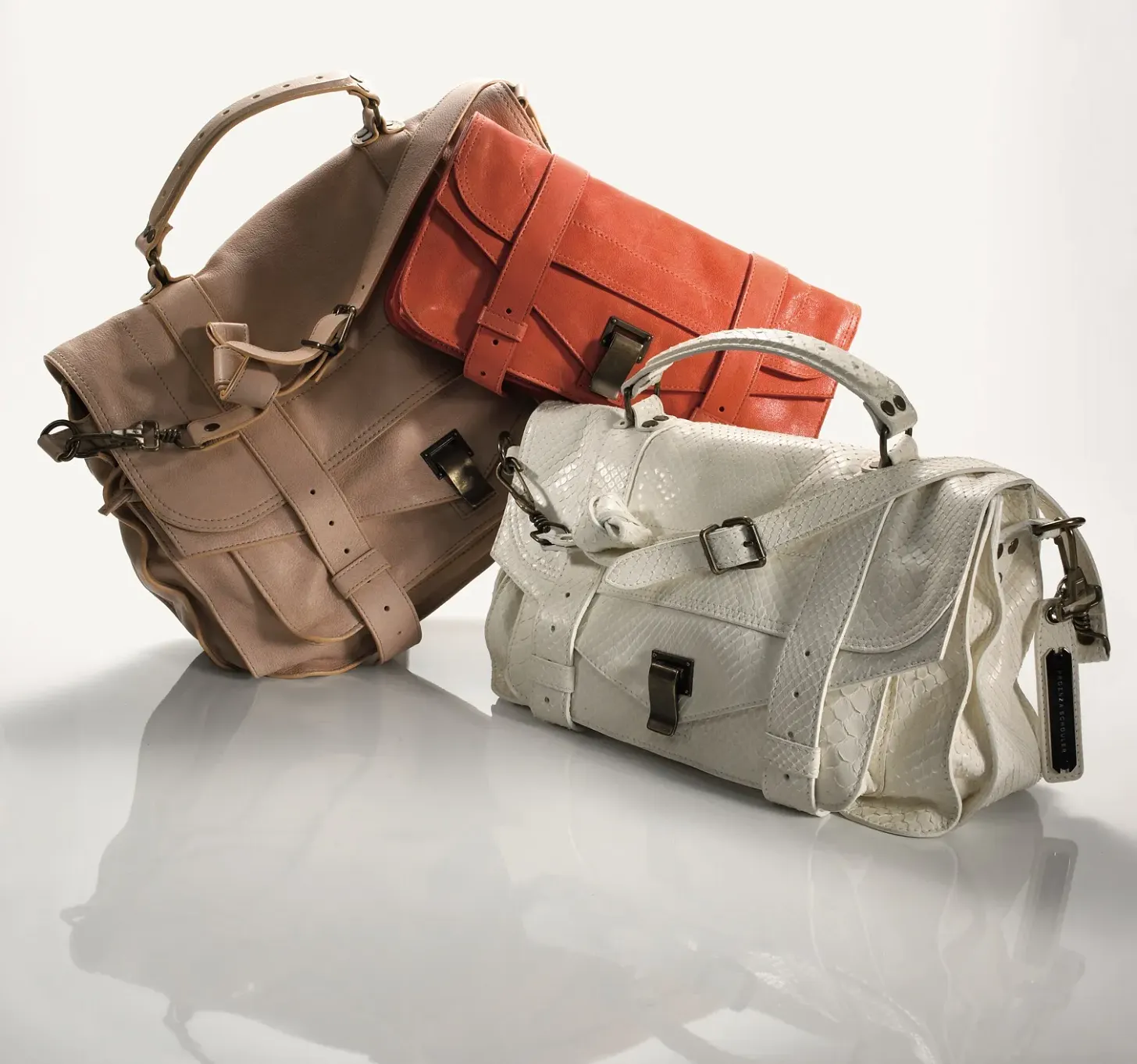
Three PS1 satchel bags by Proenza Schouler in beige, orange, and white python-embossed leather, arranged together on a white surface.
to
Scott arrived at Proenza Schouler already established, though not for runway spectacle. Born in Kingston, Jamaica, she trained at Istituto Marangoni in Milan before work her way through Costume National, J. Mendel, and Elizabeth and James, the label Mary-Kate and Ashley Olsen founded, then spent seven years at Rachel Comey, rising to vice president of design. In 2021, while still at Comey, she launched Diotima, named for the mistress of Eros in Plato’s Symposium, a womenswear line designed between Jamaica and New York and built around hand-crocheted pieces made by Jamaican artisans, alongside tailoring cut from British tweeds and Italian wool.
Diotima moved fast. Its crochet pieces turned up on Doja Cat and Letitia Wright within a couple of years of the brand’s launch, and Scott herself became enough of an industry fixture that Ayesha Curry once hosted a Jamaican-themed dinner in Oakland in her honor. Scott was a 2023 finalist for the LVMH Prize, won the CFDA‘s Emerging Designer of the Year award that same year, and took the CFDA’s American Womenswear Designer of the Year title in 2024, becoming the first Black woman to win that specific honor. She was still running Diotima full time when Proenza Schouler came calling. Jack McCollough and Lazaro Hernandez announced in January 2025 that they were stepping back from the label they’d founded together twenty-three years earlier. The pair moved to Loewe that March, succeeding Jonathan Anderson, and Proenza Schouler named Scott creative director that September, a role she has held alongside, rather than instead of, her own label.
View this post on Instagram
She’s continued designing Diotima’s own collections throughout her Proenza Schouler tenure, effectively running two design studios through the same New York Fashion Week calendar twice a year. That workload has become something of a talking point around her appointment, less as a warning sign than as evidence of the range she’s been asked to bring to a much larger, more established house’s most closely watched seasonal moment.
hint
Spring 2027 is still early in Scott’s tenure, only her second full collection, but the volume of coverage it drew, WWD, Who What Wear, and The Impression all filed reviews within days of the show, is itself a sign of how closely the industry is watching this particular handoff. Critics review the show have started asking a more pointed question than whether Scott understands the house’s codes. She clearly does. The Impression‘s review of the show described her handling of Proenza Schouler’s construction, material experimentation, and balance of polish and rawness as increasingly fluent rather than merely competent, and scored the outing well across engagement and styling. What that same review flagged as unresolved is whether fluency in a house’s existing vocabulary is enough to generate new demand for it, particularly with McCollough and Hernandez now running a far more visible design operation at Loewe and keeping Proenza Schouler’s founding generation squarely in the industry’s field of view.
That question sits underneath everything about this moment for the brand. Proenza Schouler is a New York label built for more than two decades around two specific people’s design instincts, now being reshaped by a third designer who spent the last five years building a completely different kind of label of her own. Scott’s own answer, at least so far, has been to treat New York itself, rather than any single reference point in the Proenza archive, as the throughline connecting her Diotima instincts to the house she inherited. Spring 2027 read as a version of that answer still being worked out in public, one collection at a time, with the brand’s most recognizable product reintroduced alongside it as a reminder of what worked the first time around.
Related Articles

Spotify Let Parents Omit Nursery Rhymes Out Of The Taste File
15 September 2026. Toggle off kids and family music. Wrapped, Discover Weekly, Daily Mix. Retroactive. […]