DRIFT AUDIO
Listen to this story
Choose a voice, then press play.
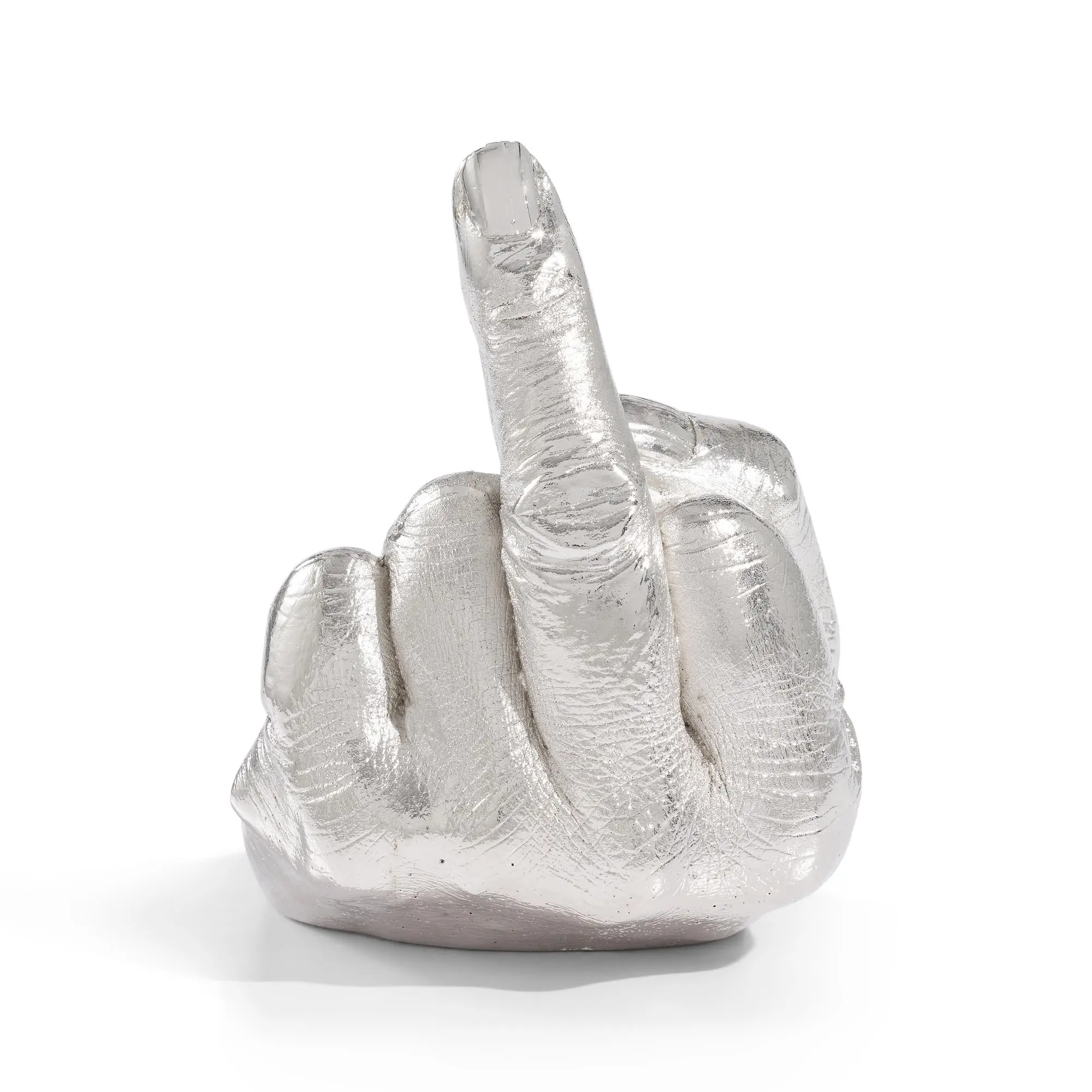
In October 2017, Ai Weiwei put his raised middle finger on eBay as a mirror-bright rhodium cast: 1,000 copies at $675, every dollar backing a New York public art show.
The object is smaller than the gesture’s reputation. Ai Weiwei‘s Artist’s Hand stands about five inches tall and four inches wide and deep, a cast of the artist’s own hand with the middle finger raised, finished in electroplated rhodium over cast urethane resin. Each of the 1,000 casts carries his signature incised into the underside, and each shipped in a plain cardboard presentation box. The edition is unnumbered, and one seller who bought a cast directly from the publisher put its weight at roughly 680 grams.
Signal. What happened: nine years after its rel, Ai Weiwei’s Artist’s Hand remains one of the most widely held physical version of his best-known image, turning up regular at auction and in dealer stock while the artist unveils new public work, most recently in Sydney. Exact object: Artist’s Hand (2017), cast urethane resin with electroplated rhodium, approximately 5 x 4 x 4 inches, unnumbered edition of 1,000, sig incised on the underside, published by Public Art Fund and eBay for Charity as a benefit edition. When and where: sold exclusively on eBay from October 17 to 27, 2017, at $675 each, to fund the citywide New York exhibition Good Fences Make Good Neighbors (October 12, 2017 to February 11, 2018). Source: the sale announcement published by Hyperallergic on the day the exhibition opened, Public Art Fund’s exhibition record, and auction lot records from Sotheby’s, Phillips, Bonhams and Wright. Why it matters: it turned a photographic protest Ai has been making since 1995 into a desk-sized object that a thousand people could own, and its resale record now runs to several multiples of the original price. Earlier: September 2026 features on Andy Warhol’s Mickey Mouse, from Myths and Louise Bourgeois’s I Have Been to Hell and Back handkerchief, both built around a single edition or multiple.
The sale ran for ten days, exclusively on eBay, from October 17 to 27, 2017. Alongside the hand, Ai offered a $100 print called Odyssey, also in an edition of 1,000, rendering the global refugee crisis in the manner of a Greco-Roman frieze. Every dollar from both went to Public Art Fund’s exhibition, and Ai framed the purchase as support for a cause rather than a collectible, telling buyers, “There is no refugee crisis, only a human crisis.”
eleven
The hand did not start as sculpture. It started in 1995, in Tiananmen Square, six years after the 1989 crackdown on the student protest movement, when Ai stretched his arm toward the Gate of Heavenly Peace and photographed his own raised middle finger in the foreground. The composition borrowed the look of a tourist snapshot, which was the point: the landmark shrinks, the hand looms, and the viewer’s eye goes where the photographer wants it.
That image became the first of the series Study of Perspective. Over the following years the finger was aimed at the White House, the Eiffel Tower, the Reichstag in Berlin and the Mona Lisa, and in 2017 at Trump Tower in New York. The Museum of Modern Art holds a gelatin silver print of the Tiananmen picture, dated 1995 to 2003 and numbered 6 from an edition of 10. The first photograph shares its year with Dropping a Han Dynasty Urn, the triptych in which Ai lets a 2,000-year-old ceremonial urn fall from his hands and shatter.
The series traveled with the platforms Ai used. He blogged prolifically from 2005 until Sina shut the blog down on May 28, 2009, then moved to Twitter, writing almost entirely in Chinese under the handle @aiww, and later to Instagram. After Chinese authorities returned his passport in 2015, the gesture became a kind of greeting: he posted middle-finger portraits with Anish Kapoor and with Julian Assange inside Ecuador’s London embassy.
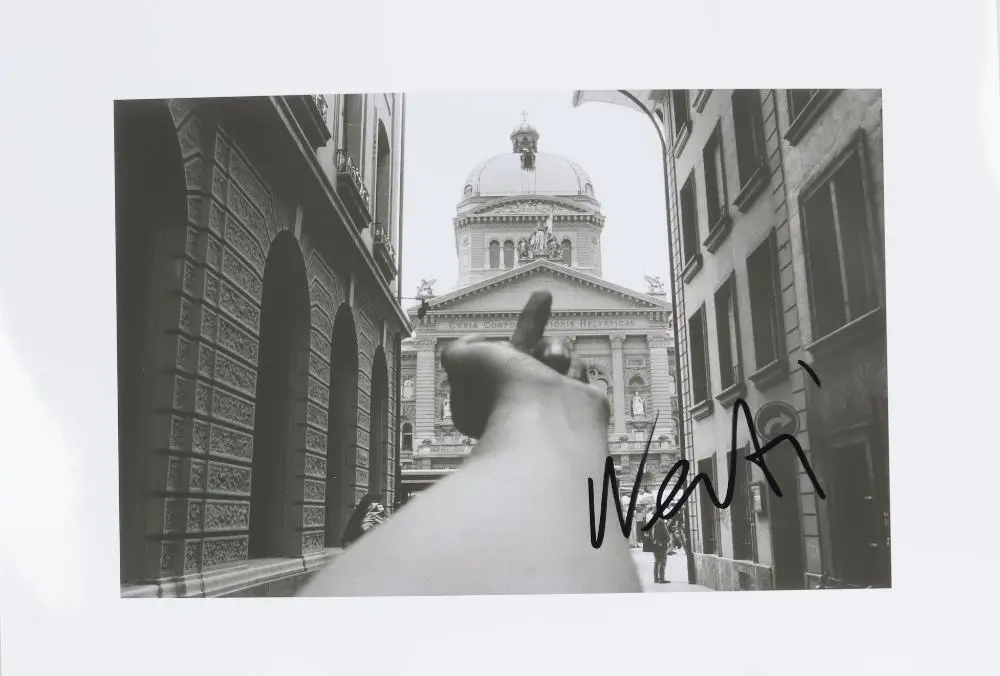
The biography behind the gesture explains its aim. Ai was born in Beijing in 1957, the son of the poet Ai Qing, who was denounced during the Anti-Rightist Movement. The family was sent into exile in Shihezi, in Xinjiang, where his father was made to clean the communal toilets. Ai studied at the Beijing Film Academy, spent the 1980s in New York as a student at Parsons School of Design, and returned to China in 1993. Back in Beijing he served as artistic consultant to Herzog & de Meuron on the Beijing National Stadium for the 2008 Olympics, and in 2010 he filled Tate Modern’s Turbine Hall with 100 million hand-painted porcelain sunflower seeds. In April 2011 he was detained at Beijing Capital International Airport and held for 81 days without charge, and his Beijing studio was razed in 2018. Since leaving China in 2015 he has lived in Germany, the United Kingdom and Portugal. Along the way he received the Václav Havel Prize for Creative Dissent in 2012 and Amnesty International’s Ambassador of Conscience Award in 2015.
flow
Artist’s Hand was a fundraiser for the largest public project Ai had attempted. Good Fences Make Good Neighbors was the culmination of Public Art Fund’s 40th anniversary year, curated by the organization’s director and chief curator, Nicholas Baume, with associate curator Daniel S. Palmer, and it spread across more than 300 sites in all five boroughs from October 12, 2017 to February 11, 2018. The subject was the fence: security barriers, cages and netting, set against the global migration crisis and a new American politics of border control.
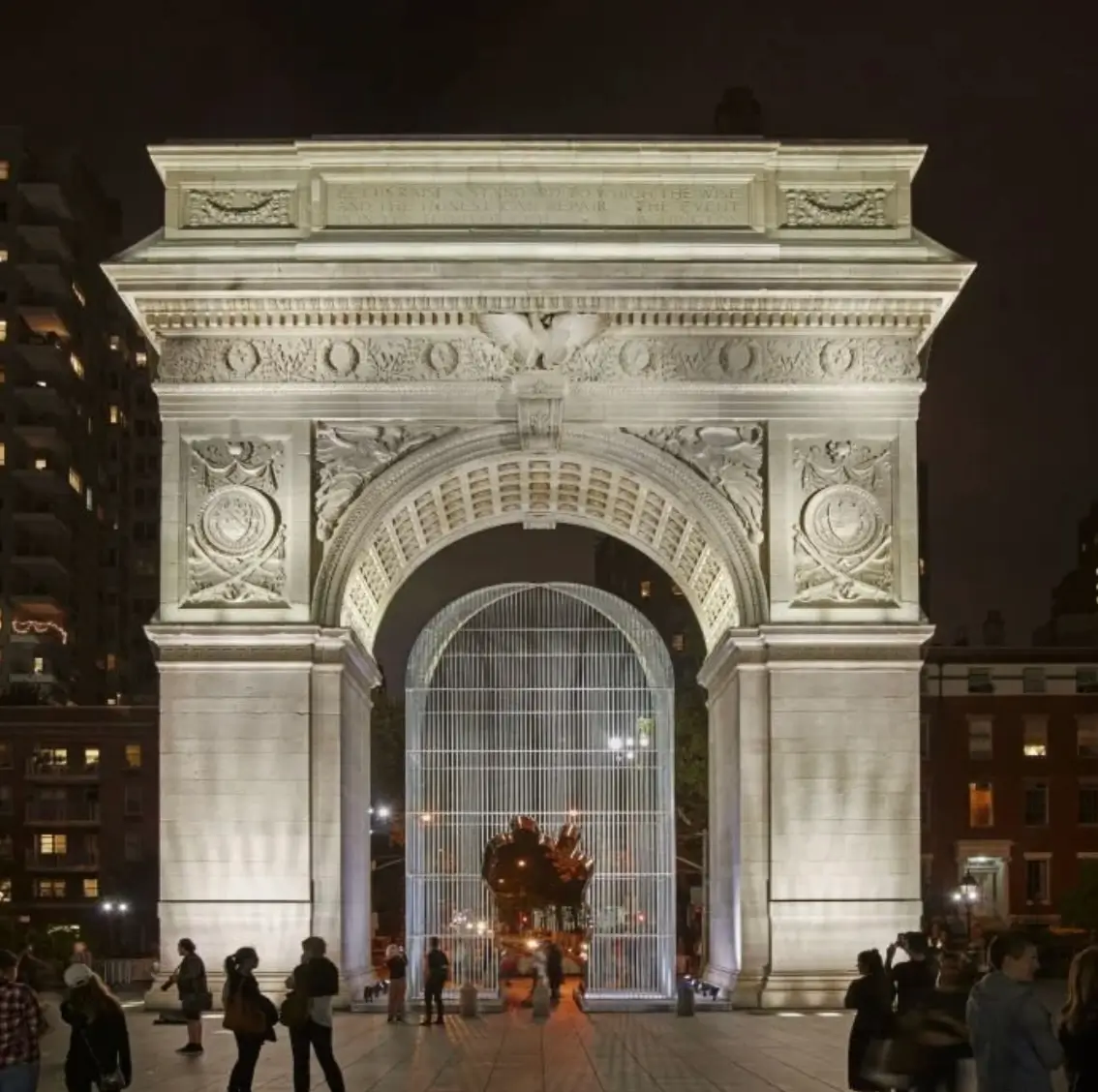
The major pieces were hard to miss. Gilded Cage, a walk-in golden structure, stood at Doris C. Freedman Plaza at the southeast corner of Central Park. In Queens, Circle Fence ringed the Unisphere at Flushing Meadows Corona Park with mesh netting. Inside the Washington Square Arch, built in 1892 for the centennial of George Washington’s inauguration, Ai installed a cage nearly 40 feet tall, cut through by a polished mirror passageway shaped like two joined human silhouettes, a reference to the doorway Marcel Duchamp designed for André Breton’s Gradiva gallery in 1937. Ai described the result as “a door obstructed, through which another door opens.”
Downtown, the interventions grew out of the buildings themselves. Rooftop fences went up on 189 Chrystie Street, a 1920s sign factory turned nightclub, and on 248 Bowery, a building dating to before 1830. Five Fences filled the arched openings on the north portico of The Cooper Union’s Foundation Building, and a sequence of flagpole banners across the Essex Street Market facade, titled Exodus, depicted refugee journeys. Ten bus shelters in Downtown Brooklyn, Harlem and the Bronx gained fence-like sculptural additions that doubled as extra seating. Public Art Fund cited Richard Serra, Gordon Matta-Clark and Trisha Brown among the minimal and conceptual artists whose interventions in the city Ai was working after.
Some of the most personal work was the smallest. At 48 East 7th Street in the East Village, the street where he lived in a basement apartment as a student in the 1980s, Ai fitted a fence into the gap between two buildings. Two hundred lamppost banners carried portraits of immigrants, from Augustus Sherman’s Ellis Island photographs to phone shots Ai took in refugee camps, and 98 documentary images drawn from his 2016 travels to 23 countries and more than 40 camps while filming Human Flow appeared on bus shelters and LinkNYC kiosks. On five Manhattan newsstands, a series called Odyssey 1 to 5 used the same black-figure frieze style as the $100 print sold beside the hand.
Baume, introducing the show, called Ai unusual for combining the roles of leading contemporary artist, political dissident and human rights activist at such scale, and described the exhibition as a culmination of his work to that point. The hand came with its own brief. The sale announcement described it as a rejection of authority and political oppression and an affirmation of individual expression, the same terms long used for the photographs, and Public Art Fund’s curatorial statement tied the whole exhibition back to Ai’s personal experience of being an outsider, first in exile in China and then as an immigrant in New York.
extend
The $675 price did not last long on the secondary market. A cast estimated at $2,000 to $3,000 sold for $5,625 at Wrightin Chicago in July 2019, and a private sale that June, of a cast acquired directly from the publisher, closed at 4,500 euros. Since then the multiple has become a regular in edition sales: Sotheby’s offered one in its 2020 Important Prints and Multiples day sale, Phillips has handled it in New York and London, and it has passed through Bonhams and Los Angeles Modern Auctions, where estimates have ranged from $4,000 to $6,000 in September 2024 down to $2,000 to $3,000 in March 2025.
Dealer pricing sits higher, with one London gallery listing a cast at £6,250 and a 1stDibs listing showing $6,600, marked down from $11,000.
A few details recur in how the object is catalogued. Houses consistently note the original cardboard box, and condition reports flag the surface: one Sotheby’s report pointed to tiny imperfections on a few fingers, fingernails and the base. Measurements drift slightly from listing to listing, from 12.4 by 9.5 by 10.8 centimeters to 12.7 by 10.2 by 10.5, and so does the title: Artist’s Hand, The Artist’s Hand, Artist’s Hand (Middle Finger), and on one British auction listing, simply Finger Sculpture.
The hand is a modest entry point to a market with a much higher ceiling. Three gold sets of Ai’s Circle of Animals/Zodiac Heads have sold at auction for between about £2.2 million and £2.9 million, at Phillips in 2015 and 2017 and at Sotheby’s in 2019, while many of his editions trade in the four and five figures. His work sits in the collections of MoMA, Tate, the Guggenheim, the Centre Pompidou and the Los Angeles County Museum of Art.
fin
The gesture has not stayed in rhodium. Ai returned to the finger in Finger, from the 2018 series Ex-Votos, and in prints such as Middle Finger in Red, which came up at auction in February 2026.
His public work has kept its scale. On September 25, Ai unveiled Mushrooms on the waterfront lawn of the Museum of Contemporary Art Australia in Sydney: 500 cast-iron replicas of 20th-century military helmets arranged in ten rows across roughly 40 meters, facing the harbor, as the second Neil Balnaves Tallawoladah Lawn Commission. He told The Art Newspaper that the work is “a metaphor and a warning” about how quickly humanity could slide into darkness, and said the title points to growth in darkness, nuclear mushroom clouds and, in Chinese, endless delay. It will stay on the lawn for seven months. The commission is a four-year program running from 2025 to 2028; its first edition, in 2025, was Ancient Feelings, a towering bust by the British sculptor Thomas J. Price. Ai’s last major Sydney appearance was Law of the Journey, the oversized black inflatable lifeboat crowded with faceless refugee figures that he showed on Cockatoo Island for the 2018 Biennale of Sydney.
Earlier this summer, Factory International staged Ai Weiwei: Button Up! at Aviva Studios in Manchester from July 2 to September 6, a survey of two centuries of relations between China and Britain, rooted in the city’s industrial history. Reviews split, with some critics arguing that the sheer scale of the installations swamped the ideas behind them. In February, members of the Royal Academy of Arts, which made him an Honorary Academician in 2011, voted on his membership over a since-deleted 2023 post about the war in Gaza, and chose to keep him.
The hand itself keeps circulating. Artsy’s auction records list another cast, catalogued as The Artist’s Hand (The Middle Finger), offered in March 2026, nearly nine years after the first thousand left eBay at $675 each.