DRIFT AUDIO
Listen to this story
Choose a voice, then press play.
Salvaged as a South London estate comes down, chunks of Brutalist concrete become small, tender records of the homes they once held.
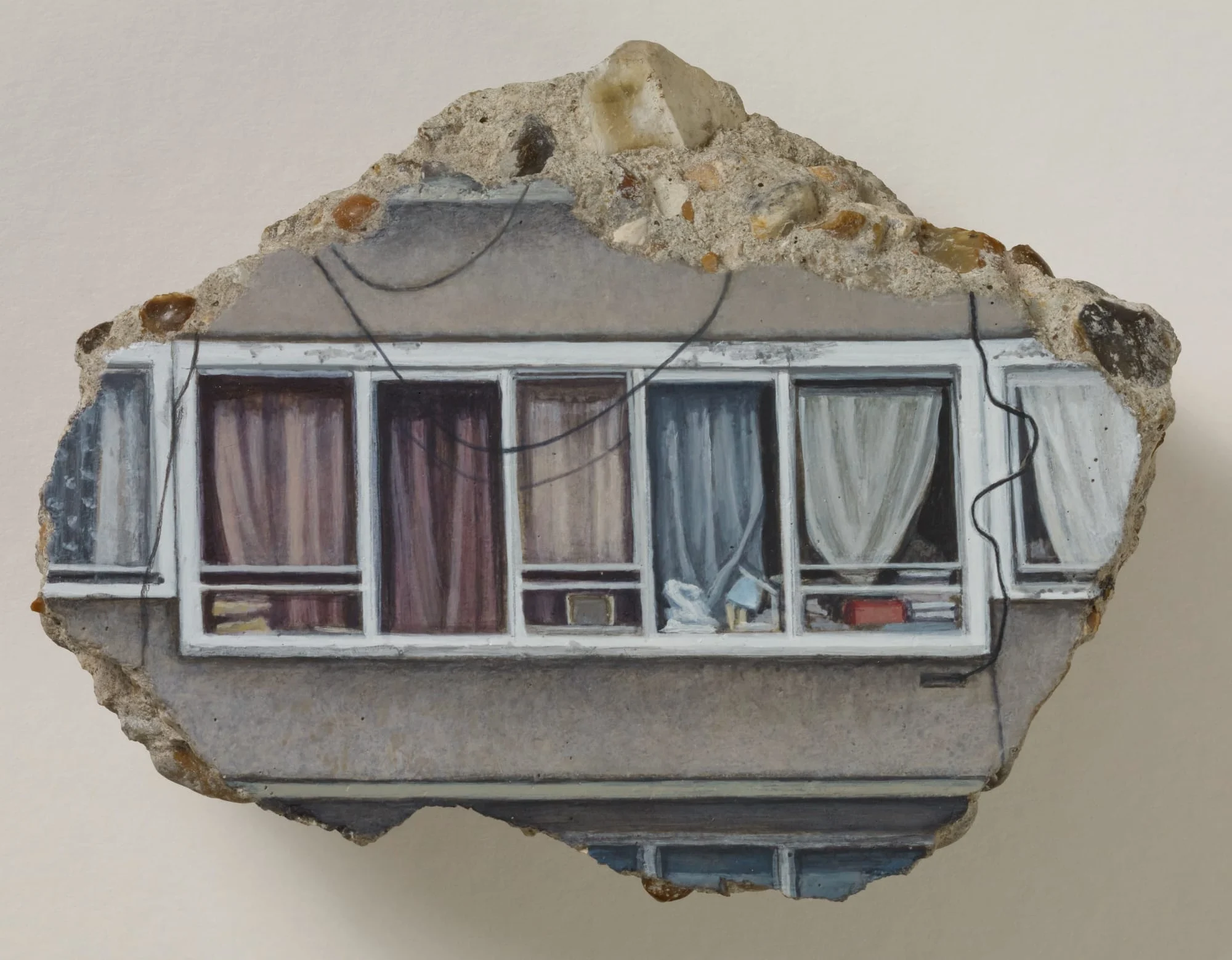
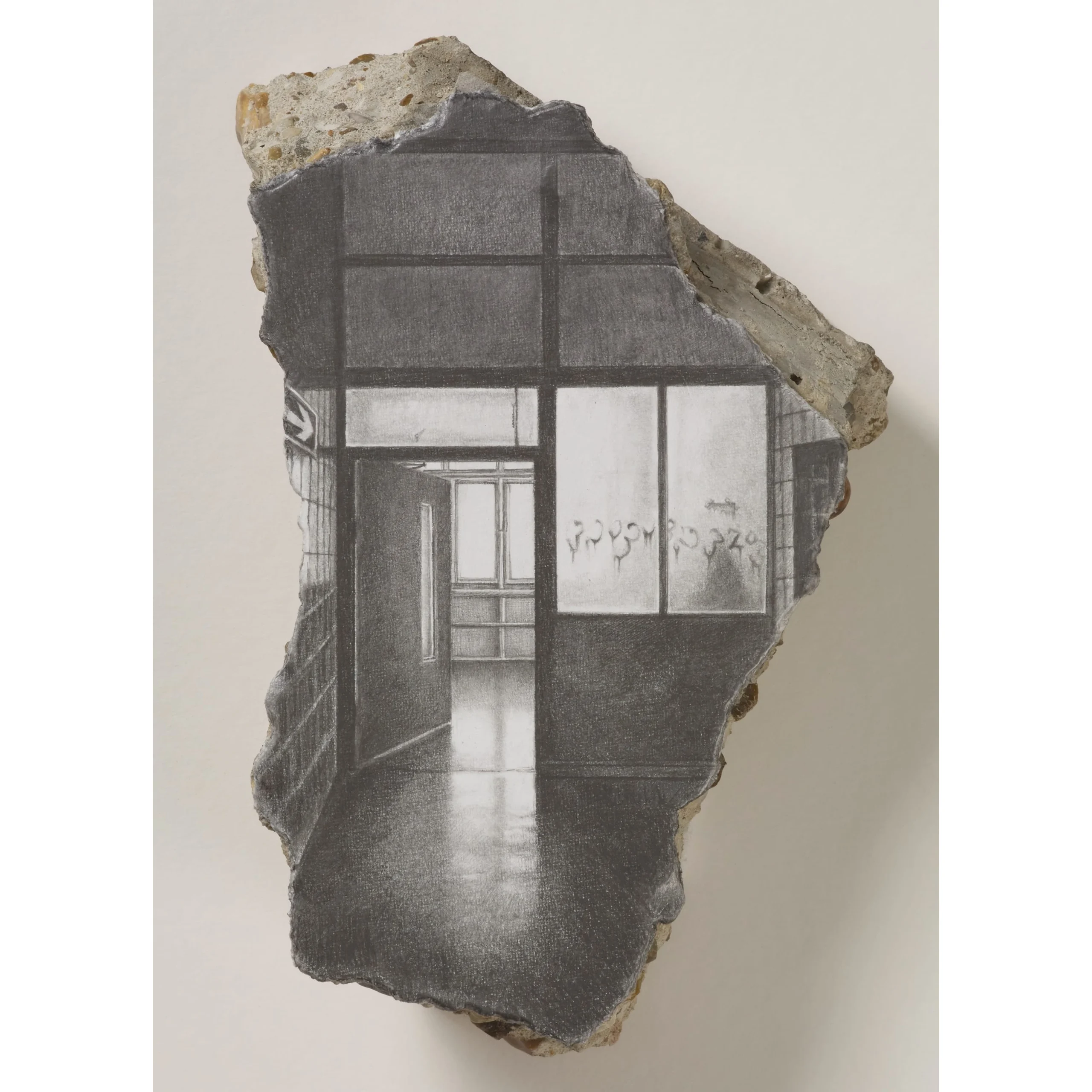
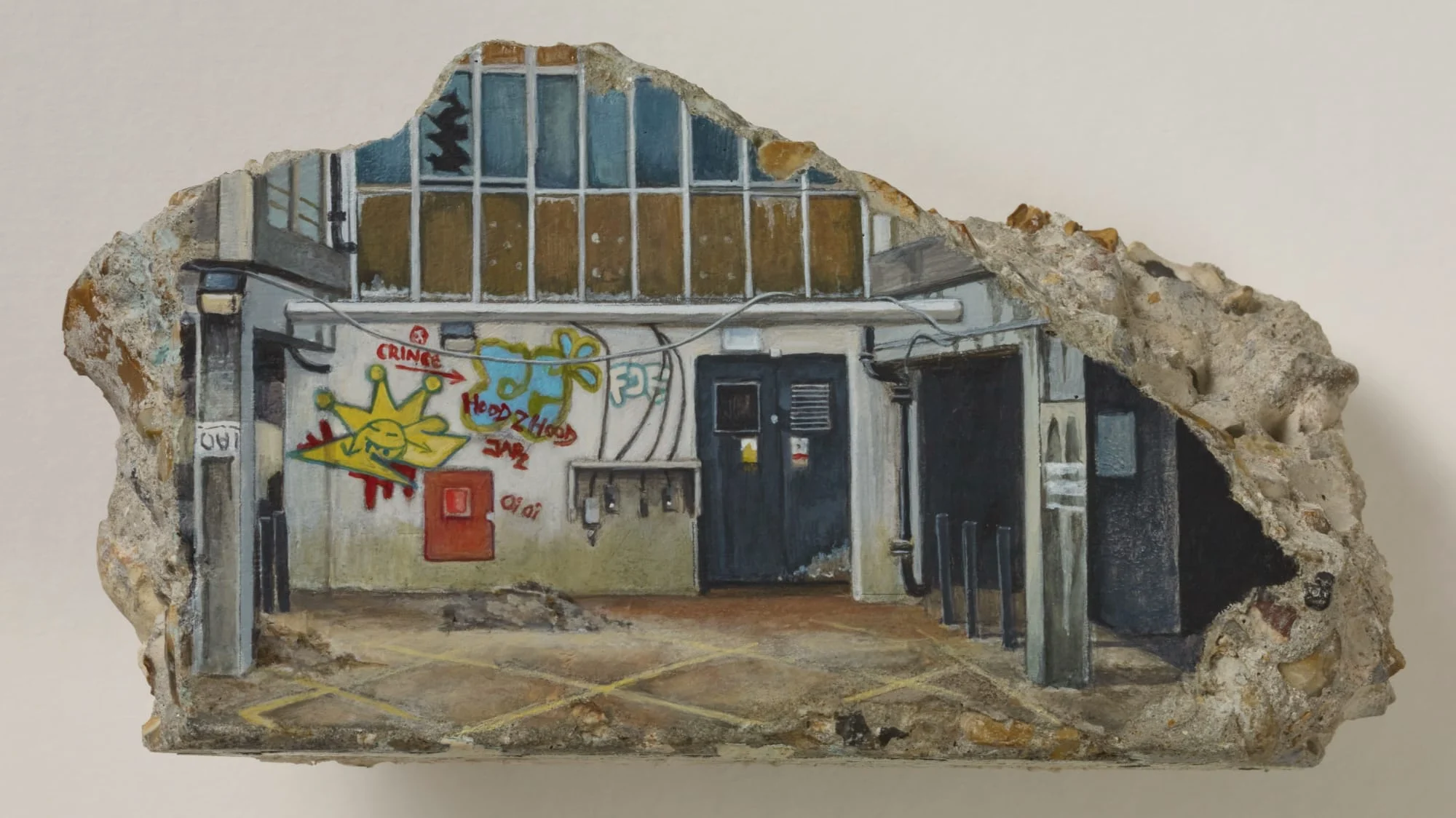
In the spring of 2020, while London sat indoors under lockdown, the demolition of Chiltern carried on. The block, one of the long concrete slabs of the Aylesbury Estate in Walworth, had at one point been home to more than 500 residents. Crews took it apart between March and July of that year. Harriet Mena Hill, a painter who had spent the previous two years running art workshops on the estate, watched families she knew stay shut inside their flats while the homes of their former neighbours were broken up next door. So she started collecting the pieces, carried the salvaged concrete back to her studio, and began to paint on it.
Signal. What happened: Hill’s six-year project on the estate has drawn a fresh round of attention this month, with a September 25, 2026 feature by Grace Ebert at Colossal and a profile in Hi-Fructose Issue 79, and the artist now counts more than 150 finished paintings in the series. Exact object: The Aylesbury Fragments, an ongoing series of paintings made directly on concrete salvaged from the estate’s demolition, shown alongside its sister series of felted wool portraits, Soft Concrete. When and where: The series began in early 2020 with concrete from Chiltern and remains in progress in South East London; it had a solo showing at London’s Eagle Gallery in 2021, and Hill has exhibitions slated for London and elsewhere in the UK through 2027, with venues and dates not yet announced. Source: The artist’s own site and CV. Why it matters: As one of Europe’s largest public housing estates is dismantled phase by phase, Hill is building a physical archive out of the demolition itself, shaped by years spent working alongside the people who lived there.
A detailed, texture
stir
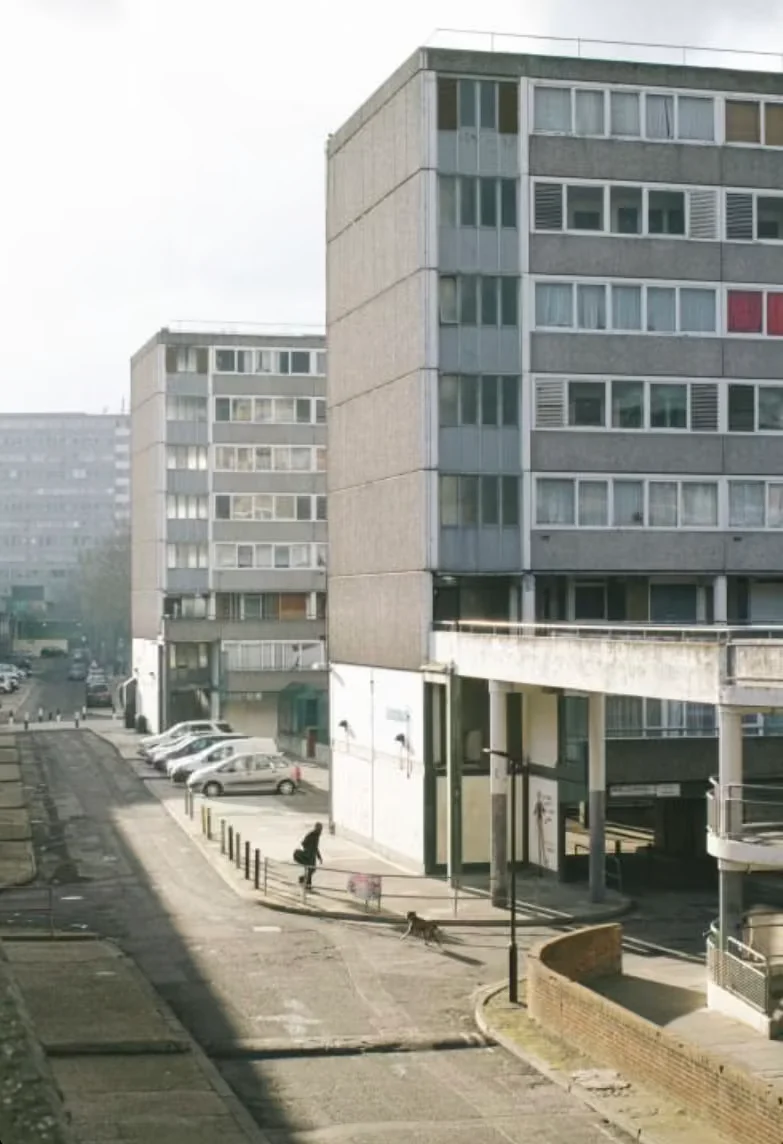
Before it became shorthand for everything said to be wrong with British council housing, the Aylesbury was a statement of ambition. Construction started in 1963 to a design by architect Hans Peter “Felix” Trenton, and by 1977 the estate held roughly 2,700 homes intended for around 10,000 people, making it one of the largest public housing developments in Europe. It was part of Southwark Council‘s slum clearance programme, and its planners borrowed openly from Le Corbusier’s idea of the radiant city: standardised units, raised walkways separating people from traffic, generous light and air. The blocks were named for towns and villages in Buckinghamshire, which is why a housing estate in inner London has buildings called Chiltern, Wendover, Taplow, Padbury and Missenden.
The decline arrived fast. By the 1980s, maintenance problems had set in and the estate’s reputation was sliding. In 1997, a newly elected Tony Blair chose the Aylesbury for his first speech as prime minister, using it as the backdrop for a promise that the country’s poorest would no longer be forgotten. From 2004 to 2015, the estate’s balconies also starred in a Channel 4 station ident, a slow camera move past what looked like rubbish-strewn walkways and drooping washing lines. Much of that squalor was dressed in by the film crew. Residents campaigned for years against the image, and one local development trust went as far as commissioning its own gentler remake.
In 2005, Southwark decided that bringing the buildings up to a decent standard, a job priced at around £350 million, was not worth it. The estate would be demolished and rebuilt in phases instead, with a housing association as the long-term partner. That partner is now Notting Hill Genesis. The first new homes on the site were finished in 2013, and more than a decade later the regeneration is still less than half done. Opposition has been steady throughout: tenants had already voted down a housing association stock transfer in 2001, activists occupied empty blocks in 2015, and some residents have spent years arguing that refurbishment was always the better option.
flow
Hill knows this ground. Born in London in 1966, she studied at Camberwell School of Art & Crafts from 1984 to 1989, a short walk from the estate, and has lived and worked in South East London ever since. She first made her name in the early 1990s with paintings of imagined architecture space render on gesso over found object, interior that seem to belong more to the mind than to any real address. That line of work grew into an intricate grid-based world she develop for more than a decade, culminate in Mapping the Grid, an install in the Chapter House of Worcester Cathedral in 2012. Writing about that show, critic Martin Holman credited her with encourage “slow looking in a fast world,” a phrase that still fits. She is present by London’s Eagle Gallery, found by Emma Hill in 1991.
The turn toward the Aylesbury came through teaching. In 2018 Hill was commissioned to run a summer art programme for young residents, and what she found did not match the headlines. Speaking to Hi-Fructose, she described meeting a group of engaged, friendly teenagers who looked out for each other, a sharp contrast to the estate’s long-standing reputation for drugs and intimidation. She came away wanting to push back against that reputation, which she felt had been manufactured by a press that never bothered to look closely. By 2020, according to her gallery, she was running a youth art club on the estate through a programme funded by Notting Hill Genesis itself, and had secured money to develop remote workshops pairing elderly residents with children to record memories of moving into the estate in the 1960s.
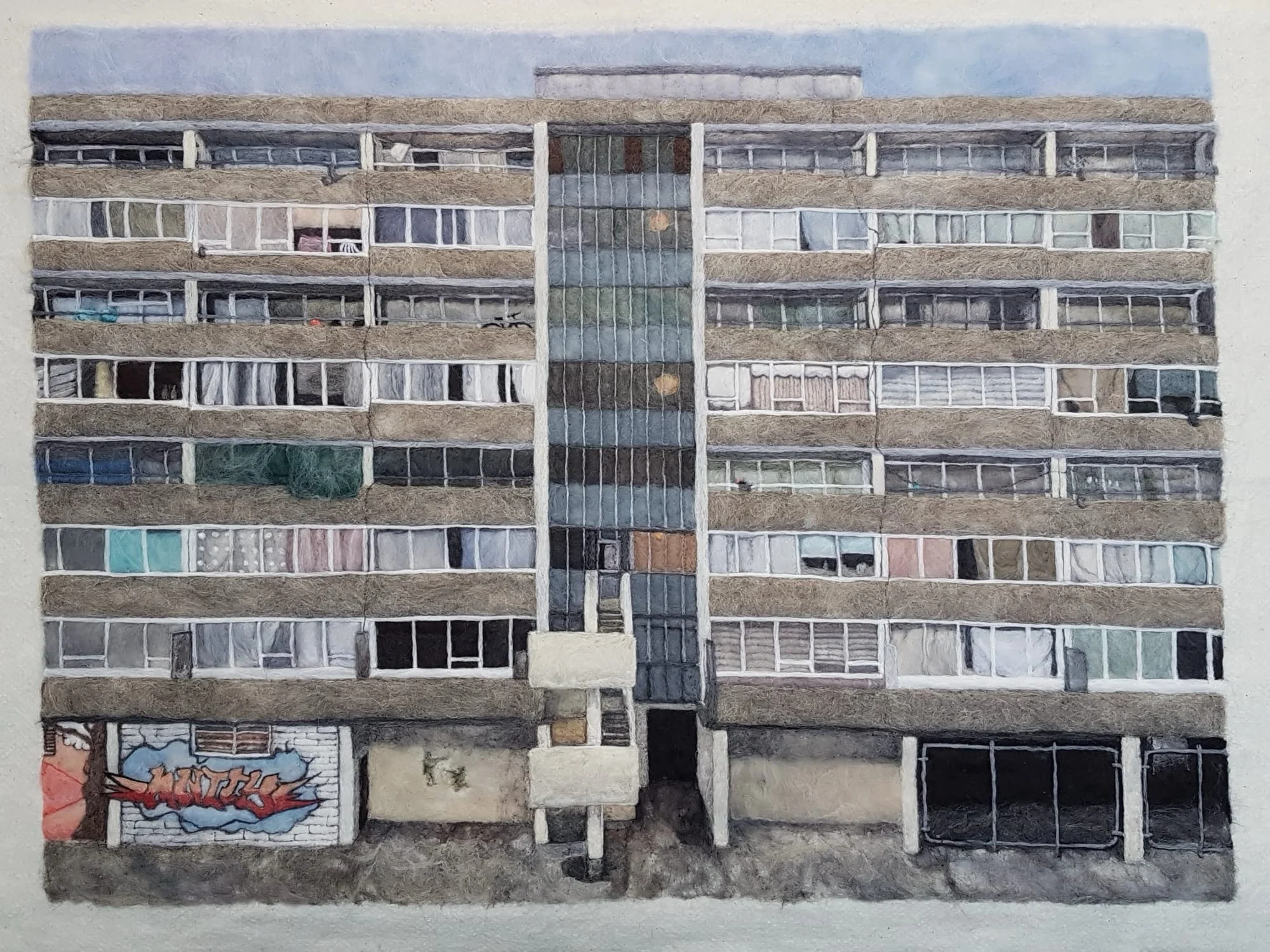
The first body of work to come out of that research was Soft Concrete, a series of large portraits of individual blocks made in wool on felt. Hill had never worked in the medium. She picked it up after staying with a friend who was wet felting, and the colour and texture of the raw wool stuck with her. The finished pieces translate hard grey architecture into something warm and hand-built. Blended strands of dyed roving map out window frames, bowed electrical cables and spray-painted tags. “Soft Concrete Missenden, Aylesbury Estate” (2020), measuring 88 by 118 centimetres, reads from across a room almost like a photograph. Up close, the fibre gives it away. Hill has framed the series as a deliberate repositioning, showing the estate as a place where people live, rather than the violent, hopeless place of its media image.
a brutal
scope
The concrete series began as an instinctive response. The lockdown demolition of Chiltern, Hill has said, took down a block that had been home to many of the children she had taught, and she started gathering what the machines left behind. She now describes The Aylesbury Fragments as “a project of memory and restitution.”
Getting the material is its own negotiation. Hill collects most of it directly from the construction sites, with permission, and has been careful to stay open with the crews so no one’s job is put at risk. Occasionally a piece turns up unattended on the street and makes its way to the studio too. There is one fixed rule: the concrete has to come from the Aylesbury. She has turned down generous offers of good-looking concrete from other sites because it failed that single test.
Out of the several hundred fragments she has salvaged, only around ten have a true right angle, two flat faces meeting at a corner. Hill, a fossil collector, has compared finding one to spotting a perfect sea urchin fossil on a beach. The piece “Cornerstone” is one of them, and the corner lets the painted building wrap around the stone the way a real block turns a street. Most of the time, though, she takes whatever is workable rather than hunting for the rare shapes.
The paintings themselves are small and close. Hallways, stacked windows and stairwells are cropped as if seen through a gap, the rough broken edges of each fragment acting as the frame. The titles hint at the moods she is after: “Stacked Sill,” “Cable Drift,” “Waiting,” “Splash of Colour,” “Water Out Of Sunlight,” “Sudden In A Shaft of Sunlight.” Night-lit windows, laundry hanging off balconies and scrawled graffiti tags turn up again and again, small signs that someone lived here. The effect is of a building being put back together one piece at a time, on the very material that used to hold it up.
Hill’s earlier grid paintings were built on the discipline of gesso, which she spent years applying to salvaged wooden panels. She has said that the question she hears most from other artists online is not about gesso or paint at all, but how to hang something that heavy on a wall.
extend
For all the attention the paintings attract, Hill is candid that most residents care more about the workshops than the finished work. A few are curious, she has said, but the bigger draw is the chance to learn new skills, get out of their flats and see friends. She has been working with a group of older residents since 2020, in sessions full of conversation and laughter where her own career barely comes up. She sees that as the point. Her wider research, she has said, is about how art can raise questions about the way communities are handled by the media and by politics, without turning the people involved into subjects all over again.
The human cost of the regeneration has been documented by the residents themselves. Aysen Dennis moved onto the estate in 1993 and became one of its most visible campaigners, eventually one of only a handful of people left on her floor. In 2023 she turned her own eighth-floor flat into an exhibition about the estate’s long resistance to demolition, and later that year brought a legal challenge against Southwark Council and Notting Hill Genesis at the High Court. She left her home in November 2023 after 30 years. Speaking to the BBC around the time of her move, she said the council had given her everything she asked for in her new flat, including the light and a view of the park, but that it still was not home.
View this post on Instagram
That gap between a replacement and a home is exactly what Hill’s fragments try to hold onto. Her gallerist Emma Hill has written that the paintings reveal a formal beauty in the geometry of the Brutalist towers while pointing back to the individual lives lived inside them, and that the work aims to give a voice to people often overlooked by civic planners.
remain
Hill’s broader exhibition history gives the project a longer arc than its recent press moment suggests. The Aylesbury Fragments had a solo presentation in the Eagle Gallery’s Cabinet Room in 2021, the same year her work appeared in the Royal Academy Summer Exhibition and in “Concrete and Tyres” at GBS Fine Art in Wells. Her CV also lists the 2023 John Moores Painting Prize among recent group showings, and her work sits in collections including the Government Art Collection and the Museum of London. Pieces from the series have since travelled well beyond the UK.
The process has not sped up with the attention. “I live with the unpainted pieces for months, sometimes years,” Hill told Colossal, explaining that she gets to know each fragment’s shape before painting it. More than 150 are finished, and the stock of raw concrete in the studio keeps changing as each phase of demolition hands over new material.
That pipeline is not running dry. Southwark’s plan now stretches into the next decade, and blocks including Padbury, Wendover, Winslow and Ravenstone sit in phases still to come. Hill has said she will keep painting for as long as buildings on the estate are still coming down. The concrete for the next Fragments is, for now, still standing in Walworth, with people living behind its windows.