DRIFT AUDIO
Listen to this story
Choose a voice, then press play.
Prime members with a Fire TV can now open the games they already paid for, without knowing they paid for them, from the same app they use to watch reruns.
On July 23, 2026, a new tab appeared near the top of the Prime Video app on Fire TV devices in the United States and the United Kingdom. It says “Games.” Tap it, and a Prime membership that many people bought for shipping discounts and Thursday Night Football suddenly opens onto a cloud gaming platform Amazon has operated since March 2022, one that most subscribers had never opened, never heard of, and in many cases were already entitled to use for free.
That platform is Amazon Luna, and its problem was never really the games. It was the door. Luna lived as a separate app, buried in a device’s app grid next to a hundred other icons, competing for a tap it was never going to get. Amazon’s answer was not to build a better door. It was to remove the door entirely and put the games inside a house people already walk through every night.
Jeff Gattis, Amazon’s general manager of gaming, put it bluntly in comments reported by the company has said that bringing Luna inside Prime Video lets members discover games the way they discover everything else on the service, and that a single click gets them playing instead of searching. The subtext is a little more embarrassing than the quote lets on. Luna’s core library has been a free Prime perk for a while now. Almost nobody used it, because almost nobody knew it existed.
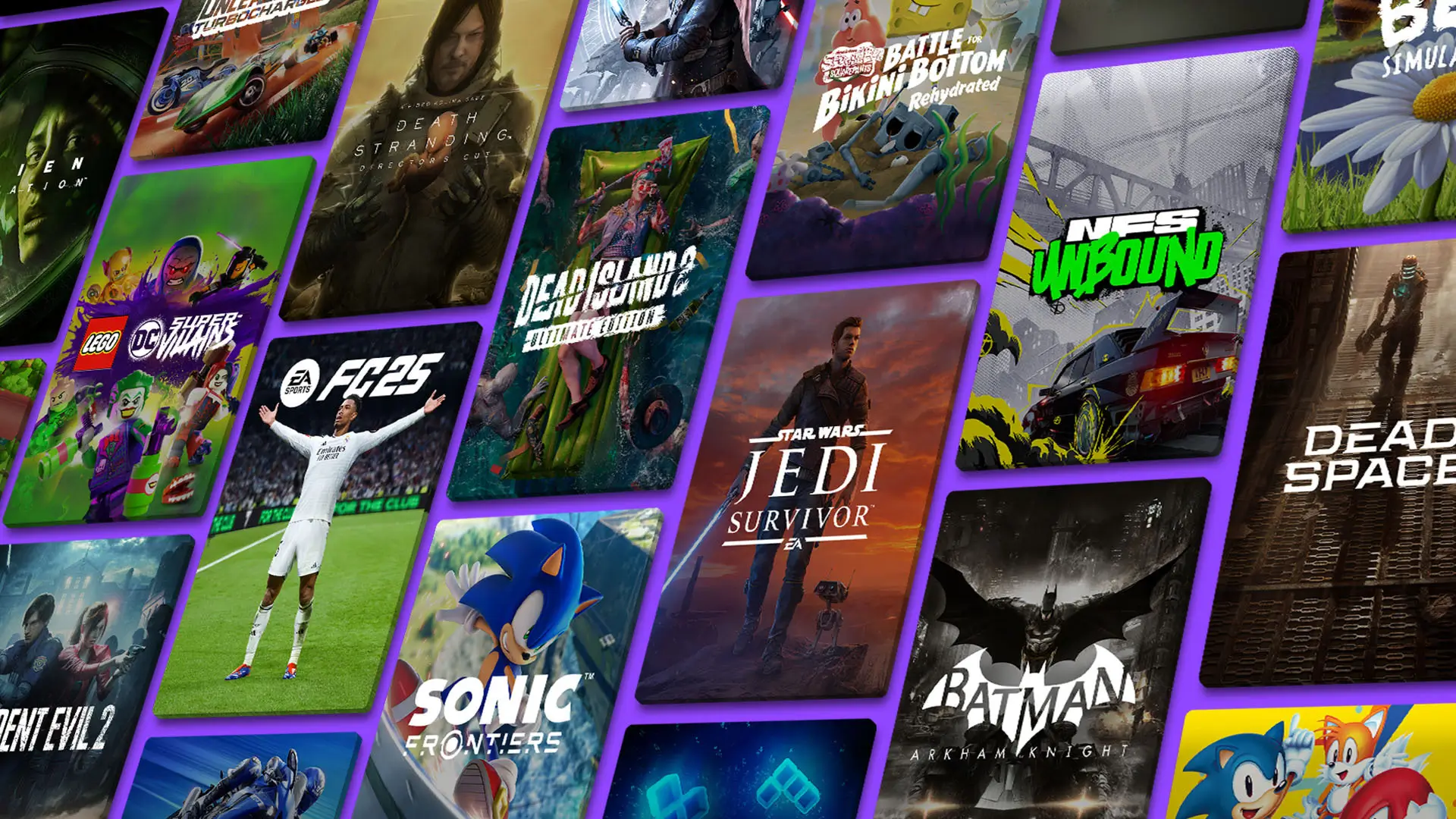
Amazon Luna showcases a wide selection of cloud gaming titles spanning action, racing, sports, adventure, and family-friendly franchises.
stir
The initial lineup is a mix of recognizable third-party names and Amazon’s own in-house experiments. According to reporting from Variety the library spans licensed titles like Hogwarts Legacy, EA Sports FC 26, and Indiana Jones and the Great Circle, alongside GameNight branded party games such as Clue, Ticket to Ride, and Taboo, plus Amazon’s own Courtroom Chaos games and the co-op card battler Masters of the Universe: Legends Unite.
Other outlets filled in a fuller catalogue. Coverage citing MSN reporter Kris Holt put the number at more than fifty titles available at no extra cost, including Fallout ,and Dataconomy’s rundown added Marvel’s Guardians of the Galaxy, Control, and the indie hit Dispatch to the list.Dispatch, a 2025 release from AdHoc Studio about office romance inside a superhero agency, has reportedly become one of the more talked about titles on Luna already, which says something about what actually catches on in a living room context: not the biggest budget, but the easiest to pick up between other things.
Not everything Amazon owns made the cut, and that omission is its own small story of the two upcoming Tomb Raider titles, Legacy of Atlantis and Catalyst, and the James Bond gaming franchise following the release of 007 First Light, are absent for now. Gattis has suggested there may eventually be a windowing arrangement between console and PC release and a later arrival on Luna, but was careful not to promise anything. “So I don’t want to make news yet because we haven’t done this yet,” is how Variety quoted him. It is a strange kind of restraint from a company that spent the rest of the week making a fair amount of news.
Launching a controller or a phone as a controller is part of the pitch too. Amazon’s own announcement describes finding games the same way Prime members already find shows, through the new Games tab, then playing within seconds on a television using either a controller or a phone.
why
There’s a version of this story where Amazon is simply chasing Netflix into games. That’s part of it. But the more specific admission buried in this launch is that Amazon tried the conventional path first and it did not work.
Amazon’s stated business goal here is solving Luna’s awareness problem and bringing new users to a platform many Prime members did not realize was already included in their membership. That’s an unusual thing for a company to say out loud about its own five year old product. Luna was not failing because the games were bad or the streaming was laggy. Only a few hundred million people worldwide own a console or a gaming capable PC, against billions who play games in some form, and Luna was built for the gap between those two numbers. The problem was distribution, not design, and Amazon had no better distribution channel sitting right next to it than Prime Video, which already opens on a television screen roughly as often as anything the company operates.
Gattis, speaking to Variety, confirmed the standalone Premium tier will remain available for nine dollars and ninety nine cents a month for people who want more than the free Prime library, but that tier is not accessible through the Prime Video integration at launch. The free layer is the hook. The paid layer stays exactly where it was, off to the side, for whoever eventually goes looking for it.
There’s no confirmation yet on whether the rollout will extend to Google TV devices or Samsung’s own operating system, which for now makes this look like a first party lane similar to what Samsung already runs with its own Gaming Hub, rather than an open standard. Google, notably, has nothing comparable to point to since Stadia was shut down in 2023.
flow
Buried inside the initial catalogue is Courtroom Chaos, an Amazon-developed party game built around Arnold Schwarzenegger. The choice of star is not incidental. Schwarzenegger also appears in an upcoming Amazon MGM holiday film, and the overlap points at something Amazon has been circling for a while: using its own streaming and gaming arms to promote the same names and titles across formats it now owns end to end.
Amazon has already tied game content to film releases once this way, with a video game companion to its recent Masters of the Universe movie from Amazon MGM Studios also available through the same channel. It’s a version of the old movie tie-in game, except instead of a rushed licensed cash grab sold at retail, it’s a free add-on sitting inside an app someone was already going to open to watch the movie itself. Reporting has floated the possibility that this integration could revive the largely abandoned practice of video game movie tie-ins more broadly, less as a genre and more as a marketing loop that costs Amazon almost nothing to run twice.
View this post on Instagram
straddle
Amazon is not moving first here, and it isn’t pretending to. Netflix has been building out its own cloud gaming push on television sets, and recently launched titles including Unhinged and a World Cup branded game, both of which the company has described as among its strongest cloud game debuts to date. Peacock has been adding casual games to its own app along similar lines. The pattern across streamers right now is consistent: nobody wants to be just a place to watch things anymore. Everyone wants to be the place you open first, for whatever reason you’re opening an app tonight.
TechCrunch’s framing of the move puts it plainly: Amazon is hoping games help turn Prime Video into a one stop entertainment destination, borrowing directly from a strategy Netflix has leaned into for several years already. What’s notable is how little Amazon is trying to disguise the borrowing. This isn’t framed as an original idea. It’s framed as catching up on a bet a competitor already validated, using an asset Amazon happened to already own and had mostly wasted.
away
Gattis has been careful, in multiple interviews this week, to draw a line around what Luna is not trying to become. He has said the goal isn’t to compete with PlayStation, Xbox, or Steam, and that framing matters more than it might first appear. Amazon is not chasing enthusiast gamers who already own a console or a gaming PC and have opinions about frame rates. t’s chasing the far larger population that plays games casually on a phone and has never owned dedicated gaming hardware at all, and trying to hand that group a television-sized version of the same casual habit, using a remote instead of a touchscreen.
That’s a notably smaller ambition than Amazon has stated before. The company spent years and real money trying to become a first-party game publisher on the strength of internally developed titles, an effort that produced far more cancellations than releases and no breakout hit to point to. This week’s announcement is Amazon reticently stepping back from being a studio and toward being a landlord instead, renting shelf space in an app it already controls to games built by other people.
fin
None of this erases a rockier stretch for Luna earlier this year, when Amazon announced in April 2026 that it would remove previously purchased games and discontinue certain third-party subscription tiers, giving users a window through June 10 to access titles bought before April 10 before losing access without refunds. That’s the kind of history that tends to sit quietly under a splashy relaunch. A free tab inside an app people already trust is an easier sell than a standalone storefront that, not so long ago, took purchased content away from the people who paid for it.
Amazon says it plans to expand the integration to more countries and device types in the coming months, alongside a monthly refresh of the Luna library. Either that expansion sticks, or whether this becomes another Amazon gaming initiative that shh fades a year from now, depends on something a games tab can’t manufacture on its own: either people who open Prime Video for a show one night decide, on some other night, to stay for a game instead.
From the DRIFT archive: In The Making: Live-Action Legend of Zelda in New Zealand · Netflix House Opens Its Doors: Streaming Meets Reality
Related Articles

Six Days of Asphalt, One Day of Dirt: The 2026 Tacoma TRD Pro Makes Its Case
Two red shock absorbers ride on the back of the driver’s seat, and they say […]