DRIFT AUDIO
Listen to this story
Choose a voice, then press play.
Two red shock absorbers ride on the back of the driver’s seat, and they say most of what Toyota’s priciest Tacoma is built to do.
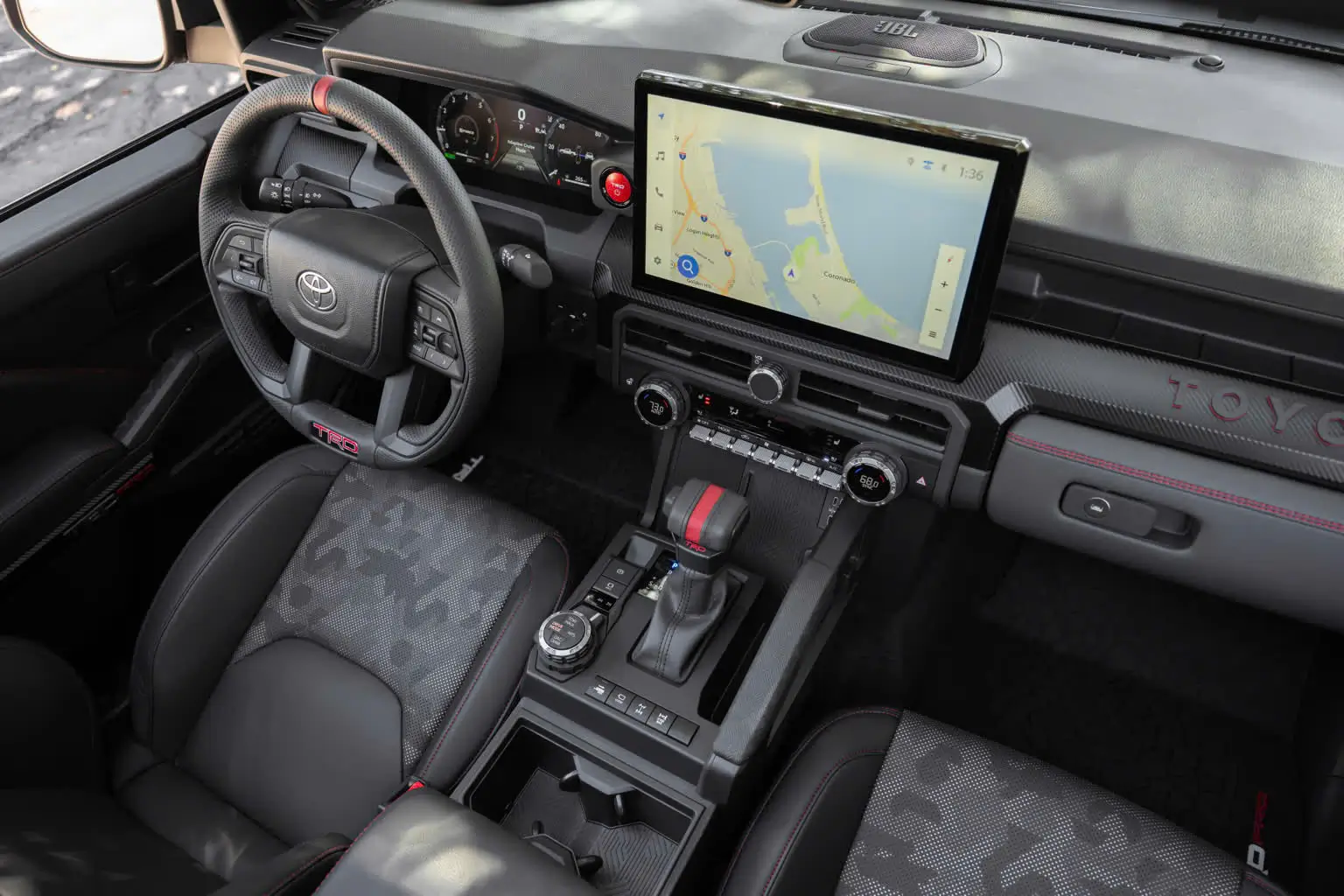
The first thing that stands out inside a 2026 Toyota Tacoma TRD Pro isn’t the 14-inch touchscreen or the Cockpit Red upholstery. It’s the hardware on the back of the front seats: a pair of compact dampers per seat, each with its own small pressure gauge, mounted in an exposed frame where rear passengers can study them at knee height. Toyota calls these IsoDynamic Performance Seats, and they are the most literal statement of intent anywhere on the truck. Everything under the body is engineered to move a great deal. The seats exist so the driver’s head doesn’t move with it.
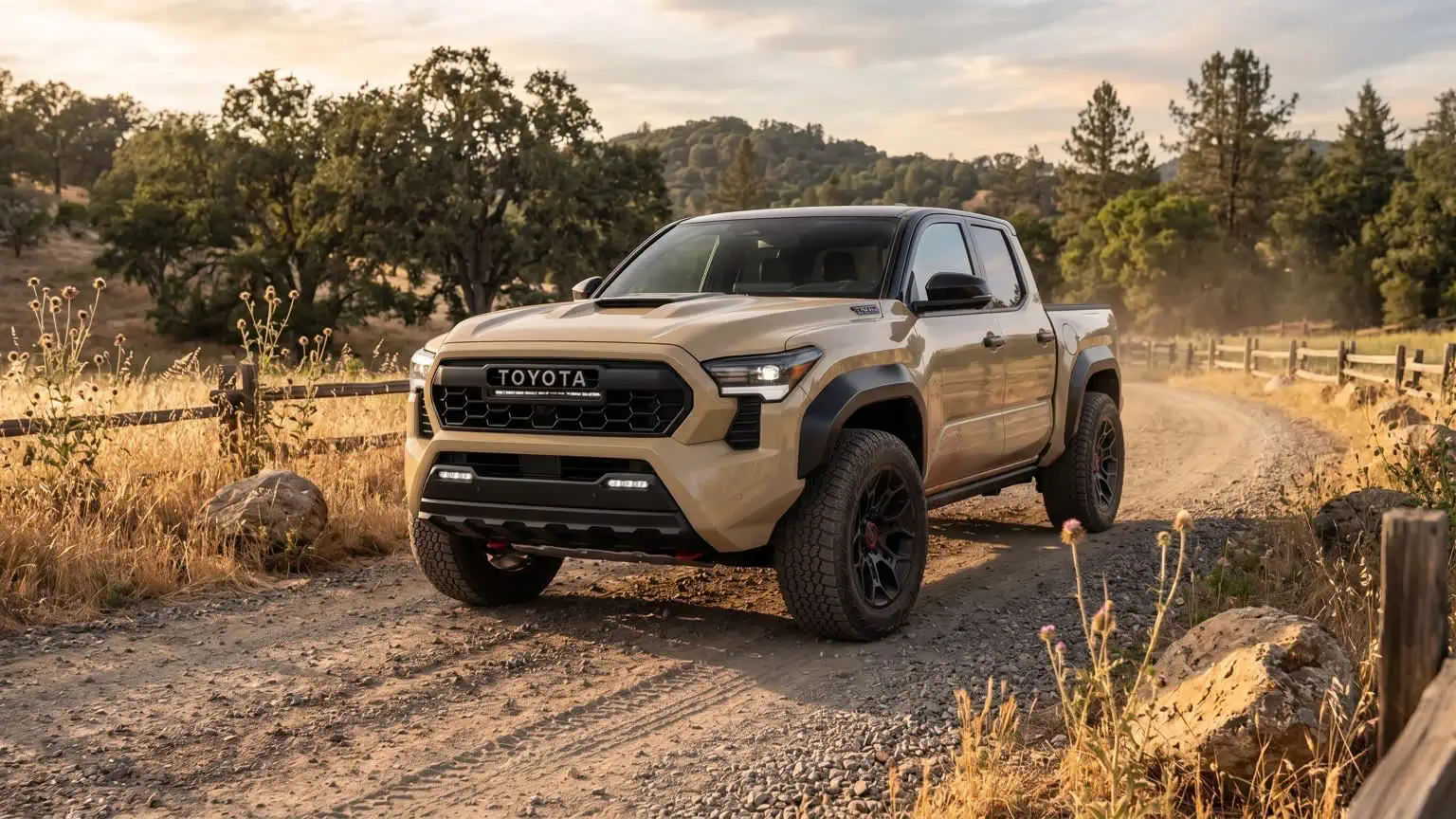
Signal. What happened: Toyota’s 2026 Tacoma lineup reached dealers over the winter with the TRD Pro still at the top of the range, mechanically carried over from the fourth-generation redesign and dressed for the year in an exclusive blue called Wave Maker. Exact object: 2026 Toyota Tacoma TRD Pro, Double Cab with a 5-foot bed, i-FORCE MAX 2.4-liter turbocharged hybrid rated at 326 horsepower and 465 lb-ft, eight-speed automatic, standard four-wheel drive, priced from $66,395 including a $1,745 destination charge. When and where: on sale at Toyota dealers across the U.S., with Wave Maker trucks scheduled to reach dealers from March 2026. Source: Toyota’s 2026 Tacoma i-FORCE MAX press materials and Edmunds’ trim-by-trim pricing. Why it matters: the TRD Pro is the clearest test of whether a hybrid four-cylinder can carry Toyota’s most serious off-road badge in America’s best-selling midsize pickup, and the 2027 version is already being teased.
The seat system runs on air over oil. A hand pump sets the pressure in each reservoir, one damper circuit handles vertical movement while the other handles side-to-side sway, and a lever at the base of each unit locks the whole assembly rigid for pavement. Testers who took early fourth-generation trucks off-road came back describing the effect as genuine rather than decorative, most noticeable in how little the head gets flicked around over ruts at speed.
stir
For most of its life, the TRD Pro badge on the Tacoma sat on a V6. The fourth-generation truck, launched for the 2024 model year on the TNGA-F body-on-frame platform it shares with the Tundra, Land Cruiser, and Sequoia, retired that engine. Every TRD Pro now uses the i-FORCE MAX hybrid powertrain, a 2.4-liter turbocharged four-cylinder with a 48-horsepower electric motor-generator sandwiched between the engine and an eight-speed automatic. It draws on a sealed 288-volt nickel-metal hydride battery tucked under the rear seat, a chemistry Toyota has used for decades and favors for durability over outright energy density.
Combined output is 326 horsepower and 465 lb-ft of torque, and the second figure is the one that shapes the driving. The motor’s job is to fill the soft spots in the torque curve, which in practice means the bottom of the rev range, before the turbocharger has built boost. That covers most of what a truck actually does: pulling away from a light with a loaded bed, walking a tire up a rock step in low range, merging from the bottom of an on-ramp. Those are the moments where the old V6 needed revs and the hybrid simply doesn’t.
It isn’t flawless. At least one reviewer has flagged the occasional clumsy shift from the eight-speed, and the efficiency gains are modest rather than dramatic. The EPA rates the 2026 TRD Pro at 22 mpg city, 24 highway, and 23 combined, drawn from an 18.2-gallon tank. The narrow gap between the city and highway figures is the hybrid’s fingerprint. The absolute numbers belong to a lifted midsize truck on 33-inch tires.
Two other hybrid details matter more on an ordinary weekday than on any trail. Every i-FORCE MAX Tacoma carries a 2,400-watt AC power supply with outlets in both the cabin and the bed, enough to run power tools on a job site or a kettle at a campsite. And Toyota covers hybrid components for 8 years or 100,000 miles, with the battery itself covered for 10 years or 150,000 miles and transferable between owners.
straddle
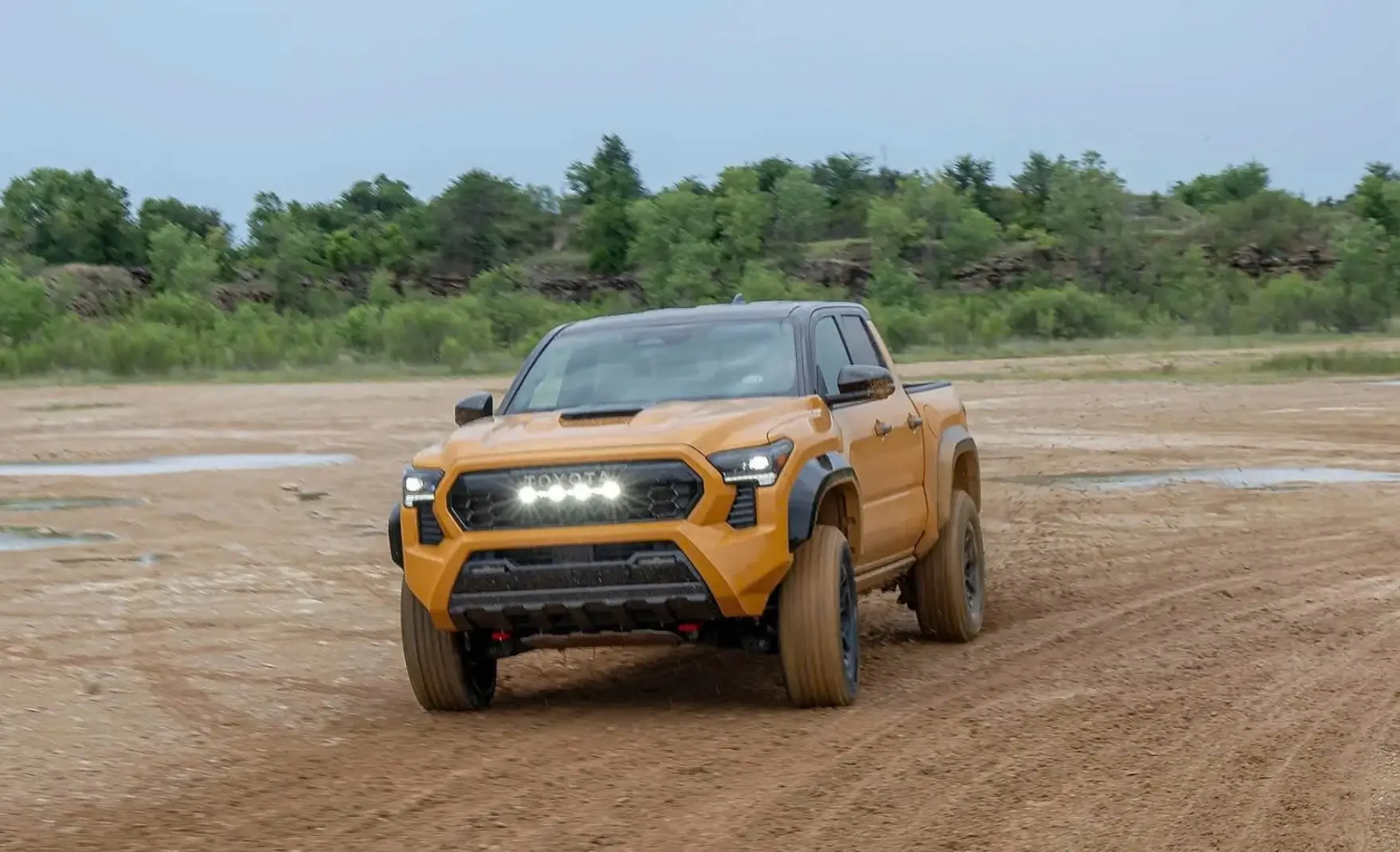
Toyota Racing Development builds the TRD Pro around its suspension. The truck rides on TRD-tuned shocks from FOX, the California-born suspension specialist better known to motocross and trophy-truck crews: QS3 internal bypass units with 2.5-inch aluminum bodies, piggyback reservoirs at the rear, and external internal floating piston bump stops behind them to soften the hardest hits at full compression. Internal bypass is the phrase that matters. Ports along the shock body let fluid route around the piston through the middle of the stroke, so damping stays relatively soft over small, fast impacts and firms up as the wheel approaches the ends of its travel. It is the architecture desert racers rely on, and Toyota’s own literature describes this truck as Baja-inspired.
QS3 stands for Quick Switch 3, and it is a physical, three-position compression adjuster mounted on each shock. There is no button for it in the cabin. Changing the character of the suspension means stepping out and turning four dials by hand, one per corner, before the trail and again before the drive home. Depending on the owner, that is either an appealing bit of ritual or a chore.
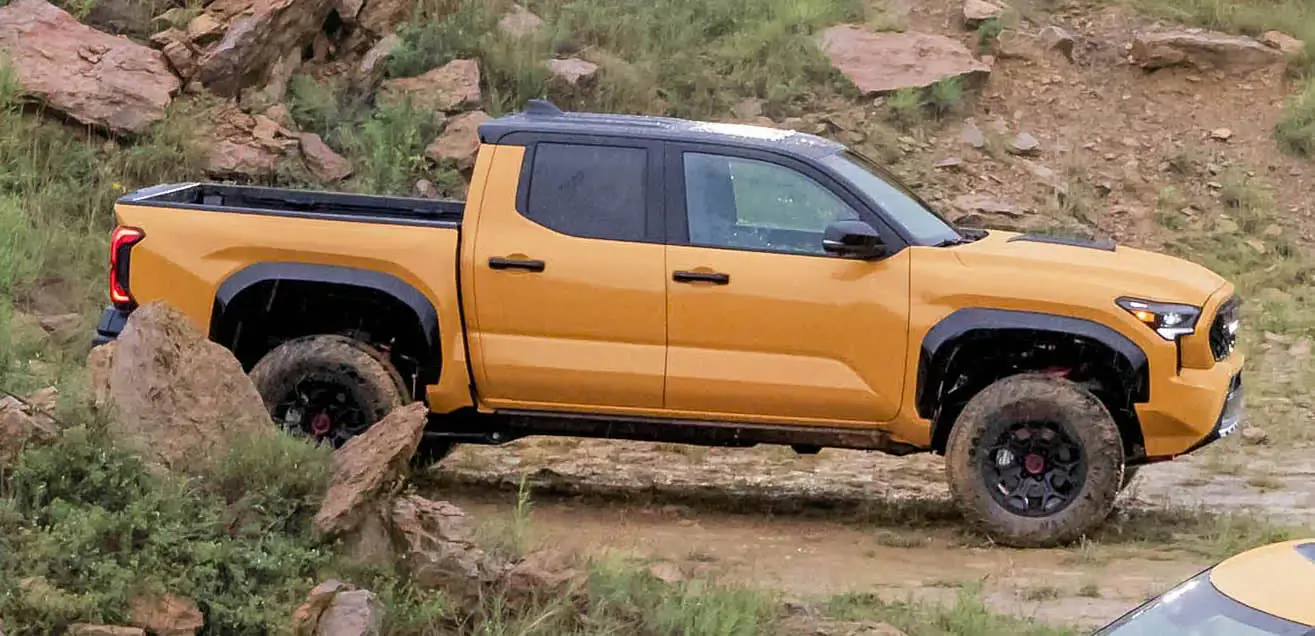
The rest of the off-road equipment is extensive. The TRD Pro sits roughly two inches higher up front and an inch and a half higher at the rear than a standard Tacoma, on 33-inch rugged-terrain tires and 18-inch black wheels, with forged aluminum upper control arms finished in TRD red. A Stabilizer Disconnect Mechanism, standard here, frees the front anti-roll bar at the push of a button for extra wheel articulation. An electronically locking rear differential, Multi-Terrain Select with settings for mud, dirt, and sand in both high and low range, CRAWL Control for low-speed creeping, and Downhill Assist Control fill out the electronics, while the Multi-Terrain Monitor uses exterior cameras to put obstacles around the nose on the 14-inch screen.
Underneath, an aluminum front skid plate joins protection for the transfer case and fuel tank, and red-painted recovery points sit at both ends of the truck, the rear pair mounted on a steel bumper. A TRD performance air intake and dual-tip exhaust round out the list.
View this post on Instagram
What’s missing says just as much about the brief. There is no front locking differential, which dedicated rock crawlers will notice, and nothing about the setup prioritizes slow, precise ledge work. The TRD Pro is built for covering rough ground quickly: washboard fire roads, whooped-out desert two-track, sandy washes taken at a pace that would shake a stock truck loose. Slower, gear-laden overland travel is the job Toyota assigns to the Trailhunter instead.
show
Monday through Friday, the TRD Pro is a Double Cab with a 5-foot bed and a lot of screen. The 14-inch touchscreen runs Toyota’s current Audio Multimedia system with wireless Apple CarPlay and Android Auto, a 12.3-inch digital gauge cluster sits ahead of the driver, and a ten-speaker premium audio system comes standard, complete with a detachable Bluetooth speaker that charges on the dash and lifts out for tailgates. Toyota Safety Sense 3.0 handles full-speed-range radar cruise control, lane tracing, and pre-collision braking with pedestrian detection. Drive Mode Select offers Normal, Eco, and Sport, and a Tow/Haul mode is standard on every hybrid Tacoma. With an active Remote Connect subscription, a Digital Key lets a smartphone unlock and start the truck, and access can be shared remotely with another driver, which is the kind of small convenience that gets used far more often than a rear locker.
On pavement, the desert hardware earns some unexpected credit. Testers who drove the fourth-generation TRD Pro back to back with the TRD Off-Road on public roads found it less prone to the jiggle and shimmy typical of body-on-frame trucks over broken surfaces, with the seats soaking up part of what the shocks let through. The trade-offs show up elsewhere: a tall step-in, heavy 33-inch tires, and a curb weight of roughly 5,100 pounds that the hybrid system has to haul through every stoplight cycle.
Towing is capable rather than class-leading. Window-sticker data for the TRD Pro lists a maximum trailer rating of 6,000 pounds with a weight-distributing hitch, short of the 6,500-pound ceiling Toyota quotes for the best-equipped Tacoma configurations. Toyota offers towing aids including a trailer brake controller and a wireless trailer camera, some of them bundled into an optional towing technology package rather than included outright.
extend
The TRD Pro starts at $66,395 including a $1,745 destination charge, according to Edmunds’ 2026 Tacoma pricing breakdown, which places it at the very top of the Tacoma range, $1,000 above the overland-focused Trailhunter and more than $11,000 above the Limited. Paint, accessories, and dealer add-ons push the figure higher from there.
The badge has traveled a long way to reach that number. When Toyota launched the TRD Pro Series for the 2015 model year, a V6 Tacoma TRD Pro Double Cab with an automatic listed at $37,415 before delivery charges. Stripped of destination, the 2026 truck asks $64,650, an increase of more than $27,000 over eleven model years. In that span the truck gained a hybrid powertrain, a coil-sprung multi-link rear suspension in place of leaf springs, and a far more sophisticated shock package.
Either the premium makes sense depends on whether the hardware gets used. A TRD Off-Road starts at $44,460 and can be optioned with the same hybrid powertrain, a stabilizer disconnect, and Multi-Terrain Select, while keeping a rear seat adults can actually use. What only the TRD Pro offers is the FOX internal bypass setup, the IsoDynamic seats, the extra lift, the armor, and the exclusive paint. Its constraints are equally specific: Double Cab and 5-foot bed only, automatic only, a cramped second row, no front locker, and a 6,000-pound towing ceiling. The ownership terms, at least, are the same as any other Tacoma: a 36-month or 36,000-mile basic warranty, 60 months or 60,000 miles on the powertrain, and two years or 25,000 miles of scheduled maintenance under ToyotaCare.
next
The paint is part of the pitch, and Toyota treats it that way. Wave Maker, the 2026 TRD Pro’s exclusive blue, came out of Toyota’s CALTY Design Research studio and is the eleventh color in a run of TRD Pro-only hues that began with Inferno orange in 2015. After several years of earthy shades such as Terra and Mudbath, CALTY’s designers drew this one from glacial water and the idea of unexplored terrain.
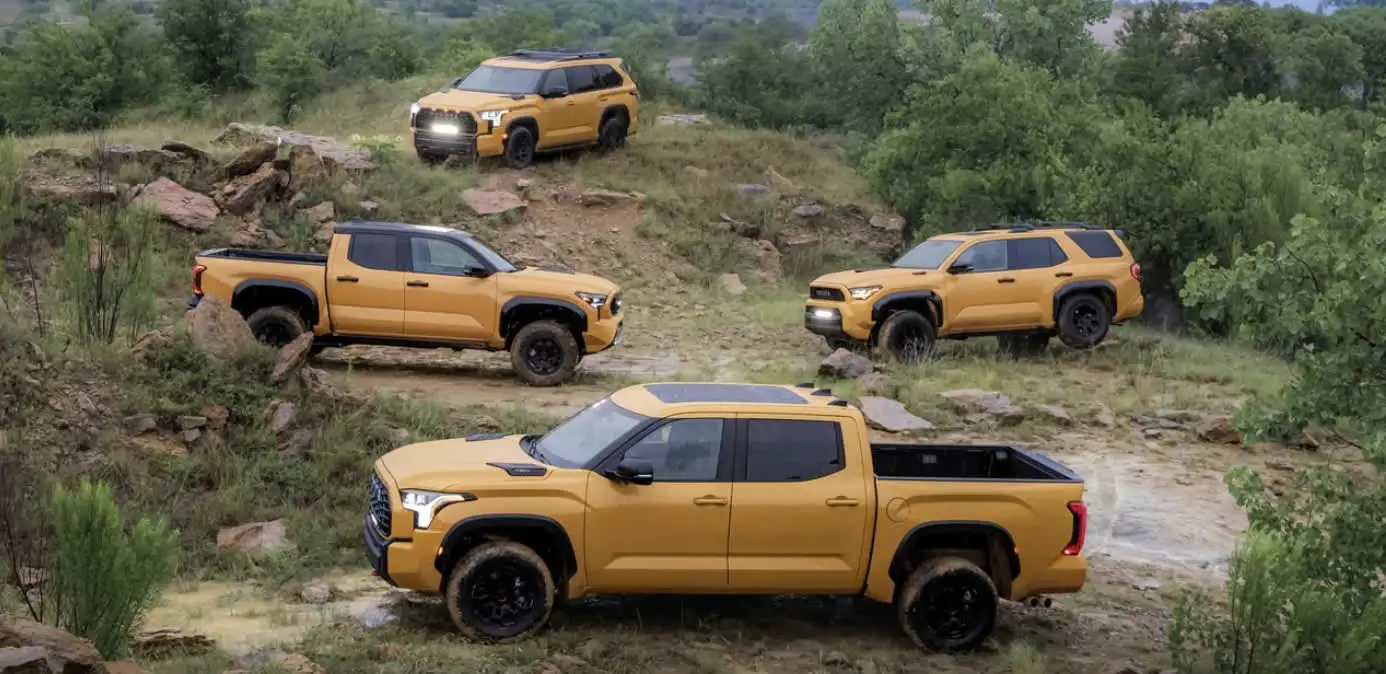
Its replacement is already on the books. On July 28, 2026, Toyota named Honeycomb as the 2027 TRD Pro color for the Tacoma, Tundra, and Sequoia, with a slightly different shade called Hot Honey reserved for the 4Runner. The full-size Tundra and Sequoia TRD Pros also receive newly designed, vehicle-specific FOX enhanced QS3 shocks and standard red tow hooks for 2027. Toyota has not yet published full 2027 Tacoma specifications, and its announcement describes the IsoDynamic seats as “available” on the Tacoma and Tundra, wording that leaves open whether they stay standard equipment on the next Tacoma TRD Pro.
Related Articles

Edifice Goes Back To HIROB In A Steel Case x Seiko
SZLJ276. 26130890000830. Stainless rectangle. Black leather. Cal. 7N01. Japan pre-order open. Second Edifice chapter. in […]