DRIFT AUDIO
Listen to this story
Choose a voice, then press play.
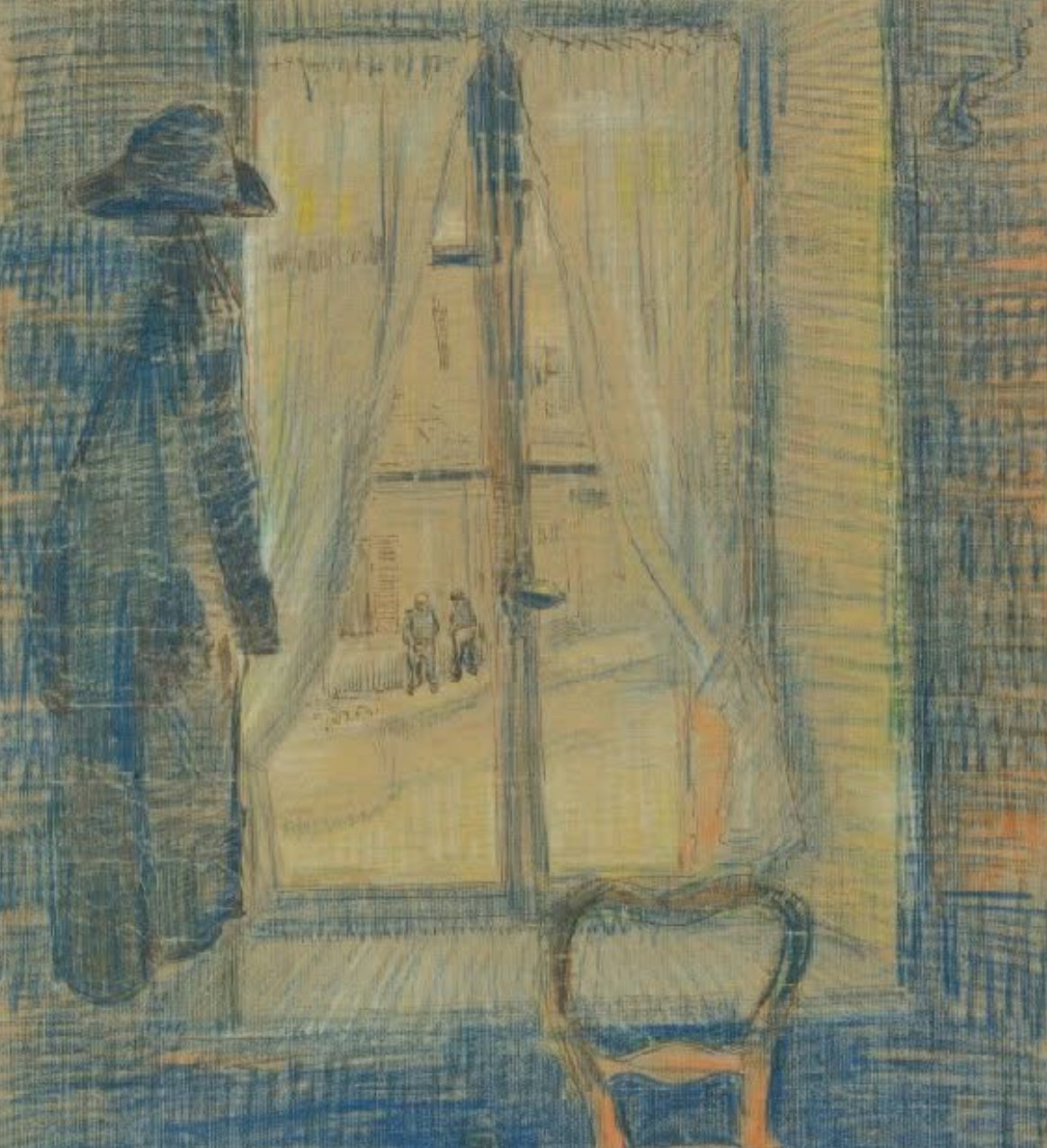
Window in the Bataille Restaurant is a drawing Vincent van Gogh made in Paris in February–March 1887. The work is not an oil painting: Van Gogh used pen and ink with chalk on paper, building the restaurant window through line, tonal blocks and restrained touches of color. Measuring 54 × 39.8 cm, it is now in the collection of the Van Gogh Museum in Amsterdam.
Window in the Bataille Restaurant: key facts
- Artist: Vincent van Gogh (1853–1890)
- Date: February–March 1887
- Place: Paris
- Medium: pen and ink with chalk on paper
- Dimensions: 54 × 39.8 cm
- Collection: Van Gogh Museum, Amsterdam (Vincent van Gogh Foundation)
Those material facts change how the work should be read. The grid of the window is not carried by loaded paint or a visible canvas weave. It is established by drawn lines, dark ink, chalk and the exposed surface of the paper. What can initially resemble a modest interior study becomes a concentrated demonstration of how Van Gogh could make structure feel emotional.
the honest line
Five years earlier, in a July 1882 letter to his brother Theo, Van Gogh described the kind of contact he wanted his art to achieve: “I want to make drawings that move some people.” The sentence appears inside a longer reflection on persistent work, observation and the difficult pursuit of what he called “the truthful.”
That ambition offers a useful way into Window in the Bataille Restaurant. It does not need the scale or instant recognition of the sunflowers, the night skies or the bandaged-ear self-portrait. Its subject is an ordinary architectural boundary. The emotional pressure comes from the attention given to it.
a Paris drawing built from ink and chalk
The drawing belongs to Van Gogh’s Paris period, when his visual language was changing quickly. Here, however, the strongest effect is not a rush of brilliant paint. The composition is controlled by the window’s intersecting bars and the contrast between the darker interior framework and the lighter space beyond it.
Ink gives the scene its skeleton. Chalk adds color and density without concealing the paper. That combination lets the image hold two conditions at once: the firmness of the window’s geometry and the uncertainty of whatever can be glimpsed through it. The outside world is present, but it is not fully surrendered to the viewer.
This is where the drawing’s restraint becomes productive. Instead of describing every object, Van Gogh allows incomplete passages to remain active. The eye moves between solid lines and softer areas, between the physical window and the space it frames.
the window as threshold
A window naturally divides interior from exterior, enclosure from possibility. In this work, that familiar function becomes the central visual event. The frame does not merely surround a view; it organizes the page and controls how that view can be encountered.
It is tempting to turn every window in art into a symbol of escape. Van Gogh’s drawing is more ambiguous. Its repeated divisions can feel protective, restrictive or meditative depending on how long one looks. The work does not resolve that tension. It gives the viewer a structure in which to experience it.
The title anchors the scene in the Bataille Restaurant, but the drawing does not depend on a grand public narrative. Its subject is the act of looking from one space toward another. The ordinary setting matters precisely because it allows Van Gogh’s observation—rather than spectacle—to carry the work.
the work of feeling
Van Gogh is often summarized through intensity: vivid color, agitated surfaces and a biography made more dramatic with every retelling. Window in the Bataille Restaurant resists that shorthand. Its feeling is created through discipline—placement, pressure, repetition and the measured relationship between ink, chalk and untouched paper.
The phrase “the truthful” is therefore relevant without turning the drawing into an illustration of a letter written years earlier. Van Gogh’s 1882 words describe a working ethic. The 1887 drawing shows what that ethic could look like after sustained practice: an uncelebrated subject observed closely enough to acquire emotional force.
Truth here is not photographic accuracy. It is the sense that the artist has remained with the subject long enough for a particular mood to emerge. The window becomes less a piece of restaurant architecture than a device for attention.
where the drawing is held
Window in the Bataille Restaurant belongs to the Van Gogh Museum in Amsterdam. The museum identifies the work as a drawing and credits the Van Gogh Museum, Amsterdam (Vincent van Gogh Foundation). Its official collection record supplies the date, medium and dimensions; the official Van Gogh Letters edition provides the 1882 letter context.
Readers can consult the Van Gogh Museum collection record and Van Gogh’s letter 249 directly.
looking through, not past
The drawing rewards a slower kind of viewing. Its window is not background architecture to be passed over on the way to a more famous image. It is the image: a grid, a surface and a threshold made expressive through economical means.
That economy is the work’s quiet strength. Van Gogh needed no monumental subject to test whether a drawing could move someone. Ink, chalk, paper and a restaurant window were enough.
Related Articles
Modigliani’s Limestone ‘Tête’
Carved from a single block of limestone in Montparnasse more than a century ago, one of Modigliani's rare stone heads goes to auction for the first time…