DRIFT AUDIO
Listen to this story
Choose a voice, then press play.
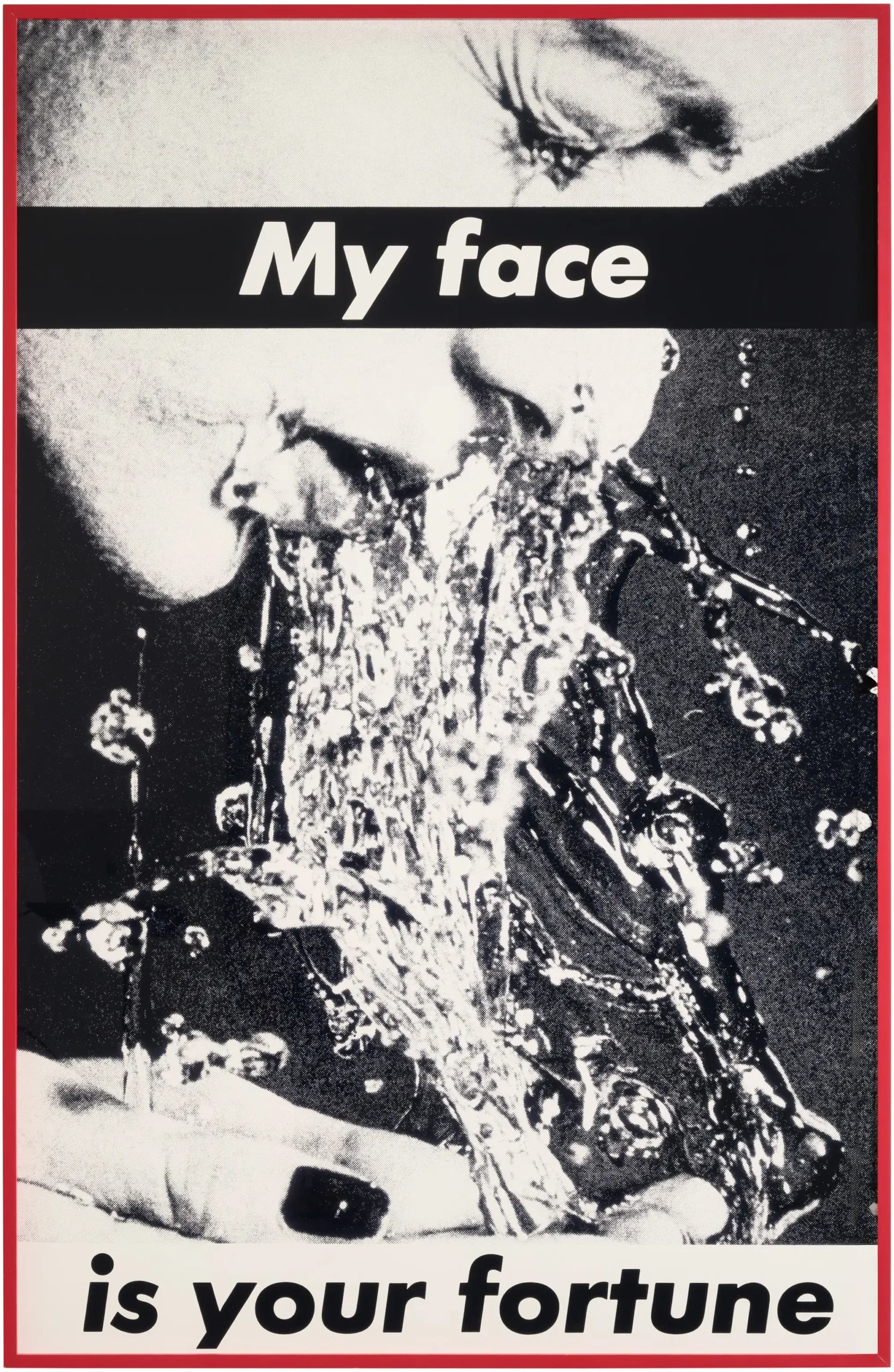
Barbara Kruger’s Untitled (My face is your fortune) (1982) remains one of the most confrontational and enduring works to emerge from the Pictures Generation and second-wave feminist art movements. Through its collision of advertising language, violent imagery, graphic typography, and gender critique, the work transformed the view grammar of commercial media into an accusatory weapon aimed directly at spectatorship itself.
In the image, a woman’s face appears in severe close-up as water violently erupts from her mouth and nose, frozen in sharp monochrome contrast beneath Kruger’s unmistakable red border and declarative typography. The phrase “My face is your fortune” slices across the composition with the immediacy of a billboard slogan, yet its meaning operates like a culture indictment rather than an advertisement.
Created during Kruger’s formative transition from magazine graphic designer to conceptual artist, the work distilled the themes that would define her career: commodification, media manipulation, gendered spectatorship, and the economics of beauty. More than four decades later, the piece feels increasingly prophetic within a digital economy built upon visible, branding, self-surveillance, and algorithmic desirability.
stir
Kruger’s appropriation strategy depends upon interruption. She takes an existing view language associated with glamour, advertising, and editorial photography, then destabilizes it through abrupt textual confrontation. Here, the source image becomes both seductive and grotesque: water cascades from the woman’s face with almost sculptural intensity, transforming bodily fluid into something jewel-like and violently excessive at once.
The title phrase functions as the work’s central inversion. Kruger flips the familiar proverb “Your face is your fortune,” exposing how female beauty has historically been tied to economic value, social mobility, and patriarchal approval. By shifting the pronouns, the sentence becomes accusatory rather than descriptive: my face is your fortune. The viewer, advertiser, institution, or consumer becomes implied in the transaction.
This linguistic reversal is crucial to Kruger’s practice. Her text does not merely accompany the image; it weaponizes it. The woman depicted is no longer passively observed but instead speaks through the machinery of mass communication itself, redirecting the violence of the gaze back toward the observer.

straddle
Kruger’s early background at Condé Nast profoundly shaped her view methodology. Before becoming an internationally recognized artist, she worked in editorial design environments where speed, view impression, and typographic hierarchy determined how audiences absorbed imagery. Rather than reject those systems, Kruger repurposed them, transforming the language of advertising into a structure for ideological critique.
Born in Newark, New Jersey in 1945, Kruger emerged during a period when postmodern appropriation art and feminist theory were increasingly interrogating authorship, representation, and power. Alongside figures associated with the Pictures Generation, she helped redefine how artists could engage with preexisting media culture rather than traditional forms of originality.
Her compositions became instantly recognizable: black-and-white photography, aggressive red framing, condensed sans-serif typography, and direct second-person address. Yet their accessibility disguised immense conceptual density. Kruger understood that propaganda and advertising succeeded through immediacy, repetition, and emotional shorthand. Her work hijacked those same mechanisms while reversing their ideological purpose.
show
Untitled (My face is your fortune) exists within a broader feminist critique of spectatorship and objectification that gained urgency during the 1970s and early 1980s. The work resonates strongly with theories surrounding the “male gaze,” particularly the idea that women within view culture are positioned as passive objects for masculine consumption.
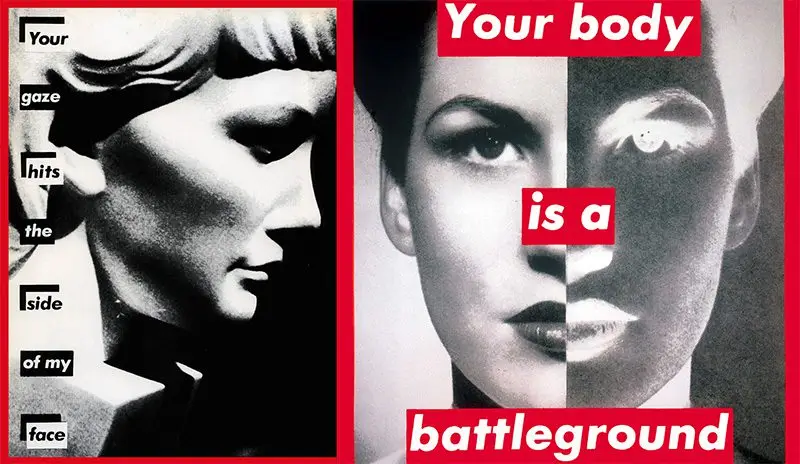
Kruger refuses passive representation. The image is fragmented, interrupted, and destabilized. The woman’s face is partially obscured by typography and overwhelmed by the eruptive violence of water, preventing viewers from comfortably consuming beauty as spectacle.
Even the composition’s scale becomes ideological. In large-format iterations approaching billboard dimensions, the piece occupies space with the same authority as commercial advertising. Kruger’s work does not politely request attention; it colonizes visual space the way mass media does.
The red frame intensifies this sensation. Often associated with emergency signage, warnings, retail urgency, and political agitation, it transforms the work into something simultaneously seductive and alarmed. The typography, meanwhile, mimics institutional neutrality while delivering emotional confrontation.
why
What makes Untitled (My face is your fortune) extraordinary today is how seamlessly its critique extends into contemporary digital life. In 1982, Kruger examined the commodification of beauty through magazines, advertising, and mass media. In 2026, faces themselves have become monetized infrastructures — optimized for engagement metrics, sponsorship economies, filters, personal branding, and algorithmic visible.
The phrase “My face is your fortune” now reads almost literally within influencer culture and platform capitalism. Identity is increasingly transformed into labor, visible into currency, and self-presentation into a continuous commercial negotiation.
Kruger anticipated this collapse between personal identity and market logic decades before social media formalized it. The image’s violent water eruption can now feel like a metaphor for digital overload, emotional exhaustion, or the relentless show demanded by online spectatorship.
Yet the work avoids becoming purely cynical. Its enduring strength lies in its refusal to simplify. It is seductive while critiquing seduction, visually beautiful while interrogating beauty itself. Kruger does not merely condemn image culture; she reveals its psychological and emotional complexity.
endure
The continued institutional and market recognition surrounding Untitled (My face is your fortune) underscores its canonical status within contemporary art history. Its reappearance at major auctions and exhibitions reflects not only collector demand, but broader acknowledgment of feminist conceptual art’s foundational influence on contemporary view culture.
Kruger’s influence now extends far beyond gallery walls. Her view language has permeated fashion, streetwear, editorial culture, internet graphics, protest design, and meme aesthetics. Yet despite that ubiquity, the original works retain extraordinary force because they remain fundamentally unresolved. They continue asking uncomfortable questions about ownership, desire, capitalism, spectatorship, and identity.
Untitled (My face is your fortune) ultimately succeeds because it knows that images are never neutral. They are systems of power, aspiration, fantasy, labor, and control. Kruger forces view to confront the machinery beneath view pleasure itself — and in doing so, transforms the act of looking into something politically charged, psychologically unstable, and impossible to ignore.
Related Articles
Joël Andrianomearisoa Finds More Than One Black in a Square of Buttons
In La Guerre des Boutons I, a field of ordinary fasteners turns a modest textile […]