DRIFT AUDIO
Listen to this story
Choose a voice, then press play.
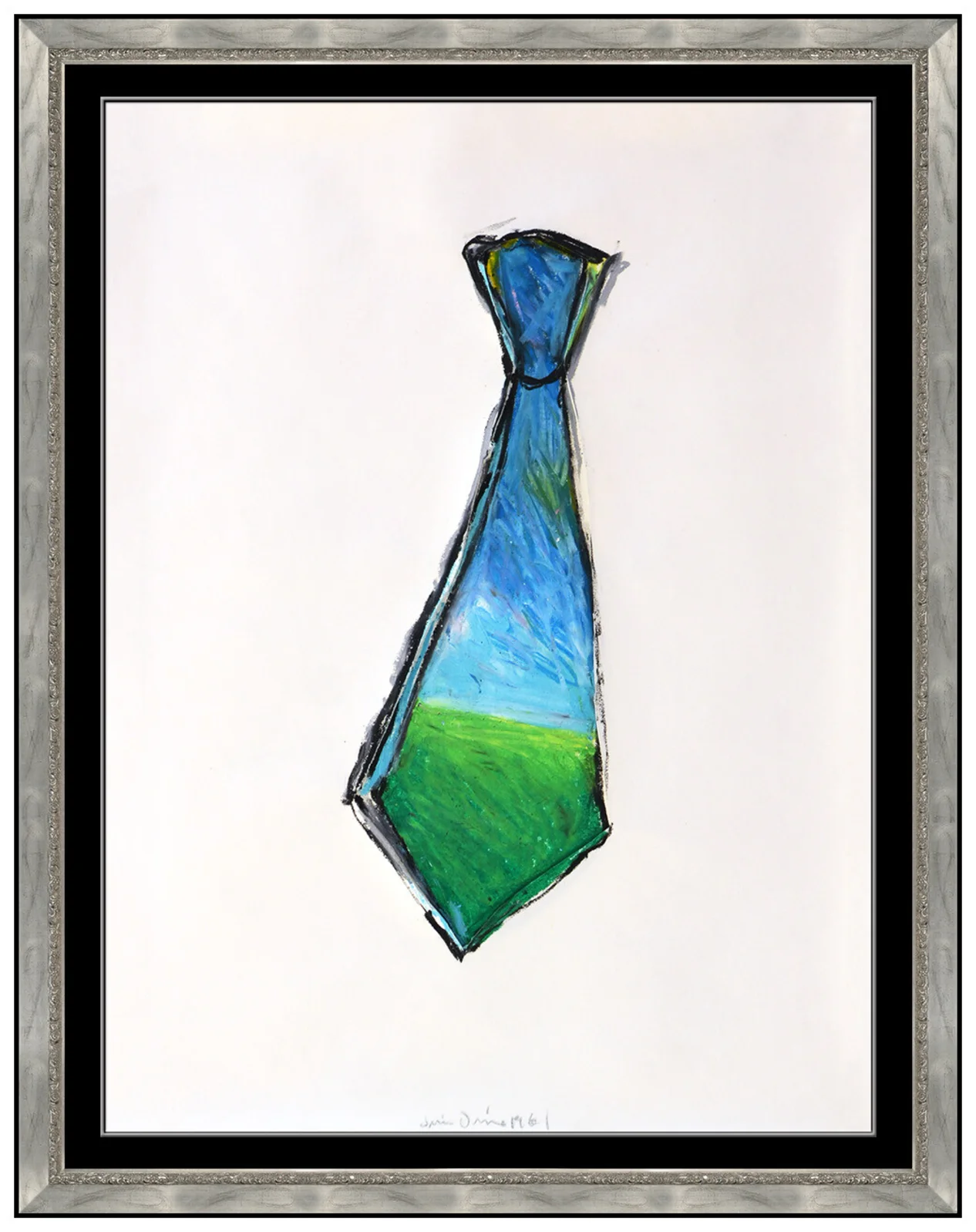
In the early years of the 1960s, New York’s downtown art scene operated like an exposed electrical wire. Happenings exploded across loft spaces, Abstract Expressionism was beginning to fracture under the weight of its own seriousness, and a younger gen of artists searched for ways to reconnect art with day life. Amid that atmosphere of experimentation and culture instability, Jim Dine created one of his most quietly flowing early works: The Tie (1961), a gouache painting on paper that transforms an ordinary necktie into something unexpectedly emotional, autobiographical, and psychologically charged.
At first glance, the composition appears startlingly simple. A solitary necktie floats against a blank white field, framed with stark clarity and rendered through expressive black contours. Yet within the elongated shape of the tie exists an entirely different world: a vivid pastoral landscape composed of lush green fields beneath an expansive blue sky. The work feels simultaneously play and deeply intimate, reducing a universal article of menswear into a vessel for memory, desire, rebellion, and selfhood.
Measuring approximately 24 × 17 3/4 inches and preserved in exceptional condition more than six decades after its creation, The Tie occupies a pivotal moment within Dine’s career — a period where he stood between the chaotic immediacy of Happenings and the emerging view language of Pop Art while remaining distinct from both.
know
Born in Cincinnati in 1935, Dine grew up surrounded by the tactile environment of his grandparents’ hardware store after experiencing instability and personal loss early in life. Tools, brushes, hammers, and utilitarian materials became embedded within his psychological landscape long before he ever entered the art world.
Unlike many artists associated with Pop Art, Dine never approached objects as detached symbols of consumer culture alone. He treated them as extensions of the body and repositories of memory. Day items became emotional stand-ins for identity itself.
After studying at the University of Cincinnati, the Boston Museum School, and Ohio University, Dine relocated to New York in 1958 and rapidly immersed himself in the city’s avant-garde circles. Alongside figures like Allan Kaprow and Claes Oldenburg, he became deeply involved in Happenings — interdisciplinary performance events that collapsed the boundaries between painting, theater, action, and daily existence.
By 1961, however, Dine’s focus increasingly shifted toward object-based imagery that balanced performance-era spontaneity with personal symbolism. Clothing emerged as one of his most significant recurring motifs. Robes, tools, hearts, and ties all became recurring stand-ins for the human body and the emotional residue attached to ordinary life.
Within that evolving visual language, The Tie occupies a uniquely revealing position.
pysch
In postwar America, few objects carried as much symbolic weight as the necktie. It represented professionalism, adulthood, conformity, masculinity, and participation within corporate society. The “man in the gray flannel suit” era elevated the necktie into an almost compulsory social uniform — a view shorthand for discipline and middle-class identity.
Dine subverts that symbolism entirely.
Rather than presenting the tie as polished or authoritative, he transforms it into a vessel of interiority. The elongated silhouette becomes less an article of clothing than a portal. Inside it exists not fabric patterns or decorative motifs, but landscape itself — open sky, green terrain, atmosphere, and light.
The contrast feels profound. A symbol associated with urban professionalism suddenly contains the view language of freedom and nature. The rigid structure of the tie becomes inhabited by emotional escape.
Executed in gouache, the work carries a remarkable luminosity. Dine uses layered opaque watercolor techniques to achieve jewel-like saturation, particularly within the blue sky and vivid green field. The brushwork remains visible throughout, emphasizing the handmade intimacy of the image rather than hiding the artist’s presence behind polish.
That visibility matters. Unlike industrial Pop aesthetics that embraced mechanical reproduction and emotional coolness, Dine insisted on preserving vulnerability inside the work. Every mark in The Tie feels human and immediate.
idea
Art historians frequently describe Dine’s object works as forms of disguised autobiography, and The Tie exemplifies that interpretation beautifully. While later robe paintings would become his most famous self-portrait substitutes, the tie works of the early 1960s reveal a similarly intimate psychological function.
Dine himself spoke openly about the layered symbolism ties carried for him, occasionally referencing both masculine and erotic associations embedded within the object. The tie became simultaneously personal and culturally loaded — an accessory tied to adulthood, sexuality, conformity, and social performance.
In The Tie, however, those associations soften into something almost dreamlike. The landscape inside the form suggests longing rather than aggression. It feels like memory contained within obligation. Nature compressed inside social expectation.
The symbolism becomes even richer when viewed autobiographically. Dine, the child shaped by hardware stores and tactile labor, inserts open terrain and natural color into the visual language of adult professionalism. The result reads almost like a private rebellion against the rigid structures of postwar masculinity.
Rather than rejecting the tie outright, he transforms it from within.
straddle
One reason The Tie continues resonating decades later is because it resists easy categorization. The work clearly shares affinities with early Pop Art through its focus on everyday objects and recognizable imagery. Yet emotionally, it operates very differently from the detached irony associated with contemporaries like Andy Warhol or Roy Lichtenstein.
Warhol transformed consumer goods into icons emptied of intimacy through repetition and mechanical coolness. Dine moved in the opposite direction. He infused ordinary objects with autobiography, vulnerability, and tactile emotion.
That distinction remains central to his enduring relevance.
The Tie exists at a crossroads between movements. Its isolated object presentation reflects Pop sensibilities. Its expressive brushwork recalls Abstract Expressionism. Its dreamlike transformation of the tie into landscape hints toward Surrealism. Meanwhile, its emotional directness feels intensely personal rather than theoretical.
Dine never fully belonged to a single artistic category, and that independence ultimately allowed his work to age differently than many of his peers. Rather than becoming trapped within a specific art-historical trend, his imagery continues feeling psychologically accessible across generations.
material
Part of the work’s emotional impact derives from its scale and material sensitivity. At roughly 24 by 18 inches unframed, The Tie invites close viewing rather than monumental confrontation. The gouache medium further enhances that intimacy through its matte surface and delicate layering.
The framing also contributes significantly to the piece’s presence. Surrounded by a thick black-and-silver gallery frame, the tie appears suspended almost ceremonially within negative space. The stark white background amplifies the object’s isolation while simultaneously elevating it into iconography.
The effect is surprisingly contemporary. Despite being created in 1961, the work feels remarkably aligned with current interests in minimalist composition, emotional symbolism, and object-based abstraction.
That timelessness helps explain why Dine’s early works continue commanding institutional and collector attention. Major museums including MoMA, the Metropolitan Museum of Art, the Guggenheim, Tate, and Centre Pompidou maintain significant holdings of his work.
scope
More than sixty years after its creation, The Tie remains compelling because it accomplishes something deceptively difficult: it makes the ordinary emotionally mysterious again.
Dine transforms one of modern masculinity’s most recognizable symbols into something vulnerable, poetic, and psychologically expansive. The necktie ceases functioning as fashion accessory and instead becomes emotional terrain — a narrow vertical world carrying memory, longing, identity, and contradiction inside its contours.
That transformation reflects the larger power of Dine’s art practice. He consistently demonstrated that everyday objects are never truly neutral. They absorb experience. They become extensions of memory and selfhood. They carry emotional residue long after their practical purpose fades.
In The Tie, a green field and blue sky remain permanently trapped within the rigid boundaries of a corporate symbol. Constraint contains freedom. Structure contains imagination. Professional uniformity contains private interior life.
That tension is precisely what gives the work its lasting emotional charge.
Decades after the radical energy of downtown New York’s early-1960s avant-garde faded into history, Jim Dine’s The Tiestill speaks with startling clarity. It reminds viewers that even the most familiar objects can become portals when filtered through memory, vulnerability, and artistic intuition.
It is not simply a painting of a necktie.
It is a portrait of interior freedom disguised as clothing.
From the DRIFT archive: Chris P. Bacon: Francis DiFronzo’s Quiet Rebellion Against the Everyday
Related Articles
Where the Face Should Be, Rafael Silveira Paints Open Sky
A pink shirt, shoulder-length hair, then no face at all: in “Surprise,” Rafael Silveira lets flowers and a clear blue sky stand in for the person.