
DRIFT AUDIO
Listen to this story
Choose a voice, then press play.
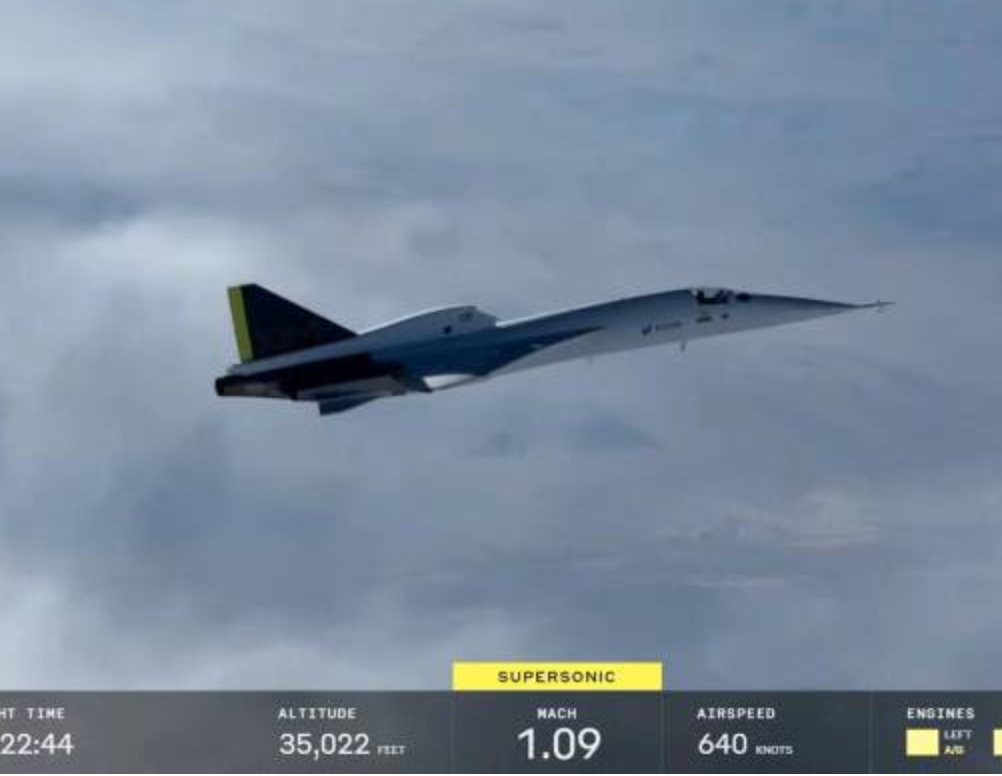
On a historic test flight over the Mojave Desert, Boom Supersonic’s XB-1 prototype successfully reached Mach 1.1, maintaining supersonic speed for four minutes. Tristan “Geppetto” Brandenburg, the test pilot, pushed the aircraft 10 percent faster than the speed of sound, marking a significant milestone in Boom’s mission to bring back commercial supersonic travel.
For context, the speed of sound—Mach 1—is approximately 761 mph (1,225 km/h) at sea level. Surpassing this threshold places the XB-1 among an elite group of supersonic aircraft, including the Concorde and the SR-71 Blackbird. However, Boom Supersonic asserts that advancements in aerodynamics, materials, and propulsion set the XB-1—and its upcoming commercial counterpart, Overture—apart from past supersonic jets.
The Rise of Overture
The XB-1’s supersonic success serves as a testbed for Boom’s larger vision: Overture, a next-generation supersonic passenger aircraft designed to redefine air travel. Unlike the XB-1, which is a smaller-scale demonstrator, Overture will be a full-size commercial jet, promising to cut flight times in half.
Overture is designed to accommodate 64 to 80 passengers and fly over 600 routes, making transatlantic and transcontinental travel significantly faster. Potential routes include:
•Miami to London in under five hours
•Los Angeles to Tokyo in six hours
•New York to Paris in just over three hours
Boom’s ambition has already attracted major interest. Airlines like American Airlines and United Airlines have placed orders and preorders for a total of 130 aircraft, signaling strong demand for the return of supersonic passenger flights.
The Supersonic Renaissance: Why Now?
Supersonic travel has been largely absent since the retirement of the Concorde in 2003. While the Concorde was an engineering marvel, it struggled with several challenges, including:
•High fuel consumption
•Intense noise pollution from sonic booms
•Expensive ticket prices
•Environmental concerns
Boom Supersonic aims to overcome these limitations through innovations in key areas:
Improved Aerodynamics
Overture’s design is optimized to reduce drag and enhance fuel efficiency, ensuring a smoother, more sustainable supersonic experience.
Advanced Materials
The aircraft will incorporate carbon composites and lightweight alloys, increasing durability while lowering fuel requirements.
Sustainable Propulsion
Boom plans for Overture to operate on 100 percent sustainable aviation fuel (SAF), addressing environmental concerns that plagued the Concorde.
Quieter Supersonic Travel
One of the Concorde’s biggest obstacles was the disruptive sonic boom, which led to restrictions on overland flights. Boom is developing low-boom technology, aiming to minimize noise impressions and allow more flexible flight paths.
The Road Ahead: When Will Overture Fly?
Despite its progress, Overture is still in development, and a firm launch date remains uncertain. Boom Supersonic plans for Overture’s first test flights in the late 2020s, with commercial service expected to begin in the early 2030s.
While challenges remain—ranging from regulatory approvals to infrastructure adaptation—Boom’s recent breakthroughs suggest that supersonic travel is on the verge of a major comeback. If successful, the era of high-speed commercial aviation could redefine how the world connects.
For now, the XB-1 serves as proof that Boom Supersonic is not just chasing a dream—it is actively building the future of flight.
Related Articles

Garage Italia’s Electric Spiaggina Puts the Fiat 500’s Riviera Years on Battery Power
Ten kilowatts, rattan seats and a €85,000 starting price: Garage Italia's 500 Spiaggina rebuilds Ghia's 1958 beach car for the yacht crowd.