DRIFT AUDIO
Listen to this story
Choose a voice, then press play.
What does it take to construct a modular synth? How do you turn a block of wood into a double bass? What compels someone to spend hours soldering wires, carving curves, and sanding every surface of a machine most people would just buy in a shop?
For a growing number of makers, music isn’t just something to be played—it’s something to be built from scratch. Whether it’s through solder fumes or wood shavings, these creators are ripping up the rulebook and building their own tools of sound. This hands-on, DIY spirit has long been part of music culture. And for some, it’s not just a hobby or even a job—it’s a way of thinking.
These days, grime music is everywhere. You can hear it in the charts, on festival stages, and in brand campaigns. But it started in bedrooms and basements, built from cracked software and pirate radio stations. Artists like Wiley sold records from the boot of his car, and the early tracks that defined the genre were passed around on CD-Rs and aired on illegal frequencies.
It’s a pattern that repeats. Grime’s spiritual predecessor, punk, was cut from similar cloth: DIY flyers, sweatbox venues, cheap guitars, and a lot of noise. Labels were started in squats, tours booked from payphones. Rave culture, too, came from DIY beginnings—drum machines, illegal parties in empty warehouses, and word-of-mouth flyers.
This mindset naturally evolves. If you can write your own music, record it yourself, and release it independently—why not go further? Why not make the instrument too?
We spoke to four modern-day instrument makers—people who have taken that DIY ethos one step further. From home-built synthesizers to hand-carved double basses, these are the stories of creators who decided that if the tools they needed didn’t exist, they’d make them.
Nick Collier, Hebden Bridge
Creation: ‘The Beast’ – custom modular synths and performance machines
“I’ve never been a very good musician,” says Nick Collier, “but I was always obsessed with the sounds.”
While most people pick up an instrument to learn it, Collier took a different path. Studying in Sheffield, he started bolting guitar strings to tree branches and creating hurdy-gurdies powered by foot pedals. His university final project was a giant walk-in instrument made of salvaged junk—part animatronic sculpture, part performance art.
After joining glam-punk band Pink Grease in the mid-2000s, Collier had to make something practical—something that could survive being loaded in and out of vans. “At first it was chaos,” he says. “I didn’t have a background in electronics. There were nights when it felt like torture.”
But the obsession stuck. His early designs were bulky—one machine took three people to carry—but eventually he built something more portable: The Beast. It took a year, constructed in hotel rooms and green rooms, soldering and polishing components after gigs. “It started out making wacky noises,” he says, “but I wanted something more melodic, more emotionally engaging.”
He’s made dozens of machines since then, including commissions like The Harmonicon for Swedish electronic legends The Knife. These days, Collier builds smaller, more accessible creations like his Chaos Engine, a mini version of The Beast made to order. He balances building with raising his daughter. “I’m not as productive as I used to be,” he says, “but I’ve got new designs on the way.”
Neal Heppleston, Mirfield
Creation: Double basses – handmade, carved, and custom-built
Not all DIY music-making is electronic. In a quiet workshop in West Yorkshire, Neal Heppleston hand-carves double basses from solid blocks of wood. It’s slow, patient work—weeks of carving, shaping, assembling, and finishing. But for Heppleston, there’s nothing more rewarding.
“I started in 2011,” he says, “when I was in a dead-end job and looking for something more meaningful.” A lifelong bass player, he had always wanted to build an instrument. But instead of diving in headfirst, he took a considered route: an evening class at Newark School of Violin Making, then four more years of full-time study.
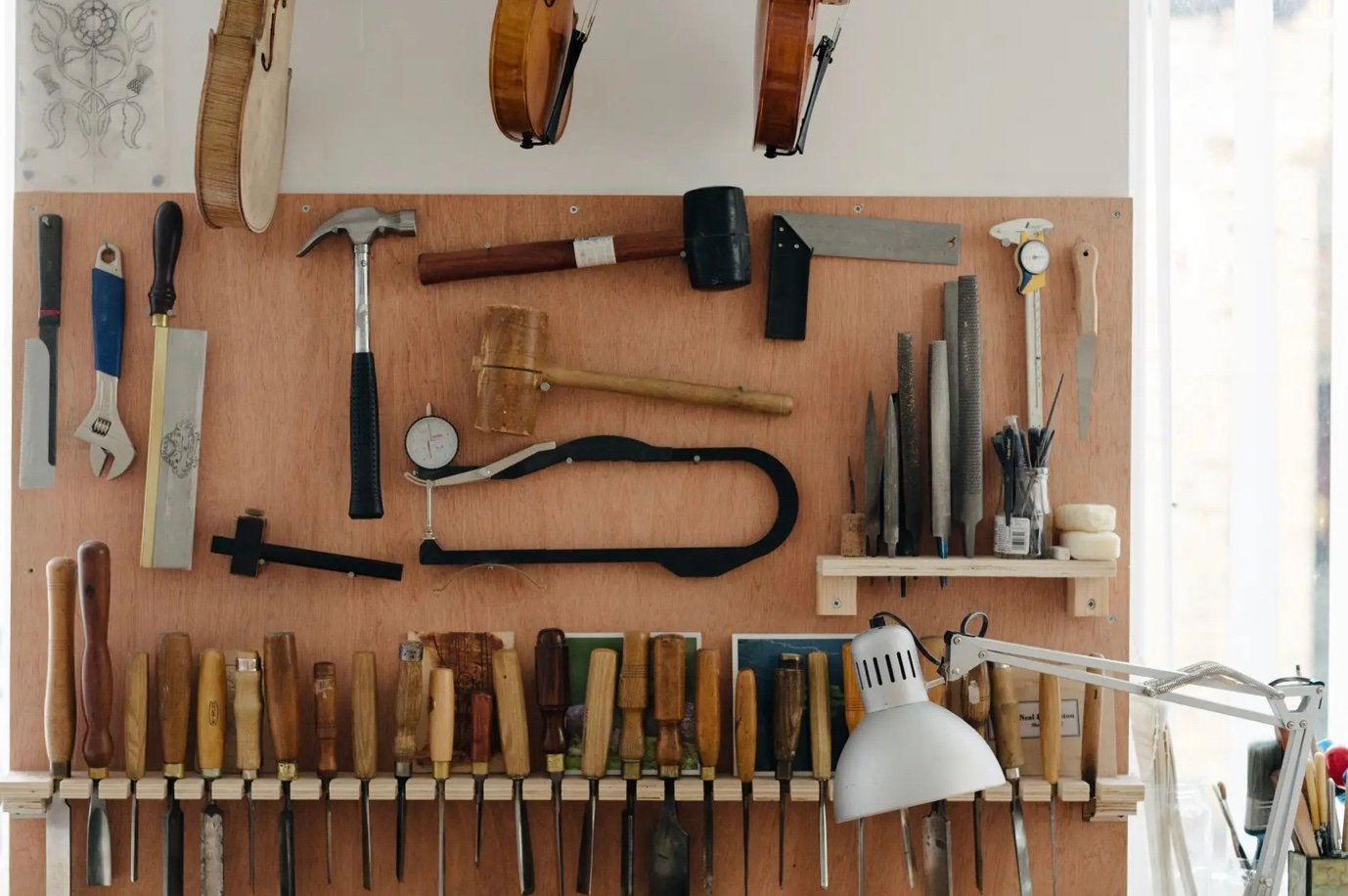
His workshop is now fully kitted out with the tools needed to tackle the biggest, bulkiest member of the string family. “Most repairers hate working on double basses,” he laughs. “They’re huge and awkward, and you need a totally different setup.”
Mistakes are inevitable—he’s had some painful ones—but the learning never stops. “There’s a saying,” he says, “‘someone who makes no mistakes, makes nothing at all.’” Luckily, in the world of lutherie, most errors can be reversed.
His favourite part? “Carving the front arching. I could do that every day.” He also loves the historical side—studying old instruments that come through the workshop, learning their stories. “It connects you to the past,” he says. “And I get to tell people things they never knew about their own instruments.”
Thomas Tietzsch-Tyler, Sheffield
Creation: Custom electric guitars
In a city with a proud musical heritage, Thomas Tietzsch-Tyler is keeping the hands-on spirit alive by crafting bespoke electric guitars. His approach mixes traditional woodworking skills with custom tweaks that suit the player’s needs—unusual neck profiles, unique pickup configurations, and eye-catching finishes.
Tietzsch-Tyler’s workshop is a place where design meets intuition. He doesn’t just build guitars; he collaborates with players to bring their ideal instrument to life. Whether it’s recreating the feel of a vintage model or designing something never seen before, it’s all about chasing tone—and making tools that feel alive.
Daniel Skevington, Sheffield
Creation: Synths, pedals, and more – DIY electronics with a purpose
By day, Daniel Skevington is a working professional. By night (and weekend), he’s a one-man instrument lab. In his spare time, he’s built synths, pedals, and even a custom drum kit—each project a mix of technical know-how and artistic experimentation.
“I started because I wanted sounds I couldn’t find anywhere else,” he says. One project turned into another, and now he performs on stage with gear no one else in the world has. It’s a side hustle, a passion project, and a personal exploration all in one.
What links all these makers isn’t just a love for music—it’s a deep curiosity, a need to understand things from the inside out. They’re not satisfied with pressing play or plugging in. They want to know how it works. They want to build it themselves.
Why DIY Still Matters
In a world where everything is streamlined and off-the-shelf, there’s something radical about choosing to make things by hand. Whether it’s soldering a synth in a hotel room, or carving a bass over weeks of patient labor, DIY instrument makers remind us that sound doesn’t have to start in a shop. It can start with a question: What if I made it myself?
And that question still echoes across genres, scenes, and generations. It’s the pulse that drives innovation in music—not just what we hear, but how it’s made.