DRIFT AUDIO
Listen to this story
Choose a voice, then press play.
The F-B100W-1A keeps the F-91W’s boxy resin case fully intact. It just adds an accelerometer and a Bluetooth radio, for less than the price of a dinner out.
Casio’s watch catalog runs past 600 models. One small, unglamorous rectangle has shh outsold nearly all of them: the F-91W, a sub-$20 quartz watch in continuous production since 1989, with more than 100 million sold. Casio, turning 80 this year, just took that exact case and wired it for a phone. Meet the F-B100W: an accelerometer and Bluetooth added to the F-91W formula, the shape left untouched. It launched in Japan on August 7. It sold out the same day. It’s now working its way into the UK and mainland Europe. Nothing about the case gives away what’s inside it.
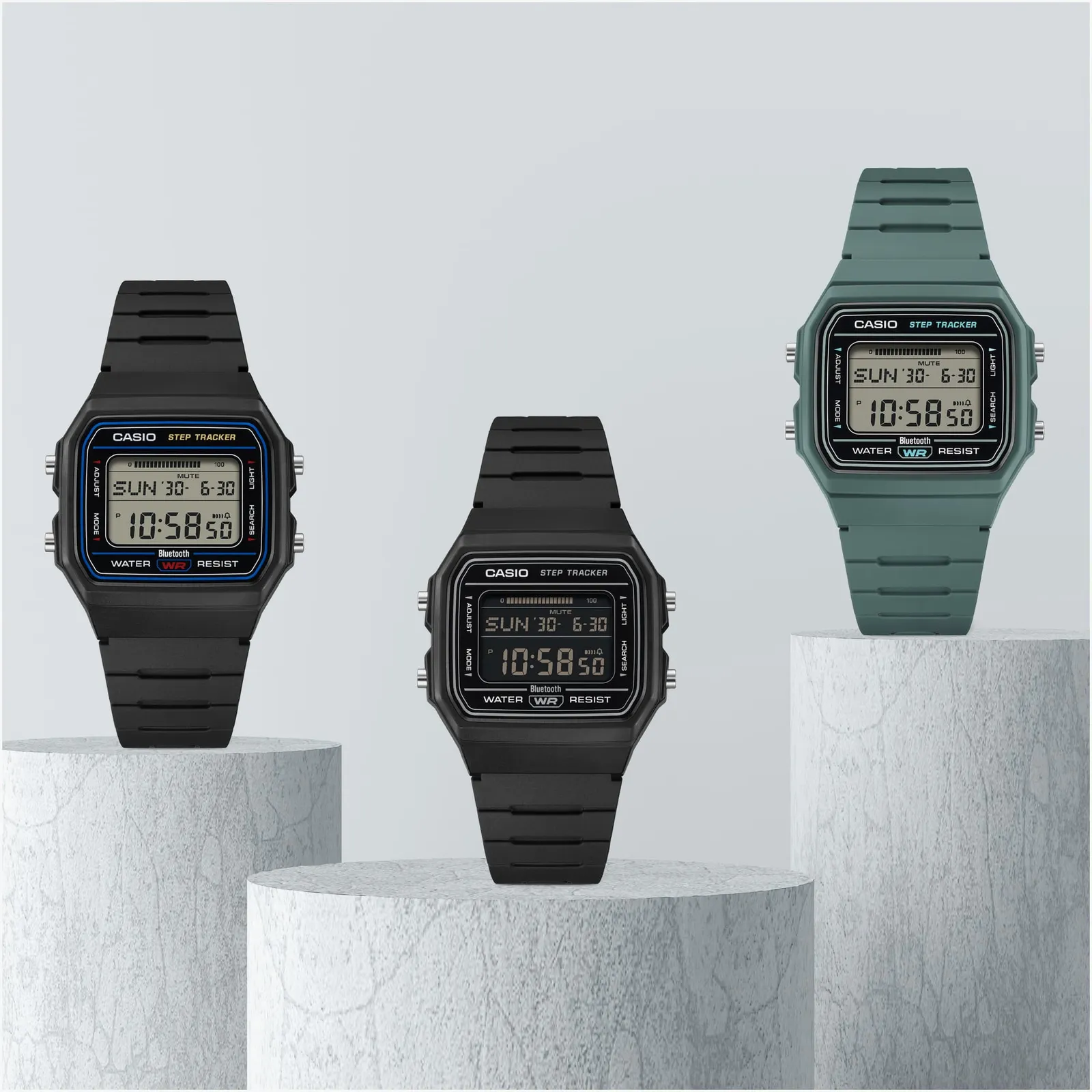
Three Casio Step Tracker watches with Bluetooth connectivity on display.
in
Set an F-B100W next to an F-91W and the resemblance is immediate. Same slim, angular resin case. Same four side pushers. Same integrated strap. Same blue, red, and gold accents on the black model. The new watch is just a touch bigger, to make room for the electronics: 41.9 x 38.1 x 8.8mm and 26 grams, against the F-91W’s 37.5 x 34.5 x 8.5mm and 21 grams. The case and strap are bio-based resin, with ventilation slits cut into the underside of the band for longer wear. Water resistance is rated for everyday use; Casio hasn’t published a specific depth.
Three colorways so far. F-B100W-1A: black case, positive LCD, the classic blue, red, and gold accents. F-B100W-3A: sage green case, turquoise accents, no real equivalent in the current F-91W lineup. F-B100W-1B: all-black, reversed negative LCD, gray text, Japan-only for now. Casio builds all three in Thailand.
The bio-based resin is the one change Casio doesn’t frame as nostalgia: a shh material swap across its Standard and Vintage lines, invisible in the hand, unchanged in price or shape.
Two display styles, the same choice Casio has offered on F-series watches for decades. Positive LCD, on the 1A and 3A: dark digits, light background, the look most people picture when they think “Casio digital watch.” Negative LCD, on the 1B: light digits, dark background, less daylight legible, a screen that reads closer to black when it’s off. All three keep the F-91W’s four-button layout at the corners of the case, untouched.
stir
An accelerometer counts steps automatically, up to 999,999 of them, with a daily goal set anywhere from 1,000 to 50,000. A six-level bar graph on the dial tracks the past several hours without a mode change. Sit too long and it beeps, flashing an icon to get moving. None of it needs a phone.
Casio tried this before. Its steel ABL-100, first in the 40-plus-year-old Vintage line to get Bluetooth and a step tracker, launched in August 2024 at $79.95 and up: same sensor pairing, a heavier 60-gram chrome-plated case, a stainless steel bracelet. The F-B100W does it in resin, at less than half the weight. No touchscreen. No mid rate sensor. No GPS. No stream of notification buzz the wrist. It counts steps, nudges you to move, and otherwise stays out of the way.
flow
Casio calls the pairing feature Mobile Link. It connects to the CASIO WATCHES app on iOS or Android, a free Casio ID required, Bluetooth 4.0 the minimum. Three tabs run the show: Home shows every registered watch at a glance, My Watch handles the actual pairing and settings, My Page logs the daily activity history.
Pair up and the watch corrects its own time, logs each day’s steps, and unlocks roughly 300 world cities for the second time zone. Hit a step milestone and Badge Collections hands out a digital reward; compatible watches can forward that data on to Apple Health, Android Health Connect, or Strava. Lose the phone and a button on the watch makes it ring. The app also takes over the fiddlier settings, the five alarms, the dual-time display, so there’s no cycle through four tiny buttons to set them by hand.
Off the phone, it’s still a standard Casio: a 1/100-second stopwatch with 200 lap and split records, a 60-minute countdown timer, five alarms, an hourly signal, an LED backlight. Accuracy holds at plus or minus 15 seconds a month unsynced. The cost of all that extra electronics is battery life: a CR2016 lasts roughly two years here, against seven in a standard F-91W.
View this post on Instagram
lineage
The family tree runs back further than the F-91W. Casio started as a calculator maker, founded in 1946 by brothers Tadao and Toshio Kashio, incorporated as Casio Computer Co., Ltd. in 1957, headquartered in Shibuya, Tokyo. When it moved into quartz watches in the early 1970s, it brought its calculator-industry chip technology along for the ride. First result: the Casiotron QW02, released November 1974, Casio’s first wristwatch, with an automatic calendar that adjusted itself for the length of the month. Two years later came the Casiotron X-1: stopwatch, counter, world time, dual time, the first watch anywhere to pack five functions into one case. That bloodline runs straight through Databank, the F-91W, and eventually G-Shock.
【電卓クイズ】 [MC]ボタンとは? pic.twitter.com/9uhjh0fAki
— CASIO カシオ計算機株式会社 ⌚🎹 (@CASIOJapan) August 24, 2026
The shape came in stages. 1978: the F-100, Casio’s first fully plastic-cased watch, the template. 1989: the F-91W, designed by Ryūsuke Moriai, successor to the F-87W. That’s the shape that stuck: over 100 million sold, likely the best-sell wristwatch ever made. It’s a simpler machine than what’s built around it today, a 1/100-second chronograph, one 20-second alarm, an hourly beep, no year on the calendar, so February is always 28 days. Casio’s own listing says the F-B100W’s face uses the same design as the F-91W. This isn’t a redesign. It’s an addition: one accelerometer, one radio, four extra alarms, and 200 stopwatch memories the original never had, wired into a case Casio otherwise left alone.
fin
Japan first: all three colorways, August 7, ¥8,800 including tax, and Casio’s official Japanese store sold through its entire allocation that same day. Casio UK listed the black F-B100W-1A and teal F-B100W-3A as coming soon in mid-August, opened sales on the 17th, and sold out of black again within a week, leaving only the F-B100W-3A in stock at £55, or roughly $74. Europe followed: the black model listed at €59.90, still marked coming soon. The US has no price and no date. The reverse-LCD F-B100W-1B hasn’t left Japan, where it sells through the same G-SHOCK STORE network as the rest of Casio’s lineup, nothing limited or special about the channel.
Related Articles
New Balance Turns the 9060 Down to a Whisper in Black and Neptune Grey
Black mesh, napped suede and a grey-tinted heel piece: the U906088B drops every bright accent and lets the 9060's swollen pod sole carry the look.