DRIFT AUDIO
Listen to this story
Choose a voice, then press play.
Three years after its Pokémon decks sold out in under five minutes, Santa Cruz Skateboards is doing it again this fall, with ten more designs and a 30th anniversary tie-in.
In September 2023, twenty Pokémon themed skateboard decks sold out on Santa Cruz Skateboards‘ website in under five minutes. Some of them are still reselling for thousands of dollars. This fall, Santa Cruz and Pokémon are running it back, with ten more designs added to the mix and the timing built around the franchise’s 30th anniversary. Santa Cruz has not said which 30 cards make the cut this time, but the format that made the first drop infamous is staying exactly the same.
stir
Santa Cruz confirmed the collection directly on its own site: a limited run of assorted Pokémon Trading Card Game blind bag decks and apparel, arriving Fall 2026. Each sealed bag will contain one randomly assorted 8 inch by 31.6 inch skateboard, printed with artwork pulled from one of 30 pieces of card art the company is calling among the most iconic in the Pokémon TCG’s history. Which 30 cards made the cut is still a secret. Santa Cruz has said the designs won’t be revealed until the collection actually goes live, the same way a booster pack keeps its contents hidden until it’s torn open. Like the rest of Santa Cruz’s standard lineup, the blind bag boards are built from traditional seven ply maple, meaning they’re technically rideable even though, as PokeBeach has noted, most buyers of the 2023 run chose to collect and display theirs instead.
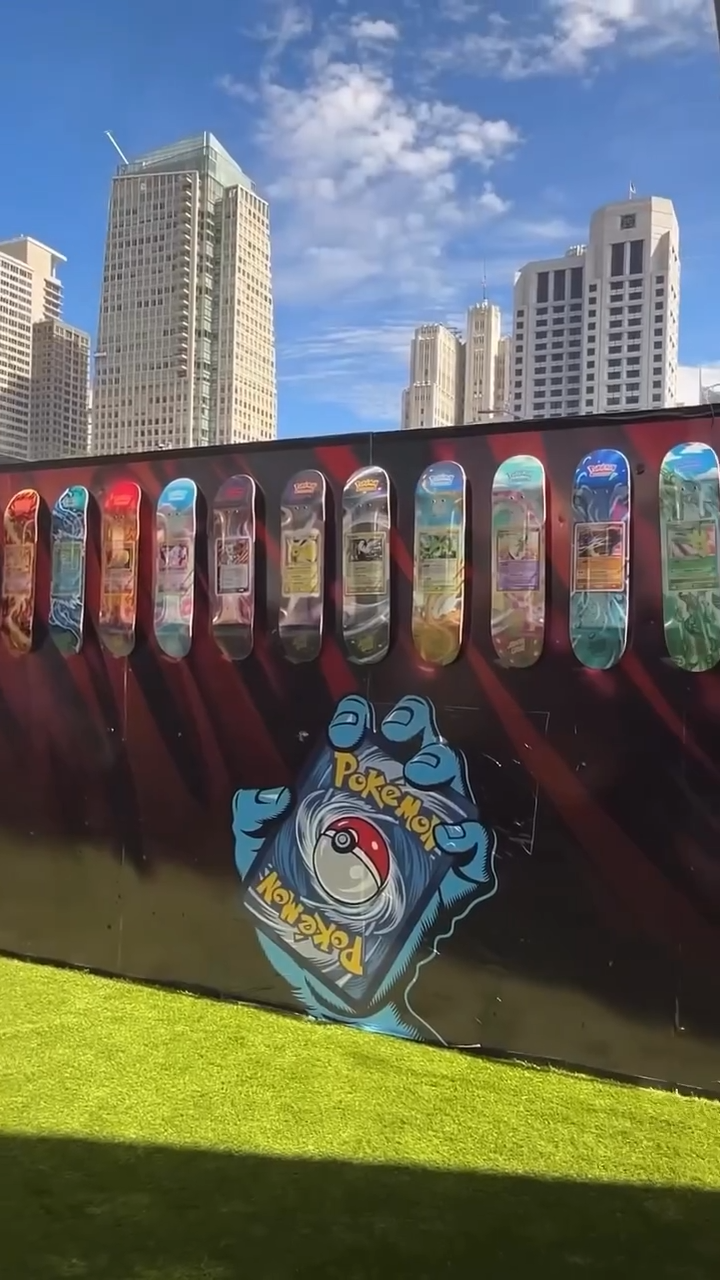
Pokémon skateboard deck display.
Beyond the 30 standard designs, Santa Cruz is bringing back a rarer tier: three additional glitter gold foil decks, each built around a multi card collage pulled from global versions of Pokémon TCG cards rather than a single character. Santa Cruz says each of those three designs will be capped at 500 pieces worldwide, a hard number, unlike the standard 30, which don’t yet have a stated print run. Apparel is part of the rel too. Bulbagarden’s coverage of the announcement describes Tee and sweatshirts built around Santa Cruz’s own hand logo, reworked to hold a Pokémon TCG card the way it normally holds a skateboard. Santa Cruz has not announced pricing, exact quantities, or a specific release date within the season. The brand is currently running an email signup for updates rather than a countdown.
flow
To understand why a skateboard company teasing 30 pieces of card art is even news, it helps to know what happened the first time. Santa Cruz’s original Pokémon connective launched September 13, 2023, at 6 a.m. Pacific, sold through the brand’s own site and a handful of local skate shops. The lineup ran 20 designs deep: 15 standard holo foil boards built around widely recognized characters, and five extremely limited gold foil boards, capped at just 50 copies each, featuring Pikachu, Charizard, Eevee, Gyarados, and Mimikyu. Each sealed bag cost $110, with a five deck limit per customer.
The whole run sold out in under five minutes. Values reply source report that Santa Cruz’s own Instagram filled up with customers accusing bots and resellers of cleaning out the stock, not an unreasonable complaint given the brand capped orders at five decks per person rather than one. Within 24 hours, sealed bags were already flipping on eBay for $250 to $350, according to contemporaneous reporting from Resell Calendar. Highsnobiety later put the average resale price for a sealed bag closer to $400, roughly four times retail, with individual gold foil pulls climbing into four figure territory. Some listings went further still. Both Kotaku and Skateboarding.com later reported individual decks and case lots reaching well into five figures, with Skateboarding.com citing sales above $20,000 for the rarest pulls, though prices at that extreme reflect outlier auction results rather than typical resale value.
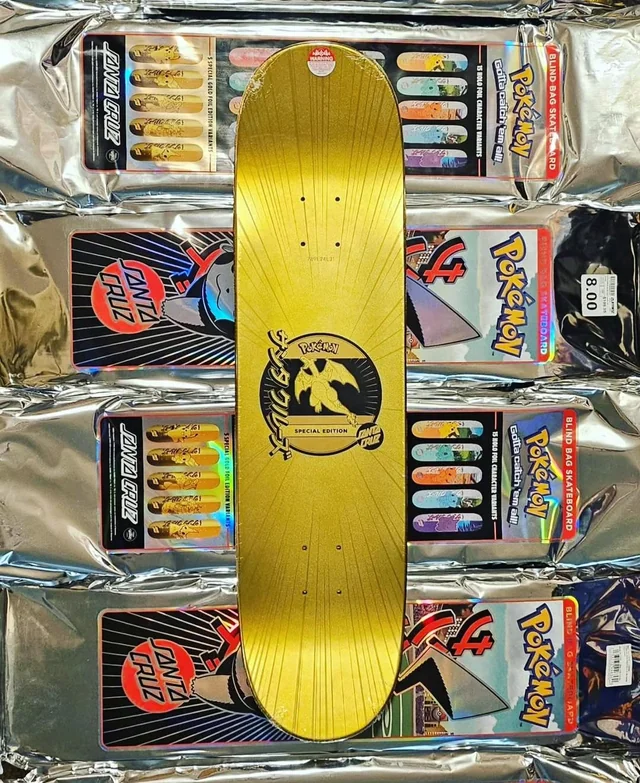
Santa Cruz Pokémon blind bag skateboard decks.
stance
What’s notable is how little that demand has cooled. A February 2026 breakdown from Resell Calendar found sealed 2023 blind bags still trading in the $200 to $400 range, with opened, non gold boards holding steady around $150 to $250, more than two years after the original release and well above the $110 sticker price. Active listings on both eBay and StockX still carry the connection today.
Part of that has to do with what the format borrows from. A blind bag skateboard deck functions less like ordinary skate hardware and more like a Pokémon TCG booster pack: fixed price, hidden contents, a small chance at pulling something rare. Highsnobiety’s original coverage made the comparison directly, framing the mechanic as a form of legal gambling dressed up as skate gear.
That overlap with the Pokémon TCG’s own secondary market is not really a coincidence. Vintage Pokémon cards already carry some of the highest resale premiums in collecting, with early holographic prints regularly selling for tens of thousands of dollars and, in rare cases, into seven figures at auction. Santa Cruz’s blind bag format essentially imports that same collector psychology onto a skateboard deck, swapping cardboard for maple and a booster pack foil wrapper for a sealed bag. The brand also maintains a dedicated archive of past graphics on its own site, a reminder that collecting Santa Cruz decks as display objects rather than riding surfaces predates this particular Pokémon partnership by decades.
length
Santa Cruz did not start out making skateboards at all. Richard Novak, Doug Haut, and Jay Shuirman founded the company in Santa Cruz, California in 1973 as a surfboard business. According to NHS Inc’s recorded company history, the pivot into decks happened almost by accident, after a Hawaiian company challenged the trio to build 500 skateboards, and they used a surplus of fiberglass sitting around the surfboard shop to do it. That first batch sold out fast, and the demand that followed helped turn Santa Cruz into what’s widely considered the oldest continuously operating skateboard company in the world.
The company kept building from there, and it did so by breaking a skateboard down into its separate parts and building a distinct brand around each one. In 1975, the team developed the Road Rider precision wheel, credited by skate historians with helping bring precision ball bearings into mainstream skateboard wheels, one of the sport’s more significant hardware upgrades. In 1978, a partnership with Ermico Enterprises produced Independent Trucks, now one of the most recognized names in skateboard hardware anywhere. Under parent company NHS Inc, the family of brands has since grown to include Independent, Creature Skateboards, Krux Trucks, Ricta Wheels, OJ Wheels, Mob Grip, Bronson Speed Co, Slime Balls, and Santa Cruz’s own surf and snowboard lines. Reporting on the company’s 50th anniversary from Lookout Santa Cruz quoted Skateboarding Hall of Fame director Todd Huber on what that longevity actually takes: “you have to be rad.”
View this post on Instagram
Santa Cruz’s view identity is inseparable from artist Jim Phillips, who design both of the brand’s sig marks: the red “classic dot” logo in 1978, and the Screaming Hand a few years after that, a clenched, wide eyed fist that has become one of the most recognize graphics in skate culture. Those graphic were rare abstract brand exercise. Many of Phillips’ most famous boards were built around specific team rider, like the Salba Tiger deck for Steve Alba or the Natas Panther for Natas Kaupas, part of why Santa Cruz’s older graphics still carry weight with longtime skater and not just collectors chasing a licensed name. Phillips was inducted into the Skateboarding Hall of Fame in 2017, and his son Jimbo now carries a similarly bold, illustrative style into new Santa Cruz graphics, work that sits alongside licensed collaborations like this one on the brand’s current lineup.
scope
Licensing partnerships of this kind are not new territory for the company. In late 2024, Santa Cruz released a Godzilla connection timed to the character’s 70th anniversary, covering decks in multiple shapes alongside hoodies, T shirts, hats, and stickers. Pokémon itself is not new to skateboarding either, outside of the Santa Cruz partnership: Kotaku has pointed to Bear Walker‘s own long running line of Pokémon branded boards as a separate, always available option for collectors who would rather skip the gamble of a blind bag entirely.
What sets the Santa Cruz version apart is the packaging mechanic itself, and it is the same mechanic driving the resale numbers above. Skateboarding is not the only corner of collectible culture that has leaned on this move recently. In July 2023, streetwear brand Kith teamed with Marvel and ASICS on a blind box release of the GEL-LYTE III to mark X-Men’s 60th anniversary, packaging seven character themed colorways, covering Beast, Cyclops, Gambit, Rogue, Storm, and two separate Wolverine versions, inside sealed $195 mystery boxes. Each box also included a reprinted card from the character’s original 1992 Uncanny X-Men trading card series, some of them graded and stamped with Kith’s own logo, tying the release back to comic book card collecting the same way Santa Cruz’s decks tie back to the Pokémon TCG itself. The parallel looks less like a coincidence than a shared playbook: pair a milestone anniversary, a beloved collectible card legacy, and a sealed mystery format, and the resale market tends to take care of the rest on its own. Whether or not Santa Cruz set out to build a trading card style resale market out of plywood and grip tape, that is functionally what happened in 2023, and it is the same format the brand is leaning back into for the 30th anniversary run, just with a third more designs in the mix.
fin
The skateboard collection lands inside a much wider anniversary calendar, and the specific 30 year math behind it is worth spelling out. The original Pokémon video games, Pocket Monsters Red and Green, launched in Japan in February 1996. The Pokémon Trading Card Game followed that October, published in Japan by Media Factory before Wizards of the Coast, the company behind Magic: The Gathering and Dungeons & Dragons, brought an English lang version to North America in January 1999 under license from Nintendo. The earliest Japanese sets took their view cues directly from those new video games, with artists Ken Sugimori, Mitsuhiro Arita, and Keiji Kinebuchi handling show that would go on to define the franchise’s card art for decades, the same body of work Santa Cruz is now drawing its 30 designs from. That card game lineage, not the games or the anime, is specifically what this collaboration draws on, which is why Santa Cruz and The Pokémon Company International built the drop around TCG artwork rather than characters pulled from the games or the show.
The card game’s anniversary is only one piece of a bigger year for the brand overall. Gaming outlet Deltia’s Gaming has tracked several other 30th anniversary tie ins already announced, including an adidas ZX 8000 built around Mewtwo, expected in September 2026. Santa Cruz’s expanded blind bag lineup fits the same pattern many of those partnerships follow: take a format that already worked, in this case a 2023 connect that became one of skateboarding’s more unlikely resale phenomena, and scale it up for a year built specifically around celebrating the franchise’s history.
The overlap between these two industries goes beyond marketing math. Skateboard graphics and trading card illustration have shared visual DNA for decades, both built around bold character art meant to be looked at as much as used, which is part of why a collaboration built specifically around card artwork, rather than movie stills or game screenshots, reads as a more natural fit than most licensed skate partnerships.
For now, the only confirmed details are the ones Santa Cruz has put on its own site: 30 sealed designs, three ultra rare gold variants limited to 500 pieces each, an apparel line, and a Fall 2026 window. Everything else, including price, exact quantities for the standard designs, and which 30 cards made the final cut, stays sealed until the brand decides to open it.
Related Articles
Pikachu Honey Cream Latte Falls On The Japan Menu
Starbucks Japan and Pokémon. Tall only. Honey and caramel on espresso. ¥690 in-store. 30 September […]