DRIFT AUDIO
Listen to this story
Choose a voice, then press play.
Linked parents get a push alert when a teen trip starts and can open a live cabin feed from the driver’s phone, with the stream gone the moment the ride ends.
Uber said Tuesday it is adding live video streaming to its teen accounts so that a linked parent or guardian can watch a ride in real time. The feed comes from the front-facing camera on the driver’s phone. The feature is already running in nine U.S. markets and will expand nationwide in the coming weeks.
The announcement lands in the middle of back-to-school season, when many families turn to ride-hailing for school runs, practice, and after-school plans. Teen accounts, first introduced in 2023, already let 13- to 17-year-olds request rides under parental oversight. Live video adds a direct visual layer on top of map tracking, PIN verification, and audio recording.
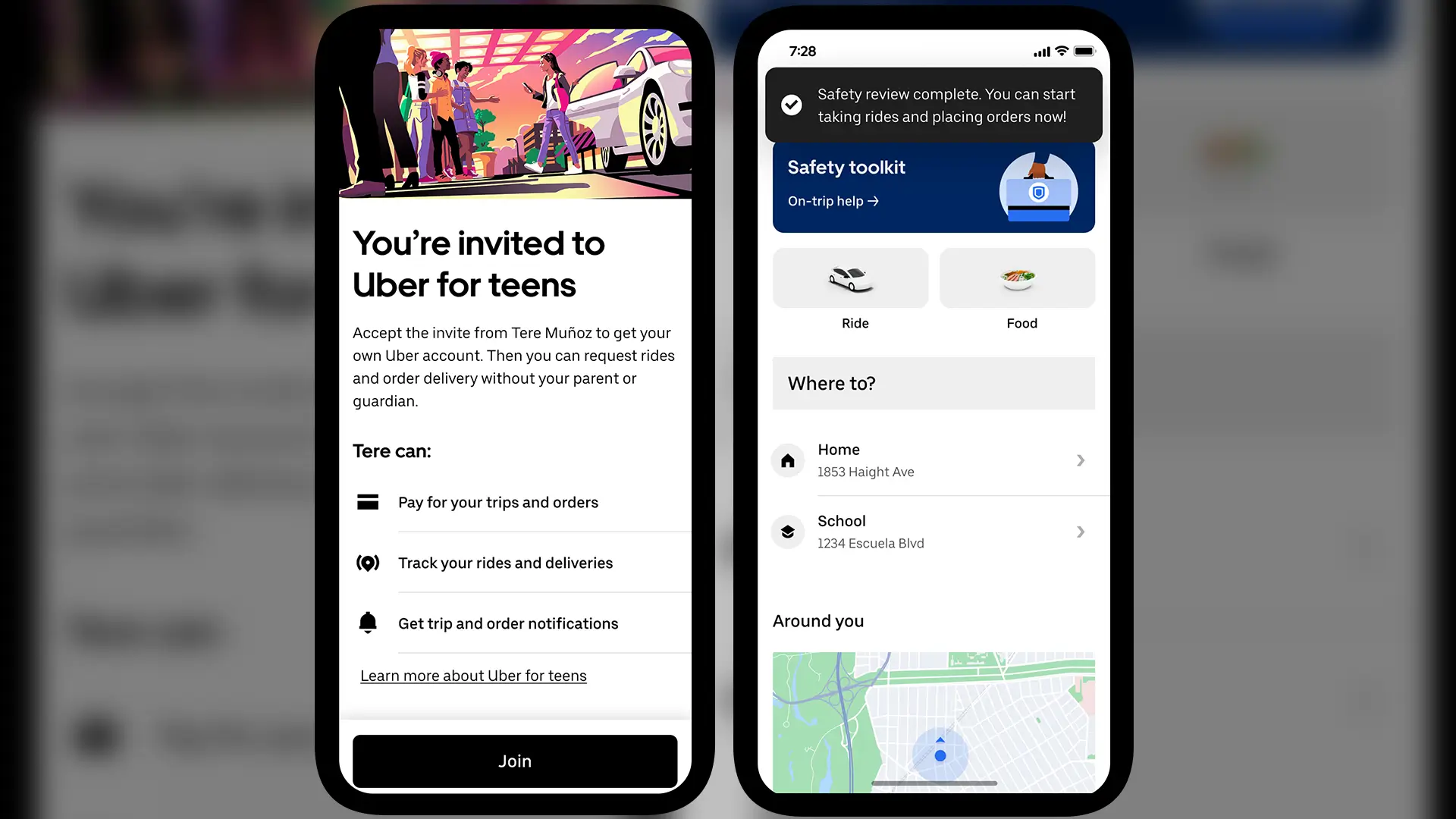
Uber for teens app interface showing an invitation screen and home screen with safety features.
stir
A driver who has enabled the feature accepts a teen trip. Once the ride begins, the linked parent or guardian receives a push notification that live video is available. A single tap opens the stream inside the Uber app. The front-facing camera on the driver’s phone supplies the feed, giving a view of the cabin that includes both the teen and the driver.
There is no silent mode. The moment a parent starts watching, both the teen and the driver receive a notification inside the app, one Manohar has said does not interrupt the driver’s GPS or any other in-app alert. Only the parent or guardian already linked to the teen’s account can open the stream. Other riders traveling with the teen have no way to stay off camera.
Drivers receive onboarding guidance on phone placement so the lens captures the back seat clearly. They can also preview the angle in the Safety Toolkit when they are not on a trip. The stream cuts off automatically the second the trip ends.
Ashu Manohar, director of product management at Uber, framed the addition as a response to consistent parental requests, telling Good Morning America that parents want to feel “connected and informed” while their teens are on the go. In the company’s own newsroom post he added that the feature builds on live trip tracking, PIN verification, and audio recording already available for teen accounts.
The system is designed to feel immediate. A parent does not need to place a separate video call or rely solely on a moving dot on a map. The cabin view appears inside the same app already used to track the trip and manage the family profile.
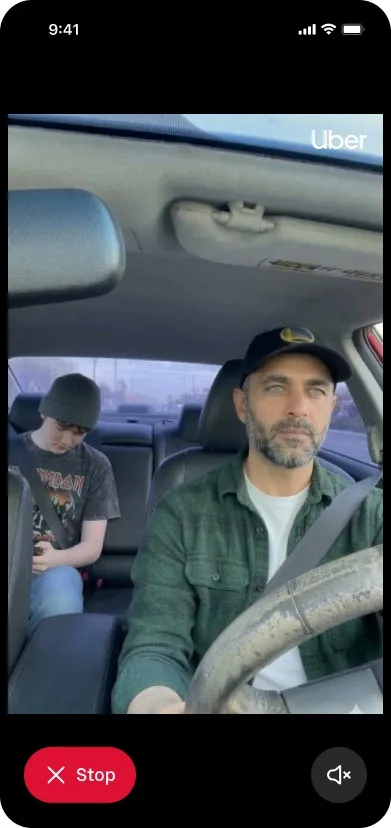
Uber in-car safety camera view showing the driver and a passenger with a Stop button.
rule
Access is limited to the single linked parent or guardian account. After the ride ends, the driver, the teen, and the parent all lose access to any recording. Uber stores an encrypted file. The company states it will open that file only if a safety incident is reported and an investigation is required.
Uber has described the video as “encrypted.” It has not confirmed whether the encryption is end-to-end. A TechCrunch report noted that a company spokesperson declined to answer that specific question. In public statements Uber says the encrypted file is normally deleted after 14 days unless a safety report triggers longer retention under existing data policies.
The design choices are deliberate. Everyone in the vehicle knows when the camera is live. No private copy remains after the trip. Uber retains the ability to review the file solely for safety investigations. The absence of an opt-out for other passengers in the car is also explicit: if someone is riding with the teen, they appear on the feed.
These rules sit alongside the existing audio-recording framework already used for teen trips. The video layer follows a similar pattern of limited access during the ride and restricted review afterward.
survive
As of the August 25 announcement the feature is active in Atlanta, Phoenix, Orlando, Raleigh-Durham, Portland, San Antonio, Cleveland, Rhode Island, and El Paso. Uber says the rest of the United States will follow in the coming weeks.
The timing is intentional. School calendars are restarting across the country and many parents are looking for reliable ways to move teens between home, school, and activities without driving every leg themselves. Teen accounts have already expanded far beyond their original 2023 pilot. Uber reports they now operate in more than 50 countries and support tens of millions of trips each year.
The nine-market launch functions as a live test bed. Feedback from parents, teens, and drivers in those cities will shape the experience as the feature reaches the rest of the country. Early availability in markets of varying size and density gives the company a range of real-world conditions before the broader rollout.
extend
Uber first opened teen accounts in May 2023. That original rollout covered 14 cities, including Atlanta, Phoenix, San Antonio, and the New York City area, well short of the more than 50 countries the product covers today. Before that launch, riders under 18 were not allowed to request trips on their own. The product requires a parent or guardian link, matches teens only with experienced and highly rated drivers, and in many markets limits trips to the local metro area. Drivers can choose to opt out of teen trips entirely.
The original safety package remains in place. Linked adults see live GPS tracking of every trip. A unique PIN must be shared with the driver before the ride begins. Audio recording is available. RideCheck alerts fire if a vehicle stops for an unexpected period. Live video is simply the newest tool in that set.
Manohar’s newsroom post frames the entire teen product as something that “started as an idea from parents,” crediting driver feedback for shaping it into what the post calls a trusted global service now used across more than 50 countries. The company says it will keep gathering input as the video feature rolls out more widely. Parents who already use the map-tracking and PIN tools now have an additional visual check available on demand.
The feature does not replace those earlier tools. It sits alongside them. A parent can still follow the route on the map, still receive the PIN, and still request audio recording. The live feed is an optional extra layer that activates only when the driver has enabled it and the parent chooses to open it.
roll
Drivers eligible for the livestream program must meet the same thresholds already used for teen trips: a completed background check, a rating of 4.5 or higher, and at least 100 completed trips. That background check already runs a motor vehicle record review alongside a criminal history check through a third-party screening partner, repeated annually for every driver on the platform. Those who accept teen rides are prompted to enable the camera feature if they wish to participate.
No extra hardware is required. By using the driver’s existing smartphone, Uber avoids install additional cameras while still giving parents a direct visual check. The stream runs in the background and adapts to the device, monitoring battery level, device temperature, and connection strength, and pausing automatically if any of those slip below a usable threshold. Drivers can preview the camera angle through the Safety Toolkit when they are not conducting a ride, which helps them position the phone for a clear cabin view.
The front camera itself is not new territory for Uber. Record My Ride, rolled out nationally in 2024, already lets drivers capture encrypted video and audio of a trip for their own protection, with the file staying on the driver’s device unless they choose to submit it for a safety report. Live video for teen accounts uses the same hardware but flips who benefits and when: instead of a private recording a driver controls after the fact, it becomes a real-time feed a linked parent can open while the trip is still happening.
The nine-market launch is the first public step. Nationwide expansion is scheduled for the coming weeks. Whether the encryption details satisfy privacy questions will become clearer once more markets are live and any safety investigations put the retention rules into practice.
For the moment the practical outcome is simple. A parent whose teen is heading to practice or a friend’s house can open the app, see the cabin in real time if the driver has the feature enabled, and know that the feed disappears when the trip ends. The initial nine markets are already running. The nationwide expansion is next.
Related Articles

Under Rue de Castiglione, Liaigre Gives Hôtel Costes a Spa With No Hard Corners
A 20-meter lap pool, eight treatment rooms and not one sharp angle: Studio Liaigre’s spa […]