DRIFT AUDIO
Listen to this story
Choose a voice, then press play.
Thirty-eight years after Jean-Charles de Castelbajac stitched a coat out of stuffed bears, Mattel has cut it down to doll size for Barbie and Ken.
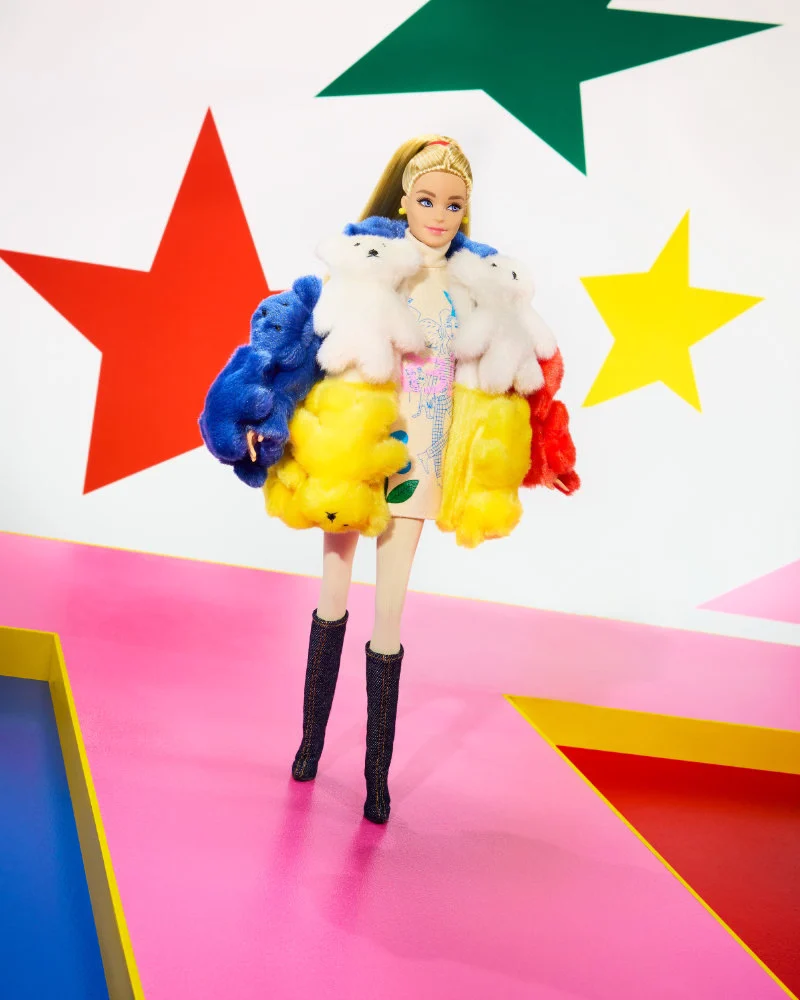
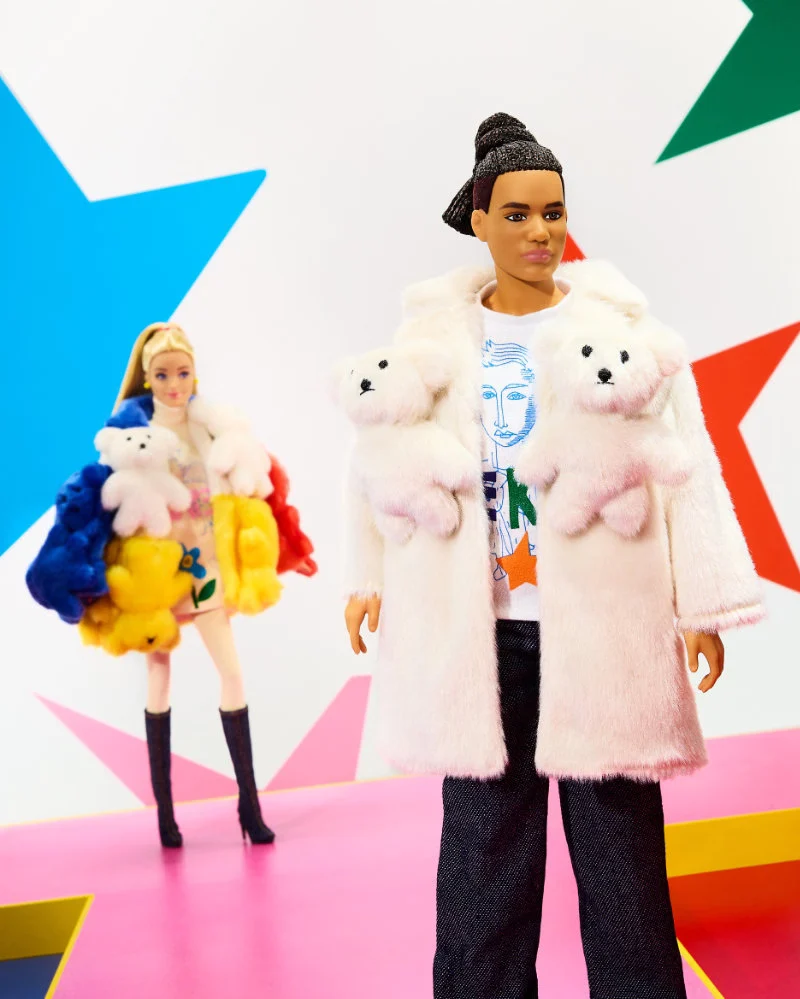
The coat registers before the doll does: a cloud of min teddy bears in red, yellow and blue, piled over a figure just under a foot tall. At 9:00 a.m. Pacific on Friday, October 2, Mattel Creations opened sales on two collector dolls styled by Jean-Charles de Castelbajac, the French designer who built a full-size version of that coat out of stuffed toys in 1988. Barbie wears the primary-flow take. Ken gets an ivory one. Each doll is listed at $150 and sold only through Mattel’s own collector storefront, and both carry identical credits: doll design by Robert Best, packaging design by Laydiana Chiv. Each box also holds a certificate of authenticity.
Signal. What happened: Mattel Creations released a pair of collector dolls designed with Jean-Charles de Castelbajac, each wearing a miniature version of his teddy bear coat. Exact object: Barbie x Jean-Charles de Castelbajac Doll (SKU JLH31) and Ken x Jean-Charles de Castelbajac Doll (SKU JLH32), $150 each in the US, with a two-doll bundle listed at A$539.98 in Australia. When and where: October 2, 2026 at 9:00 a.m. PT, exclusively through Mattel Creations, with the Australian storefront following at 9:00 a.m. AEST on October 3. Source: Mattel Creations’ own product and collaboration pages, plus WWD’s first look at the dolls. Why it matters: it moves one of French fashion’s most reproduced garments, a 1988 statement against fur, into Mattel’s adult collector line, about six weeks after a major Castelbajac retrospective closed in Toulouse and four weeks after Mattel’s doll with Yoon Ahn of AMBUSH.
stir
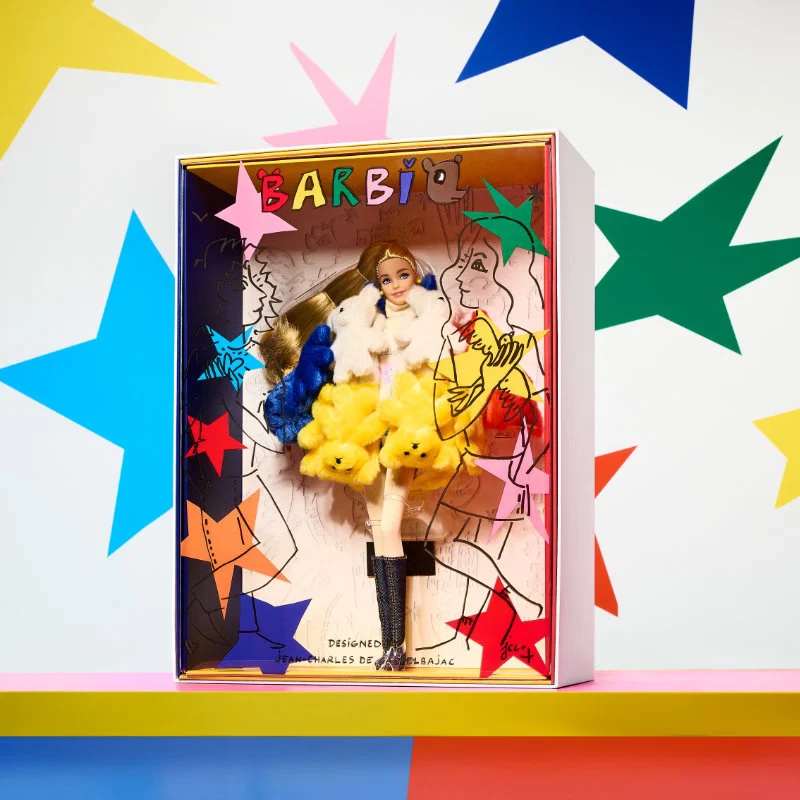
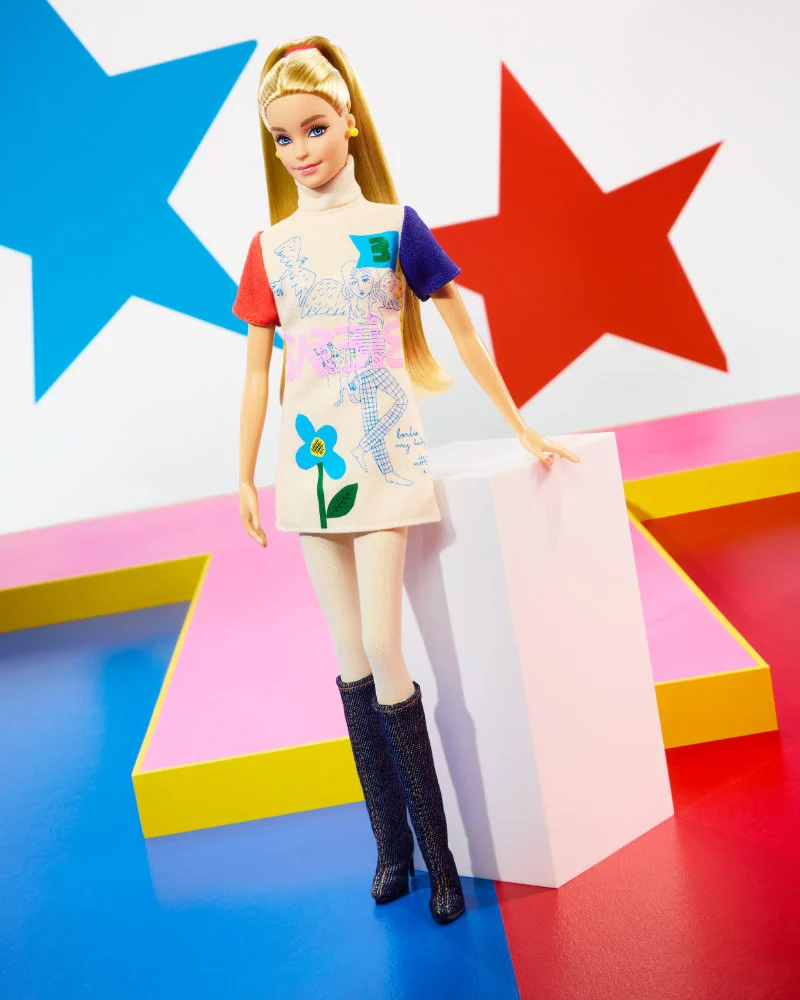
Mattel calls this Barbie “Bear-bie,” and the nickname lands at first glance. Her coat is oversized and covered edge to edge in tiny bears, worked in the red, yellow and blue that Castelbajac has used as a personal flag since the early 1980s. Beneath it sits a high-neck Tee dress printed with doodles in his loose, cartoon-friendly drawing style, and the look finishes with denim boots. The Barbie product listing puts her on the Closed Mouth Millie face sculpt and the Model Muse body, and like Ken she ships with a stand, since neither doll can stay upright on its own.
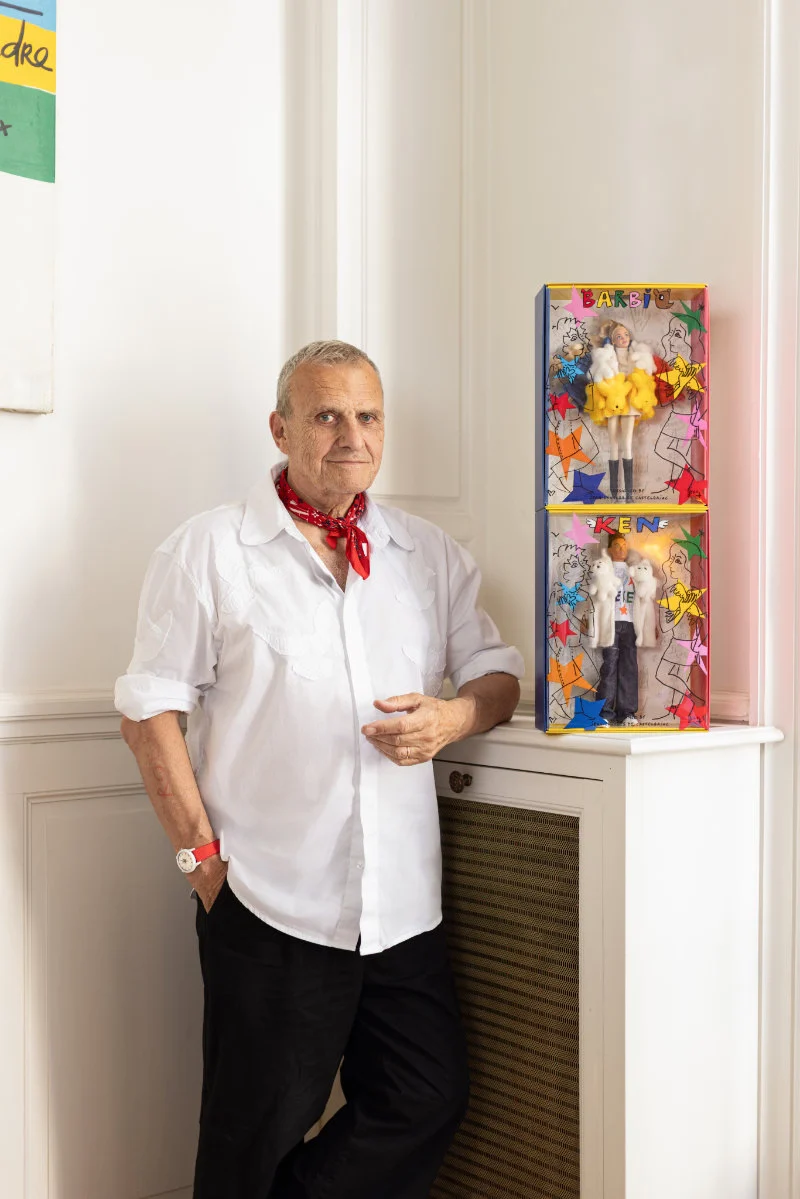
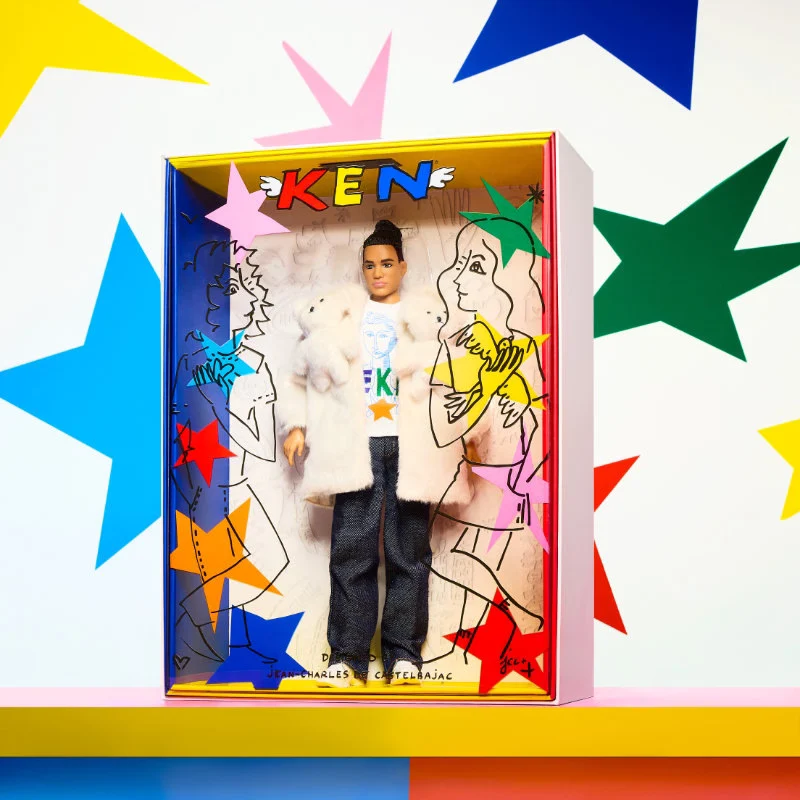
The box was not left plain either. Castelbajac also redrew it, according to WWD’s first look at the dolls, covering it in his trademark hue and drawings and swapping the last letter of Barbie’s name for a little bear’s head. The same report said he dedicated the Barbie to his young daughter, who watched the doll take shape during development.
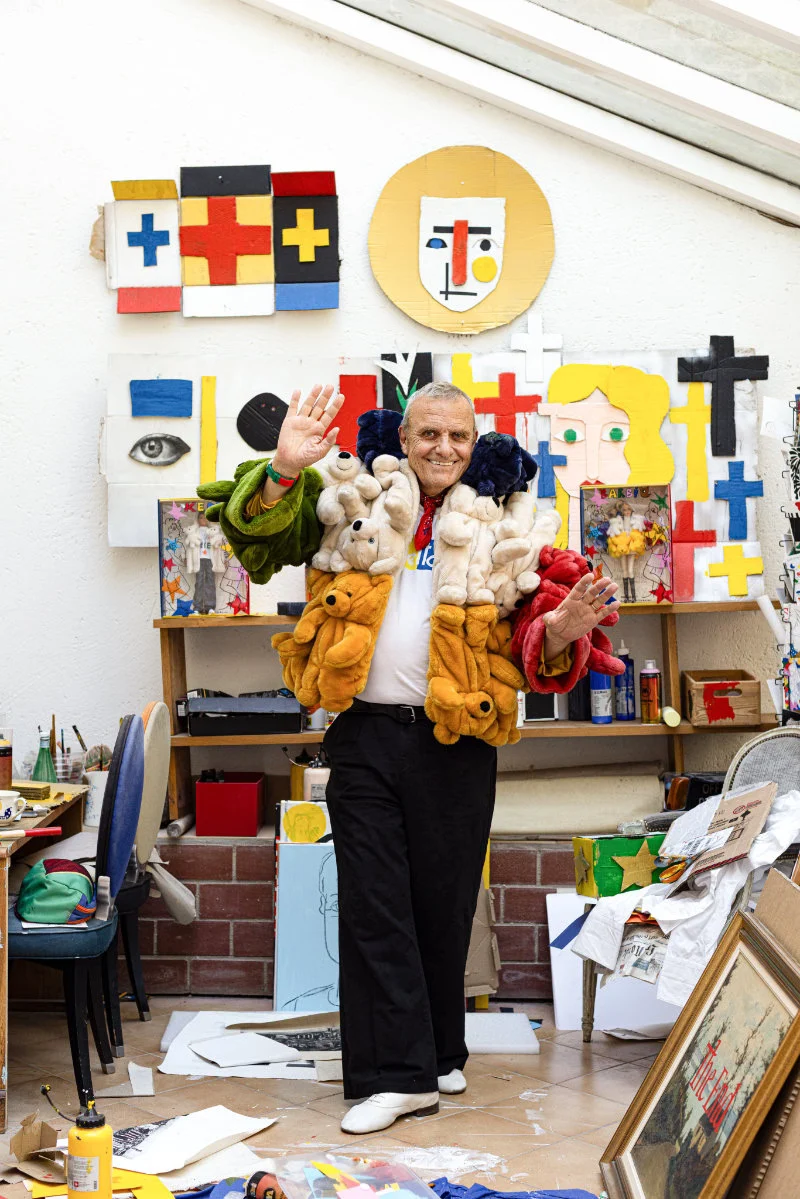
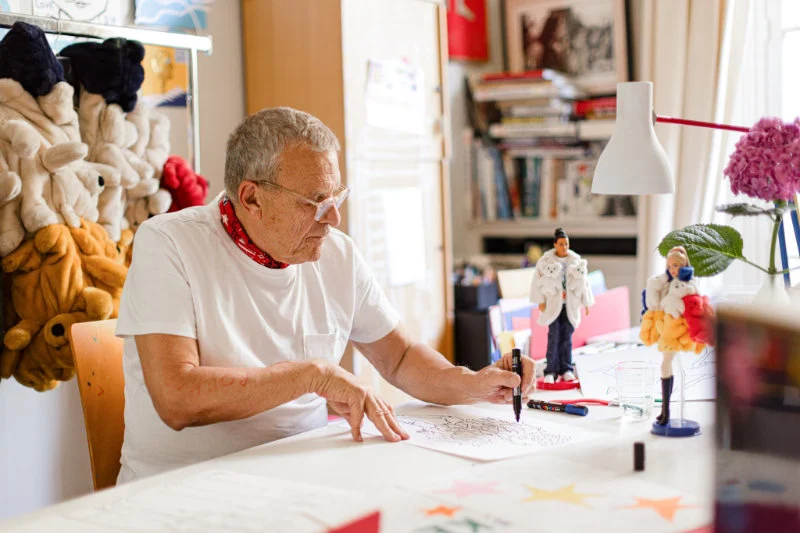
On Mattel’s collision page, Castelbajac describes the looks as drawn from his own career and says he wanted to “invite Barbie and Ken into my playful and colorful universe,” with art and fashion sharing the same frame. The coat, the doodles and the palette each trace back to a specific part of that career.
flow
Ken’s coat is the quieter of the two. His bears come in ivory rather than saturated hue, laid over the same oversized cut, and Mattel pairs the coat with a Castelbajac-style illustrated Tee, super-baggy dark jeans and bright white sneakers. The Ken product listing places him on a Model Muse body as well, with a face sculpt drawn from Mattel’s Basics line.
Castelbajac did not treat Ken as an afterthought. Giving him a makeover of his own felt natural, he told WWD, and he summed up the pair in four words: “They’re a free-spirited couple.” The styling supports the line. Side by side, the two dolls read as a set without matching, one saturated and one muted, the way a designer might dress two people walking out together rather than two halves of a boxed costume.
The release also lands in a notable year for Ken. Mattel introduced him in 1961, two years after Ruth Handler’s Barbie made her debut in March 1959, which makes 2026 his 65th anniversary, a milestone Mattel Creations is already marking elsewhere in its catalog.
where
The original coat belongs to Castelbajac’s Autumn/Winter 1988-1989 collection. It was a full-length garment covered in stuffed teddy bears sewn together, conceived as a statement against the fur trade: a coat that looked from a distance like a pelt but was built entirely from toys. It became one of the most reproduced images of his career, and it fits the way he has long described his own output, with runway shows treated as performances, window displays as installations and coats as sculptures. Madonna later wore it, and the idea branched into other plush coats, including a Kermit the Frog version made famous by Lady Gaga and a Snoopy version worn by Vanessa Paradis.
Paris museums have taken the coat seriously for nearly two decades. In 2007, the Palais Galliera, the City of Paris fashion museum, staged Gallierock, the first Paris exhibition devoted to Castelbajac, surveying his work since 1968 with the bear coat and his blanket garments among the headline pieces.
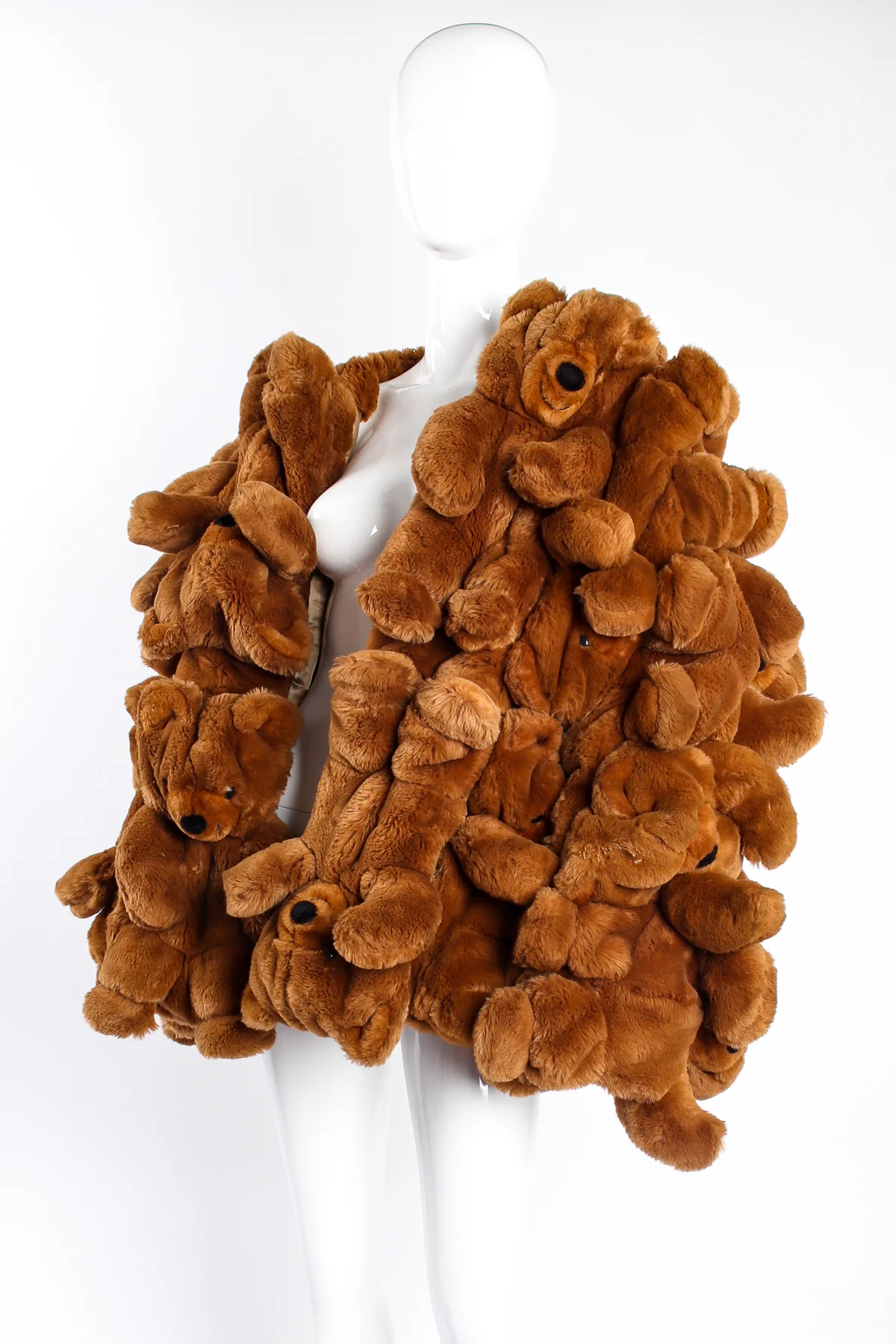
The 1988 coat has kept traveling as an object in its own right since then. The Musée des Arts Décoratifs in Paris showed it, catalogued under the title Nounours, in its exhibition Mon ours en peluche, which ran from December 4, 2024 to June 22, 2025 and traced the teddy bear’s path from feared wild animal to bedside companion through around 130 bears, posters and books. In a museum vitrine, the coat already looks halfway to a toy box.
One small discrepancy sits in Mattel’s own materials. The collide page dates the coat’s debut to 1987, while museum and reference records place it in 1988, which is the date used here.
At doll scale, the coat has one clear advantage: a field of bears survives the reduction intact, and even shrunk to a few inches the Barbie reads as Castelbajac from across a room.
straddle
Castelbajac was born in Casablanca in 1949 into an old French noble family, and he holds the title of marquis. His father died in 1964, when Castelbajac was a teenager, a loss often linked to the fascination with childhood that runs through his work. His fashion story starts in 1968 with a coat cut from a boarding school blanket, an early sign of the taste for humble, repurposed materials that still marks his practice, and he worked alongside his mother in Limoges before founding his own house in 1978. He left that house in 2016, according to his Wikipedia biography, though the name and the visual language have stayed firmly attached to him.
That language is built on three colors. Castelbajac has said he began using red, yellow and blue around 1980 as banners for pop culture, partly as a contemporary answer to his love of medieval heraldry. Over the following decades he worked with Keith Haring, Robert Mapplethorpe, Malcolm McLaren and Cindy Sherman, and dressed performers from Farrah Fawcett to Lady Gaga.
The same palette went somewhere few fashion designers ever reach. In 1992 he designed vestments for chaplains working in French prisons, and for World Youth Day 1997 in Paris, where he served as creative director of the event, he dressed Pope John Paul II, 500 bishops and 5,000 priests in vestments striped with rainbow color. He has recalled warning church leadership at the time that the rainbow could be read as transgressive, and the vestments went ahead anyway. The pope’s ensemble later went on loan to New York for a 2018 exhibition on fashion and Catholicism, and it was among the treasury pieces rescued during the 2019 fire.
Twenty-seven years after World Youth Day, church leaders in Paris came back to him. For the reopening of Notre-Dame de Paris on December 7, 2024, Castelbajac designed vestments for roughly 700 celebrants, in an off-white chosen to match the cathedral’s stone and marked with bursts of color meant to evoke its stained glass. His starting point was the golden cross in the choir that came through the fire intact. Among the ref he drew from the cathedral itself was a medieval penitential shirt associated with Saint Louis, a garment he likened to a Tee and recreated. He signed the work reticent, place his name inside a dove carry a Chi Rho, and he has called the label reading Jean-Charles de Castelbajac for Notre-Dame de Paris the most important of his life.
extend
The dolls also arrive on the heels of a major museum survey. From December 12, 2025 to August 23, 2026, Les Abattoirs, the contemporary art museum and Frac Occitanie collection in Toulouse, ran L’Imagination au pouvoir (Imagination at Work), a retrospective of nearly 300 works spanning clothing, accessories, collages, drawings, design objects and photographs. It was billed as the museum’s first fashion exhibition.
The show was staged with scenographer Pascal Rodriguez and set to an original composition by Vladimir Cauchemar, and visitors entered past colored banners and cut-out shapes designed by Castelbajac himself. The bear coat was there too. The museum’s own visitor guide lists a teddy bear coat dated 2024 among the works on view, a sign that Castelbajac has kept remaking the piece rather than leaving it in 1988.
The museum framed his output through upcycling, accumulation, collage and hybridization, and set it against art movements from Arte Povera to Nouveau Réalisme. In a statement for the show, Castelbajac described a lasting soft spot for modest, rough natural weaves of uncertain origin, some of them made from textile waste. It is the same instinct that turned a pile of plush toys into outerwear in 1988, and the same one that now puts a doodled Tee dress under a doll’s coat.
The Toulouse retrospective closed about six weeks before the dolls went on sale.
sig
Mattel launched Mattel Creations in 2020, its 75th year, as an e-commerce and content platform built around collaborations with outside artists and designers. Barbie Signature is the label it uses for Barbie releases aimed at adult collectors, and both Castelbajac dolls carry that adult designation. In comments to WWD, Robert Best, Mattel’s vice president of Barbie product design, praised Castelbajac’s imagination and described him as an obvious fit as a creative partner for Barbie.
The Castelbajac pair follows another fashion collaboration by just four weeks. On September 4, Mattel Creations released a doll designed with AMBUSH founder Yoon Ahn, the Tokyo-based designer, priced at $110. That project went in the opposite direction: an all-new sculpted body with 13 points of articulation, minimal robotic paneling and an articulated robot cat companion, developed with Mattel doll designer Suim Noh and boxed in custom packaging by Diana Leto. It even paired the new body with a different face sculpt, Kit. Castelbajac’s dolls keep established sculpts and put nearly all of the design weight on the clothes.
The Castelbajac dolls sit in a catalog that leans hard on named creative partners. The Mattel Creations storefront currently carries a Viktor&Rolf x Disney Collector Cinderella doll alongside a dedicated Mattel Creations x MoMA collection, and its archive of past projects includes a Barbie made with the painter Mark Ryden.
Side by side, the two most recent Barbie Signature fashion releases show the range of the line. Ahn’s doll imagined a future Barbie from the body outward, while Castelbajac’s pair starts from an archive, taking a garment that already lives in museum collections and fitting it to two figures that have been on shelves since the Eisenhower and Kennedy years.
Mattel’s listings carry the usual collector caveats: tincture and decorations may vary, avail is not guaranteed, and purchase limits can change at the company’s discretion. In Australia, where Mattel Creations runs a separate storefront, the Barbie and Ken dolls went up at A$269.99 each on the morning of October 3, local time.
Related Articles
Four-Fifths of a Giant Killer: Hedley Studios Builds an Electric Porsche 550 J
Porsche opened its archive to a workshop in Bicester. What came back is a two-seat, […]