DRIFT AUDIO
Listen to this story
Choose a voice, then press play.
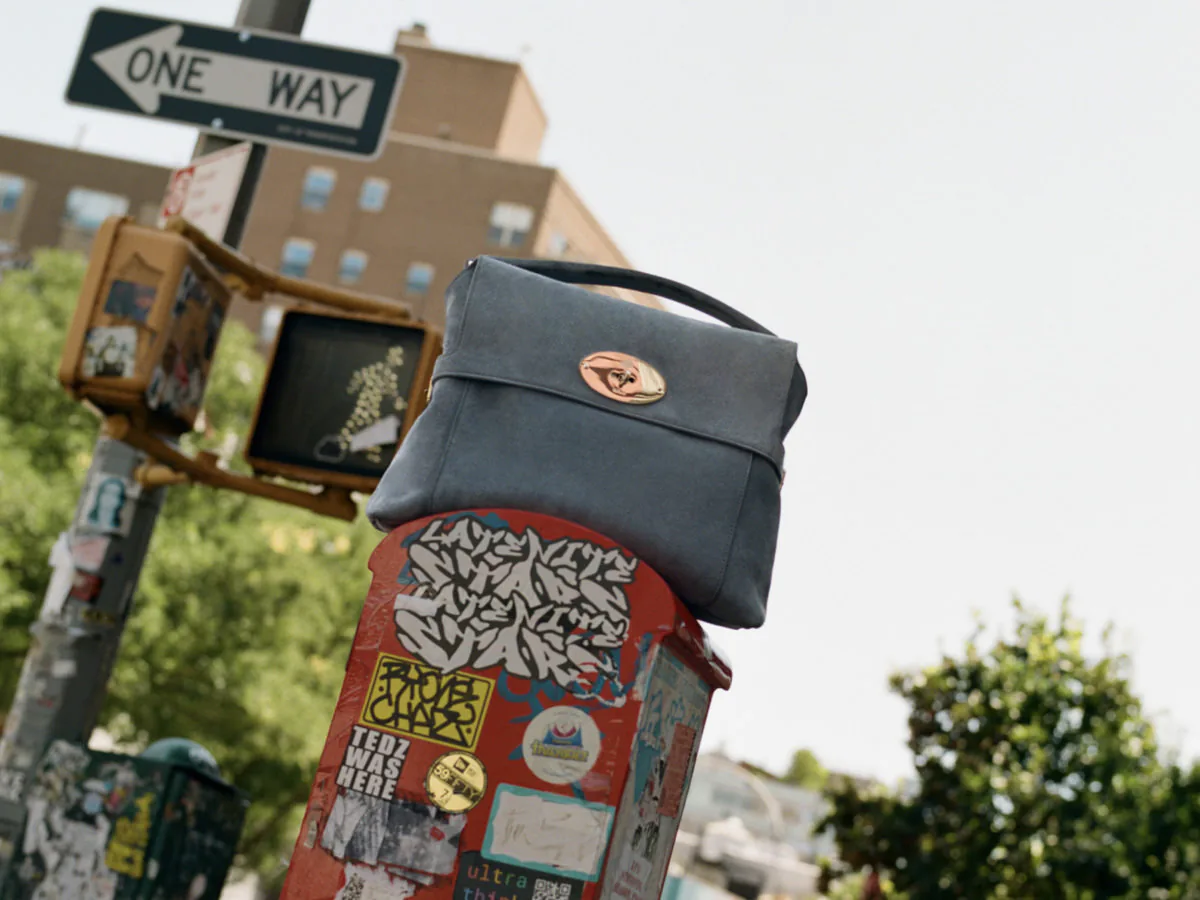
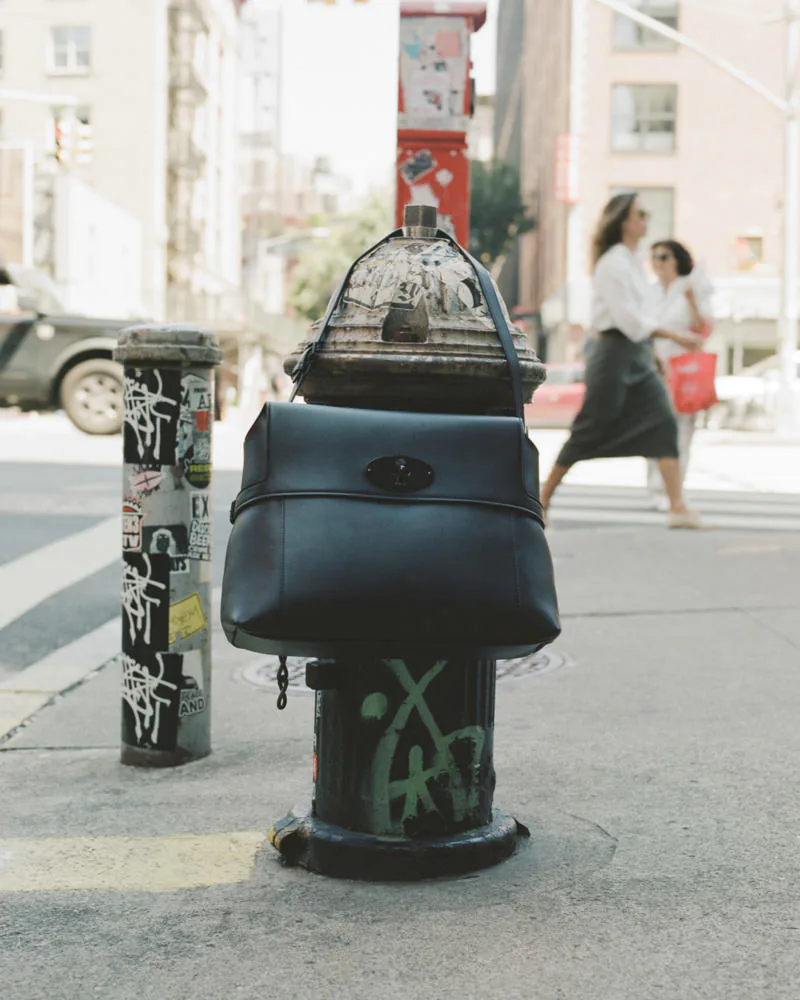
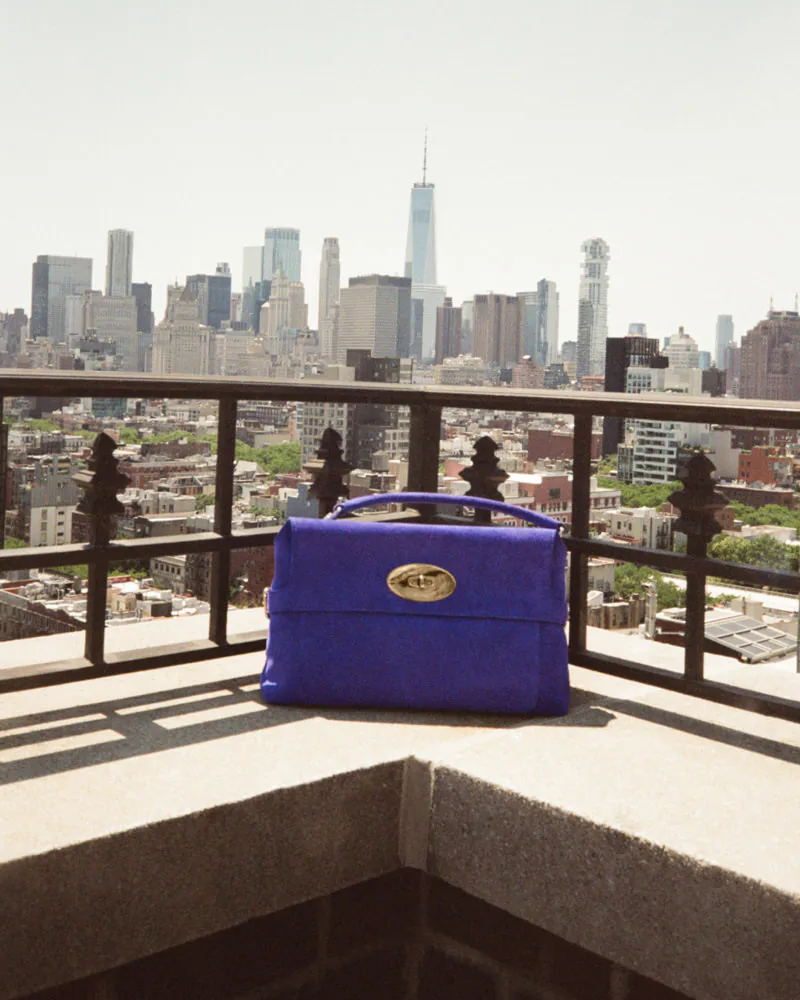
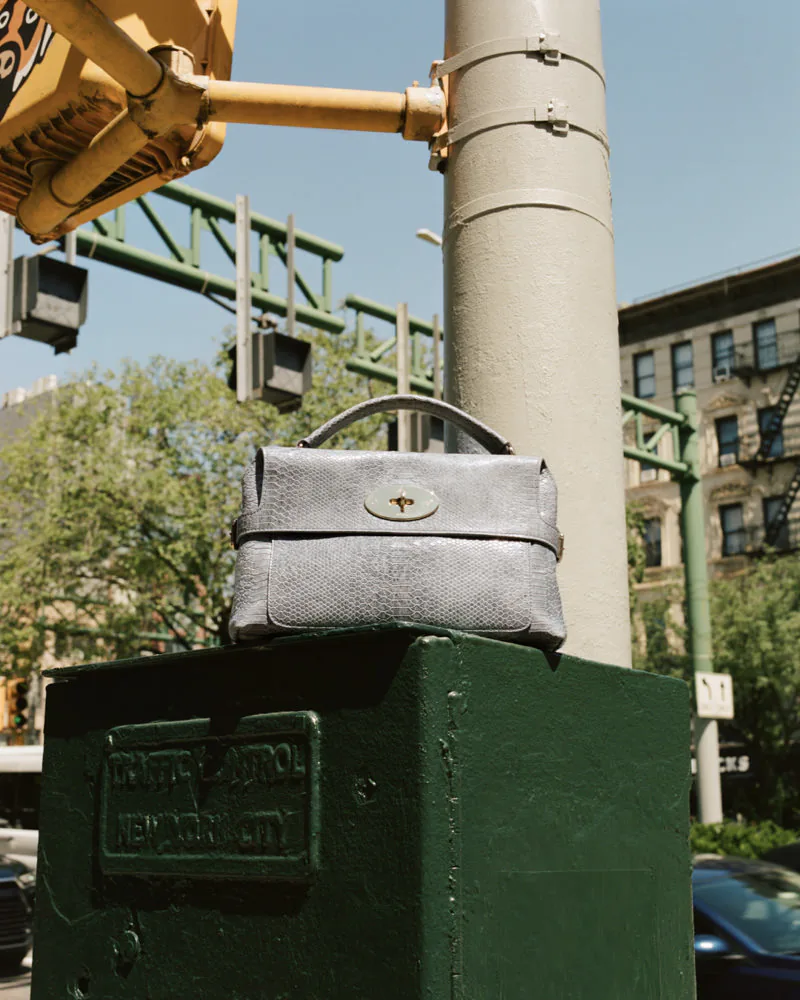
Shot in New York by Stevie Dance, the campaign for Mulberry’s new Stevie bag ran on a single casting rule: everybody in it had to answer to the name.
On location in New York, a photographer named Stevie gathered a cast of people named Stevie and handed each of them a bag called the Stevie. That is the whole premise of Mulberry’s new campaign for its latest handbag family, and the British house has been disciplined about not dressing it up as anything grander. The stills and accompanying video introduce a softly structured top handle bag in two sizes, fronted by the brand’s Postman’s Lock, and they landed in mid-September, a few days before Mulberry put a new creative director’s work on the London Fashion Week schedule.
Mulberry scheduled the Stevie ahead of that show rather than folding it into it, which gave the bag its own launch window, its own photographer and its own running joke. The brand presents it as the start of a bag family rather than a single style, and the opening range bears that out: two sizes, three materials and eight versions from day one.
View this post on Instagram
Signal. What happened: Mulberry launched the Stevie, a new top handle bag family, with a New York campaign shot by photographer Stevie Dance and cast entirely with people named Stevie, the bag’s own designer among them. Exact object: the Stevie Top Handle (HH0197) and the Small Stevie Top Handle (HH0199 in leather, HH0231 in suede), each with a Postman’s Lock front pocket, a detachable top handle and an adjustable, detachable strap, priced at £1,595 and $2,195 for the regular size and $1,845 for the small in the US. When and where: September 14, 2026, through mulberry.com and Mulberry stores. Source: Mulberry’s own Stevie campaign page and product list. Why it matters: it is Mulberry’s headline new bag in the same month the house returned to the London runway with Christopher Kane, and it lands while the brand’s turnaround plan is returning it to growth.
stir
Mulberry’s campaign page credits the cast by name. There is Stevie Jackson, Stevie Hunter, Stevie Boykin and Stevie Fusco, and there is Steevie van der Veen, whose extra e only sharpens the bit. Then there is Maria, who has no claim to the name at all beyond the fact that her boyfriend is a Stevie. The two appear together, the one loophole in an otherwise airtight brief.
The brand also mentions a Stevie who was named after her mother lost a bet, though it does not say which member of the cast carries that backstory. It closes the loop with the person who designed the bag. Mulberry identifies that designer only as its very own Stevie, which means the product was not named for a muse, a neighbourhood or a famous client, as several of the house’s best-known bags were, but for the person who drew it.
That is a small break with Mulberry habit. The Bayswater took its name from a West London neighbourhood when it arrived in 2003, and the Alexa borrowed its name from Alexa Chung. Naming a bag after its in-house designer, then building the campaign around everyone else who happens to share that name, turns the usual muse arrangement inside out.
Mulberry describes the campaign as playful and its cast as shade, and it frames the project around the idea of universal connection. Across the stills and video, shot on location in New York, the Stevies appear with both versions of the bag, regular and small, so the product stays in the frame without the shoot collapsing into a catalogue. The brand has not said how the cast was found, nor has it published full styling, hair or makeup credits for the shoot.
flow
None of this would land quite as neatly if the person behind the camera were called anything else. Stevie Dance is Australian born, and her career began at the Australian magazine RUSSH, where she worked her way from intern to fashion editor and eventually to editor before moving to New York to work as a freelance stylist.
Her styling work went on to run through major American, Japanese and Chinese fashion titles, and she held the role of fashion director at POP magazine, where at least one story credits her as both photographer and stylist. That dual credit marks the turn her work has taken since.
Over the past several years Dance has moved increasingly behind the lens. Industry credit listings show her photographing a Steve Madden campaign for Fall 2023, a booking that now reads like a small rehearsal for the Mulberry job, as well as a SKIMS project with actor Madelaine Petsch that same autumn.
what
Strip away the casting gag and the Stevie is a carefully specify day bag. Mulberry describes it as lightweight and softly structured, built to move from day into evening, and carried either by its top handle or over the shoulder.
The Postman’s Lock is the visual anchor, but on the Stevie it fastens a front pocket rather than acting as the main closure. The top handle detaches. An adjustable, detachable strap turns the bag into a shoulder style, and adjustable belt details on each side let the owner cinch the profile tighter or let it relax. Around the back there is an external zipped pocket, while inside sit a hook keeper closure and a microfibre lining.
The regular Stevie Top Handle measures roughly 36cm wide, 24cm high and 15cm deep. The Small Stevie comes in at about 11 by 7 inches with a depth of four and a half inches, and its strap drop adjusts between roughly 7¾ and 11¾ inches.
Eight versions anchor the launch, as listed on Mulberry’s own Stevie page. The regular size comes in Ebony, Amethyst and Black supple smooth leather and in Foggy Grey suede. The small runs in Ebony and Black supple smooth leather, Royal Amethyst suede and a Foggy Grey waxed snake print. Mulberry describes its supple smooth leather as a bovine hide polished to a high gloss, and treats the suede with a clear resin backing meant to cut down on colour and fibre transfer. Hardware shifts with the colourway: the Amethyst regular carries a brass finish, while the Ebony versions use a soft gold.
The Stevie Top Handle in Amethyst lists at £1,595 in the UK. In the US the regular size costs $2,195 and the small costs $1,845, in leather and suede alike, while UK retail listings put the small at £1,295.
Mulberry’s product pages are also specific about where the bag comes from. The leather is sourced from a partner tannery in Italy holding a Gold environmental rating, and the Stevie is made at a partner factory in Türkiye. That sets it apart from the brand’s limited Bayswater anniversary pieces earlier this year, which were produced at home in Somerset. The house has held B Corp certification since 2024, and its Mulberry Exchange resale programme, which buys back and resells pre-loved pieces, has passed £1 million in turnover as it expands internationally.
nar
Mulberry began in 1971, when Roger Saul founded the company in Somerset. By the brand’s own account, he grew up around leather through his father’s work at a local shoe factory, and the early collections drew on the textures of English country life: saddlery leather, quilted fishing bags, leather-trimmed waistcoats and poacher jackets. The Postman’s Lock is the house’s signature piece of hardware, and it appears across many of its best-known designs, nowhere more famously than on the Bayswater.
That bag, launched in 2003, became one of the defining It bags of the decade, and Mulberry has leaned on it ever since. In February 2026, to mark the brand’s 55th anniversary, the house released 55 one-off Bayswaters made at The Rookery, one of its two Somerset factories, each priced at £1,855. The first drop sold out in under eight minutes of going live.
The lock has not always been the house’s only signature. Under creative director Johnny Coca, Mulberry introduced the Amberley at its Autumn Winter 2017 show alongside a new piece of hardware, the Rider’s Lock, which Coca designed by inverting the rounded lines of the Postman’s Lock into something closer to a horse bit and bridle. The Amberley remains in Mulberry’s icons lineup today.
The Stevie, though, is built around the older lock rather than a new signature. That continues the house’s recent emphasis on its established codes, from the anniversary Bayswaters to an icons section that still leads with the 2003 bag, and it gives an unfamiliar sil a piece of hardware that shoppers recognise at a glance.
run
The Stevie also arrives at a moment when Mulberry has numbers to point to. Chief executive Andrea Baldo set out his Back to the Mulberry Spirit strategy in January 2025, built around restoring profitability, rebuilding gross margin and investing in the brand. In its full-year results for the 52 weeks to March 28, 2026, the group reported revenue of £125.5 million, up 4 percent, with gross margin rising to 72 percent from 67 percent and underlying EBITDA swinging to a £0.8 million profit from a £16.8 million loss the year before.
The second half did most of the work. Over those six months, like for like sales rose 13.7 percent in the UK, 37.8 percent in the EU, 20.1 percent in the US and 20.8 percent across Asia Pacific. Revenue for the 13 weeks to June 27, 2026, the first quarter of the current financial year, ran 23 percent ahead of the same period a year earlier.
Then came the creative appointment. In March 2026 Mulberry named Christopher Kane creative director of women’s ready-to-wear, returning the house to a category it had left when its licensing arrangement with Onward Luxury Groupended in 2020. Kane founded his own label in 2006 after Central Saint Martins, won four Fashion Awards along the way, and closed the business in 2023. At Mulberry he continues to work alongside his sister and longtime creative partner, Tammy Kane.
He presented his debut Mulberry collection on September 20 at the Queen Elizabeth II Centre in Westminster, under the title Mulberry by Christopher Kane, with the clothes due in stores and online from January 2027. Kane framed the debut around continuity rather than rupture, describing heritage as “a foundation, not a limitation” and calling the result a mix of Mulberry’s codes and his own. Teasers posted before the show had shown a figure cutting into a tree trunk, a nod to the house’s mulberry tree emblem.
The Stevie sits outside that remit. It is an accessories launch, designed in house by the Stevie on the campaign’s own cast list, and it reached shoppers six days before Kane’s show. Arriving in the same week, the two launches put both halves of the house’s plan in public view at once: the leather goods heritage the business is built on, and the ready-to-wear voice meant to widen it.
fin
Mulberry is selling the Stevie through its own stores and through mulberry.com, which ships to more than 190 destinations. Its UK and US sites both carry the family under a dedicated Stevie section within new arrivals, alongside separate edits for suede and Scotchgrain.
Further afield, Korean retailer Club21 lists the Small Stevie in black leather at ₩2,402,000, with product notes describing tonal gunmetal hardware on that version. In Japan, where Mulberry trades through department store boutiques, no Stevie listing or yen price had surfaced at the time of writing.
Kane’s first ready-to-wear for the house is not due in stores until January 2027. The Stevie, launched six days before his runway debut, is already on Mulberry’s shelves in two sizes and eight versions, under a name that, for the length of one New York shoot, belonged to everyone in the frame.
Related Articles
Moncler Re/Icons Takes On Four Archive Jackets at Once, and Isetan Shinjuku Gets Them First
Moncler’s 2026 Re/Icons chapter reworks four archive down styles dating from 1954 to 2009, and […]