DRIFT AUDIO
Listen to this story
Choose a voice, then press play.
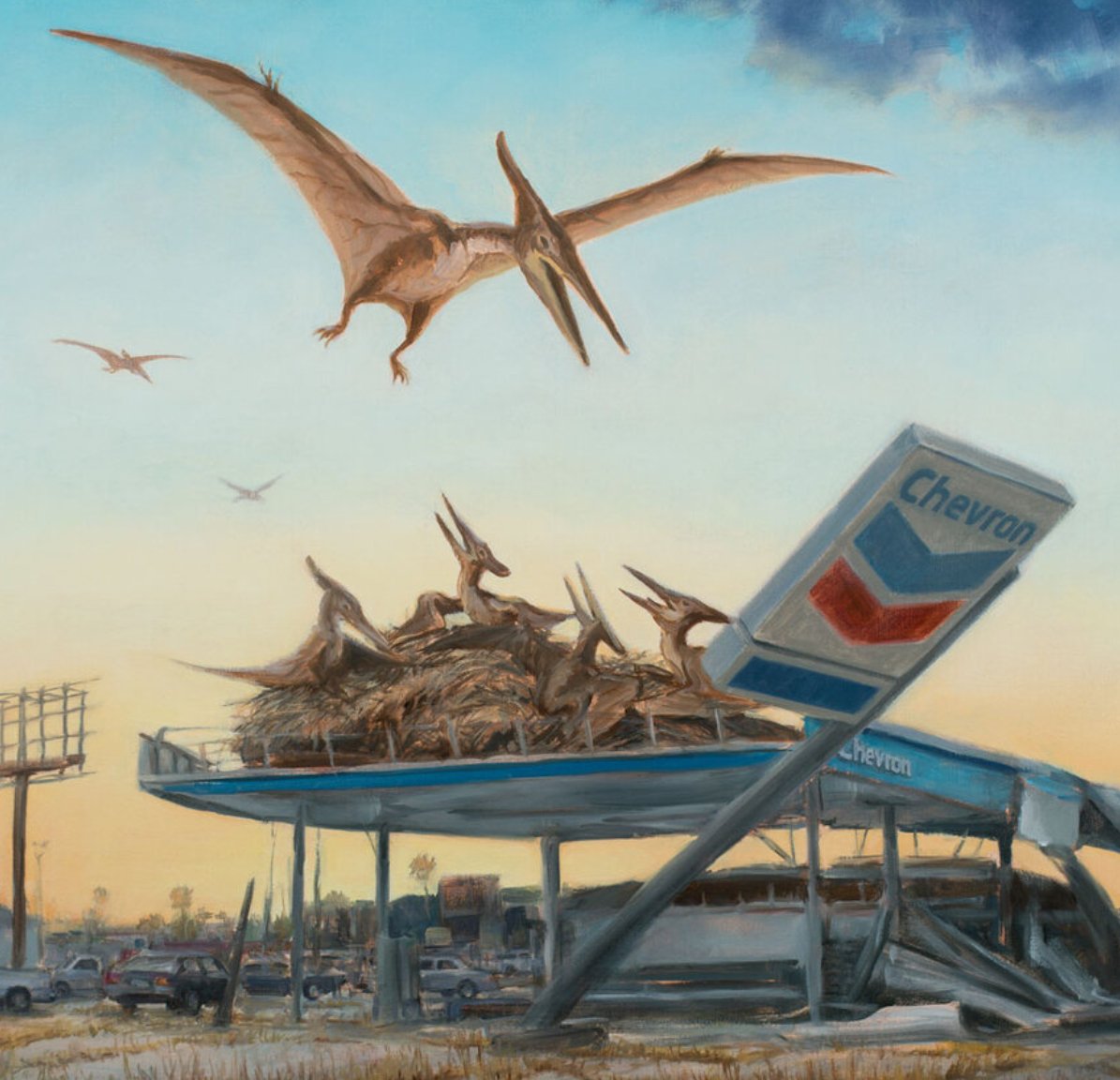
In a mesmerizing blend of surrealism and environmental commentary, artist Michael Kerbow’s paintings imagine a world where dinosaurs once again dominate a post-apocalyptic Earth. Through vivid imagery and haunting landscapes, Kerbow creates a speculative vision of humanity’s failure to combat climate change, leaving nature to reclaim the planet in a way both fantastical and thought-provoking.
Kerbow’s work is not just an artistic exploration of the past colliding with the present—it’s also a warning. By juxtaposing the ancient with the modern, his paintings confront viewers with the consequences of unchecked environmental destruction, imagining a scenario where humanity’s negligence has created a landscape ripe for primal forces to reign supreme.
The World of Michael Kerbow: Surrealism Meets Environmentalism
Michael Kerbow is known for his ability to merge the fantastical with deeply relevant social and environmental issues. His surrealist approach draws viewers into worlds that are visually stunning yet carry heavy undertones of caution and critique. His paintings have often explored themes of industrialization, consumption, and environmental degradation, making the dinosaurs in his post-climate disaster series both a natural extension and a stark contrast.
The series presents Earth as a desolate, unrecognizable place. Modern infrastructure—skyscrapers, highways, and factories—lies in ruins, consumed by nature and overtaken by gargantuan dinosaurs. While the imagery is fantastical, Kerbow’s attention to detail grounds these scenes in unsettling realism. The viewer is left questioning how far-fetched these scenarios truly are.
Dinosaurs as a Metaphor
In Kerbow’s vision, dinosaurs symbolize a return to primal, untamed forces, filling the void left by humanity’s collapse. Their overwhelming size and dominance in his paintings dwarf the remnants of human civilization, creating a visual hierarchy that speaks volumes. The dinosaurs are not mere decorations—they represent nature’s indifference to human fragility.
Kerbow’s use of dinosaurs also draws parallels between the mass extinction event that wiped them out millions of years ago and the climate crisis humanity currently faces. The irony is palpable: while the dinosaurs fell victim to an asteroid-induced disaster, Kerbow’s apocalyptic world is entirely man-made. This cyclical narrative of dominance, extinction, and resurgence invites viewers to reflect on humanity’s precarious place in Earth’s history.
The Ruins of Civilization
Kerbow’s paintings feature crumbling cities, toppled monuments, and abandoned vehicles, all overtaken by the unstoppable march of time and nature. In one striking piece, a Tyrannosaurus rex strides through a half-submerged cityscape, its massive form silhouetted against a hazy sky filled with ash and smog. The message is clear: humanity’s technological advancements mean nothing in the face of Earth’s enduring forces.
Nature’s Resilience
While Kerbow’s work depicts a bleak future for humanity, it also celebrates nature’s resilience. Trees sprout from the wreckage of skyscrapers, vines creep over highways, and the dinosaurs themselves embody the Earth’s ability to evolve and adapt. This duality—destruction and regeneration—is central to the series’ impact.
Environmental Warning
At its core, the series is a stark warning about the consequences of climate inaction. By presenting a world where humanity’s negligence has paved the way for nature to reclaim dominance, Kerbow urges viewers to consider their role in shaping the planet’s future. The dinosaurs, while awe-inspiring, are also a reminder of what’s at stake if we fail to address the climate crisis.
Artistic Techniques and Style
Kerbow’s mastery of surrealist techniques is on full display in this series. His use of dramatic lighting, intricate textures, and carefully balanced compositions creates scenes that are as immersive as they are unsettling. Each painting feels like a snapshot of a larger narrative, inviting viewers to imagine the stories that led to and will follow these moments.
Color Palette
Kerbow employs a muted yet rich color palette, dominated by earthy tones and atmospheric hues. This lends his work a sense of realism while also evoking the desolation of a post-climate disaster world. The contrast between the vibrant dinosaurs and the decayed human infrastructure further emphasizes the themes of dominance and collapse.
Attention to Detail
One of Kerbow’s strengths is his meticulous attention to detail. From the rusted metal of abandoned cars to the weathered stone of crumbling buildings, every element in his paintings feels deliberate and immersive. This level of detail grounds his surrealist vision in a sense of plausibility, making the fantastical elements even more impactful.
Influences and Inspirations
Kerbow’s work draws inspiration from both art history and contemporary issues. The surrealist influences of artists like Salvador Dalí and Max Ernst are evident in his dreamlike compositions and blending of reality with fantasy. However, Kerbow’s focus on environmental themes sets his work apart, aligning him with modern eco-artists who use their craft to advocate for climate action.
The choice of dinosaurs also speaks to a fascination with deep time and Earth’s history. By reintroducing these prehistoric creatures into a modern context, Kerbow challenges viewers to consider the transient nature of human existence in the grand timeline of the planet.
Reception
Kerbow’s post-climate disaster series has garnered significant attention for its striking visuals and powerful message. Art critics and environmental advocates alike have praised his ability to merge artistic beauty with urgent commentary, creating work that resonates on both emotional and intellectual levels.
The series has been featured in exhibitions focused on climate change, sustainability, and the Anthropocene, highlighting its relevance in today’s cultural and environmental discourse. Viewers are often struck by the duality of the paintings—awed by their beauty yet unsettled by their implications.
A Call to Action
At its heart, Kerbow’s work is a call to action. While the scenes he paints are speculative, they are grounded in the real consequences of climate inaction. By presenting a world where humanity’s hubris has led to its downfall, Kerbow invites viewers to reflect on their own relationship with the environment and consider how they can contribute to a more sustainable future.
Impression
Michael Kerbow’s paintings of dinosaurs overrunning a post-climate disaster world are more than just artistic expressions—they are a vivid and urgent commentary on humanity’s impact on the planet. Through his unique blend of surrealism, environmentalism, and historical reflection, Kerbow creates a vision that is as awe-inspiring as it is cautionary.
As the world grapples with the realities of climate change, Kerbow’s work serves as both a reminder of what’s at stake and a celebration of nature’s resilience. His dinosaurs may dominate his paintings, but the real story lies in humanity’s ability—or inability—to rewrite its future.
Related Articles
Twelve Albums on a Pharmacy Shelf
Damien Hirst has shelved Eminem's twelve albums beside pill packets, and one cabinet stocks every drug the rapper has named in a lyric.