DRIFT AUDIO
Listen to this story
Choose a voice, then press play.
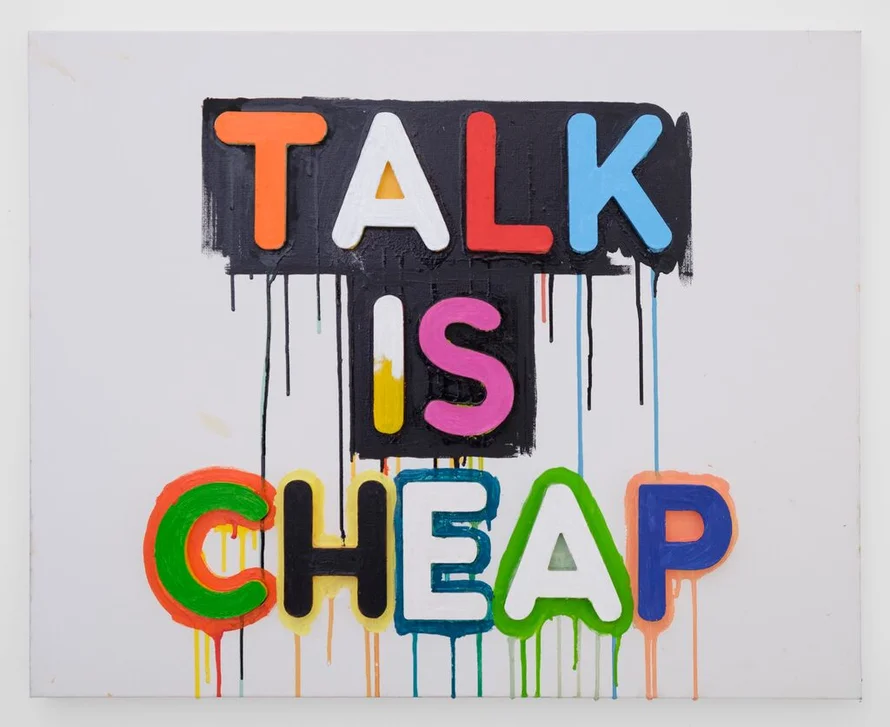
A small oil and acrylic painting from 2023 carries the full weight of a six decade argument about words, paint, and what happens when the two refuse to agree.
Talk Is Cheap measures twenty four by thirty inches, a size Mel Bochner favored late in his career because it let him work fast and hang the results close together, like a run of headlines. The 2023 painting is built from oil and acrylic laid onto canvas that has been mounted to PVC foam core, a support Bochner started using in the 2010s because its rigid, slight plastic surface held paint differently than raw canvas: less absorption, more slide, so a loaded brush could skid across the letters and leave a view record of the hand that pushed it. The words themselves, TALK IS CHEAP, are not new to Bochner’s vocabulary. He had painted the same three words in 2012 as part of a suite of etchings, again in a 2022 canvas shown at Peter Freeman, Inc. in New York, and once more in this 2023 version, which entered the market through TOTAH, a gallery on Stanton Street on the Lower East Side. Repetition was never a weakness in Bochner’s practice. It was closer to the point. A phrase that gets said again and again starts to come loose from its meaning, and watching that happen, slowly, in oil paint, was a large part of what his late work was doing.
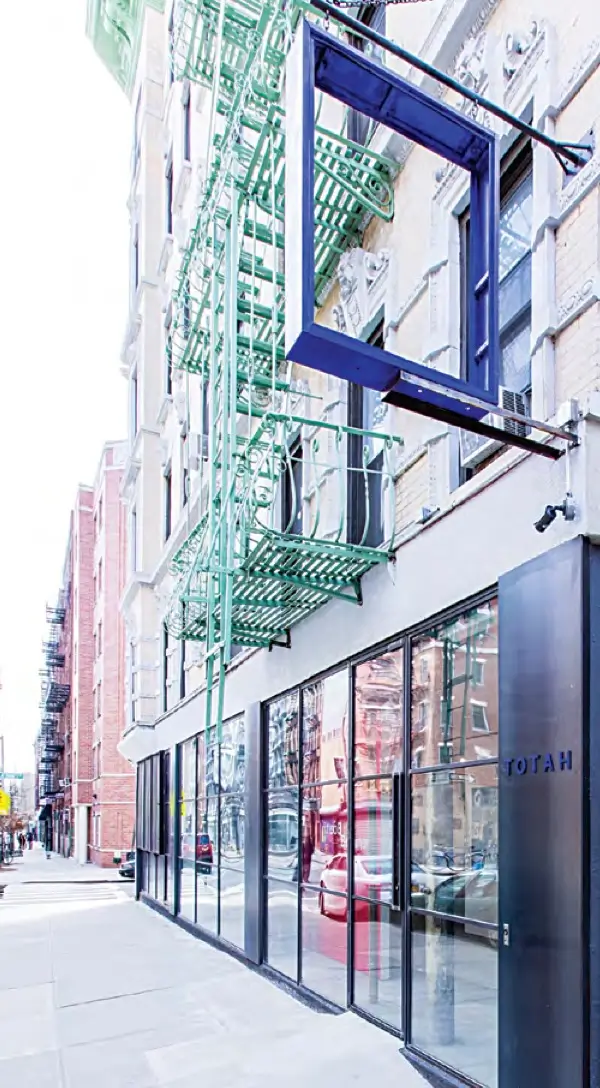
TOTAH, the Stanton Street gallery that gave Bochner his second solo New York exhibition since joining its roster.
What makes the phrase land differently in 2023 than it did in 2012 has less to do with the painting and more to do with the man who kept returning to it. By his final decade, Bochner was widely understood as one of the people who had made Conceptual art a working discipline rather than a provocation, and a three word insult rendered in thick, dripping paint was, coming from him, something closer to a signature than a slogan.
stir
Melvin Simon Bochner was born on August 23, 1940, in Pittsburgh, the son of a sign painter, a detail that biographers return to often enough that it risks sounding like an origin myth, except that Bochner himself brought it up. Growing up around lettering, stencils, and the commercial trade of making words legible from a distance left a mark that shows up plainly in the confident, sign painter’s hand of his late text paintings. He studied at the Carnegie Institute of Technology, now Carnegie Mellon University, earning a BFA in 1962, and took philosophy courses at Northwestern University near Chicago before moving to New York in 1964. He supported himself for a stretch as a guard at the Jewish Museum, a job that put him inside the machinery of an institution before he had any real footing in it as an artist, and two years later he was teaching at the School of Visual Arts.
flow
The show that art historians keep pointing back to happened almost by accident. In 1966, Bochner was asked to put together a holiday drawing exhibition at the School of Visual Arts. Rather than solicit finished drawings, he approached artists he knew, among them Eva Hesse, Donald Judd, Robert Smithson, Sol LeWitt, Carl Andre, Dan Flavin, and Jo Baer, and asked for working material: notes, diagrams, studies, anything that existed on paper but was not necessarily meant to be looked at as art. He photocopied what came back, bound it into four identical binders, and set the binders on pedestals under the title Working Drawings and Other Visible Things on Paper Not Necessarily Meant to Be Viewed as Art. Harvard art historian Benjamin Buchloh later called it probably the first genuinely conceptual exhibition, and the show is still taught that way. Bochner did not set out to found a movement. He set out to solve a scheduling problem with the material he had on hand, which is a very Bochner kind of beginning: a system applied to an ordinary situation, producing a result nobody had quite categorized yet.
atelier
Bochner spent the years that followed testing how far art could move away from objects altogether. His Measurement pieces, beginning with a Measurement Room staged in 1969 at Galerie Heiner Friedrich in Munich, involved taping straight lines directly onto gallery walls and annotating them with their own dimensions in grease pencil. There was nothing to buy, nothing to hang, nothing that survived the run of the show except documentation and the memory of having stood inside a room that was describing itself back to you. The work sat comfortably alongside what Eva Hesse, Judd, and Smithson were doing at the time, a generation deliberately stepping away from Abstract Expressionism’s gesture and toward information, seriality, and systems. Later restagings of the Measurement pieces, including one at Dia: Beacon, have kept that early, austere strand of Bochner’s practice view even as his later work grew louder and more colorful.
word
The paintings most people now associate with Bochner’s name arrived later and looked almost nothing like the taped, grease pencilled rooms of the late 1960s. Starting in the late 1990s and running for decades after, he began painting single words alongside their thesaurus synonyms, stacked in tight columns and rendered in saturated, sometimes clashing color. A word like DIE might unfold into EXPIRE, PERISH, CROAK, KICK THE BUCKET, each synonym drifting slightly further from politeness than the last, until the list itself became a kind of joke told entirely through vocabulary. Jeffrey Weiss, writing in Artforum, described Bochner’s gift for isolating a platitude until it turned strange in your hands, and the thesaurus paintings are the clearest demonstration of that gift: dictionary language, a genuinely neutral source, made to feel confrontational purely through selection and arrangement.
blah
By the 2010s, Bochner had shifted from synonym lists to what he called exasperations, short bursts of frustrated speech piled onto the canvas in overlapping, half legible bands. The most durable of these, Blah Blah Blah, first appeared around 2013 and kept reappearing for the rest of his life in paint, monoprint, and, memorably, outside the gallery system altogether. He had the phrase installed on a billboard in the small town of Hatton, Missouri, painted across the rolldown security gate of a restaurant supply shop in New York City, and printed on a parking lot wall in San Diego. Moving the words off canvas and onto infrastructure people actually drive past did something the gallery versions could not: it let a private art world joke about the emptiness of lang collide with real commercial signage, the exact context Bochner’s sign painter father had worked in decades earlier.
show
Talk Is Cheap belongs to this later, plainspoken register. The 2023 version was shown as part of ALL SALES FINAL!, Bochner’s second solo exhibition at TOTAH, which ran from April 25 through June 15, 2024. TOTAH had opened less than a decade earlier on Stanton Street, in a storefront that had previously housed a liquor store, and built its early identity partly around Bochner’s work: his first show there paired him with Alighiero Boetti, and the gallery went on to include him in group exhibitions marking its history. Press materials for ALL SALES FINAL! described the show’s paintings as revealing less about the artist’s own subjectivity and more about how language, treated as a set of graduated meanings, quietly muddles the world while hiding its own history, a description that could apply just as well to Talk Is Cheap as to any of the other canvases in the room. The title of the show itself, borrowed from retail signage, extended the same joke the paintings were already telling: words meant to close a transaction, repurposed to open a conversation about how little any of us trust them.
challenge
Bochner died on February 12, 2025, at a hospital in Manhattan, at the age of 84, from complications following a fall. His death was announced jointly by the three galleries that represented him at the time, Peter Freeman, Inc. in New York and Paris, Fraenkel Gallery in San Francisco, and Marc Selwyn Fine Art in Los Angeles. He had lived in Manhattan with his wife, the photographer Lizbeth Marano, and the two had two daughters. His final exhibition at Peter Freeman had opened only months earlier, in November 2024, a recreation of his 1969 48 Standards series that closed the same month he died. A year before his death, in 2024, it was announced that his complete archive would be acquired by the Getty Research Institute in Los Angeles, joining a body of institutional recognition that already included his work in the permanent collections of the Museum of Modern Art, the Whitney Museum of American Art, Tate Modern, the Centre Pompidou, the Hirshhorn Museum, LACMA, and, following a 2023 acquisition, the Menil Collection in Houston. He had also spent decades teaching, joining Yale as an adjunct professor in 2001 after decades of concurrent studio and academic work, shaping the way generations of students thought about the distance between what a work of art says and what it means.
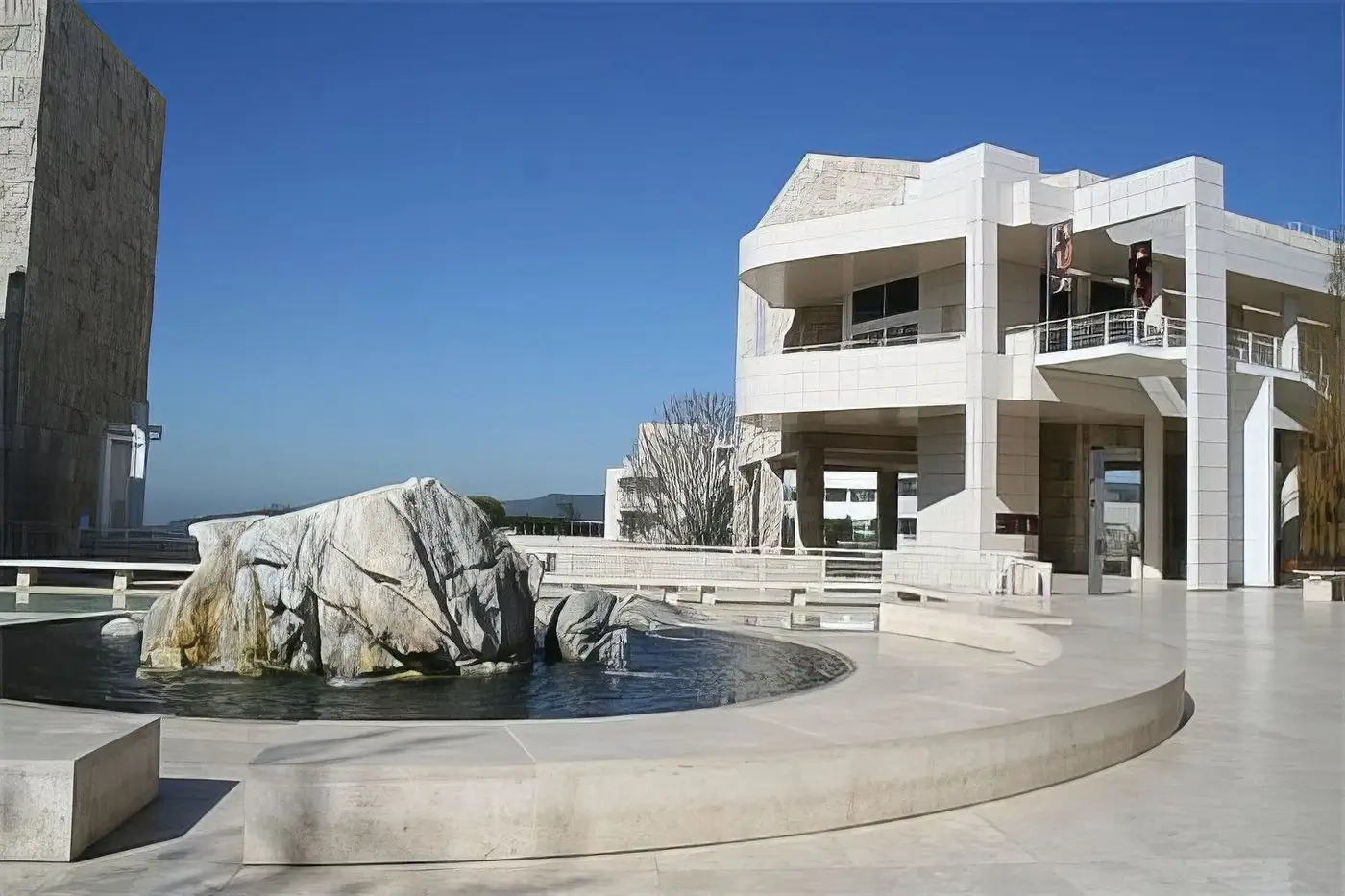
Getty Research Institute in Los Angeles, which announced the acquisition of Bochner’s complete archive in 2024.
fin
Critics who sat with these later canvases tended to notice the same tension. Reviewing the 2022 Peter Freeman survey that included an earlier Talk Is Cheap, Jonathan Goodman described Bochner as a genuinely skilled painter who turned casual, almost thrown away phrasing into compositions that acknowledged, and just as quickly rejected, the gestural drama of Abstract Expressionism that had dominated the previous gen. A companion review in the Brooklyn Rail described the same body of work as confrontational and occasionally nihilistic, with viewers left mulling over the font choice and paint handling long after the joke of the words themselves had worn off. Bochner had his own explanation for the friction. Asked whether art needed to mean what it said, he told the Art Institute of Chicago that for him humor was not a laughing matter and that he found irony more interesting, since it smuggled a second meaning inside the first. Talk Is Cheap works exactly that way. Read quickly, it is a shrug. Read slowly, in front of the actual canvas, with the drips and the skidded brushwork visible up close, it starts to look like an argument the painting is having with its own title.
Talk Is Cheap, then, is a small painting carrying a large amount of context. It is not Bochner’s most historically important work, and it was never meant to be; by his own account, the late text paintings were meant to be immediate, almost disposable in feel, three or four words thrown at the canvas the way you might actually say them out loud. But the phrase has outlived the year it was painted in a way its author could not have fully anticipated when he picked up the brush in 2023. Talk is cheap, the painting says, in the loose, dripping capitals of a man who spent sixty years testing exactly how much weight three plain words could hold before they buckled, and who, it turns out, is no longer around to argue the point further. The argument, on canvas, continues without him.
n
From the DRIFT archive: Eric Stefanski and the Art of Selective Living: A 2025 Confession Painted in Plain Sight