DRIFT AUDIO
Listen to this story
Choose a voice, then press play.
She’s Light (Pure) strips the most photographed face of the past thirty years back to something no camera had ever reached before — and the 2019 inkjet edition keeps that shh revolution accessible
In This Story
- The Problem with Photographing Kate Moss
- Who Is Chris Levine
- The Photograph Itself
- What “Pure” Actually Means
- Light as Philosophy, Not Technique
- The Edition and the Object
- Where This Sits in the Levine Catalogue
- Why the Work Still Lands
There is almost no view problem harder than this one: make a picture of Kate Moss that tells us something we do not already know about her.
By the time Chris Levine first photographed Moss in the early 2010s, she had been the most recognisable face in global fashion for more than two decades. She had been shot by Corinne Day, Juergen Teller, Mario Testino, Peter Lindbergh, Helmut Newton, Nick Knight, David Sims, and seemingly every other photographer who had defined what the camera could do to a face in the late twentieth century. She had appeared on thousands of magazine covers across dozens of countries, in advertising campaigns for products ranging from opulent perfume to budget supermarkets, in documentary films, in artworks, in newspapers in connection with scandals. Her face had been reproduced so many times that it had become something close to a public resource — instantly legible, emotionally pre-loaded for everyone who encountered it. The challenge facing any artist approaching Kate Moss as subject was not photographic but conceptual: what could you possibly do that hadn’t been done, and to what end?
Levine’s answer was, on its surface, so simple it sounds like a joke. He asked her to close her eyes.
stir
Chris Levine was born in Ontario, Canada in 1960, and came to Britain to study graphic design at Chelsea School of Art before completing an MA in computer graphics at Central Saint Martins. His early professional life was dominated not by photography but by holography — the laser-based process of recording three-dimensional images — which he encountered in his final year at Chelsea and which consumed his thinking for years afterward. The commercial holography business eventually gave way to an independent artistic practice, but the preoccupation with light, with the physics of how we see and what we see when we look, remained at the centre of everything he made.
What is less commonly discussed is the turning point that shaped the know dimension of that practice. Around the turn of the millennium, following a ten-day silent meditation retreat in Kathmandu, Levine underwent what he describes as a significant shift in how he understood perception and presence. The influence of Buddhist thought — specifically its attention to stillness, to the moment between moments, to the quality of consciousness before it attaches to an object — entered his work and has not left it since. It inflected not just the subject matter but the methodology: the idea that to photograph a person truthfully you must first get past your idea of them, must strip away the iconography and the established view lang and find what is underneath.
This is an artist, then, for whom the question of what light reveals is never only technical. Light, for Levine, is both a medium and a metaphysics. His most famous work before the Moss portraits was Lightness of Being (2004), a portrait of Queen Elizabeth II made during a commission for Jersey Heritage Trust. The image that became iconic was not the commissioned formal portrait but an outtake — a moment when the Queen had her eyes closed between shots, resting, briefly off-duty from the show of being the most photographed monarch on Earth. In that instant of non-show, something entered the frame that decades of official portraiture had systematically excluded: the quality of a presence rather than the representation of an office. The National Portrait Gallery, which holds five separate Levine works in its permanent collection, described it as the most evocative image of a royal by any artist. The image eventually appeared on a British £100 note. Levine, who had thought the Buckingham Palace call was a hoax when it first came in, had established the template that would define his portraiture from that point forward.
alone
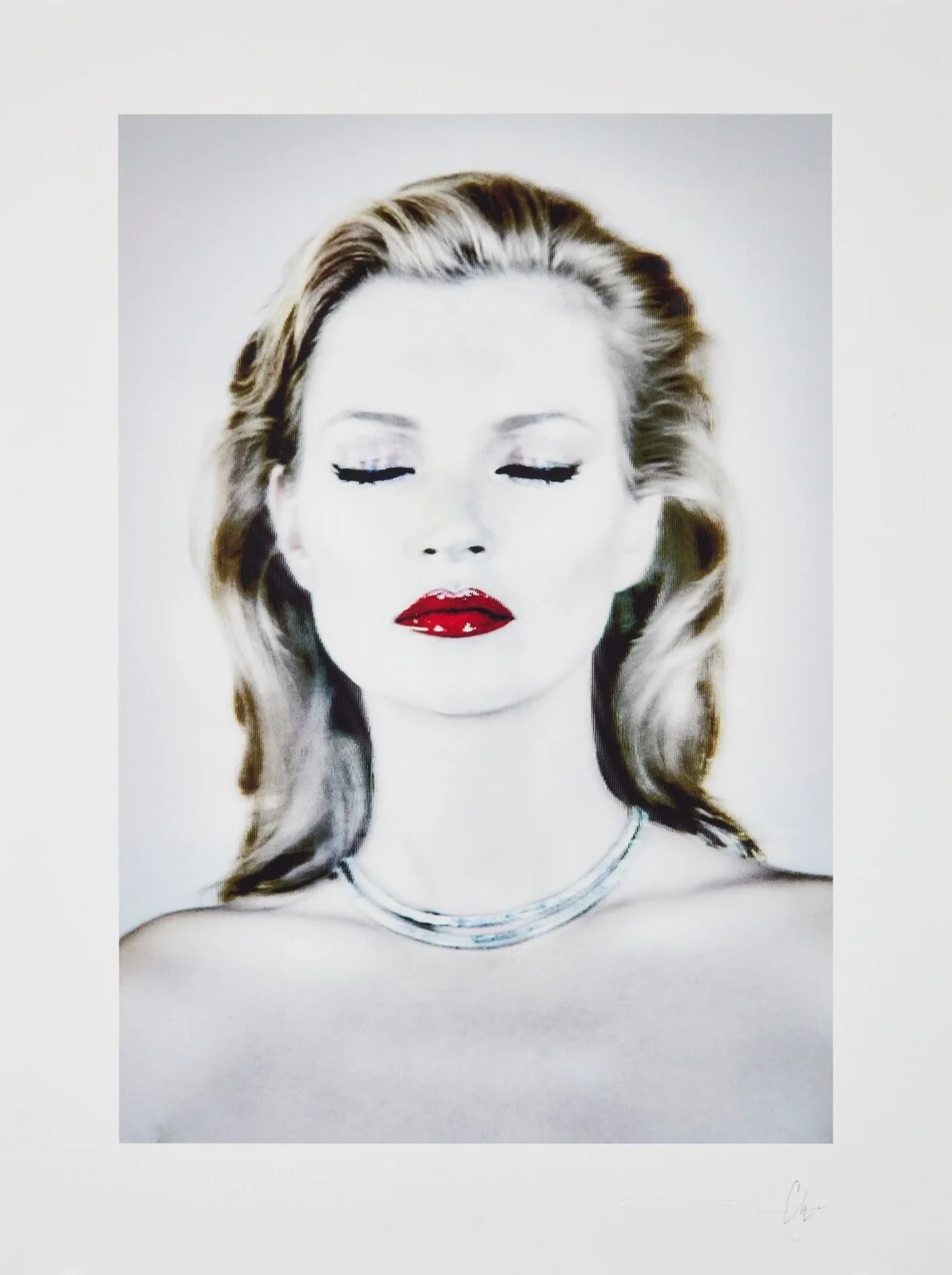
She’s Light (Pure), the version of which this 2019 inkjet on wove paper represents, shows Kate Moss against a stark white field. The image is close-cropped, high-key, and minimal. Her skin is pale to the point of near-luminescence — not the processed porcelain of retouched fashion photography but something rawer, more diffused, as though she is dissolving into the whiteness around her rather than being positioned against it. Her eyes are closed. Her lips, precisely lacquered in a deep, waxy red, are the image’s single point of concentrated colour and the anchor that keeps the composition from floating entirely free of its subject.
The hair is unspecific. The background is seamless. There is no styling to indicate an era, no accessory or garment that places the image in any particular fashion moment. The face is unmistakably Moss’s but the face is no longer doing what Moss’s face typically does in pictures — it is not holding eye contact, not projecting, not performing. The make-up — applied in collaboration with Charlotte Tilbury, whose relationship with Moss had its own long and storied history in the fashion world — is paradoxically both precise and dissolved: the red lips are exact, but they are not commanding attention the way a fashion photograph uses a lip. Here they read more like a mark, a sign of presence, something to locate us before the rest of the image absorbs us.
Levine has said his intention with the shoot was to move beyond beauty and into something deeper. “Given all the images that have ever been made of her, I needed to take it beyond beauty and somewhere deeper. Her true beauty is within and that’s what I hope is projected in the form of light.” The statement is not without its vulnerable — it risks the obvious response that all photographers claim to seek depth, and many are kidding themselves — but the image makes a case for the claim. What She’s Light (Pure) shows is not Kate Moss being photographed. It shows Kate Moss in the absence of photography, in the moment before the show of being photographed begins. By closing her eyes she has removed herself from the transaction that normally governs the relationship between camera and subject. She is not looking at us. She is not anywhere in particular. She is simply present, and what Levine has recorded is that presence.
huh
The subtitle does significant conceptual work in this piece and in the broader She’s Light series. “Pure” is not a value judgment about Moss’s character or a claim about her innocence in any moralistic sense. It refers to something closer to its scientific usage: light in its pure or single-frequency form is laser light, undivided and uninterrupted, as opposed to the mixed, compounded, redirected light of ordinary illumination. To work with pure light is to work with something before it is modified by the world.
Levine has spoken explicitly about this in relation to his attraction to laser as a medium: pure light, for him, connects to a deeper stratum of reality than the light we ordinarily see, which has been scattered, reflected, absorbed, and transformed by everything it has touched. In transposing that concept into portraiture, he is reaching for a picture of a person that similarly precedes modification — before the person has been interpreted, narrated, positioned by culture, by media, by the accumulated freight of being known. The “pure” in She’s Light (Pure) is the image after all that has been stripped away.
Whether or not one accepts the metaphysics entirely, the visual argument is coherent. By eliminating everything from the frame that would anchor Moss in any particular cultural moment or context — the clothes, the era, the expression calibrated for the camera — Levine produces an image that has no obvious relationship to the fashion photography tradition that made its subject famous. The eyes-closed portrait is, by definition, a refusal of the genre. Fashion photography is predicated on the model’s directed gaze or intentional posture, on the communication between face and lens. Remove that communication and you have something else, something the genre cannot contain.
a know
Levine’s work exists at an unusual intersection: technically sophisticated in ways that matter to specialists, spiritually oriented in ways that might make secular art audiences cautious, and commercially successful in ways that sometimes make the serious art world nervous. These tensions are worth examining rather than flattening.
The technical dimension is real. Levine’s engagement with holography and lenticular printing represents a genuine contribution to the history of photography as technology, and his light install — including the massive Higher Power laser work in Riyadh and the Molecule of Light sculpture at Houghton Hall, a 25-metre high monumental piece — demonstrate an engineering ambition far beyond most artists working with light as an aesthetic element. He has collaborated with the Eden Project, with Massive Attack, with the National Portrait Gallery, with Anohni (then performing as Antony and the Johnsons) in a production commissioned by the Museum of Modern Art in New York. His work has been exhibited across twelve countries through the British Council’s international touring programme. He is not a fringe figure operating at the edges of art discourse.
The spiritual dimension is also real, and it is worth being precise about what it is. Levine does not make devotional art in any traditional sense. He is not making religious pictures. What he is making is work in which the quality of attention — the meditative attention he cultivated partly through his engagement with Buddhist practice — functions as a shaping principle. The quiet, the stillness, the reduction of imagery to essentials: these are not simply aesthetic choices. They reflect a conviction that what photography normally shows us is the surface of experience, and that a different approach can reach something underneath. This is a claim many artists have made, and many have made it unconvincingly. In Levine’s case, the technical approach to light — the literal use of high-key illumination, the elimination of shadow, the reduction of view information to what the light itself can sustain — gives the metaphysical claim a formal anchor.
scope
She’s Light (Pure) has existed in multiple formats since its inception, which reflects the different contexts in which Levine wanted it to operate. The primary, large-format version is a lenticular lightbox — a format in which multiple images are interlaced behind a ridged lens surface so that as the viewer moves around the piece, the image shifts in three dimensions. Mounted on a lightbox, it becomes a luminous, participatory object: you move around it and it moves with you. This is the version that appeared at Sotheby’s in 2014 with an estimate of £30,000–£50,000, and that realised £75,000 when a comparable She’s Light lenticular went under the hammer in September 2018.
The 2019 inkjet print on wove paper is a different proposition. Where the lenticular lightbox asks to be experienced in a gallery — requires movement, requires the viewer to orbit the piece — the inkjet print asks to be lived with. Wove paper is the standard, unribbed sheet that has been the dominant surface for fine-art printing since the late eighteenth century, and in this context it gives the image a matte, considered quality that softens the intensity of the original shoot into something that hangs on a wall and asks for sustained looking rather than active experience. It is the domestic edition of a work conceived at a different scale, and in that translation something is inevitably lost but something is also gained: the accessibility of an object you can return to, in your own time, without the mediation of a gallery context.
The specifics of edition size and dimensions for the 2019 inkjet variant were not confirmed in available records at time of writing and should be verified against the certificate of authenticity that accompanies any individual work. The Artsy listing for the piece is the authoritative current source.
catalogue
To understand She’s Light (Pure) fully requires placing it in the context of what surrounds it — both within the Moss portrait series and within Levine’s wider practice.
Within the series, She’s Light (Pure) is the zero-degree version: the image stripped of everything that the other variants add. The She’s Light (Laser) works introduce green laser traces across the face, visible evidence of the technology that underlies the image’s creation, a kind of transparency about the means. She’s Light (Dots) adds a fluorescent screenprint element that pushes the image toward something more graphic, more explicitly in conversation with pop art traditions. She’s Light (Laser 3) at Christie’s in September 2013 realised £115,875 — the highest sale price in the Kate Moss series at that time. These variants represent the artist’s different approaches to the same underlying image, each modifying its relationship to the surface and to light.
Within the wider practice, the Moss portraits occupy a specific position between the Queen Elizabeth portraits and the Dalai Lama commission of 2015. The Queen images were commissioned work that then exceeded their commission. The Dalai Lama portrait was explicitly spiritual in context, a formal honour in which the meditative dimension was part of the brief. The Moss portraits are neither: they are voluntary, collision and they negotiate between two domains — fashion and fine art — that are often in tension. Levine has spoken about needing to transcend the fashion image to access what he was actually after. The fact that he did so using the specific vocabulary of fashion — the studio, the professional make-up, the model — rather than abandoning it, gives the work its particular character. It is not a rejection of fashion photography. It is a transfiguration of it.
fin
There is a standard critique of images like this one, and it runs roughly as follows: the spiritual claims are grandiose, the subject is still a celebrity, the work is ultimately fashion photography with better PR. It is a critique worth taking seriously, because it points to real risks in the approach.
But it misses what the image actually does to time. A fashion photograph ages. It becomes a record of when it was made, of the specific trends and styles and editorial modes of its moment. Its meaning changes as the world it was made for changes. She’s Light (Pure) does not work this way. There is nothing in it that belongs to any particular moment in fashion history — no garment, no set, no expression that carries the period’s imprint. The face is Moss’s, but the face is not performing. The effect is something closer to a portrait by Georges de La Tour than to anything in the editorial tradition — the subject illuminated by a pure source, rendered still, caught in a state of absorption that photographs almost never produce.
The white field around Moss is not a backdrop in the studio photography sense. It functions as the source rather than the setting: Moss appears to be constituted by the light around her rather than illuminated against it. That perceptual shift — from light as context to light as matter — is the technical and known signature of everything Levine makes. It is why the image holds even when removed from the lenticular technology of its most spectacular shows. The stillness is in the picture, not in the equipment. Close your own eyes for a moment after looking at it, and you will find the image is still there.
From the DRIFT archive: Almost Time — Instant Ninja!
Related Articles
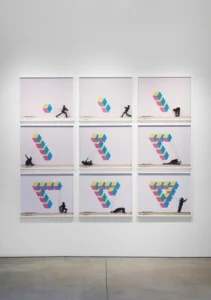
Robin Rhode, Edition of Five: Inside the 2017 C-Print Called David
A 2017 C-print by Robin Rhode, titled David, measures 185.8 x 227.8 cm in an […]