DRIFT AUDIO
Listen to this story
Choose a voice, then press play.
Ferrari’s fashion arm marks the British Grand Prix with a Union Jack capsule and a reworked “Reconditioned” range built on circular design.
In This Story
- A Union Jack Capsule Built for Silverstone
- Reconditioned by Ferrari: Circularity as Craft
- Denim Reworked Through Corrosion and Overdyeing
- The Retro Runner Gets a Circuit-Inspired Update
- Avail
Ferrari has used the build-up to the British Grand Prix at Silverstone to unveil a new capsule collection from its fashion division, and the release doubles as a statement of intent about where the brand wants its style business to go next. Rather than a straightforward trackside merchandise drop, the collection is framed by the marque as an exercise in “translating the energy and spirit of motorsport into a contemporary expression of craft and innovation.” The more notable claim, though, is the one about process rather than product: Ferrari says the range exists to build a dialogue between racing culture and circular design, using “elevated materials, artisan techniques, and the reinterpretation of existing resources” as its working method.
That frame matters because it positions the collection as two related but distinct projects rather than one themed capsule. The first is a straightforward, celebratory nod to the host nation, built around the red, white, and blue of the Union Jack. The second is a continuation of Ferrari’s ongoing “Reconditioned by Ferrari“ programme, which takes garments and materials from earlier collections and rebuilds them into new pieces. Together they give the British Grand Prix release a split personality: part collectible race-week merchandise, part case study in how a haute car maker’s fashion arm thinks about sustainable without using the word as a market crutch.

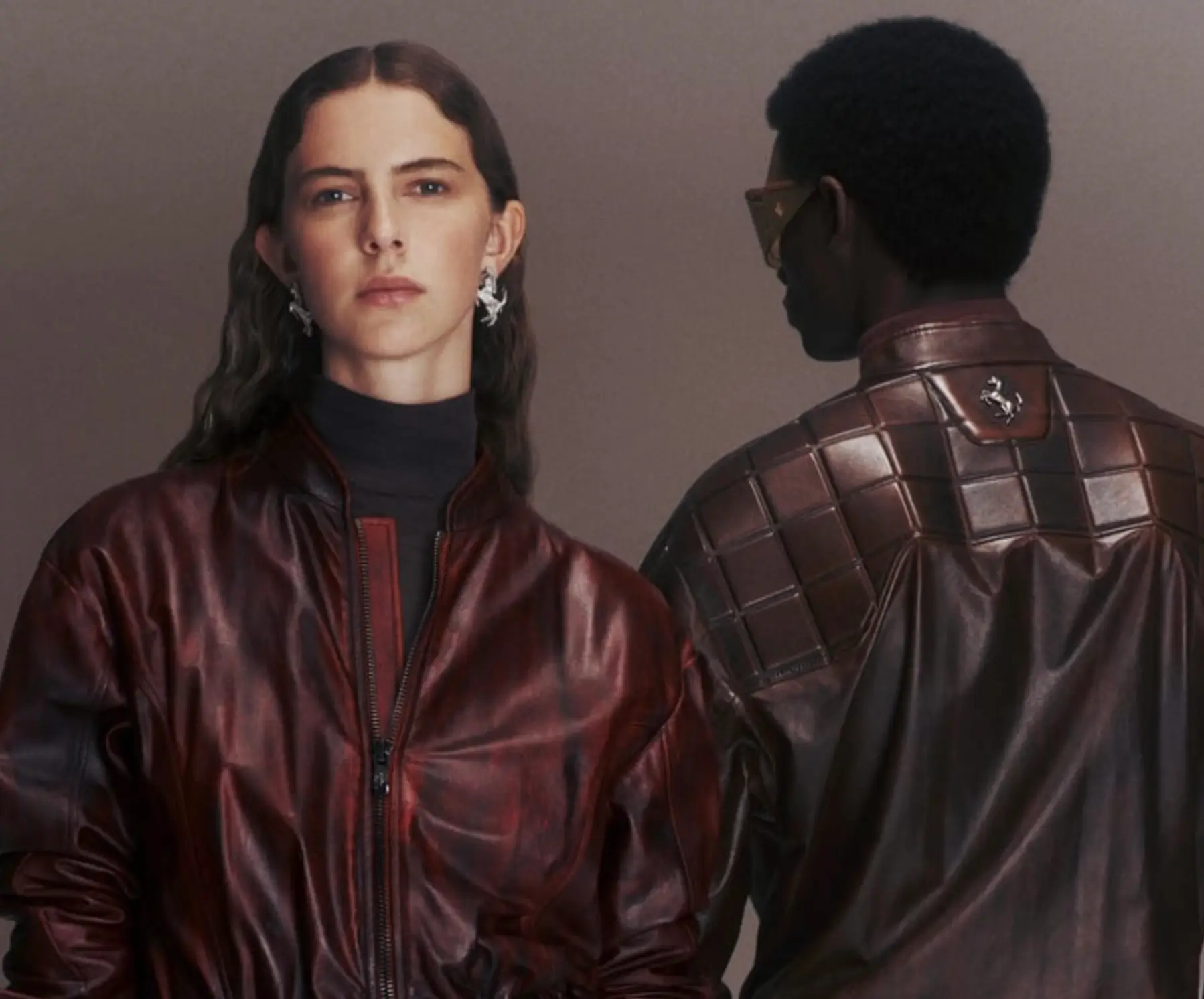
Model wearing oversized aviator sunglasses and a charcoal gray Ferrari bomber jacket with embroidered racing-inspired patches, posed against an oceanfront backdrop under a cloudy sky. Slicked-back hair, bold red lipstick, and the coastal setting create a sleek, contemporary luxury fashion campaign aesthetic
It’s also a useful snapshot of where Ferrari’s style operation sits right now, roughly midway between two identities. On one side is the more conventional trackside-merchandise model that has underpinned motorsport-adjacent fashion for decades: wordmarks, team colours, and a fairly literal translation of racing iconography onto Tees and caps. On the other is a design-led ready-to-wear business making a case for its own creative point of view, independent of whatever car happens to be on the grid that weekend. The British Grand Prix release doesn’t resolve that tension so much as let both approaches sit side by side within a single drop, which is arguably a more honest reflection of where the brand’s fashion arm actually is than a capsule that leaned entirely into one identity or the other.
stir
The first narrative strand is the more immediately recognisable of the two. It leans on the Union Jack’s palette, applying red, blue, and white across a small range of limited-edition garments and accessories designed to be worn trackside or off it. A graphic Tee and a baseball cap sit at the centre of the range, both carrying Ferrari wordmark embroidery alongside additional graphic detailing that nods to the flag without reproducing it as a literal print. The approach is consistent with how Ferrari’s style division has handled race-specific capsules in the past: rather than leaning on lap-timing graphics or circuit maps, the emphasis stays on tincture block and embroidery, keeping the pieces wearable outside a race weekend context.
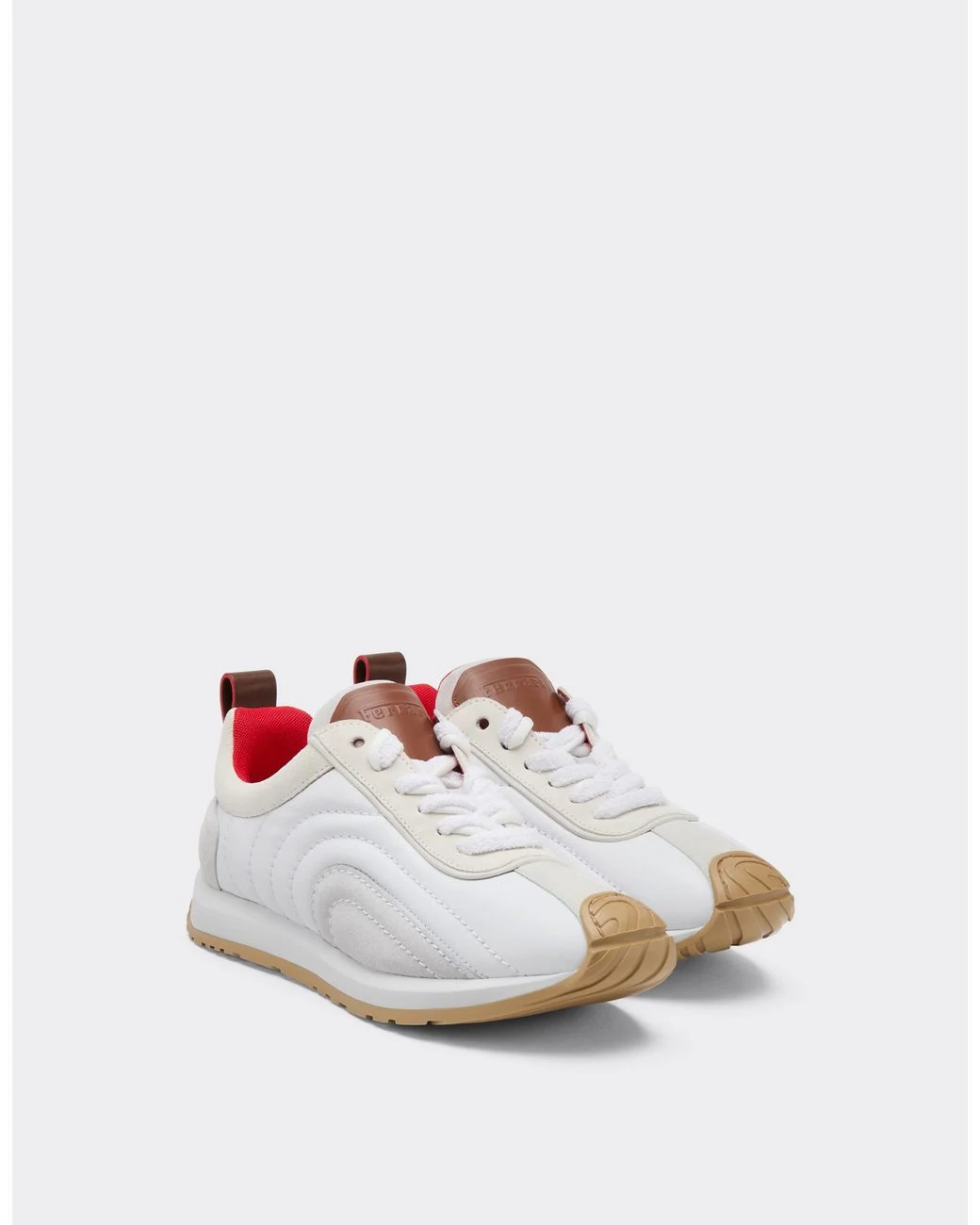
Ferrari’s white leather and suede running shoe blend retro athletic inspiration with premium craftsmanship, featuring sculpted overlays, gum rubber detailing, vibrant red lining, and refined Italian design for a contemporary luxury sportswear aesthetic.
Accessories round out this half of the collection, and this is where the “reinterpretation of existing resources” idea first shows up in tangible form. A leather Prancing Horse keychain anchors the range as the more traditional, full-price accessory. Alongside it, Ferrari has introduced a braided-cord keychain made from recycled silk sourced from the brand’s own Shelley scarves — the silk squares long associated with Ferrari’s heritage accessories line. Repurposing offcut or surplus material from an existing product category into a new accessory is a small gesture, but it’s a meaningful one for a brand whose fashion arm has, until recently, operated largely as a licensing and merchandising exercise rather than a design-led business with its own supply chain considerations.
The choice of the Union Jack as the organising motif is also worth sitting with for a moment, given how carefully brands in this space usually handle national symbolism. Rather than wrapping a full flag graphic across a garment — the kind of treatment more common in football shirt culture or festival merchandise — Ferrari’s approach breaks the palette down into its component colours and lets embroidery and panel placement do the referencing. That restraint keeps the capsule closer to the brand’s existing style codes than to a one-off novelty tie-in, meaning the Tee and cap are designed to sit comfortably within a wardrobe alongside the rest of Ferrari’s ready-to-wear line rather than reading as disposable race-week souvenirs bought once and shelved after the chequered flag falls.
That distinction matters commercially as much as creatively. Motorsport merchandise has historically had a short shelf life once a race weekend ends, which is part of why so much of it leans on team liveries and driver numbers that date quickly. By keeping the graphic language restrained and largely limited to embroidery, wordmark placement, and colour-blocking rather than literal flag or lap-time imagery, Ferrari’s style division gives itself a better chance of the T-shirt and cap continuing to sell — and to be worn — well past the Silverstone weekend itself.
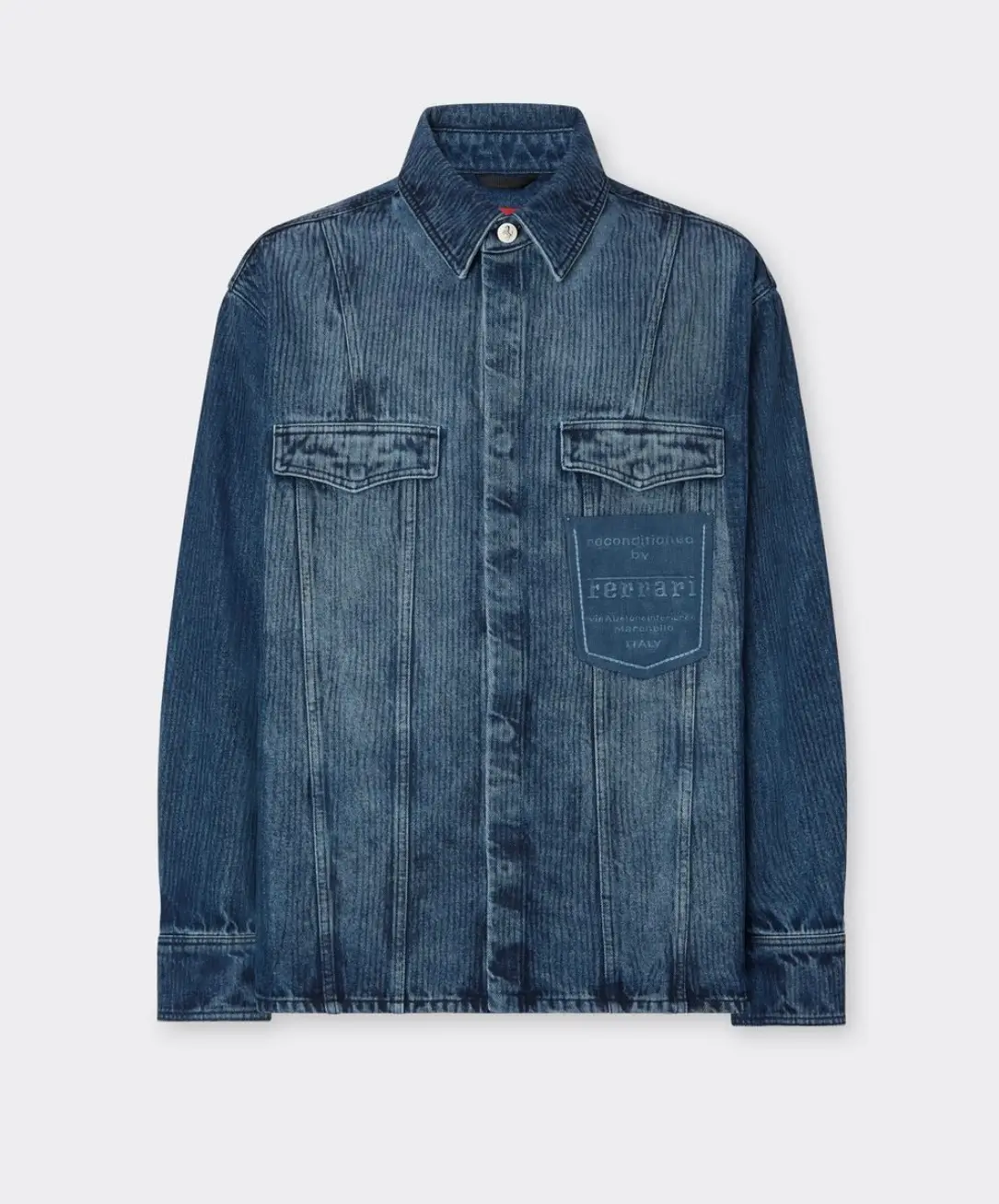
Ferrari’s reconditioned denim overshirt showcases vintage-inspired craftsmanship with a washed indigo finish, structured workwear silhouette, dual chest pockets, and an oversized branded patch that reflects the brand’s contemporary approach to sustainable luxury fashion.
condition
The second and more substantial narrative belongs to Reconditioned by Ferrari, the project the brand has built specifically around recovering and transforming garments and accessories from prior seasons. Where the Union Jack capsule is additive — new pieces made to mark an occasion — the Reconditioned line is subtractive and transformative by design, taking existing stock and reworking it rather than starting from raw material.
Every garment in this part of the collection carries a dedicated leather tag, hot-stamped with the Ferrari logo and the historic Maranello address, Via Abetone Inferiore 4 — the site of the company’s original factory and still its operational headquarters. It’s a detail aimed squarely at collectors and long-time followers of the brand: a reference that only lands if you already know what that address means, which is very much the point of a sub-line built for people already fluent in Ferrari’s history rather than newcomers drawn in by the Grand Prix tie-in alone.
The Reconditioned know also reframes how Ferrari’s fashion arm talks about longevity. Most luxury “archive” or “upcycled” programmes lean on the language of exclusivity — one-of-one pieces, deadstock fabric, limited runs justified by scarcity. Ferrari’s version leans instead on provenance and traceability: each piece is positioned as a documented continuation of a specific earlier collection, with the hot-stamped tag functioning as a kind of certificate of transformation rather than just a branding flourish.
There’s also a practical logic to running a Reconditioned line alongside a race-week capsule rather than as a standalone seasonal release. Grand Prix weekends generate some of the highest foot traffic and highest purchase intent of the fashion calendar for a brand like Ferrari, since they bring together collectors, motorsport tourists, and casual fans in the same physical and retail space at the same time. Attaching a circularity-focused sub-line to that moment — rather than launching it quietly outside the racing calendar — puts the Reconditioned story in front of an audience that’s already primed to engage with Ferrari’s product story, rather than asking a separate, smaller sustainability-focused customer base to seek it out independently.
The programme also sits at an interesting angle relative to how the broader haute sector has approached circularity over the past several seasons. Resale platforms, rental schemes, and take-back programmes have become fairly standard tools across the industry, but most of them keep the “new” and “recovered” product streams clearly separated — a resale marketplace here, a mainline collection there. Reconditioned by Ferrari instead folds the recovered-material story directly into the mainline retail experience, selling reworked pieces alongside newly manufactured ones in the same drop, under the same presentation, at the same point of sale.
work
The most technically detailed part of the Reconditioned story is the unisex denim offer, which uses corrosive dyeing and garment overdyeing to produce deliberately weathered, aged finishes. Corrosive dyeing works by chemically distressing the fabric’s surface during the dye process itself, rather than through mechanical abrasion like sandblasting or stone-washing, which tends to produce a more textured, uneven tonal result than conventional distressing methods. Garment overdyeing — dyeing a fully constructed piece rather than the raw fabric or yarn — adds a second layer of tonal variation, since seams, pockets, and stitching absorb dye differently to the main panels.
Applied across matching jackets and trousers, the combination produces pieces that read as genuinely worn-in rather than pre-distressed in the more uniform way associated with mass-market washed denim. Because the technique is applied to reclaimed garments rather than new fabric, no two pieces in the run are likely to weather in exactly the same way, which reinforces the Reconditioned line’s broader pitch: that circularity, done properly, produces variation and character rather than the flattened consistency of a standard production run.
The unisex cut is also a notable departure from how Ferrari’s ready-to-wear has traditionally segmented its denim offer. Building the jacket and trouser pairing to a single unisex fit, rather than running separate men’s and women’s blocks, simplifies the Reconditioned supply chain considerably, since the programme is already working with a constrained and variable pool of source garments rather than an unlimited run of new fabric. It also positions the denim pairing closer to how contemporary streetwear and workwear labels have approached fit in recent seasons, favouring a boxier, less gendered silhouette that can be styled loose or fitted depending on the wearer, rather than the more tailored, body-conscious cuts that have historically defined luxury denim.
View this post on Instagram
retro
Footwear anchors the collection’s more directly motorsport-referencing pieces. Ferrari’s retro runner silhouette returns here in a reworked material mix of suede, hand-buffed leather, and nappa leather, a combination chosen to balance the softness and depth of colour that suede and nappa provide against the structure and durability that hand-buffed leather panels add to a running-shoe silhouette built to be worn rather than displayed.
The design’s motorsport references are more literal here than elsewhere in the collection. Circuit-inspired graphic elements run across both the upper and the sole unit, translating track-map lines and circuit geometry into a wearable graphic language rather than a literal printed map. A high-frequency printed Ferrari-branded tongue completes the shoe, using a fine, closely spaced print technique that allows for sharper detail and a more subtle branding application than a standard screen print or embroidered patch would allow at the same scale.
The retro runner silhouette itself is a deliberate choice within Ferrari’s footwear range. Rather than pushing further into the chunkier, more technical trainer shapes that have dominated much of the past decade’s sneaker output, the brand has stayed with a lower-profile, running-inspired last that reads closer to a heritage athletics shoe than a performance trainer. Pairing that quieter silhouette with a richer material mix — suede uppers, hand-buffed leather overlays, and nappa leather panelling — shifts the emphasis away from technical storytelling and toward the kind of tactile, craft-driven detailing more commonly associated with Ferrari’s leather goods than with its footwear line, suggesting the two categories are being pulled closer together in how they’re designed and marketed.
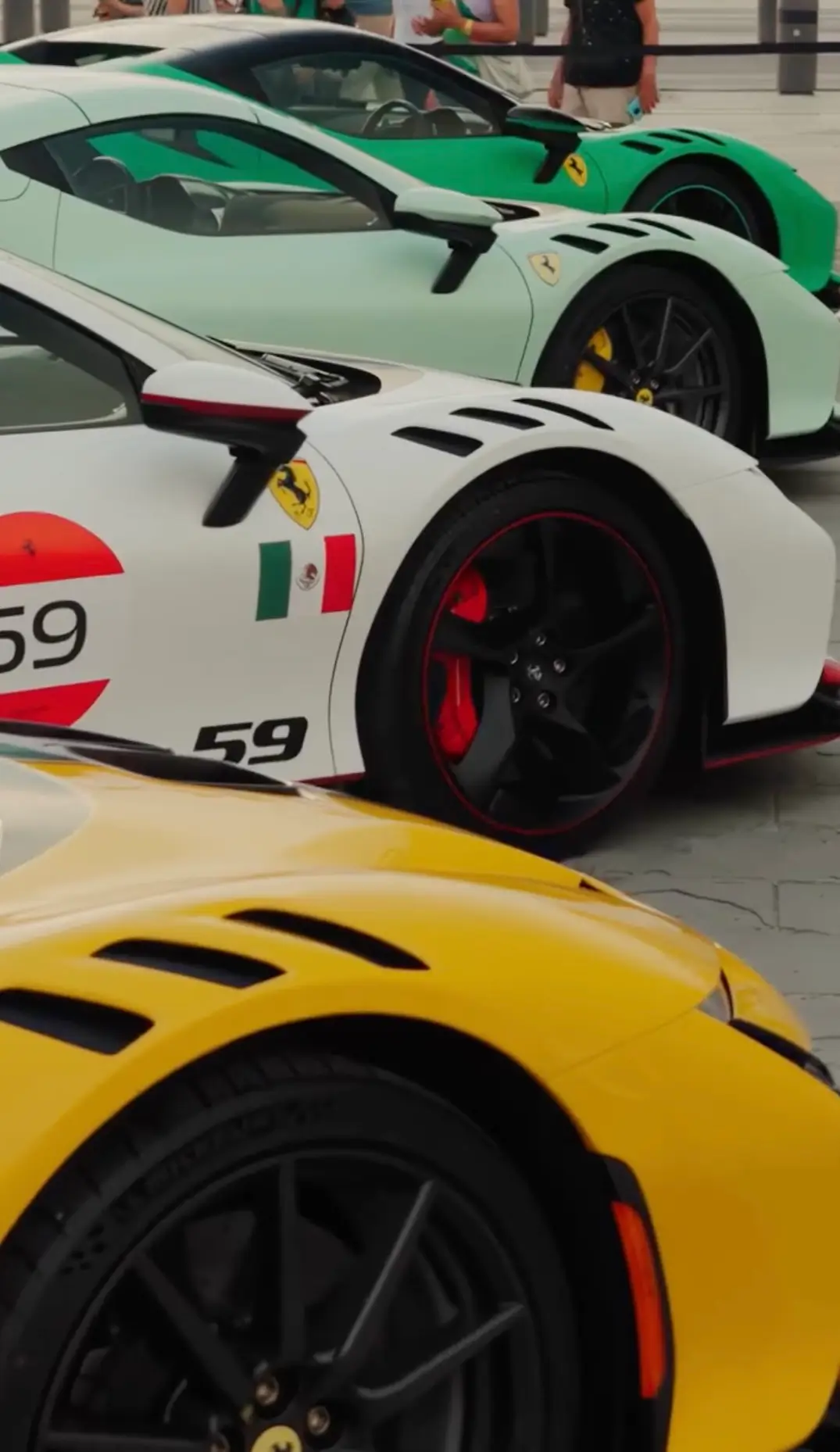
A vibrant lineup of Ferrari sports cars highlights the marque’s signature blend of performance engineering and Italian design, with striking paint finishes, aggressive aerodynamic style, and race-inspired details displayed at a public automotive gathering.
fin
As with previous race-week capsules, the British Grand Prix collection is positioned as a limited-edition release tied to the Silverstone weekend, sold through Ferrari’s official store alongside the brand’s core ready-to-wear and accessories lines. Ferrari has not published full pricing or a piece-by-piece release calendar for the capsule at the time of writing, and stock levels for the Reconditioned pieces are, by the nature of the programme, inherently limited since each garment depends on the available of a specific reclaim source piece.
For a brand whose motorsport identity has always done a significant amount of the marketing work for its fashion arm, tying a capsule to a marquee calendar date like the British Grand Prix is a low-risk, high-view way to keep the style business in the conversation during race week. What’s more interesting is the decision to use that same moment to foreground the Reconditioned programme rather than treating it as a separate, shh sustainable initiative running on its own timeline. Pair a flag-waving, souvenir-adjacent capsule with a circular-driven sub-line in the same release suggests Ferrari’s fashion division is betting that its audience — car collectors, motorsport followers, and streetwear-literate luxury shoppers alike — is ready to engage with both halves of that story at once, rather than needing them kept separate.
Related Articles

WACKO MARIA Brings Its Leopard Lining to the Big Leagues
Black nylon outside, leopard fur inside: WACKO MARIA’s first Major League Baseball collection reached Japan […]