DRIFT AUDIO
Listen to this story
Choose a voice, then press play.
Director Olivia Wilde on figuring out the fate of her on-screen marriage with Seth Rogen, and why silence said more than the script ever could.
In This Story
- A Marriage Five Adaptations in the Making
- Two Weeks of Improv Before a Single Frame Was Shot
- Shooting in Order, and Why That Mattered
- The Ending That Wasn’t Locked Until the Last Minute
- Cutting the Dialogue Down to Silence
- What Critics Made of It
- A Dedication to Diane Keaton
“The Invite” arrives in theaters as the sixth version of a story that has now been told in five different languages. The film is an English-language remake of the 2020 Spanish film “The People Upstairs,” itself adapted from Cesc Gay’s earlier stage play “The Neighbors Upstairs.” In the years since, that same premise — two couples, one dinner party, one very bad night — has been reshot in Italy, Switzerland, France, and South Korea before finally landing on Olivia Wilde’s desk as an American studio comedy.
Wilde has said the material’s repeated cross-cultural adaptation is part of what convinced her to take it on in the first place. Speaking on the Filmmaker Toolkit Podcast, she explained that any story adapted this many times across this many cultures must have a kind of universal root, since it turns out relationships are difficult in every language — and that what pulled her toward directing it was the possibility of making a version that felt specific to this particular moment and audience, rather than simply repeating what had come before.
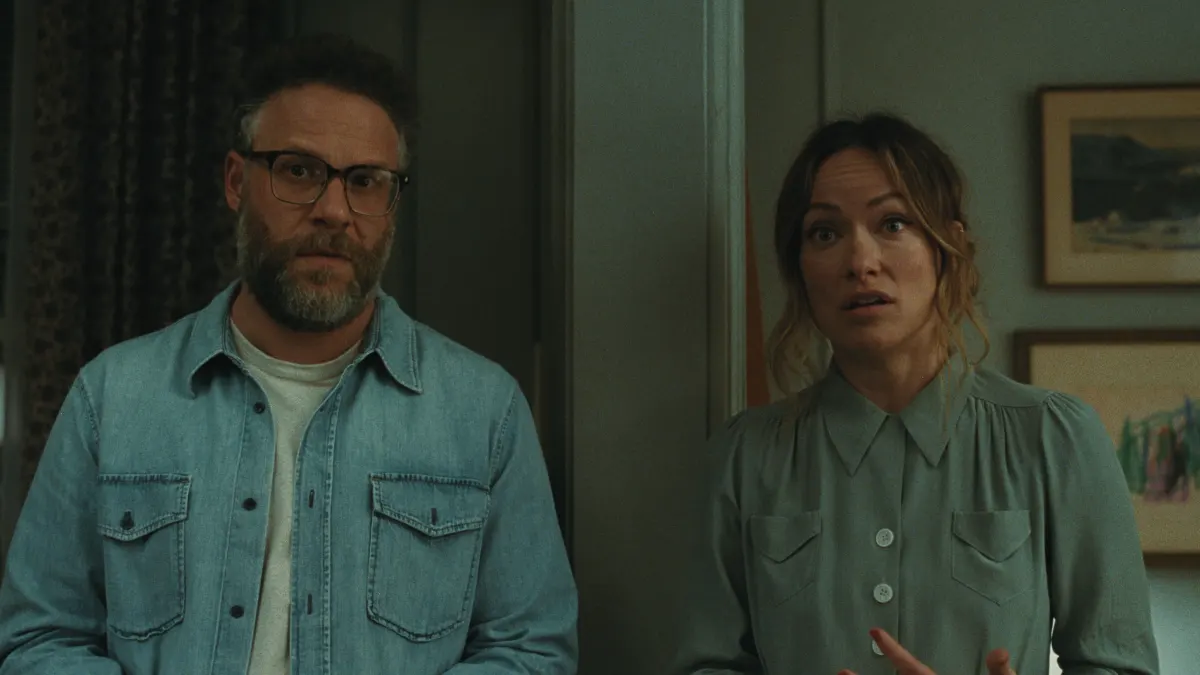
The English-language version stars Wilde herself as Angela, opposite Seth Rogen as her husband Joe, with Penélope Cruzand Edward Norton as their upstairs neighbors Piña and Hawk. The film premiered at the Eccles Theater as part of the 2026 Sundance Film Festival on January 24, receiving positive reviews from critics, before A24 gave it a limited theatrical release on June 26, expanding wide on July 10.
stir
Before production began, screenwriters Rashida Jones and Will McCormack reworked the script alongside the cast during an extended rehearsal period. As IndieWire previously reported, that process involved a two-week improvisational rehearsal in which the actors were given room to discover and breathe life into their characters, once Wilde, Cruz, Norton, and Rogen were already attached to the project.
McCormack, one of the film’s two credited screenwriters alongside Jones, has described the ending specifically as the piece of the adaptation the team spent the most energy on. He’s said the writers didn’t want to reinvent the source material — they genuinely liked the Spanish film — but that the ending was something they focused on from the very start of the process, digging into how the couple fell in love, whether they’re still in love, and whether they’d stay together, and making sure all of that actually held up.
matter
That improvisational spirit carried straight through into the 23-day shoot of the one-location film, which was filmed chronologically to let the actors keep discovering their characters as production went on, while still giving them the stability of moving through the story in a straight line. For a film built almost entirely around a single night in a single apartment, that decision meant the cast was never jumping backward or forward in the emotional arc of the marriage — by the time they filmed the final scene, they’d genuinely lived through everything that came before it, in order. IndieWire
Wilde has described the production as a rare chance to build a set the way she’d always wanted to: real collaborative workshopping with the cast, extensive rehearsal, shooting on film, and — because the story is confined to one location — filming in sequence, something she said she’d dreamed of doing for a long time.
event
Despite all that preparation, Wilde says the film’s actual ending wasn’t settled until the closing days of the shoot. “The end of the film was something that Seth and I workshopped up until the last minute,” she said, “because the end is different than the original movie, and very different from our script.”
That’s a notable admission for a film built so deliberately around structure and sequence — the emotional destination was baked into the writers’ room from day one, according to McCormack, but the specific way Joe and Angela would arrive there on screen kept shifting all the way through production. Wilde has explained that the film’s themes and narrative beats were locked in during the scriptwriting phase, but that how those beats would actually play out on camera changed significantly once the cast was living inside the characters day after day.
She’s pointed specifically to a late scene where Piña, Cruz’s character, effectively steps into the role of therapist for the other couple, calling out how Joe and Angela each blame the other for their own unhappiness in a way that breeds resentment Wilde believed was likely irreparable. It was only once that scene had actually been shot — and Cruz’s insights as Piña landed with the clarity Wilde was hoping for — that she and Rogen understood how the film needed to end.
silence
Perhaps the most striking detail Wilde has shared is how much dialogue got stripped away from the film’s final scenes. She’s explained that one of the biggest shifts during production was pulling out a lot of dialogue that had been genuinely well-written on the page, but that felt unnecessary once the actors realized just how verbose and almost manically combative these two characters had been for the entire runtime.
In the finished film, once Hawk and Piña leave for the night, Joe and Angela never explicitly discuss whether they’re splitting up. What little they do say is limited to small logistics — where each of them will sleep, what to do about a summer rental — rather than any direct confrontation about the state of the marriage. Wilde has said that by that point in the story, the couple has effectively already made their decision, and there was nothing left that needed saying out loud.
Wilde described the choice this way: it was silence that communicated the shell-shocked scale of what her and Rogen’s characters had just decided, and it only became clear once the rest of the film had already been shot — one of those calls that simply wasn’t possible to make cleanly back in the rehearsal room. Because they’d shot everything else by that point, she said, they knew there was nothing more that needed to be said.
That restraint plays out in the film’s final images. According to reviews describing the closing scene, after the neighbors leave, Joe moves back to his piano and begins to play — something he hasn’t been able to do earlier in the film — and Angela is drawn toward him, the two of them ending the story sitting quietly together rather than resolving anything through conversation.
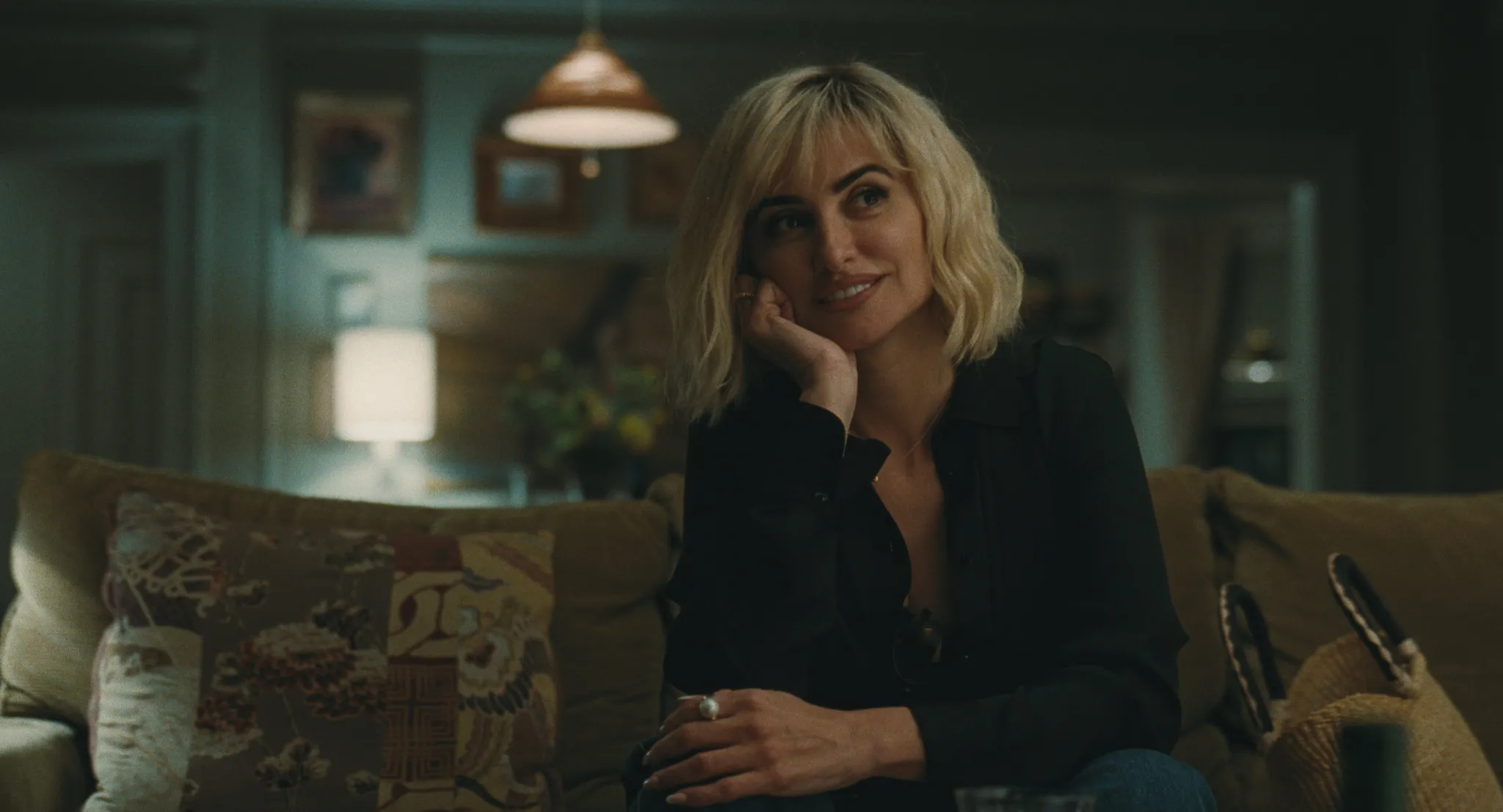
Penélope Cruz appears in a warmly lit living room scene from The Invite, bringing shh charm and intrigue to the intimate setting.
huh
Reception to “The Invite” has generally split along a familiar line for two-hander marriage dramas: praise for the performances and the writing’s honesty, with more mixed feelings about how far the film is willing to go. NPR’s review credited Wilde as a genuinely strong director of actors, including herself, calling her and Rogen entirely convincing as a long-married couple who know exactly how to needle each other, with Rogen in particular delivering work that trades the good-natured energy of his Apatow-era comedies for something more hardened by middle age — while also noting the film ultimately pulls back from a more audacious version of its own premise, settling for emotional safety over a bigger swing.
Other outlets were more effusive: one review called Wilde’s restraint in the closing piano scene the moment the film earns its emotional ending, arguing that recognition between two people who’ve stopped truly seeing each other doesn’t need to promise a fixed relationship to land as powerful. Trade reviews out of Sundance similarly praised the film as a tart, occasionally dark marital comedy anchored by Rogen’s performance, with reports the film ignited one of the festival’s first major bidding wars.
fin
Before the credits roll, “The Invite” flashes a brief on-screen dedication: “For Diane.” Wilde has confirmed the note refers to Diane Keaton, telling press at the film’s Los Angeles premiere that she doesn’t think there’s a version of this film without Keaton, since so many of the movies that inspired “The Invite” featured her — and that Keaton was the first actress Wilde recognized as representing a genuinely singular, complex woman who didn’t fit any easy archetype. The dedication carries added weight given Keaton’s death on October 11, 2025, during the period between the film’s production and its release.
Between its lineage stretching back through five countries of adaptation, a rehearsal process built to let the cast rewrite the marriage from the inside out, and an ending its own director and star were still negotiating in the final days of the shoot, “The Invite” is a useful reminder that even a tightly structured, single-location film can stay genuinely unresolved behind the scenes for far longer than audiences might assume.
Related Articles
Under Rue de Castiglione, Liaigre Gives Hôtel Costes a Spa With No Hard Corners
A 20-meter lap pool, eight treatment rooms and not one sharp angle: Studio Liaigre’s spa […]