DRIFT AUDIO
Listen to this story
Choose a voice, then press play.
Once a mark of medieval punishment, the dishevelled morning-after look has been restaged on the FW26 runways as a full-blown aesthetic of pride.
In This Story
- A Brief History of Shame
- Runway as Restaged Scene
- Performance or Genuine Vulnerable
There is a very specific kind of morning: the club lights are long gone, the hangover has arrived on schedule, and the outfit from the night before is doing double duty as daywear. It is an unglamorous, universally recognisable moment — the kind most people would rather forget than dress for. And yet, somewhere between TikTok’s fixation on lived-in aesthetics and the FW26 runway calendar, that same dishevelled exit has been rebranded as a look worth chasing. Designers across Milan and Paris spent the season staging exactly that scene — crumpled coats, visible slips, smudged eyes, hair that hasn’t seen a hairbrush — turning a private embarrassment into a very public, very deliberate style statement.
It’s worth pausing on how strange that inversion actually is. Looking exhausted, under-slept, and slightly unravelled has historically been something to conceal, not broadcast. That a runway full of haute labels would spend an entire season chasing the look of someone who has not yet made it home says something about where fashion currently sits in relation to polish, control, and the idea of being seen as effortlessly put-together.
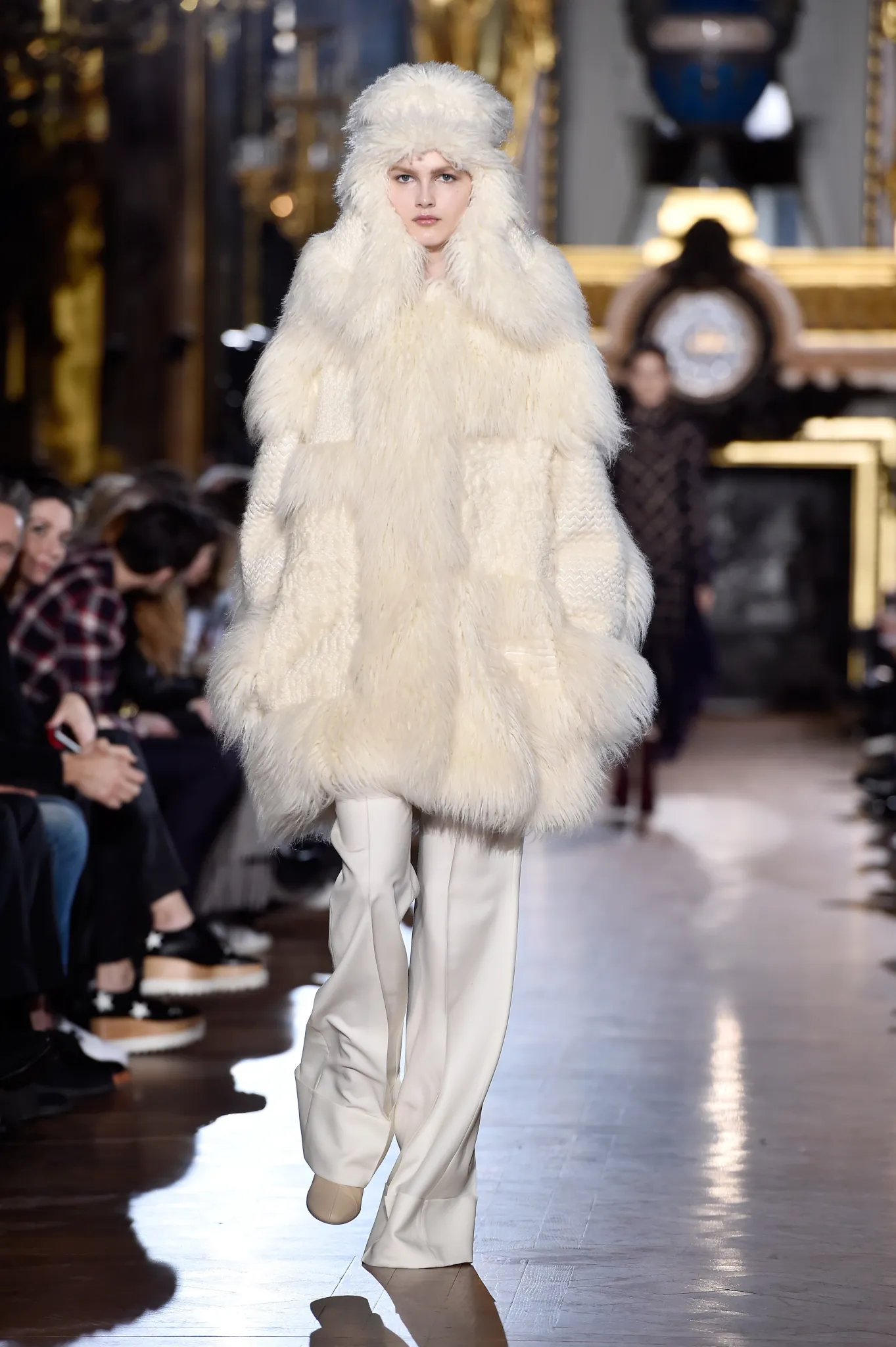
A dramatic runway look pairs an oversized ivory faux-fur coat and matching hat with flowing cream trousers, creating an elegant monochromatic statement during a haute fashion presentation.
Part of what makes this particular trend cycle interesting is how openly it draws from something with genuinely uncomfortable roots rather than a purely aesthetic reference. Fashion regularly borrows from subcultures, decades, and even historical costume, but rarely does it lean this directly on a phrase whose original meaning was explicitly about humiliation and control. That the industry chose to surface it now, and to do so across so many collections simultaneously rather than as a single designer’s idiosyncratic reference, suggests the appeal runs deeper than a passing styling trick.
brief
The phrase carries real weight before it ever touches fashion. In earlier centuries, public shaming rituals for perceived moral transgressions, adultery among them, were staged as literal processions through town squares, the accused paraded through the streets in view of a jeering crowd. It was, in effect, a punishment built entirely around visible — the public display itself was the sentence. That template, visibility as punishment, is the root from which the modern phrase grew, even as its target shifted over the centuries from formal, sanctioned punishment to a much more informal and unofficial form of social judgment, one disproportionately aimed at women who dared to be seen enjoying themselves the night before and unwilling to hide the evidence the next morning.
Pop culture spent decades gradually softening that judgment into something closer to romance than punishment. The image of a woman crossing a city street at dawn in last night’s clothes became, through film, less a mark of shame and more a signature of glamour and independence. The opening of Breakfast at Tiffany’s, with Audrey Hepburn stepping from a taxi in a beaded Givenchy sheath dress at sunrise, is the moment most often credited with that shift, turning an early-morning walk in last night’s clothes into one of cinema’s most referenced style images. Decades later, Sex and the City‘s Carrie Bradshaw carried the same energy into contemporary television, treating her own morning-after looks as an extension of her personality rather than something to hide. More recently, the series Love Story restaged the same idea again, with actress Sarah Pidgeon, playing a young Carolyn Bessette, hastily knotting John F. Kennedy Jr.’s shirt over the skirt she had worn the night before — a small styling detail doing a lot of narrative work.
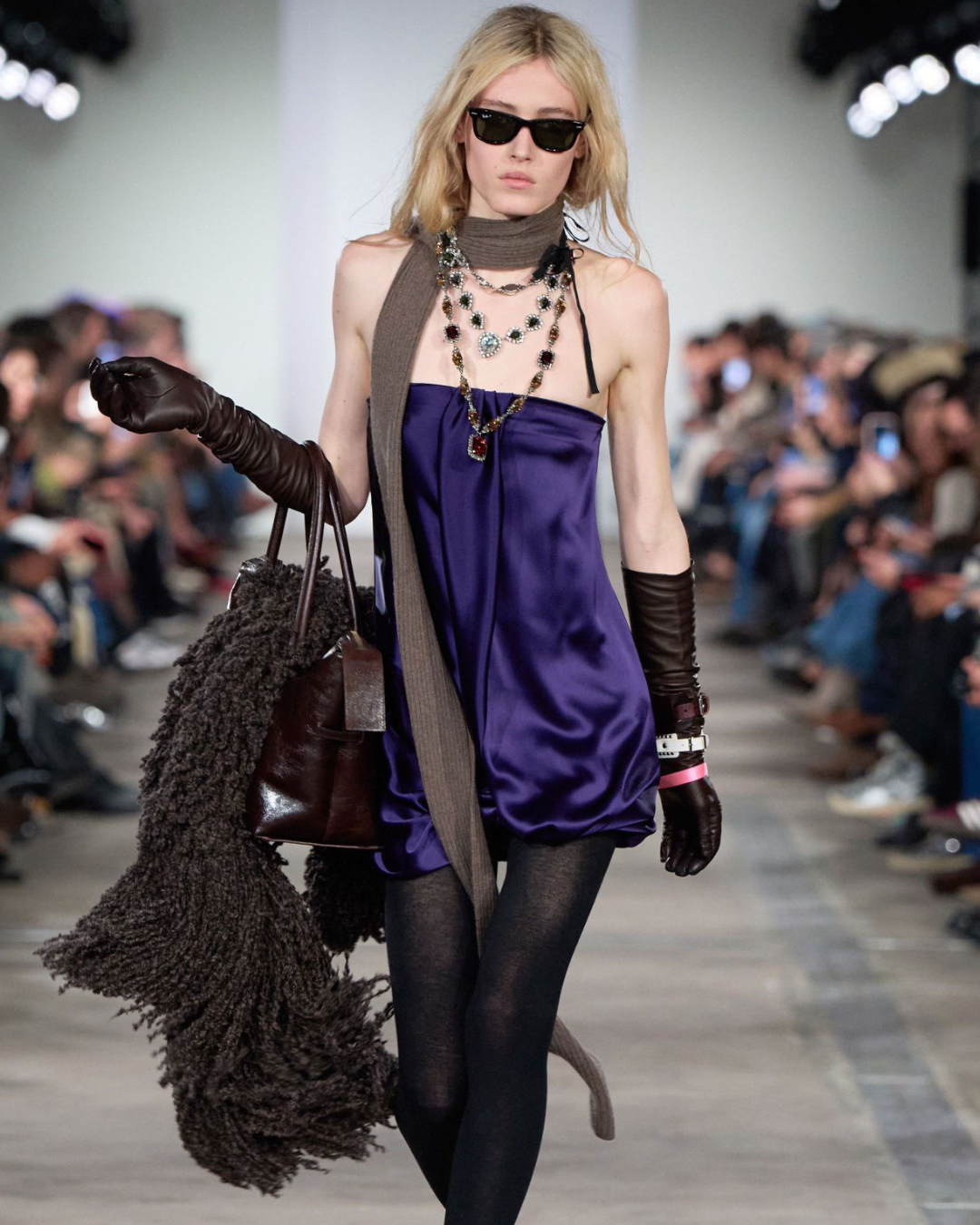
A sophisticated runway look pairs a lustrous purple satin mini dress with layered gemstone jewelry, leather gloves, a flowing scarf, oversized handbag, and dark sunglasses, blending vintage glamour with modern luxury fashion styling.
But the pendulum swung back hard in the 2000s, when tabloid photography turned the same scene into something punitive all over again. Paparazzi built entire business models around catching celebrities at their most exposed and least composed moments, treating a messy morning exit as content rather than as a private moment worth respecting. The post-night-out photographs of Kate Moss and Pete Doherty, or the raw, unguarded dawn images of Amy Winehouse, were treated at the time as evidence of personal unravelling rather than as style references. It’s a strange twist, then, that those very images have since been recirculated on FashionTok as aesthetic reference points, stripped of their original tabloid context and repackaged as mood-board material for a generation that never lived through the original media cycle that produced them, and for whom the images now read as aesthetic rather than invasive.
The distance between those two readings of the same photographs is worth sitting with. What was captured, in the moment, as evidence of a person’s private struggle has been recirculated decades later as a curated mood board, complete with edited colour grading and captions treating the exhaustion as intentional style. It’s a reminder that the line between documentation and aesthetic reference is rarely stable, and that time has a way of smoothing over context that was, for the people actually photographed, anything but glamorous. Whether that recontextualisation is harmless nostalgia or something closer to erasure of real hardship is a question the trend’s current wave of admirers rarely stops to ask.
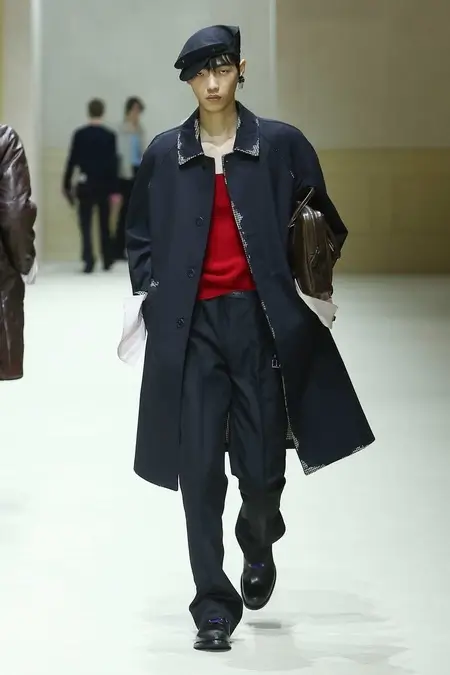
A refined runway look pairs an oversized navy coat with a vibrant red knit top, relaxed tailored trousers, a tilted black beret, and sleek leather accessories, blending classic tailoring with contemporary menswear styling.
stage
FW26 took that history and put it directly on the runway, less as reference and more as full reenactment. The visible-underwear motif that has circulated for several seasons found new momentum here, with The Attico and N°21 both sending out sheer, lingerie-adjacent pieces as outerwear rather than something glimpsed underneath — the slip dress no longer hidden under a coat but worn as the entire outfit.
The Attico’s recent shows have leaned into exactly this kind of undone glamour, pairing barely-there slips with the label’s signature going-out sensibility, a continuation of the after-dark energy the brand has built its identity around for several seasons now.
Saint Laurent and Isabel Marant both worked lace slips into their collections, treating them as standalone pieces rather than layering staples, while Valentino and Andreas Kronthaler for Vivienne Westwood built lingerie details into their silhouettes — sometimes tucked away beneath tailoring, sometimes deliberately left on display for anyone paying attention.
A handful of designers went further, using the aesthetic as a structural device for the entire show rather than a one-off styling detail, treating the morning-after narrative as a framework flexible enough to hold an entire collection together rather than a single reference point buried in the show notes. At Diesel, creative director Glenn Martens staged the walk of shame as a walk of fame, sending crumpled garments through a maximalist, cluttered set in a continuous, almost theatrical process of layering, one piece dragging the next along with it in a kind of controlled disarray.
Belgian label Façon Jacmin structured its SS26 show around the same idea in three explicit acts — waking up, getting dressed, and the resulting chaos — with models climbing a staircase to evoke the physical disorientation of an after-party morning, the collection unfolding almost like a short film rather than a straightforward presentation.
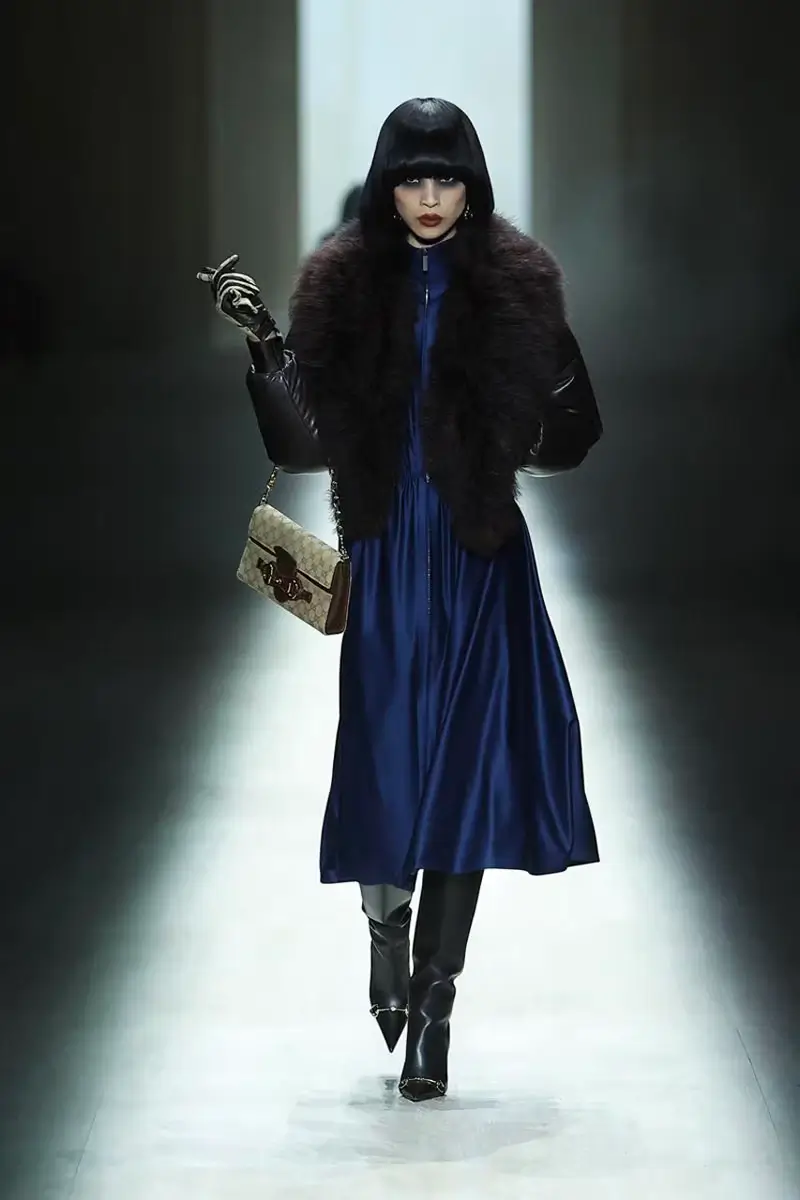
A moody runway ensemble combines a rich blue satin dress with a dramatic dark fur stole, leather gloves, pointed knee-high boots, and a signature monogram handbag for an elegant luxury fashion statement.
At his debut show for 7 For All Mankind, Nicola Brognano pulled from early-2000s indie sleaze, referencing the off-duty looks of Sienna Miller and the Olsen twins to build a collection around dishevelled hair wrapped in long scarves, oversized cardigans thrown over skinny jeans, and double-platform heels — the uniform of someone with no time to change before heading straight into the next thing.
Elsewhere, the same idea showed up in gesture as much as in garment. At Gucci, Demna Gvasalia‘s FW26 debut sent out models with smoky, sunken eyes striding nervously down the runway with bags clutched tightly to their arms, the styling doing as much narrative work as the clothes themselves.
At Prada, the previous night’s clothing was hidden beneath a rumpled coat pulled tightly across the chest — a protective, almost defensive gesture that reads as instinctive rather than posed. At Tom Ford, creative director Haider Ackermannsent models down the runway with arms crossed, as if concealing a lace slip dress worn underneath a jacket, the body language suggesting something the wearer would rather keep private.
A further variation of the trend, playing on the idea of “nothing underneath,” leaned into suggestion rather than outright display. Stella McCartney and Natasha Zinko both sent vintage-inflected fur coats down the runway with sheer stockings just barely visible beneath, letting the imagination do the rest of the work.
At Hodakova, the same coat-as-cover idea appeared worn back-to-front and clutched in the model’s hands, staged like a hurried exit from someone else’s apartment before the sun was fully up.
Taken together, these approaches show just how many entry points the trend offers designers: it can be a single garment detail, a full narrative arc for a show, or simply a way of holding the body that communicates exhaustion and reluctant visibility without a single stitch of lingerie in sight.
View this post on Instagram
It also helps explain why the trend has travelled so easily beyond the runway and into everyday styling. Because the aesthetic is built around gesture and attitude as much as any specific garment, it doesn’t require access to a designer collection to replicate — a coat clutched a certain way, hair left undone, makeup allowed to smudge, all read as fluent in the trend’s lang regardless of price point. That accessible is likely a large part of why it has spread so quickly across social platforms, where the look can be recreated with clothes already sitting in most closets rather than requiring a specific runway piece.
a show
Read against the current resurgence of indie sleaze and grunge references across social platforms, the trend’s runway arrival looks less like a coincidence and more like a natural extension of a broader generational mood — one built on discomfort with polish and a skepticism toward relentless self-optimisation. In its original subculture context, the dishevelled morning-after look carried real weight as a rejection of forced positivity and a response to the exhausting pace of contemporary life, or, for the celebrities who lived it under tabloid scrutiny, the pressures of fame itself. That the aesthetic keeps resurfacing at moments when younger generations feel similarly overwhelmed by the demands of visibility is probably not a coincidence.
It’s also worth noting how much this cycle mirrors previous fashion returns to deliberately “undone” aesthetics — grunge’s flannel-and-slip-dress combinations in the early nineties carried a similar charge, positioning scruffiness as a rejection of the decade’s power-dressing polish. Each time the industry revisits this territory, it does so with a slightly different justification, but the underlying gesture stays consistent: taking something coded as failure or carelessness and repositioning it as a considered point of view, available for purchase.
View this post on Instagram
That history is exactly what makes the trend’s fashion-week translation feel complicated. On one hand, there is something genuinely appealing about a runway that makes space for imperfection and view vulnerable rather than airbrushed control — a designer choosing to show exhaustion rather than polish is, in its own way, a small act of honesty within an industry built on managed image. On the other hand, the moment a raw, unplanned image is deliberately restaged under studio lighting, styled down to the last crease, and sent down a runway in front of editors and cameras, it risks becoming just another performance — disorder as a carefully considered choice rather than an honest accident. The paradox sits right at the centre of the trend: the more convincingly a show recreates the look of not caring, the more visible the effort behind it becomes.
There’s also a question of who gets to wear this look without consequence. The celebrities whose actual morning-after photographs became tabloid fodder in the 2000s paid a real reputational price for the same images now being celebrated as runway inspiration decades later. A model walking a controlled version of dishevelment under professional lighting, with a styling team behind her, is operating under very different terms than a public figure caught by a long lens outside a nightclub. The aesthetic can be reclaimed on the runway in a way it never could be for the people who lived through its punitive version in real time, and that gap is worth keeping in mind whenever the trend gets framed purely as playful or empowering.
Whether the walk of shame holds onto its original charge or gets absorbed into the usual cycle of trend and repetition may depend on how designers handle it beyond this one season. For now, at least, fashion month has made its position clear: the morning after is no longer something to hide from the world, but something to walk it in.
From the DRIFT archive: Labubu: How a Designer Toy Became Hollywood’s Next Obsession · Nike & Chipotle: How a Young Cancer Patient’s Burrito Ritual Became a Once-in-a-Lifetime Sneaker
Related Articles
WACKO MARIA Brings Its Leopard Lining to the Big Leagues
Black nylon outside, leopard fur inside: WACKO MARIA’s first Major League Baseball collection reached Japan […]