DRIFT AUDIO
Listen to this story
Choose a voice, then press play.
At 22, the London-based artist known as Jusheiy has moved his digital illustrations onto Vans, beanies and a client’s Goyard bag, one airbrush pass at a time.
There is a version of how creative careers are supposed to start that involves a fully formed plan: a style, a medium, a five year outlook, worked out in advance. Jusheiy’s version looks almost nothing like that. Joshua works under the name Jusheiy, and by his own account the practice started with a constraint rather than a plan. Growing up, he did not have easy access to a wide range of physical art materials, so illustration on a screen became the medium that was actually within reach, not necessarily the one he would have chosen first. In an August 2026 interview with PAUSE, the London-based artist described himself simple: a 22 year old Nigerian artist work across illustration, airbrushing, fashion and object making in general, without ever settling into one lane for long.
stir
For a long stretch, that show work stay a hobby rather than a plan. He was not thinking about becoming a working artist so much as he simply liked making things, and that instinct for tinkering rather than finishing on the first attempt still shapes how a single piece comes together now. What looks like a clean, simple final image is usual the result of testing several expressions, shapes and small details before anything gets locked in, a process that happens well before anyone outside the work ever sees it.
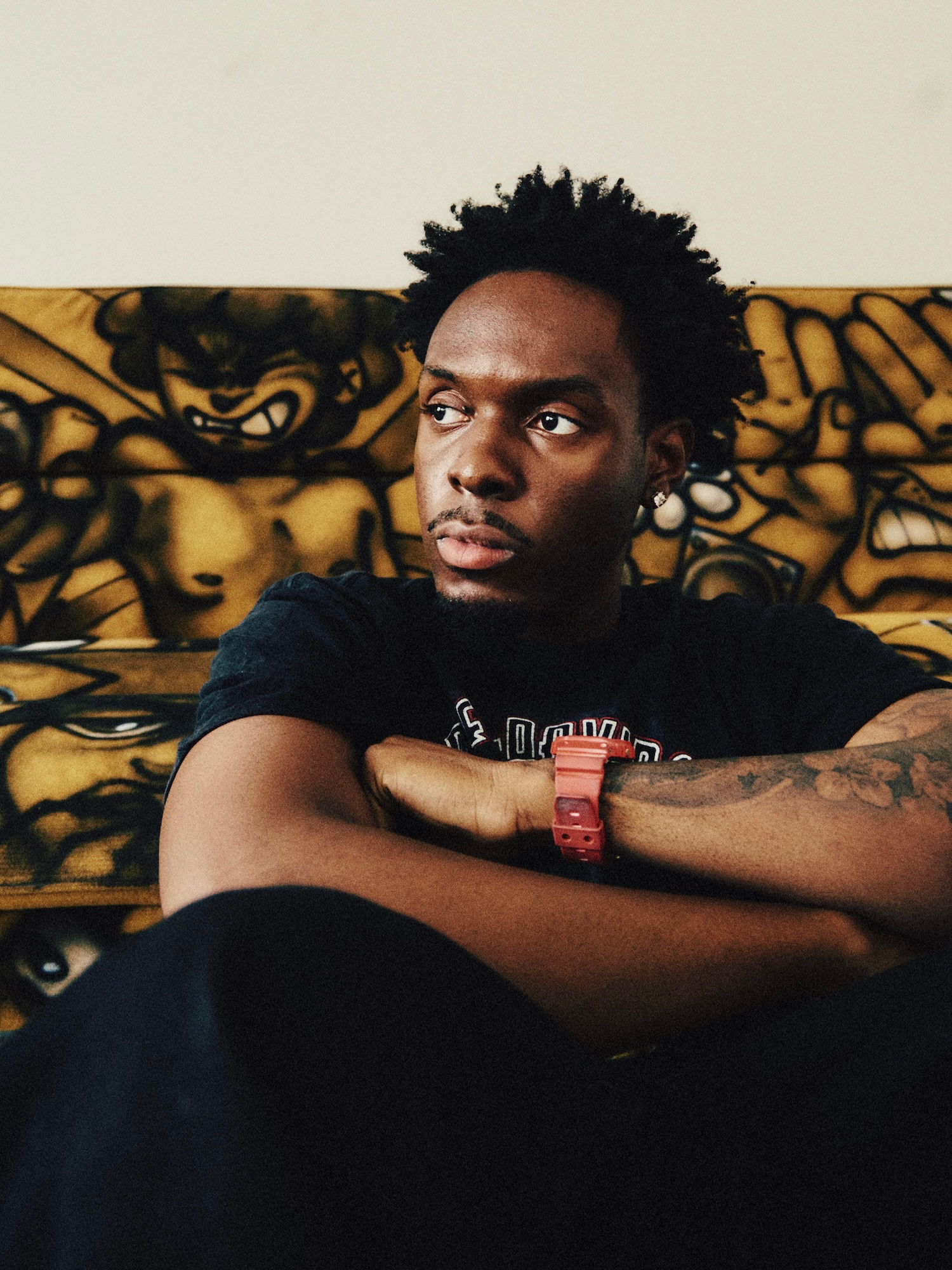
A portrait of a Jusheiy with short twisted hair wearing a black tee and a red watch, sit with his arms crossed in front of a yellow wall cover in graffiti art.
That resourcefulness carries through everything Jusheiy has done since. He has described the outlook behind his early work as more instinct than plan: rather than waiting until an idea, a project or a whole creative identity felt fully resolved before starting, he put things into the world first and let the shape of the practice reveal itself afterward. It is a rougher, less linear route than the one many working artists describe when asked how they got started, and it shows in how casually he talks about the years before anyone outside his own circle was paying attention to what he made.
flow
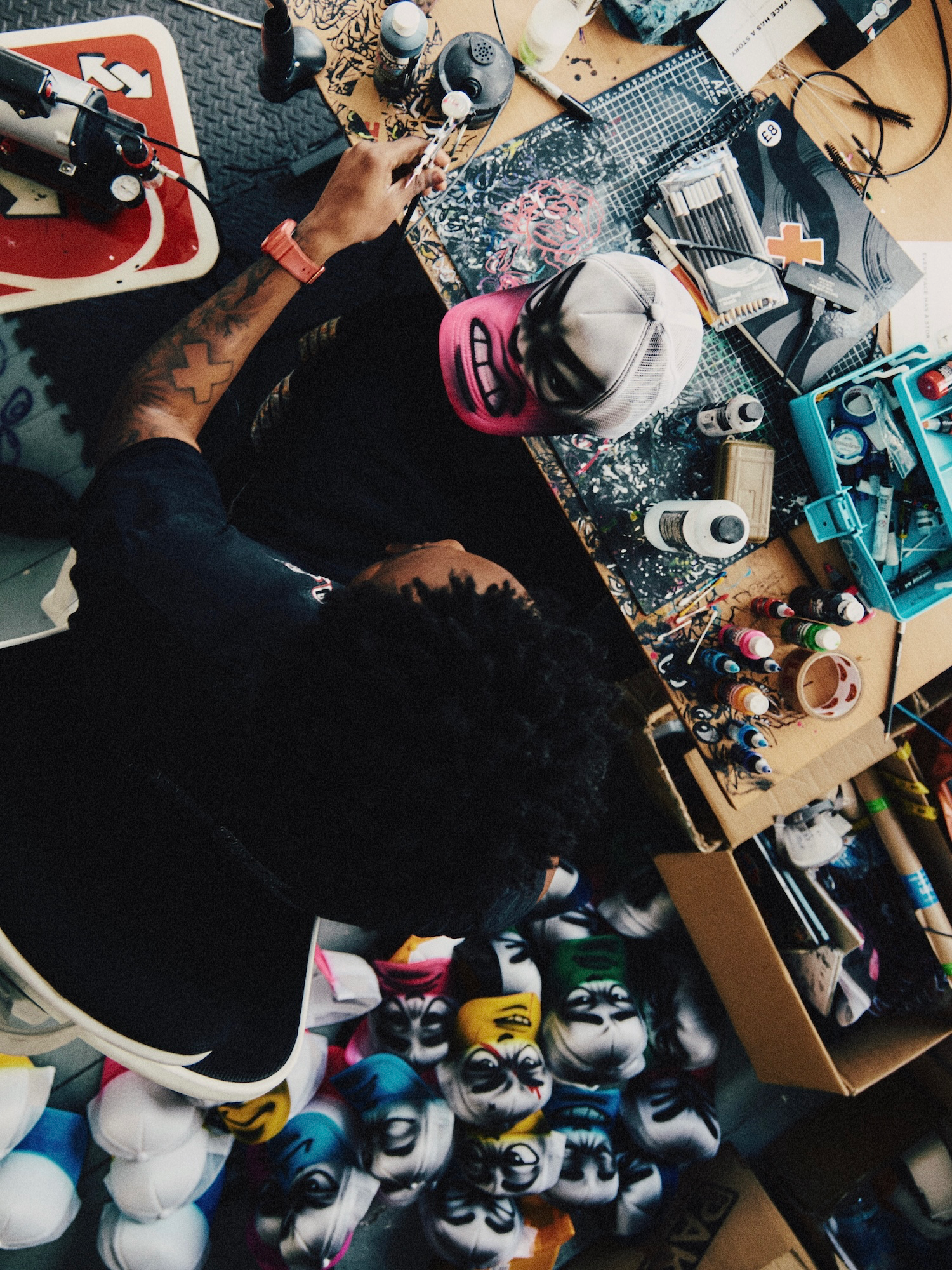
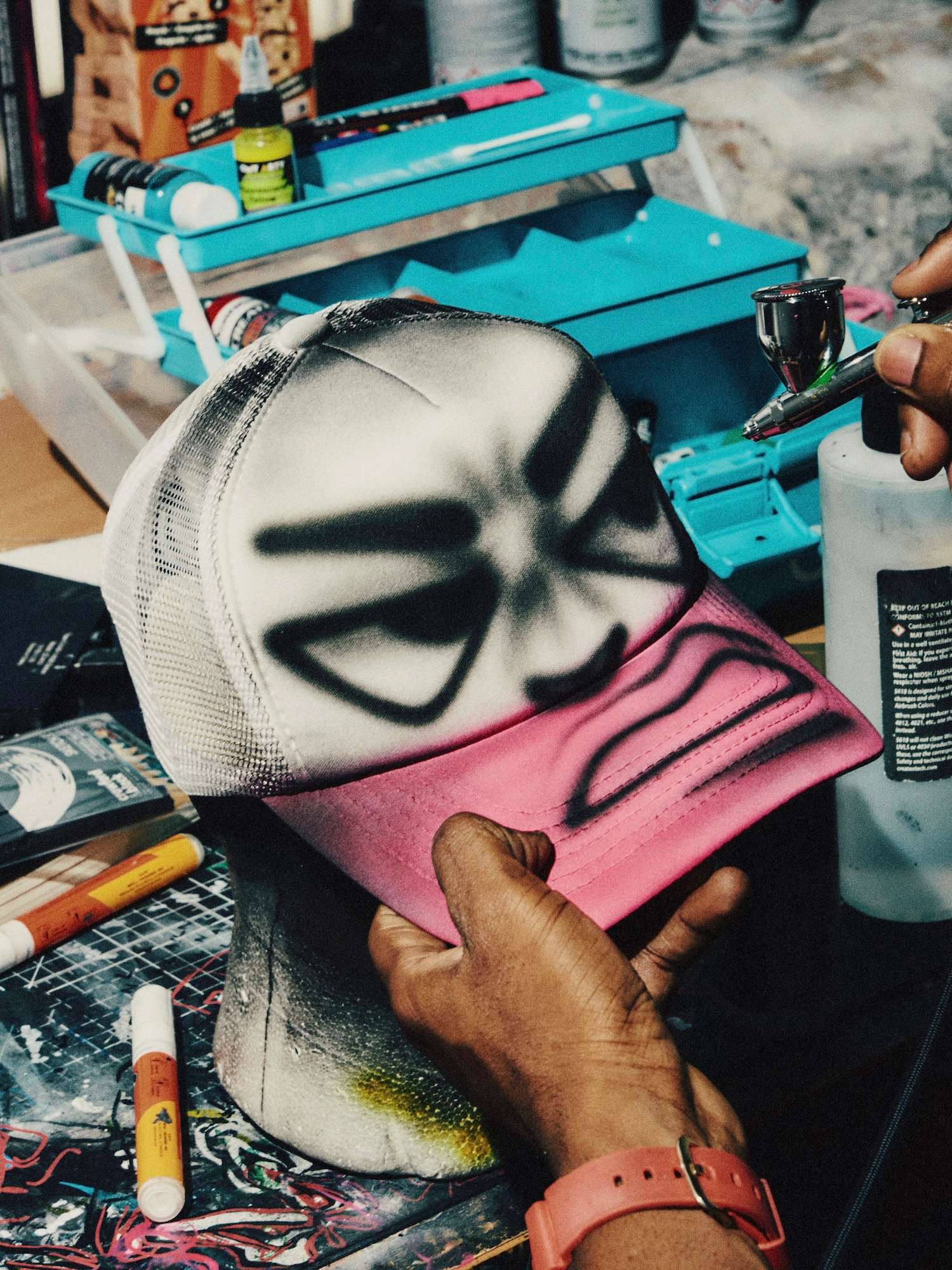
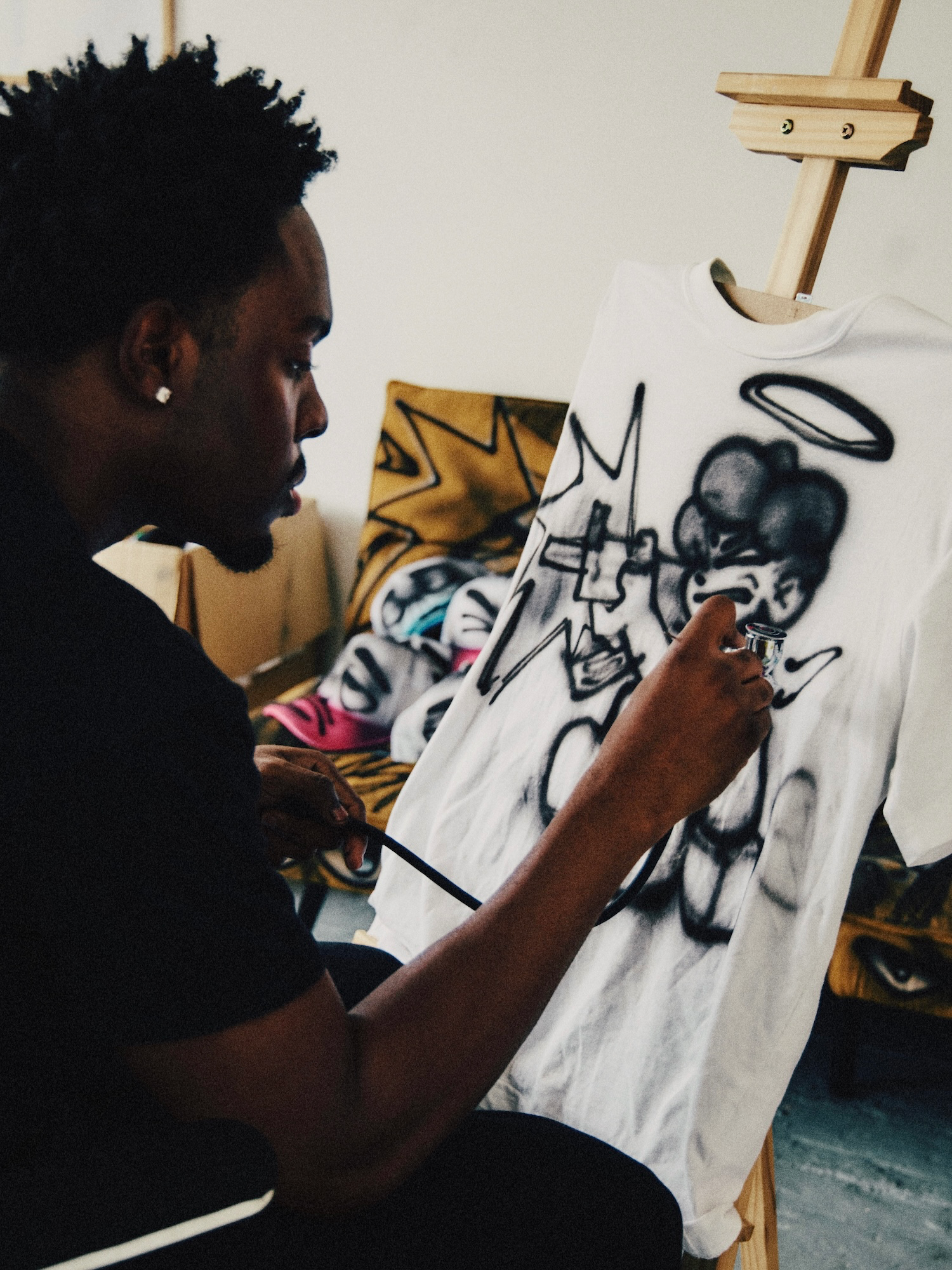
Digital illustration eventual ran into its own ceiling. Jusheiy has said he wanted his work to exist physically at some point, and prints were the first attempt at that, but prints have an obvious limit: there is only so large one can get before it stops resembling the object he actually wanted to make. Traditional painting was not the answer either, by his own admission, since he does not connect with it the way some artists do. Airbrushing became the option almost by elimination, helped along by the fact that he had not seen many people around him working that way. That gap left him room to treat the medium as his own territory rather than stepping into somebody else’s established lane.
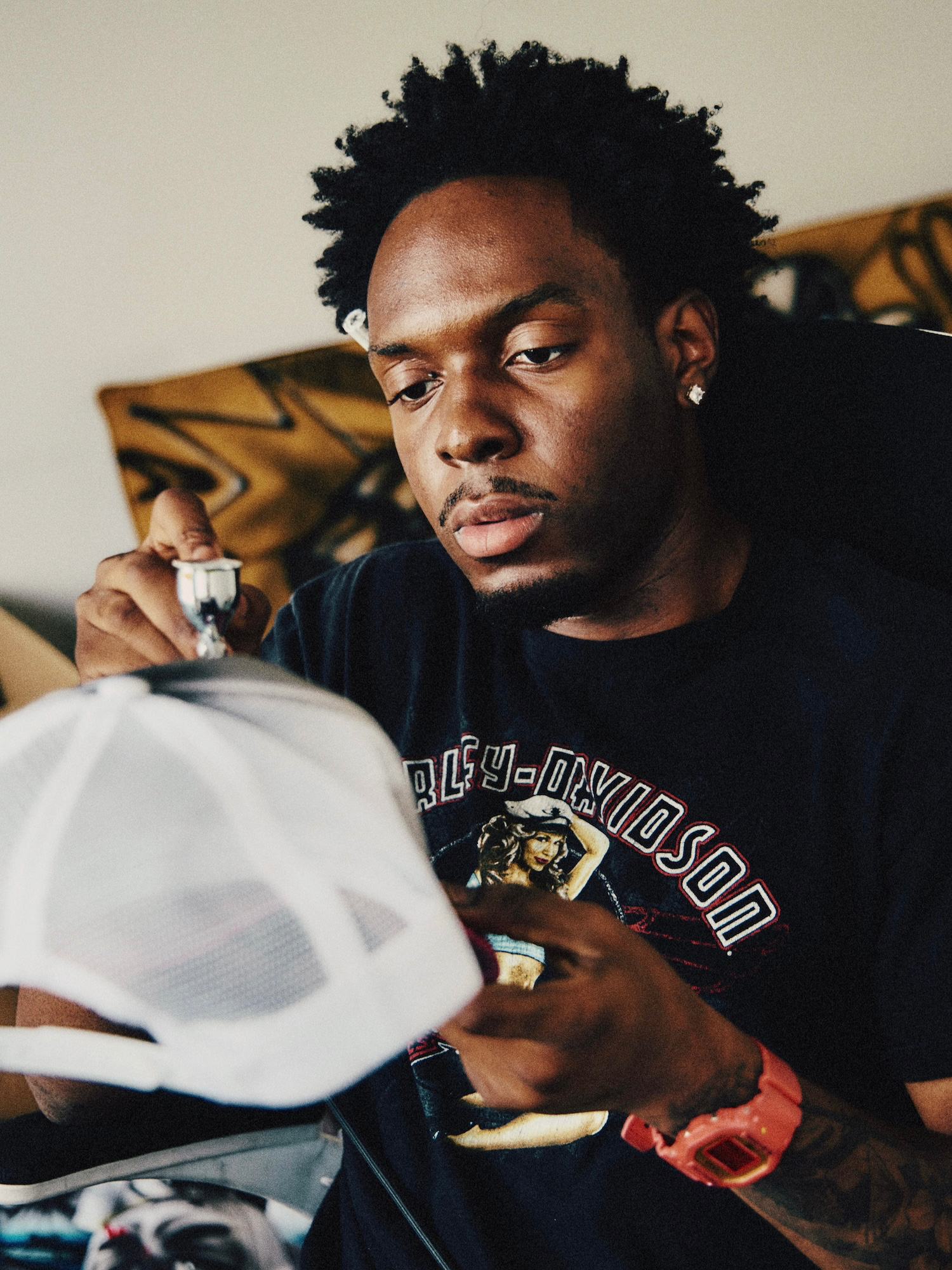
Airbrushing itself is one of those techniques streetwear keeps rediscover. The technique has roots in show and photographic retouch going back more than a century, then found a second life in custom car and motorcycle paint jobs, and a third in the fairground and carnival art that flourished through the 1970s and 80s, long before it became a fixture of custom sneaker culture and mall kiosks. Its most recent revival has arrived through independent streetwear artists who build an audience directly on social platforms rather than through a gallery or a retailer, offering bespoke work on everything from canvas high tops to leather goods. What has mostly changed since airbrushing’s earlier eras is the canvas itself. Where an earlier generation of airbrush artists needed a car panel, a motorcycle tank or a helmet, Jusheiy is working on knu skool Vans, wallets, and, in at least one case, another house’s leather goods entirely.
Moving off the screen also meant giving up a kind of convenience he had taken for granted without realising it. Digital tools allow instant correction, an undo command for almost any misstep. Fabric and leather do not offer that same safety net. Getting comfortable with materials that do not forgive a slip, he has said, turned controlling the airbrush into a discipline in its own right, layered on top of whatever design instinct got him there in the first place. It is a slower, less forgiving way to work than the one he started with, and by his own telling that is part of the appeal rather than a drawback.
straddle
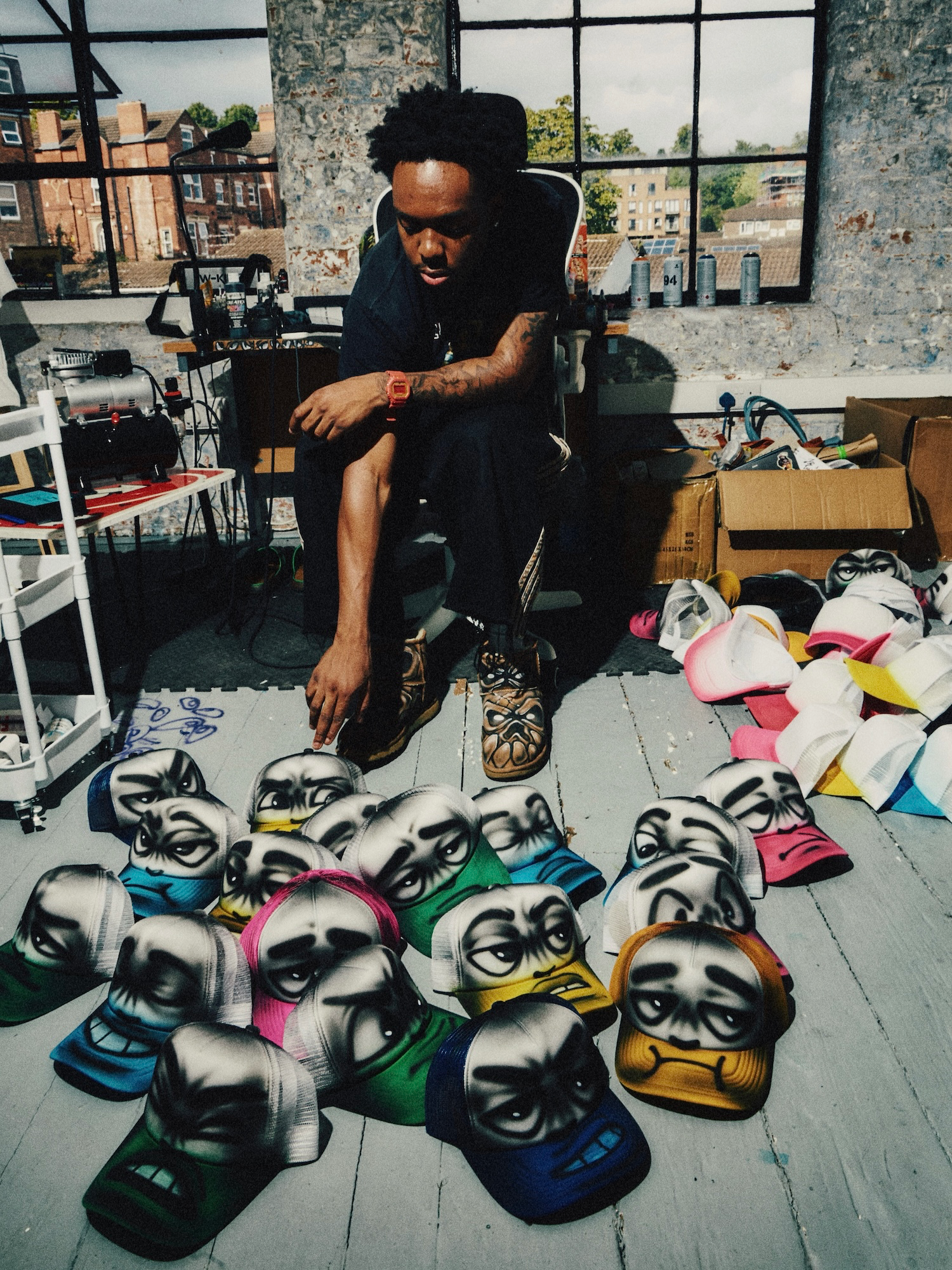
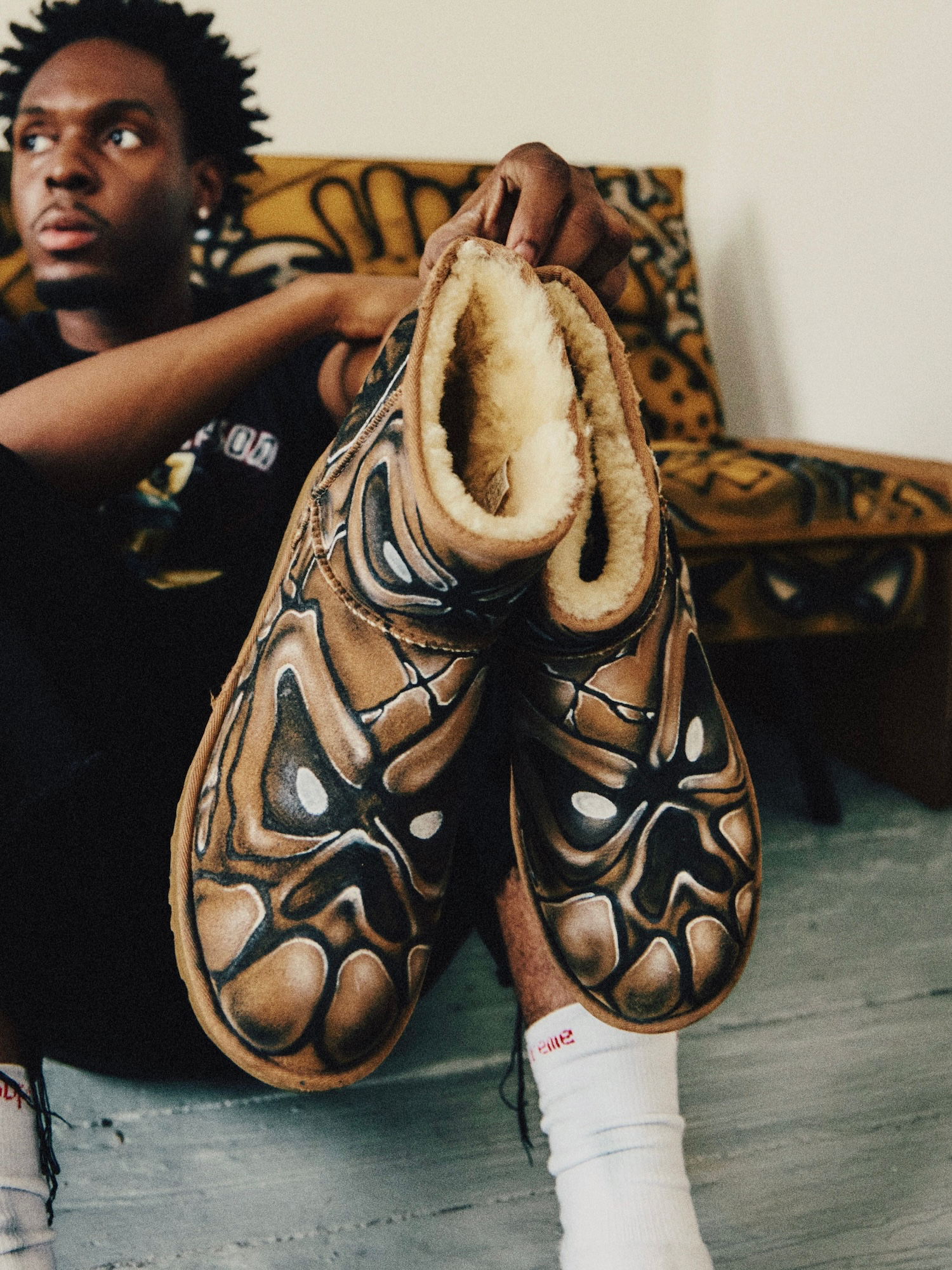
The results now live on his own storefront, jusheiy.com, under names that read like inside jokes rather than product copy. Beanies, wallets and shoes are the throughline of the current catalog, alongside one off pieces like the Goyard commission that sit entirely outside the standard product line. A Thugger Beanie, priced at $55, nods to Atlanta rapper Young Thug; Jusheiy has floated the idea of the rapper actually wearing one online, more as a running joke than a confirmed endorsement. A run of Facecaps, part of what the site calls Series 001, sits at $82. Pairs of pearlised, airbrushed knu skool Vans run from $217 for the Noir colorway up to $231 for the Crimson, and a limited edition X-patch Beanie in Crimson has already sold out in Noir, a small but real signal that the retail side of the practice has an audience beyond his own following. As of this writing, the storefront itself was temporarily gated behind a password page reading “BRB…shipping orders,” which suggest the small operation is current work through a backlog rather than sit idle.
Commission work sits alongside that retail line, and Jusheiy has singled out a custom Goyard bag as a favourite project so far. It is a different kind of job than airbrushing his own blank stock: taking an object that already carries its own visual sig, a house with a reputation for discretion rather than flash, and adding another layer on top of it. He has described having real creative freedom on that brief, which let him treat an already finished, recognisable object as raw material rather than a constraint to work around, and the result reads less like a repaint than a genuine second design pass over something that already had one.
Garment work in general, he has said, demands more materials and more setup than digital ever did, trading the portability of a laptop for a studio he actually has to show up to and stock before he can start. He has framed that trade off as a net positive rather than a complaint, since having to physically set everything up makes the process feel more tangible, and by extension closer to the outcome he originally wanted his illustrations to reach when they were still confined to a screen.
View this post on Instagram
scope
Ask Jusheiy about originality in the current landscape of urban art and he does not pretend the well is still full. His view, laid out plain in the same on social media, is that almost nothing counts as genuine original anymore, given how much view mat everyone online is exposed to at once. What is left to actually claim as one’s own, in his telling, is not the raw material itself but what a given artist does with it: how influences get put together, rather than whether any single piece of them is new to begin with.
Music remains the influence he names first when asked, alongside a broader appetite for ideas that make people stop and reconsider something they thought they already understood. That is a fairly common answer for an artist his age working in and around streetwear, but it is a noticeably narrower one than he might have given a couple of years ago. He spent a stretch learning 2D animation specifically to bring his illustrated characters to life, then set it aside once he realised the medium demanded more time and dedication than he actually wanted to commit to it. He talks about that decision now without much regret, more as a data point about where his energy is better spent than as a project he abandoned.
None of this has come without friction. Screen time and eye strain were the obvious occupational hazards of a purely digital practice, and Jusheiy has said plainly that they have not gone away now that the work has physical stakes attached to it. If anything, the stress has compounded: a merch line brings pricing, fulfilment and a version of the business side that a sketchbook never demanded of him. He still resists calling himself a brand for it, describing himself instead as an artist who happens to make things people can buy, a distinction that appears to matter more to him than it would to a customer simply checking out on his site.
His own social presence carries a version of that same tension in miniature. He posts under @Jusheiy on X, where his bio reads, with some irony, “a boring artist,” and where a clip captioned “Got bored #airbrush” has picked up tens of thousands of views, considerably more than most of what else he has posted since joining the platform in August 2024. A follow up post the same week, showing a piece next to its original reference image, did comparable numbers. It is a small, telling gap between how he describes himself and how an audience he never set out to build has actually responded to the work.
slow
What comes after beanies, Facecaps and airbrushed Vans, in Jusheiy’s own account, is more of the same instinct applied at a different scale: more unconventional formats, and eventually work built larger than his current studio setup allows for. He has stayed vague about specifics, which tracks with an artist who has already change direction at least twice, leave 2D animation behind and later leave prints behind for airbrush, without treating either move as a defeat or a failed experiment.
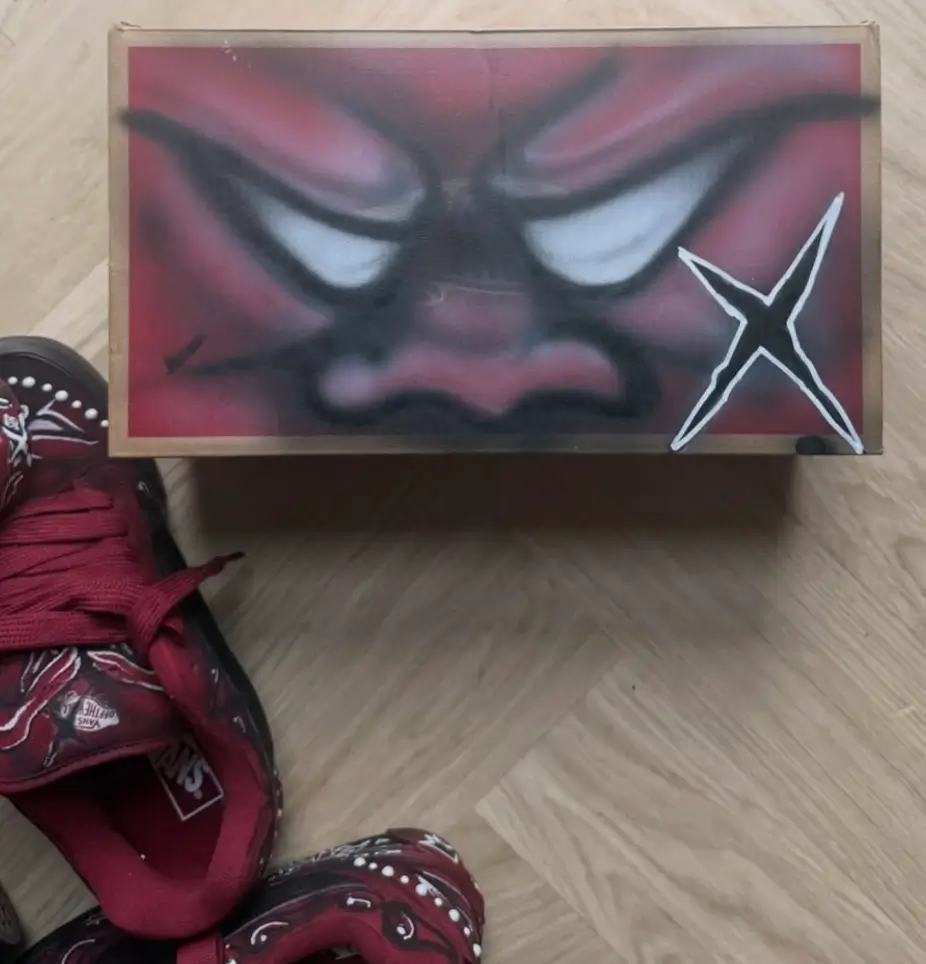
A close-up image of a red graffiti character with a fierce expression and a cigarette in its mouth, depicted on a textured surface.
That route, hobbyist illustration turning into a self run product line without an agent, a publicist or a retail partner attached to it, is not unique to Jusheiy. A growing number of younger visual artists are building a public following and monetising work directly through their own social accounts and storefronts, rather than waiting on a gallery show, a magazine feature or a brand collaboration to validate what they make first. What sets his version apart so far is less the model than the specific object he chose to prove it with: a spray gun rather than a paintbrush, and somebody else’s handbag rather than a blank canvas.
His advice to anyone earlier in that same process is correspondingly loose rather than prescriptive: keep making things instead of waiting to identify a personal style in the abstract, since the style tends to reveal itself only once there is enough finished work behind it to actually recognise a pattern in. It is advice that maps fairly directly onto his own route from a hobbyist illustrator working with whatever materials were on hand, to an airbrush artist whose sold out beanies and one off Goyard commission now sit on the same storefront as an $82 face cap.
Whether that trajectory holds a clean shape for much longer is a question Jusheiy himself does not seem especially interested in answering in advance. For an artist who has built an entire practice out of testing things and discarding whatever does not work, that may be closer to the actual plan than it first appears.
Related Articles
Spotify Let Parents Omit Nursery Rhymes Out Of The Taste File
15 September 2026. Toggle off kids and family music. Wrapped, Discover Weekly, Daily Mix. Retroactive. […]