DRIFT AUDIO
Listen to this story
Choose a voice, then press play.
Two letters, five weeks apart, capture Einstein mid-breakthrough — one giddy, one exhausted — before gen relativity had a name.
In This Story
- Prague, February 1912: A Breakthrough in Cursive
- “I Was Working in a Frenzy”: The Letters to Besso
- A Face for the Theory: The 1930 Portrait
- Why Scientific Manuscripts Are Having a Moment
- The Sale
In February 1912, Albert Einstein was a month shy of his 33rd birthday, a year into a professorship in theoretical physics at Prague’s Charles University, and already regarded by his peers as one of the most important minds in physics. That reputation rested on the four papers he had published in 1905 — his so-called annus mirabilis — written while he was a patent examiner in Bern rather than an academic. The third of those papers established special relativity: that the speed of light is constant for every observer, regardless of how fast they themselves are moving. The fourth extended the idea to show that mass and energy are interchangeable, giving the world its most recognisable equation, E = mc².
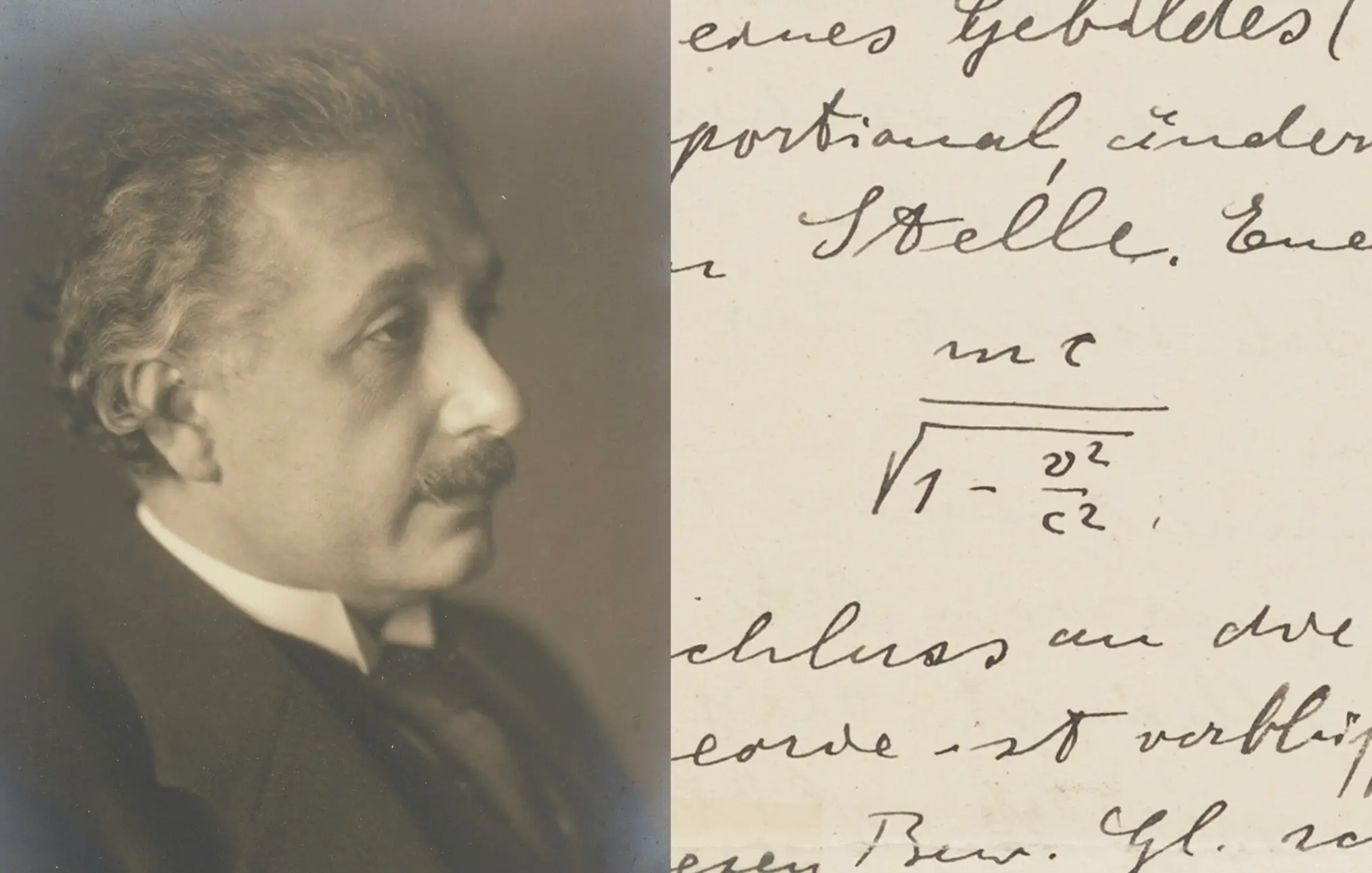
What Einstein had not yet worked out, in 1905, was how gravity fit into any of it. He carried that unresolved question with him for years, turning it over quietly, until February 1912 in Prague, when he had what amounted to a eureka moment. He moved quickly. In neat, unhurried cursive, he wrote to his former assistant, Ludwig Hopf, describing a “stunningly beautiful and amazingly simple” discovery. That letter is now the earliest surviving evidence of Einstein’s move toward what would become the general theory of relativity — the theory that redefined gravity not as a force acting between objects, but as the curvature of spacetime itself.
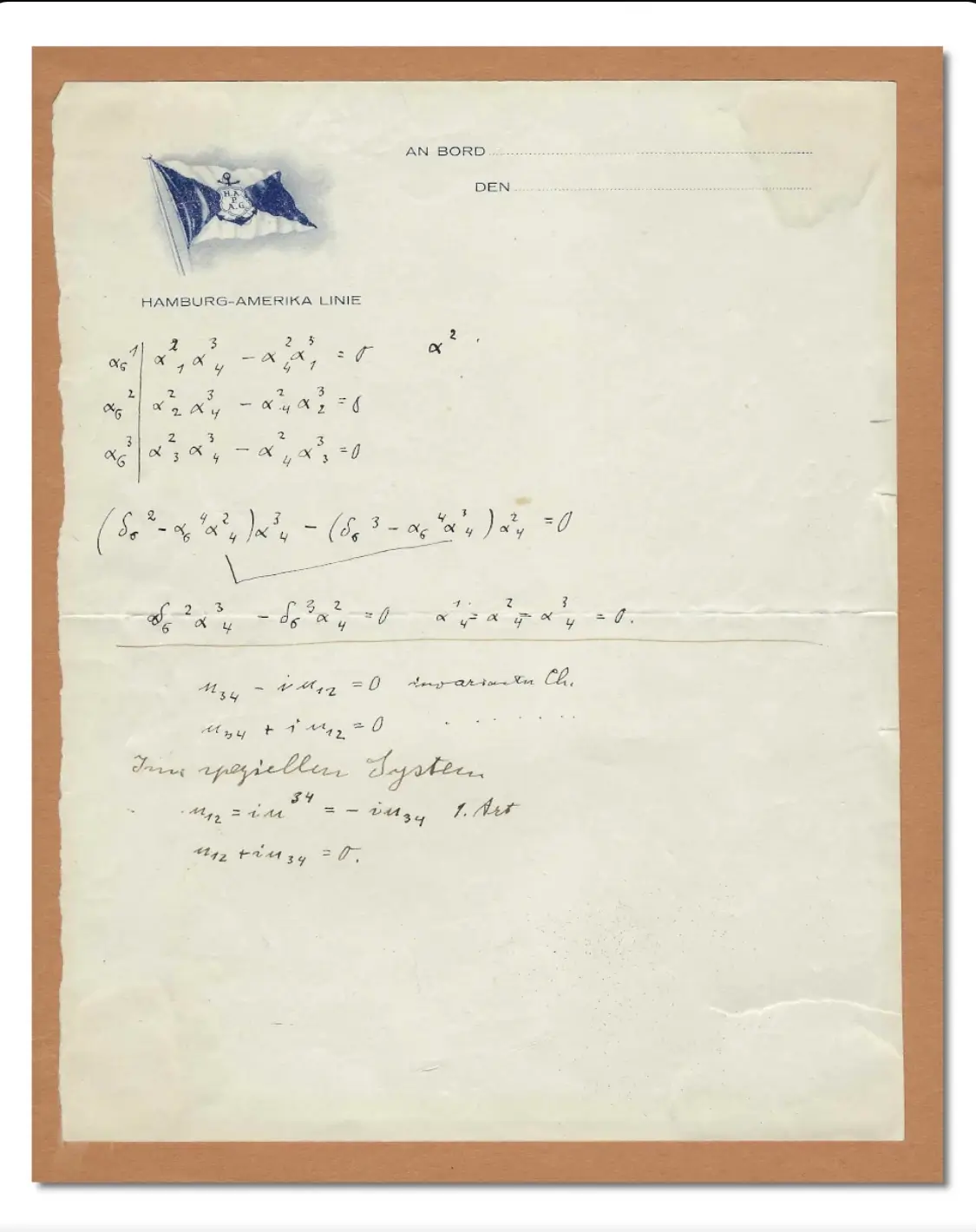
Historic Hamburg-Amerika Line stationery filled with handwritten mathematical equations and theoretical physics notes, reflecting Albert Einstein’s scientific work.
The choice of correspondent was not incidental. Hopf, a German-Jewish theoretical physicist a year older than Einstein, had studied under Arnold Sommerfeld in Munich before the two men were introduced at a physics conference in Salzburg. When Einstein needed an assistant at the University of Zurich, he hired Hopf — helped, by some accounts, by the fact that Hopf was a capable pianist and Einstein liked to play violin duets in the evenings. The pair co-authored two papers together on the statistical aspects of radiation in 1910, and Hopf went on to accompany Einstein when he moved to Prague in 1911, before eventually settling back in Germany, where he built a career in hydrodynamics and aerodynamics. Writing to a physicist who had worked alongside him on real research — rather than to a family member or an outside admirer — meant Einstein could describe the idea in its own technical terms, without translation or simplification. It is precisely that unguarded, specialist register that makes the letter so valuable now: the earliest surviving trace of the theory, addressed to someone who would have understood exactly what was at stake.
The letter’s significance lies less in its length than in its timing: it captures the exact moment an idea that would occupy Einstein for three more years, and eventually reshape 20th-century physics, first took shape in his own handwriting.
flow
A month after Prague, on 26 March 1912, Einstein put the same idea to the person he trusted most to stress-test it: Michele Besso, a Swiss engineer he had first met as a student in Zurich in the late 1890s and later worked alongside at the Bern patent office in the early 1900s. Besso was, by Einstein’s own account, the only person he formally acknowledged as a collaborator on the 1905 papers, thanking him in the special relativity paper itself for having “steadfastly stood by me” through the work. The friendship long outlasted their time together in Bern: the two maintained a correspondence that ran for decades, ending only days before Einstein’s own death in 1955, when Einstein wrote to Besso’s family with a line that has since become one of his most quoted reflections on mortality and physics alike. In this particular letter, offered as lot 6594780 in Christie’s upcoming sale, Einstein announces the same breakthrough referenced in the Hopf letter — the earliest documented step toward general relativity, addressed to the friend who would go on to become his most consistent sounding board on the subject over the three years it took to complete the theory.
Five weeks later, Einstein wrote to Besso again, this time at far greater length: seven pages walking his friend through the concept in detail. The emotional register of the two letters is markedly different. Where the Hopf letter is composed and confident, the second Besso letter reads like a mind working at full tilt. “I was working in a frenzy,” Einstein tells him, before admitting that “each step is devilishly difficult” — and yet, he adds, the results are “staggering.” It is a rare glimpse of Einstein mid-process rather than post-triumph: not the composed elder statesman of later photographs, but a working physicist genuinely unsure, from one page to the next, whether the idea would hold.
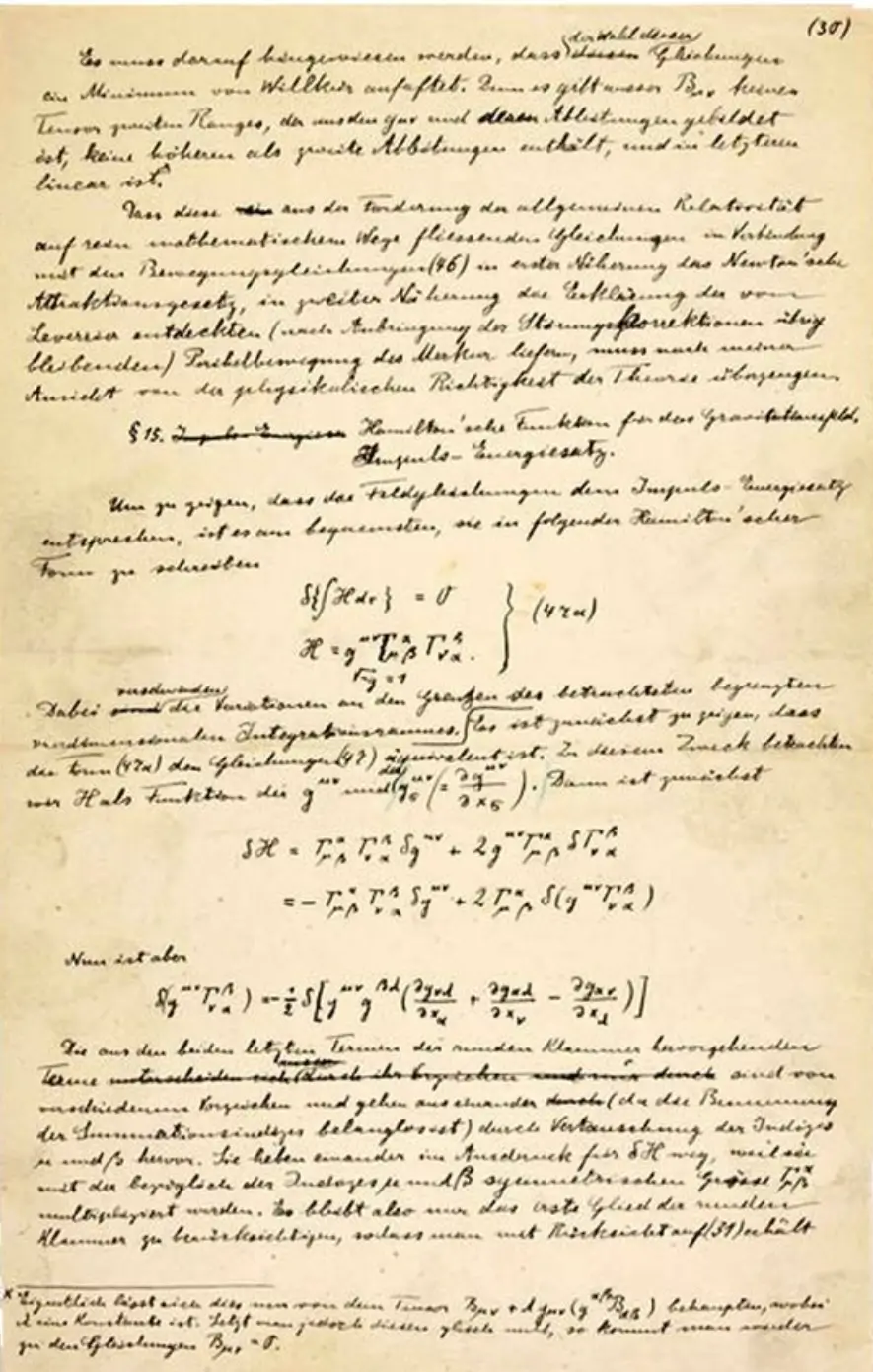
A handwritten scientific manuscript featuring German text, mathematical formulas, and theoretical physics calculations associated with Albert Einstein’s groundbreaking work on relativity.
That gap between the two letters — from a tidy announcement to a sprawling, seven-page working-through — mirrors what historians of science have long understood about how Einstein actually built general relativity. It was not a single flash of insight but a three-year grind, running from this initial 1912 breakthrough through a flawed intermediate version of the theory (later known as the “Entwurf” theory) before Einstein finally arrived at the correct field equations in November 1915. Besso was present, in one form or another, for almost every stage of that process, which is part of why the correspondence between the two men has become one of the primary sources historians rely on to reconstruct how the theory actually took shape, rather than how it looked once finished and published.
That rarity is precisely what makes the pair valuable to collectors and historians alike. Einstein was famously reluctant, throughout his career, to discuss where his ideas actually came from — biographers have long noted how little he revealed about his own working process, preferring the finished theory to the mess behind it. Correspondence that documents the development of relativity in real time is accordingly scarce. Seen together, the Hopf letter and the two Besso letters trace a five-week arc from first insight to full articulation, offering what may be the closest thing that survives to a working diary of the idea that became general relativity.
stance
Alongside the letters, the sale also includes a signed portrait photograph of Einstein dated 10 October 1930 — described as a unique print, carrying a pre-sale estimate of £30,000–40,000. By 1930, Einstein was no longer the relatively obscure Prague professor of 1912; the 1919 solar eclipse expedition that confirmed general relativity’s prediction of light bending around the sun had already made him a global celebrity, and his face was by then as recognisable as his equations. That transformation had happened remarkably fast by the standards of scientific fame: within a year of the eclipse results being announced, newspapers around the world were treating Einstein as a household name, and by the time this photograph was taken he had already spent a decade fielding the kind of public attention that no working theoretical physicist, before or arguably since, has experienced in quite the same way.
The portrait sits in the sale as a kind of bookend to the letters: the private, uncertain scientist of 1912 set against the public, fully mythologised figure he had become less than two decades later. Where the Hopf and Besso letters show handwriting rushed, doubtful, and addressed to an audience of one, a signed photograph from 1930 is a different kind of object altogether — a considered, public-facing artefact, produced for an Einstein who by then understood exactly how his image circulated in the world. Placing the two kinds of material in the same sale gives collectors an unusually complete arc: the scientist mid-discovery, and the icon he became once the discovery had been proven correct.
current
The appetite for this kind of material has been building for some time, and it reflects a broader shift in how the collectibles market treats scientific history. Historically, the market for autographs and manuscripts has been led by literature, music, and political history — a Jane Austen letter, a Beethoven score, a Lincoln signature. Scientific material was often treated as a secondary category, valued more for the celebrity of the signatory than the content of the document itself. That has changed considerably over the past decade, as institutions and private collectors alike have come to treat the working documents behind major scientific breakthroughs as historical artefacts in their own right, comparable in significance to a literary first draft or a composer’s manuscript score.
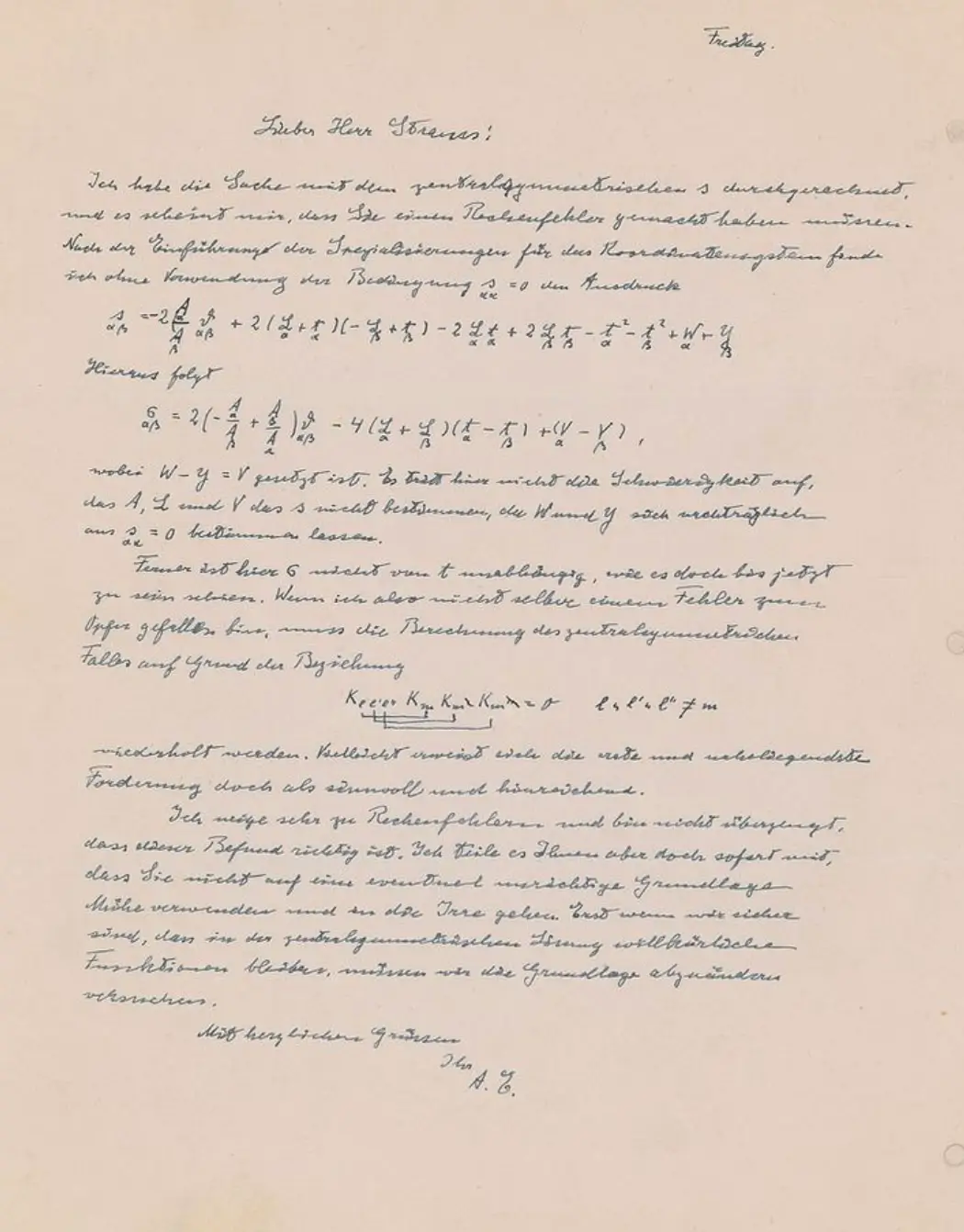
A handwritten German manuscript by Albert Einstein filled with mathematical formulas, calculations, and theoretical physics notes, reflecting his scientific correspondence and research.
In 2021, a 54-page working manuscript jointly written by Einstein and Besso — documenting their (ultimately unsuccessful) attempt to explain an anomaly in Mercury’s orbit using an early version of general relativity — sold at a Christie’s-run auction in Paris for just over $13 million, roughly quadrupling its pre-sale estimate and setting a record for any science manuscript sold at auction. Christie’s had described that document at the time as one of only two surviving manuscripts documenting the theory’s genesis, the other being the so-called Zurich notebook held at the Hebrew University of Jerusalem’s Einstein Archives. Separately, a 1920 letter Einstein wrote to the same Ludwig Hopf — a different letter to the one in this sale, written after the 1919 eclipse results had made him internationally famous — sold through RR Auction for close to $30,000, a useful reminder of just how differently the market values Einstein’s later, more reflective correspondence compared to the working documents from his most productive scientific years.
What both sales point to is a market that draws a sharp distinction between Einstein memorabilia broadly and Einstein’s actual working documents. Signed photographs, letters on unrelated personal matters, and later correspondence all have value, but it is the material tied directly to the genesis of his major theories — manuscripts and letters written while an idea was still being formed, rather than after it had been published and absorbed into physics textbooks — that consistently commands the largest premiums and the most attention from institutional and private collectors alike. Part of this is simple scarcity: Einstein rarely kept his own working drafts, considering them disposable once an idea had been refined into a finished paper, which means most of what survives from his most productive years exists only because a correspondent such as Besso happened to hold onto it. The Hopf and Besso letters on offer at Christie’s this July sit squarely in that rarer category: not Einstein reflecting on relativity after the fact, but Einstein in the act of discovering it, five weeks apart, in two different registers of his own handwriting.
sale
The Hopf letter, the two Besso letters, and the 1930 signed portrait are being offered as part of Valuable Books and Manuscripts including Cartography, Christie’s recurring London sale of significant manuscripts, autographs, and printed material, taking place on 8 July 2026. The Besso letter of 26 March 1912 carries a pre-sale estimate of £150,000–200,000, while the signed 1930 portrait is estimated at £30,000–40,000. As with any sale of this kind, final hammer prices are determined on the day and can move well beyond pre-sale estimates, particularly for material as narrowly rare as documentation of a still-unnamed theory in its earliest, handwritten form.
For collectors and institutions alike, the appeal of this particular grouping is less about any single lot and more about the sequence they form together. Read side by side, the Hopf letter and the two Besso letters do something a finished physics textbook never can: they let a reader watch the idea change shape in real time, from a tidy first announcement to a long, anxious working-through and back to something Einstein himself seemed to trust. Three years before the theory reached its final, published form, this is what it looked like still being built.
From the DRIFT archive: The Rise of a Masterwork: Klimt’s Portrait and Its Historic $236.4M Sale
Related Articles

Where the Face Should Be, Rafael Silveira Paints Open Sky
A pink shirt, shoulder-length hair, then no face at all: in “Surprise,” Rafael Silveira lets flowers and a clear blue sky stand in for the person.