DRIFT AUDIO
Listen to this story
Choose a voice, then press play.
In This Story
- A Practice Built on Slowness
- From Savannah to the Farm Country of Pennsylvania
- The Language of Wool and Lambs
- Notable Works in the Studio
- Hand in Hand at Waterworks Visual Arts Center
- A Bigger Stage: Handwork 2026
- Why Guertin’s Work Resonates Now
stir
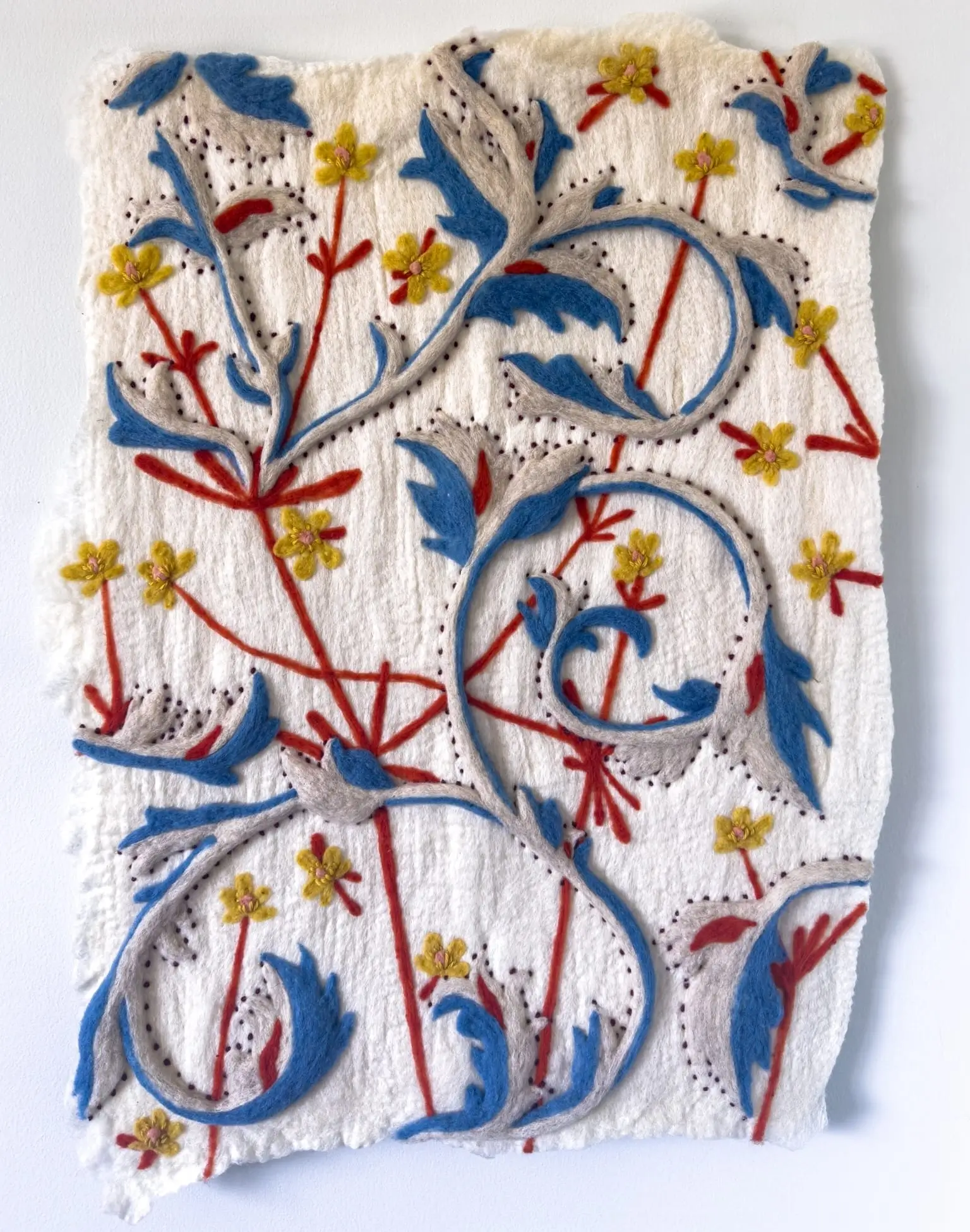
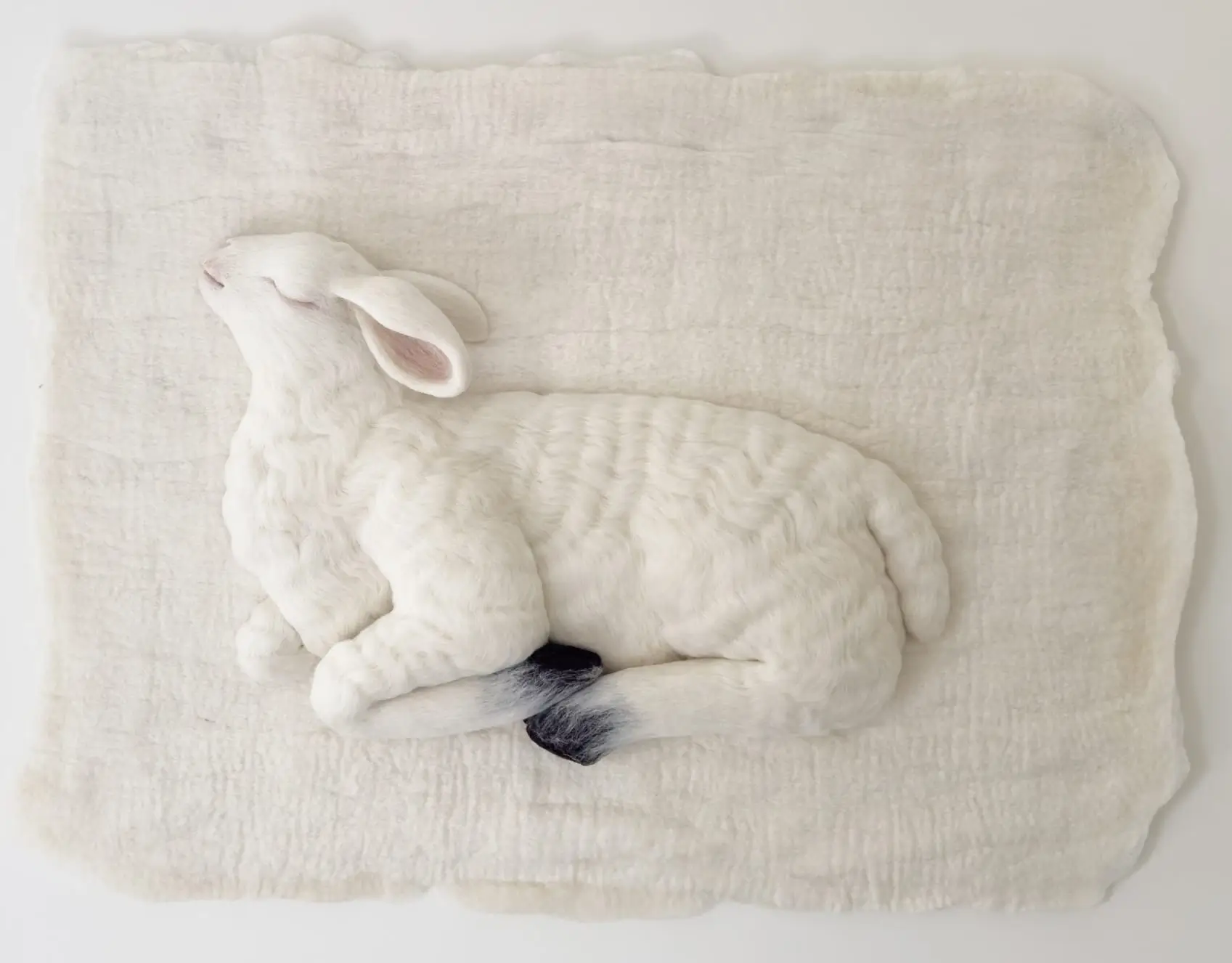
Holly Guertin works in a register that’s almost entirely out of step with the speed of contemporary image culture. Her pieces move between three slow, hand-driven processes — wet and needle felting, crochet, and embroidery — to build textile works that read less like craft objects and more like reliefs. Lambs recline or stand at rest, foliage curls around them in dense, embroidered detail, and the overall effect is closer to a quiet devotional painting than anything typically associated with fiber art’s more playful, novelty-driven corners.
What separates Guertin’s work from a lot of contemporary textile art is the deliberate restraint in her subject matter. She isn’t chasing spectacle. Instead, her pieces sit with a single animal, a single gesture, a single patch of ornament, and ask the viewer to slow down enough to notice it. That’s by design: across interviews and her own writing, Guertin has described being drawn to the idea that the natural world’s most extraordinary details — the layered color of a bird’s feathers, the texture of a blade of grass — are easy to overlook simply because they’re so common. Her work functions as a kind of close-reading of those details, translated into fiber.
View this post on Instagram
flow
Guertin’s technical foundation comes from a BFA in Fibers from the Savannah College of Art and Design, where she graduated in 2011. During her time at SCAD, two of her early pieces — “All Like Sheep No. 1” and later “Pink Sheepskin” — were acquired into the school’s permanent collection, an early signal of the sheep-and-wool motif that would come to define her practice.
She’s now based in the Philadelphia area, where she balances studio work with raising four sons and teaching. Guertin chairs the Craftsmanship Department at Martin Saints Classical High School, a role that puts her hand-skills directly into the classroom rather than treating them as a separate, private practice. It’s a detail that tracks with how she talks about her work more broadly — less as a solitary, precious studio pursuit, and more as something lived alongside family and community. By her own account, her sons are often nearby in the studio, picking up felting needles or embroidery hoops of their own.
Her path into fiber art wasn’t purely formal, either. Guertin has spoken about an early fascination with the toile wallpaper in her childhood dining room — an ornamental, pattern-heavy print style — as a kind of first encounter with the ideas she’d later spend years exploring in textile form: repetition, pattern, and the relationship between decoration and meaning.
lang
Wool, specifically, carries more weight in Guertin’s practice than it might in another fiber artist’s studio. Her conversion to Catholicism during her college years runs underneath much of her later work, and the recurring lamb imagery in her pieces draws directly from that framework — sheep and shepherd, wool and labor, the Lamb of God as a long-standing devotional image. She’s cited Francisco de Zurbarán’s 17th-century painting “Agnus Dei,” a stark, single-lamb composition, as a touchstone for how she thinks about depicting sheep with reverence rather than as decorative animal portraiture.
That doesn’t mean her work reads as overtly religious to every viewer — much of it can be (and is) appreciated purely as exceptionally crafted textile art, the kind that drew Anthropologie to commission Guertin-inspired pieces for its fall home goods and holiday décor lines back in 2019. But the spiritual undercurrent helps explain why her lambs feel less like illustrations and more like icons: still, dignified, and rendered with a level of care that borders on ceremonial.
Technically, her best-known works — the ongoing “Sheepskin” series — are built from crocheted domes of varying tone, size, and depth, each filled with raw, unspun wool and stitched onto a muslin base with quilting stitches. The result mimics the texture of a freshly shorn fleece while functioning as a sculptural wall piece, somewhere between textile and bas-relief.
novel
Two recent pieces give a clear sense of where Guertin’s practice has been heading. “The Invitation” (2024) depicts two young lambs leaping across a meadow, built through a combination of wet and needle felting techniques and stretching roughly four feet across. Guertin has said the piece grew out of a spring visit to a local farm and her interest in what, if anything, humans might offer one another the way sheep offer their wool — a small but telling example of how an everyday observation becomes the seed for a much larger fiber piece.
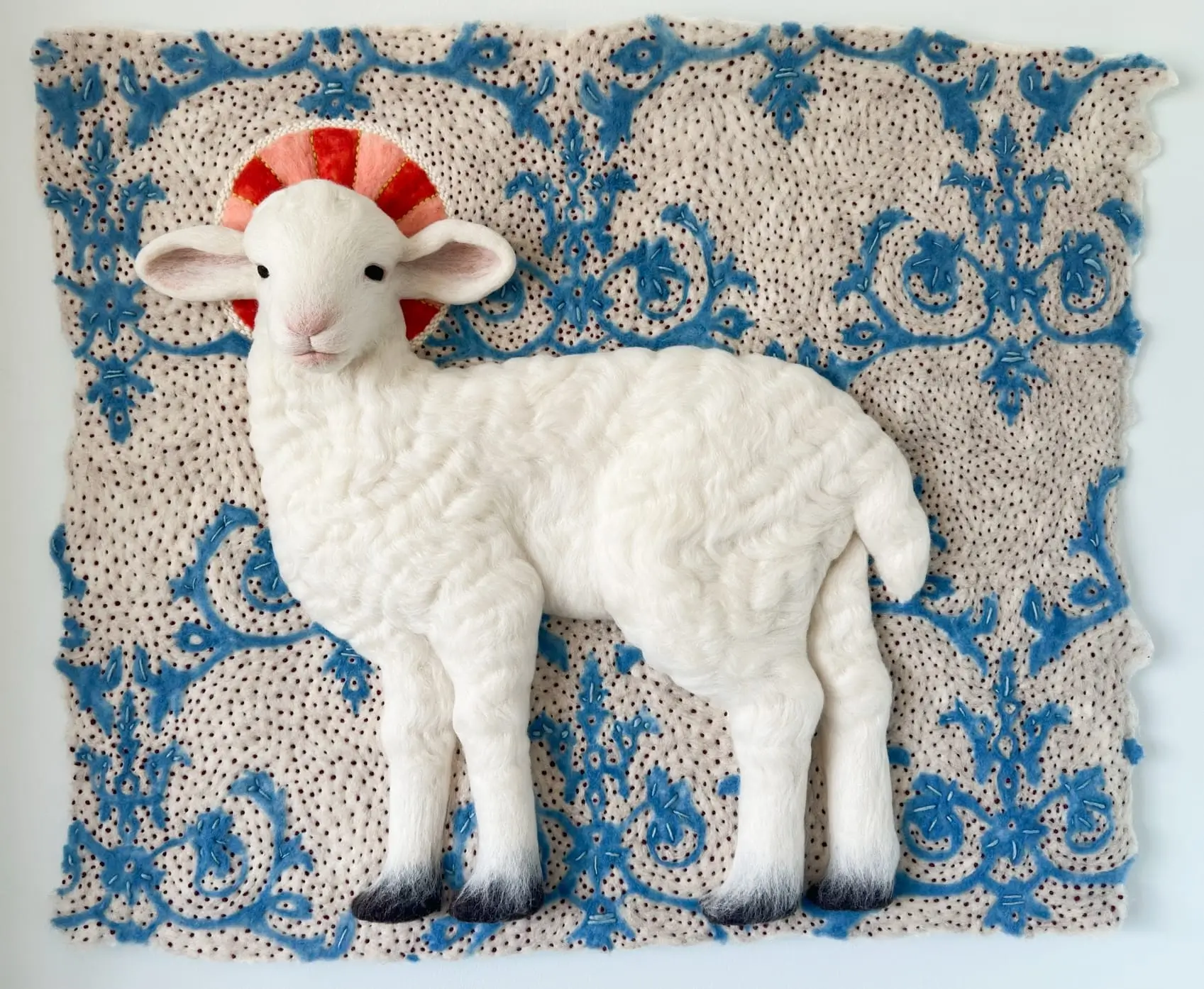
Her most recent major work, “Lamb of God,” pushes that devotional thread further. Completed earlier this year, the piece is a wool felt artwork with embroidery, measuring 39 by 32 by 4 inches, and depicts the Lamb of God set against a patterned blue-and-gray background. Guertin has described the process of making it as one weighted with reverence, given the subject matter, and has noted that the piece pulls together themes of labor, repetition, pattern, and craft that she’s been developing in her research and studio work over roughly two years. It’s also one of the pieces anchoring her upcoming solo exhibition.
show
That exhibition, Hand in Hand, opens July 6 and runs through October 10 at Waterworks Visual Arts Center in Salisbury, North Carolina — notably, Guertin’s hometown. It’s her first solo museum exhibition, a meaningful milestone for an artist whose work has, until now, mostly circulated through gallery group shows, online features, and a single high-profile retail collaboration.
Waterworks itself is a fitting venue for that kind of homecoming. The center is a non-collecting contemporary art museum and the anchor of Salisbury’s East Square Cultural Arts District, accredited by the American Alliance of Museums — one of only a small number of museums in North Carolina to hold that distinction. It typically rotates through three exhibitions a year across its gallery spaces, with free general admission.
For Guertin, the show is an opportunity to dig further into the ideas she’s been circling for the past two years: labor, repetition, pattern, and craft, framed through pieces like “Lamb of God” alongside selections from her felted, crocheted, and embroidered body of work. Given the timeline she’s described — nearly a year of sitting on the announcement before going public — Hand in Hand reads as a long-planned culmination rather than a quick survey show.
scope
Hand in Hand isn’t an isolated event, either. The exhibition has also been folded into Handwork 2026: Celebrating American Craft, a broader regional initiative spotlighting craft-based art across participating institutions. Waterworks is listed as a participating organization for that program, which places Guertin’s solo show inside a larger conversation about the current state of American craft practice — fitting, given how directly her work engages with the histories of felting, crochet, and embroidery as both technique and subject matter.
That dual framing matters for how the show will likely be read. On one hand, it’s a hometown solo debut for an artist who’s spent over a decade quietly building a singular visual language. On the other, it’s positioned within a moment where craft media — long treated as secondary to painting and sculpture in many institutional contexts — are getting dedicated, region-wide attention.
fin
It’s worth zooming out on why fiber art centered on stillness and pattern is finding an audience right now. Online coverage of Guertin’s work — from arts outlets to design-focused aggregators — has consistently framed her lambs and floral vignettes as a kind of visual exhale: detailed, unhurried, and built from materials and methods (felting, crochet, hand embroidery) that stand in obvious contrast to anything produced quickly or digitally.
There’s also the matter of scale and labor being made visible. A four-foot felted piece like “The Invitation,” or a multi-layered work like “Lamb of God,” carries an implicit record of the hours spent making it — something that’s increasingly rare and increasingly valued in a cultural moment saturated with fast, frictionless image production. Guertin’s pieces don’t just depict patience; they’re physical evidence of it.
For enthusiasts tracking where craft, design, and fine art continue to blur — whether through brand collaborations, museum programming, or independent studio practices — Guertin’s trajectory is worth watching. A SCAD-trained fiber artist whose work already crossed into mainstream retail via Anthropologie is now stepping into her first solo museum exhibition, in her hometown, framed within a national craft initiative. That’s a meaningful arc for an artist working almost entirely in wool, thread, and yarn.
Hand in Hand opens July 6 and runs through October 10 at Waterworks Visual Arts Center, 123 East Liberty Street, Salisbury, NC. Admission is free.