DRIFT AUDIO
Listen to this story
Choose a voice, then press play.
Hublot milled a 42mm watch to look pumped full of air, then paired it with a $488,000 sapphire cosmos. Jeff Koons calls the result dignified.
The Balloon Dog has never been a small idea. The five stainless steel versions Jeff Koons produced between 1994 and 2000 each stand roughly ten feet tall and twelve feet long, coated in blue, magenta, yellow, orange or red, and Balloon Dog (Orange) sold at Christie’s in 2013 for $58.4 million. In the decades since, the dog has been reissued in porcelain, cameoed in an animated Spider-Man film and echoed by a collectible statue in Grand Theft Auto Online. In September it picked up a new job, when Hublot rebuilt one of its core cases around the sculpture so that the finished watch looks as though someone took a pump to it. At the launch celebration in New York, held at Studio 525 in Chelsea, Koons’ sketches lined the walls and oversized animated balloon dogs were projected across the room.
In conversation with Hannah Silver, Koons said the watch presents itself in a way that is “dignified to the balloon dog.” He then made a larger case, aware of how grand it might sound: that the balloon dog now ranks among the signature sculptures of this century, and that any watch carrying its name had to hold both the lightness of a party trick and the weight of the idea underneath. That tension, between a children’s entertainer’s twist of latex and a serious object, runs through both watches the partnership produced at launch.
Signal. What happened: Hublot named Jeff Koons a brand ambassador on September 9, 2026, then unveiled two collide watches in New York on September 16. Exact object: the Classic Fusion Balloon Dog by Jeff Koons, a 42mm watch in mirror-polished stainless steel, red anodized aluminum or blue anodized aluminum, limited to 200 pieces per edition, plus the MP-14 Origin by Jeff Koons Sapphire Titanium, a 44mm sapphire, titanium and gem-set white gold piece limited to 30. When and where: both are listed on request through selected Hublot points of sale, with the Classic Fusion Balloon Dog also set to appear in selected galleries; the Classic Fusion Balloon Dog is $25,100 (CHF 20,800) and the MP-14 Origin is $488,000 (CHF 405,000). Source: Hublot’s own launch rel and product list. Why it matters: rather than printing an artwork on a dial, Hublot reshaped a production case around a sculpture, and it used the same partner to debut its first automatic central tourbillon. Earlier: past coverage of Andy Warhol’s Mickey Mouse print from the Myths portfolio and Louise Bourgeois’ I Have Been to Hell and Back handkerchief, two other cases of a famous artwork becoming an object people can buy.
stir
Hublot introduced the Classic Fusion in 2008 as its calmer, slimmer counterpart to the chunky Big Bang, a watch defined by a sleek case and a fairly flat profile. Koons treated that flatness as the problem to solve. His brief, in Hublot’s account, was to rework the watch’s architecture so it reads “as though each component had been shaped by air pressure.” Hublot CEO Julien Tornare has said every part was reimagined and reshaped for the project, cut into its puffed form on five-axis CNC machines and then finished by hand.
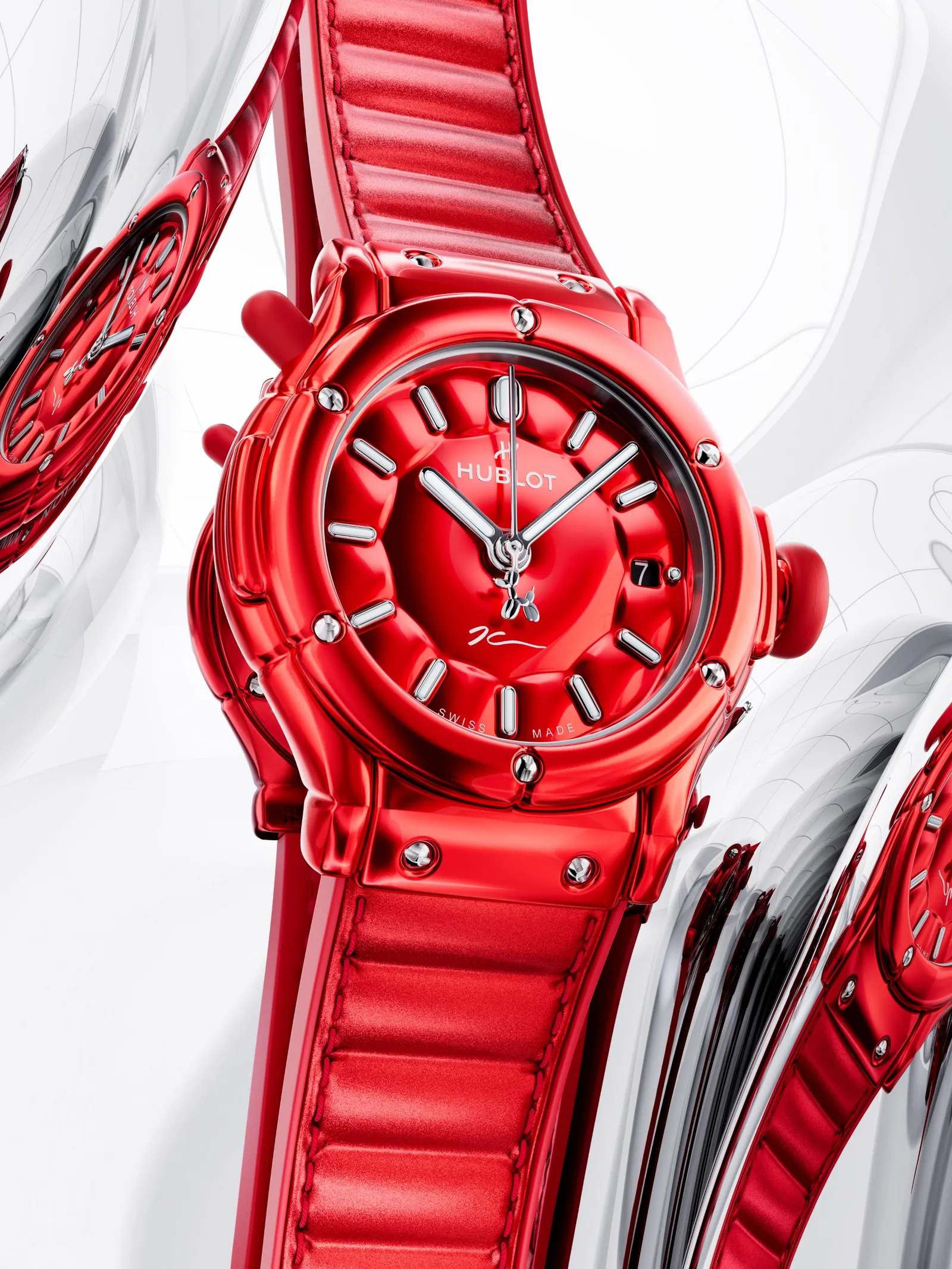
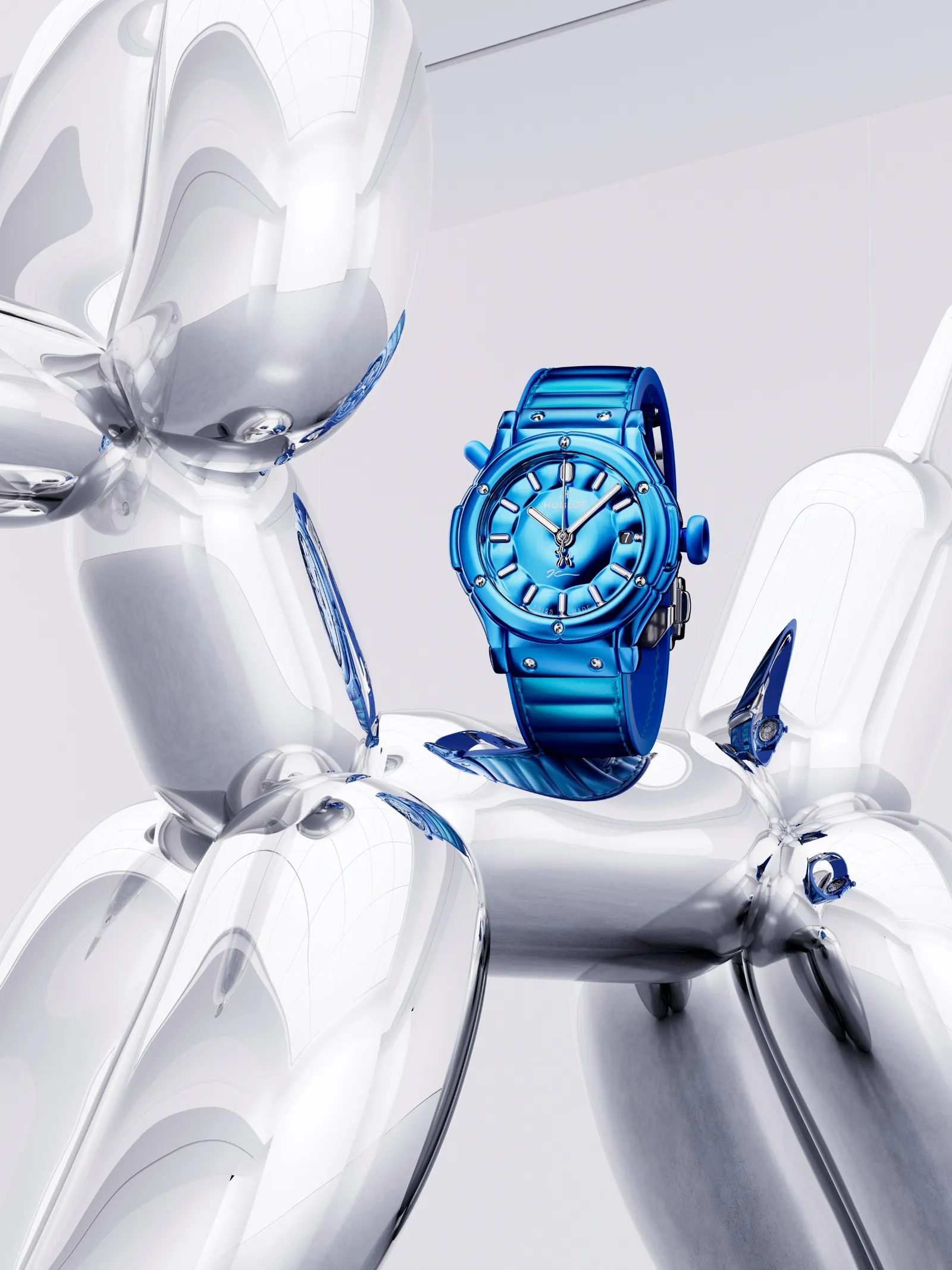
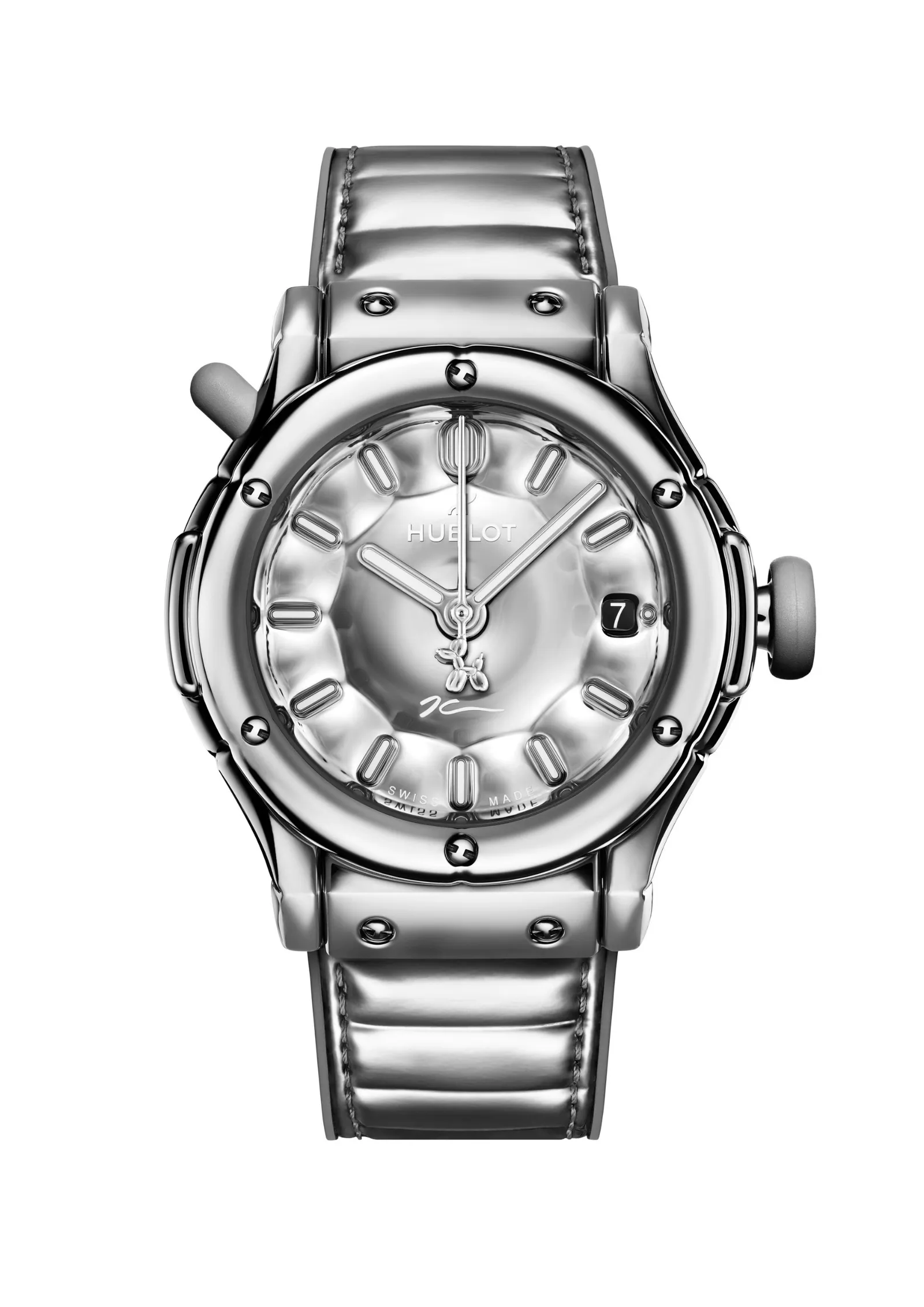
The inflation reaches places most collision never touch. The sapphire crystal is domed. So are the heads of the titanium screws set into the bezel. The dial is built in a convex, cushion construction, with Super-LumiNova indices and hands that swell outward in three dimensions, and Koons’ sig sits at six o’clock. A small Balloon Dog rides at the tip of the central seconds hand as a counterweight. The crown, molded in rubber over aluminum, takes the shape of a balloon’s inflation valve, and at 10:30 a flexible rubber “balloon tail” sticks out of the case flank, the single most unexpected detail on a watch full of them.
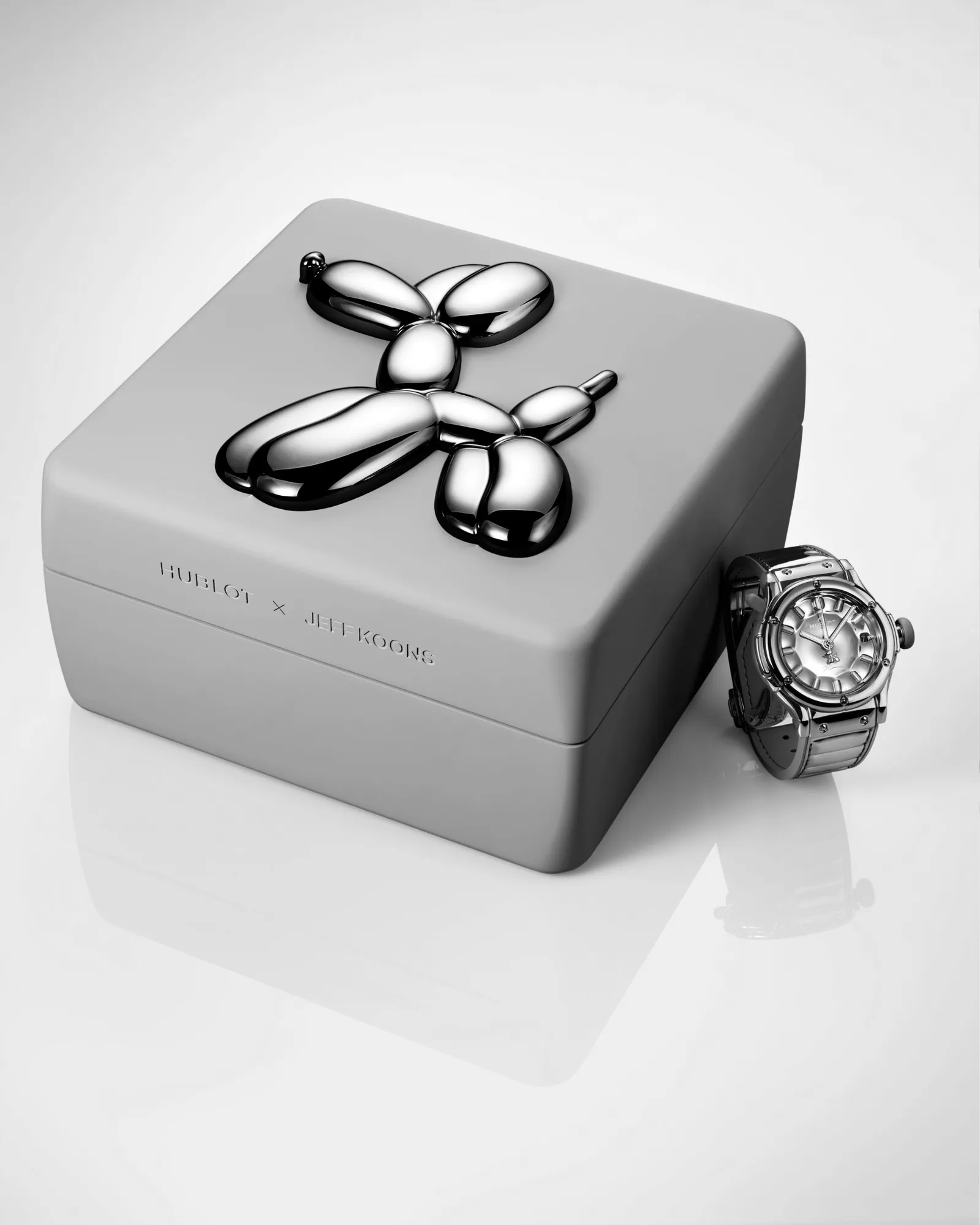
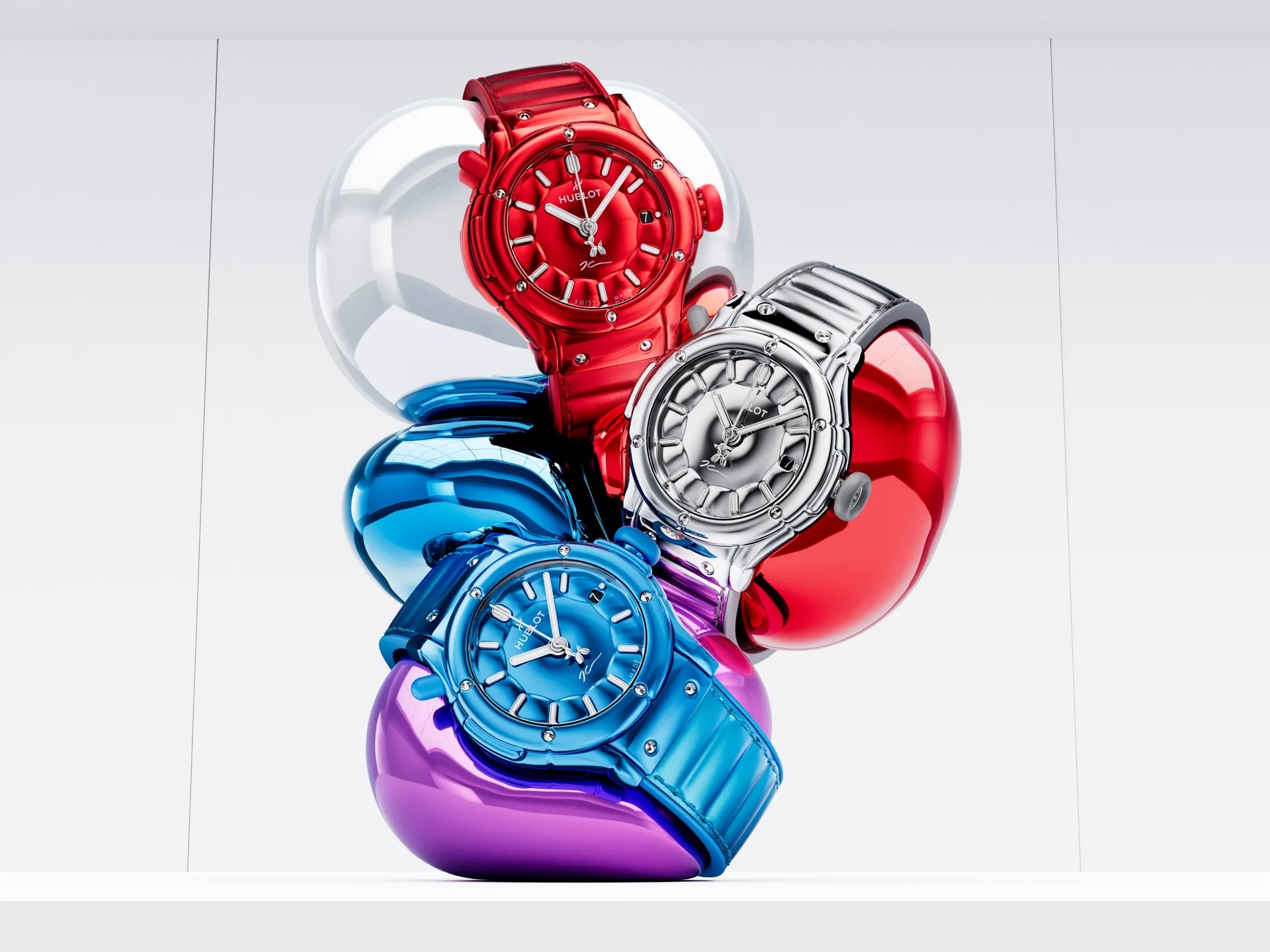
Three editions anchor the launch. The silver version is mirror-polished stainless steel, the closest of the three to the chrome surface of the sculptures themselves. The red and blue versions are anodized aluminum, a material Hublot says it chose for its ability to hold the saturated color Koons is known for. That mirrors how the original dogs work: each one is stainless steel underneath, with its color supplied by a coating rather than by the metal.
Inside, the watch runs on the automatic HUB1710, a movement built on Zenith’s Elite 670 base, beating at 28,800 vibrations per hour with a 50-hour power reserve. It drives hours, minutes, central seconds and a date. It is the most conventional part of the package, though even here the theme carries through: the custom tungsten oscillating weight has rounded, bulging forms that echo the case. The case measures 42mm across and 11mm thick, and water resistance is rated at 5 ATM.
The strap continues the idea. A rubber base carries a debossed metallic leather insert (a metallic polymer on the silver edition) with a padded, inflated look and tone-on-tone stitching, closed by a steel deployant buckle with its own puffed shape. The packaging goes one step further. Each watch ships with a chromed balloon dog sculpture, color-matched to its edition and finished with rubber-effect paint, so the box carries a small version of the original object the watch is trying to translate.
straddle
Koons has explained his attraction to balloon animals in bodily terms for years. His argument is that people are balloons too: every breath in reads as a small act of optimism, and every breath out hints at mortality. The inflatable, in that reading, is a portrait of being alive.
Speaking with Silver about the watch, he pushed the analogy further. The swollen surface of a balloon dog, he suggested, is where the object meets the outside world, the same role skin play for a person. A real balloon dog is latex; his sculptures and now the watch are steel. Strip away the material and the shape still describes something pressurized from within, which for Koons connects the toy to the body’s own organs. He framed the dog as carrying two charges at once, a cheerful face turned outward and something more mysterious about existence held inside.
He took a similar route when Roberta Naas asked him about moving from monumental sculpture to the wrist. Koons reached for Plato, citing scale as the first question any artwork has to answer, then argued that a watch operates at two scales simultaneously: physical small, yet tied to an idea of time that lives inside the mind and is enormous.
The making process left its own impression. Koons told Silver he was struck by the size of Hublot’s operation, by what its milling technology could achieve, and by the company’s effort to train young watchmakers to carry the craft forward. He described the collaboration as a mutual push, each side challenging the other a little further than it would have gone alone.
View this post on Instagram
flow
The second watch heads somewhere far less literal. Where the Balloon Dog starts from one of Koons’ best-known images, the MP-14 Origin starts from an abstraction: the moment the universe begins. Koons describes it as “the idea of a Big Bang translated through engineered motion.” It joins Hublot’s Exceptional Timepieces collection, the brand’s home for experimental mechanics and materials.
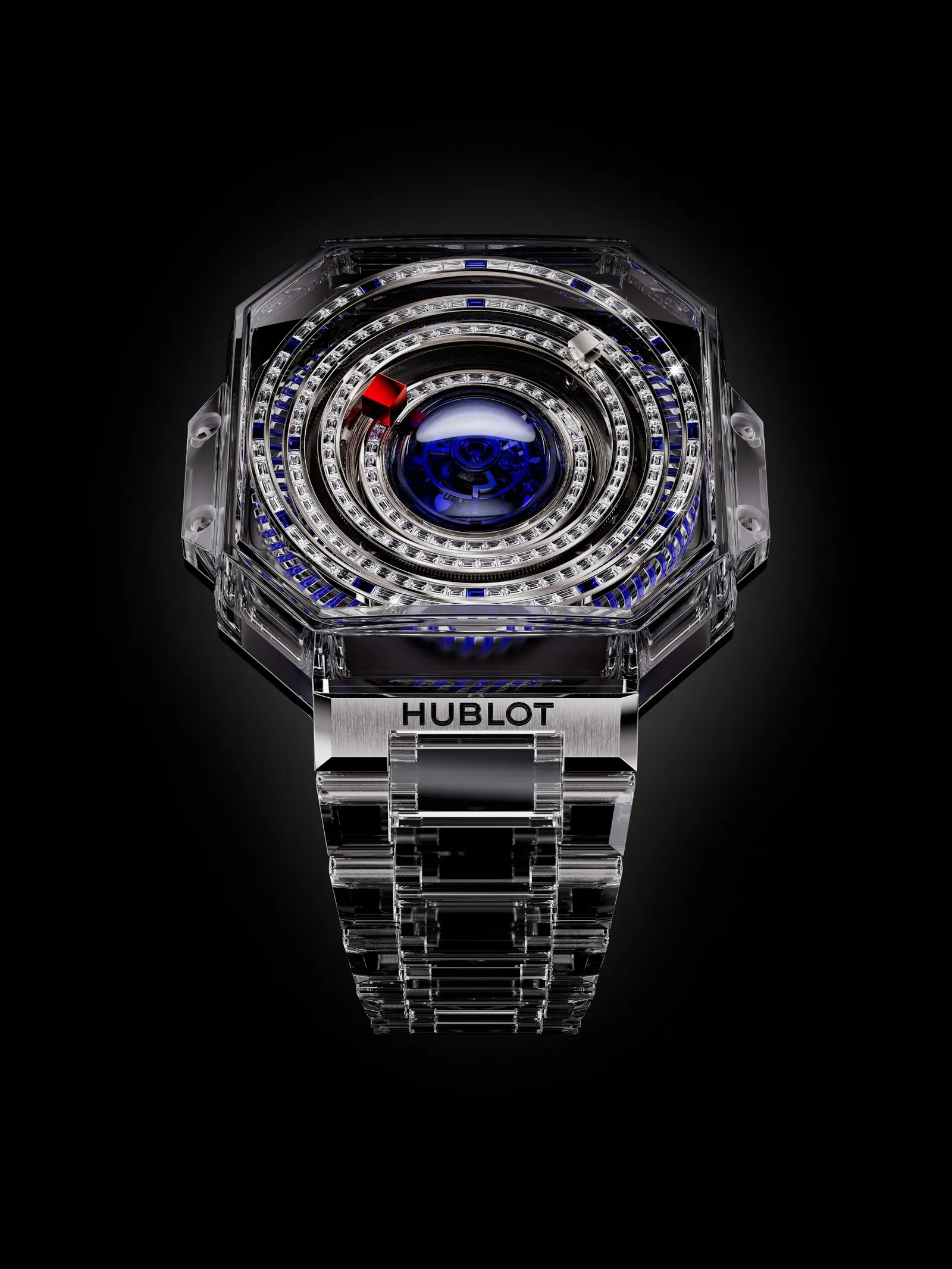
The case is a 44mm octagon cut from sapphire crystal and titanium, 20mm thick, with each sapphire case requiring roughly 534 hours of machining. Inside it, four concentric rings of 18K white gold, set with 202 stones in total (baguette diamonds and blue sapphires), surround the center of the dial. Two of those rings rotate to tell the hours and minutes, marked by small red and grey steel indicator cubes, so the display behaves less like a dial and more like an orrery. At the center, beneath a sapphire dome hand-coated in translucent blue varnish, sits the tourbillon. The blue dome nods to Koons’ Gazing Ball works, in which reflective blue spheres sit alongside white classical figures. A fully integrated sapphire and titanium bracelet carries the transparency onto the wrist.
The movement is the real headline for watch collectors. The HUB9014 is Hublot’s first automatic central tourbillon, wound by a peripheral oscillating weight so that nothing blocks the view of the cage at the center. It runs at 21,600 vibrations per hour, holds a 60-hour power reserve and is assembled from 594 components. Hublot had placed a tourbillon at the center of a dial before, in the hand-wound MP-15 it made with Takashi Murakami, but the self-winding version is new.
Pricing puts the piece in rare territory even for Hublot: $488,000, CHF 405,000, or £383,000 in the United Kingdom, where, by UK list prices, that figure tops both the MP-10 Sapphire and the Murakami MP-15. Each of the 30 examples is presented inside an infinity-mirror installation built from one-way mirrors and LED lighting, a format closer to a gallery display than a watch box.
The name carries a piece of Koons’ biography. According to Hublot, the 14 refers to his first solo exhibition, held in 1980 at the New Museum, which was then located at 65 Fifth Avenue at 14th Street.
before
That 1980 date is the hinge of the whole partnership. Hublot was founded the same year and made its name by putting a gold watch case on a natural rubber strap, a pairing that traditional Swiss watchmaking treated as close to heresy at the time. The Big Bang followed in 2005 and turned the brand into a commercial force, and LVMH acquired Hublot in 2008, the same year the Classic Fusion arrived. Hublot dates its work with outside artists to 2011, a run that has included street artists, painters, architects and designers.
Koons came aboard formally on September 9, when Hublot announced him as its newest brand ambassador in a statement from its headquarters in Nyon. LVMH followed with its own announcement, framing the appointment as the latest chapter in Hublot’s long relationship with the art world. Koons, for his part, pointed to a shared interest in material science, the idea that both an artist and a watchmaker can push a material past its parts into something with more meaning.
The deal lands in the second year of Julien Tornare’s tenure. He took over as Hublot CEO on September 1, 2024, after leading TAG Heuer and, before that, Zenith. Talking to Naas, Tornare described the balance the project demanded: watchmaking is a discipline of constraints, but an artist of Koons’ standing has to be given as much freedom as possible, with Hublot’s engineers then responsible for turning that freedom into a watch that is solid, functional and water resistant.

The Classic Fusion Balloon Dog was conceived, developed and assembled at the Nyon manufacture, and Hublot covers it under its 5+5 warranty program, which can extend coverage to ten years. The brand also plans to show the watch in selected art galleries alongside its usual retail network, a distribution choice that matches the way both pieces have been presented.
build
Brand announcements rarely describe a new ambassador as divisive. Hublot’s did. Its September 9 statement placed Koons among the most “commercially successful and polarizing figures in contemporary art,” which reads less like an accident than a positioning decision. Few living artists split opinion as reliably, and fewer still sit as high in the auction rankings; Balloon Dog (Orange) remains among the most expensive works by a living artist ever sold at auction.
Tornare appears entirely comfortable with that split. At the New York launch, he acknowledged that the watch is very different and disruptive, then added: “I totally assume that people might love it or not like it.” For a brand that built its identity on a gold case strapped to rubber, provoking a reaction is not a side effect.
The numbers keep the experiment contained. There will be 600 Classic Fusion Balloon Dogs across the three editions and 30 MP-14 Origins, a total of 630 watches. Each Classic Fusion leaves Nyon in a box that holds a second balloon dog, chromed and color-matched to the watch it travels with.