DRIFT AUDIO
Listen to this story
Choose a voice, then press play.
A closer look at the 2012 giclée print that reworks Marley’s face into stencil-sharp black lines over a backdrop of actual sheet music, now listed through Danysz Gallery in an edition of 50
In This Story
- A Portrait Built on Layers
- The Artist Behind the Ribbon Logo
- Why Bob Marley, Why 2012
- The Edition, Explained
- Where the Work Sits in Monopoly’s Market
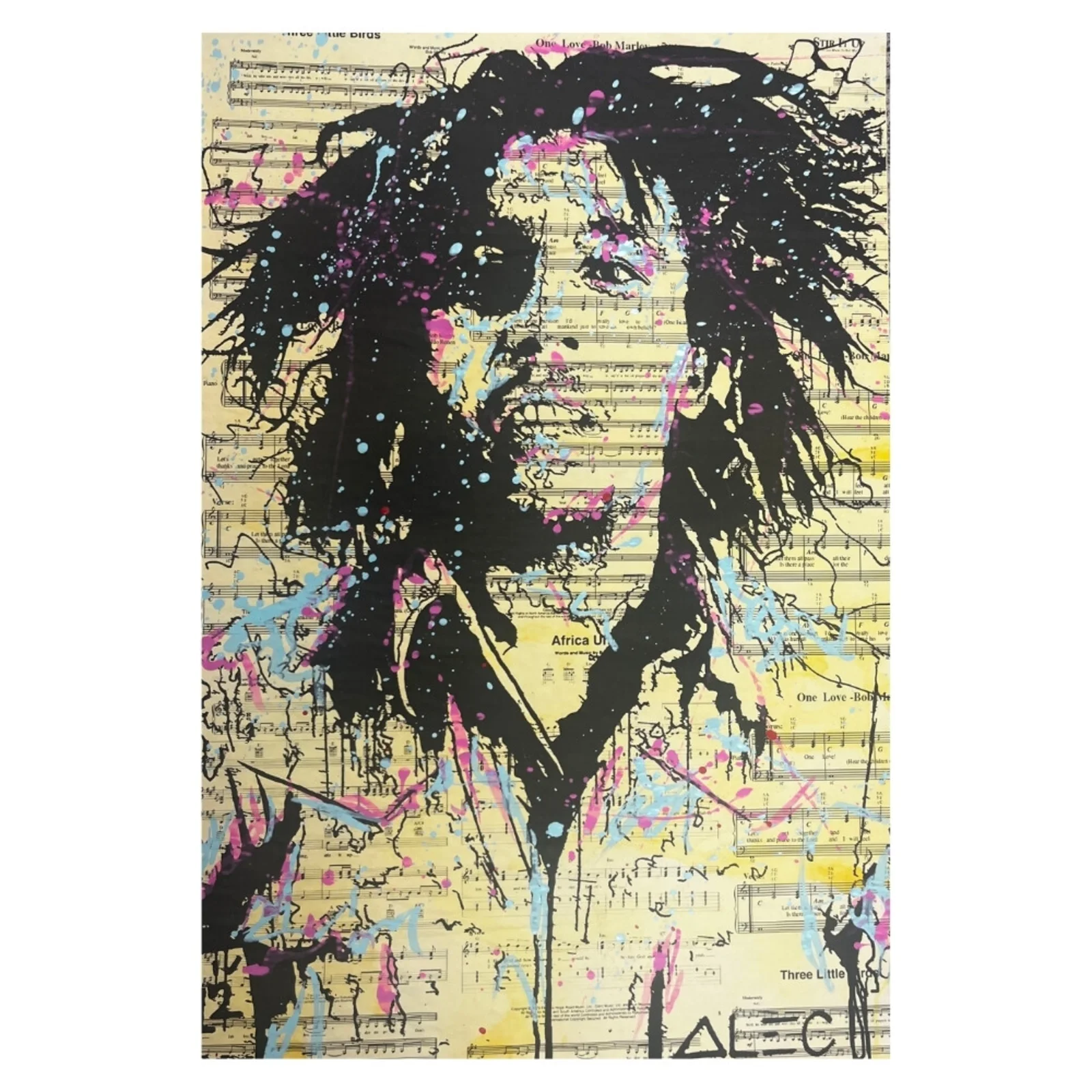
Alec Monopoly‘s Bob Marley, 2012, builds its portrait in stages rather than a single gesture. The base layer is literal: sheets of actual printed music, collaged and lacquered flat across the paper, standing in for the canvas most artists would leave blank. Over that musical ground, Monopoly lays down a bold, near-stencil outline of Marley’s face in stark black — dreadlocks rendered as thick, confident strokes, the wide, instantly recognizable smile pulled tight across the composition. The final layer is the loosest: deliberate drips and splatters of bright pink, cyan, and yellow paint scattered across the surface, the kind of controlled spontaneity that has defined Monopoly’s practice since his earliest days working outdoors rather than in a studio.
That layering — collage ground, stencil-sharp figure, loose paint on top — mirrors a compositional formula Monopoly has used across much of his best-known work, but the choice of ground material here does more narrative work than his usual newsprint backdrops. A viewer doesn’t need wall text to understand why sheet music sits underneath a portrait of a musician; the reference announces itself immediately, in a way that his more oblique newspaper-and-stock-ticker grounds sometimes require more context to parse. It’s a small structural decision, but it’s the one that keeps the piece from reading as a generic street-portrait treatment applied indiscriminately to a famous face.
The piece is a Giclée print on wove paper with hand-embellishments, meaning each of the 50 numbered editions carries paint applied by hand on top of the printed base — no two examples in the run are pixel-for-pixel identical. Each measures roughly 91 by 61 centimeters (35 4/5 by 24 inches), hand-signed and numbered by the artist. It’s currently listed for sale through Danysz Gallery, the Paris- and Shanghai-based contemporary art gallery founded by Magda Danysz in 1991, with the work priced at €6,150 and shipping from the gallery’s Paris location. Danysz has built its program around exactly this kind of crossover between street art and gallery-world validation, representing artists including Futura, Vhils, JR, and Shepard Fairey alongside its photography and Chinese contemporary art programs — a roster where Monopoly’s pop-inflected street work sits comfortably.
View this post on Instagram
The sheet-music backdrop is the detail that separates this piece from the rest of Monopoly’s better-known output. Where much of his catalog leans on newsprint — stock ticker pages, financial headlines, the visual language of Wall Street excess that gave his practice its name — swapping that for musical notation is a direct, uncomplicated nod to what made Marley a subject worth painting in the first place. It’s a quieter formal choice than the composition’s surface energy suggests, and it does most of the conceptual work in a piece that otherwise reads, at first glance, as pure graffiti bravado.
stir
Alec Monopoly was born Alec Andon in 1986 in New York City, and began his career making unsanctioned street work around the city before adopting the persona that would define his practice: a reworking of Rich Uncle Pennybags, the mustachioed, money-bag-carrying mascot of the Monopoly board game. According to Artsy’s overview of his practice, Monopoly uses that character — along with other pop-culture figures including Bob Dylan, Scrooge McDuck, Patrick Bateman, and Richie Rich — as a vehicle to simultaneously critique and cash in on ideas of celebrity, money, and fame, turning conspicuous displays of wealth into a recurring visual punchline across his output.
He’s cited Salvador Dalí as a formative influence, alongside street-art forerunners Keith Haring and Jean-Michel Basquiat, and has drawn frequent comparisons to Banksy for his early willingness to paint outside sanctioned spaces before transitioning into gallery and auction representation. That trajectory — unsanctioned murals first, blue-chip validation later — is a well-worn one in contemporary street art, but Monopoly’s version moved unusually fast: by the early 2010s, when this Bob Marley print was made, his work was already circulating through celebrity collections and international exhibitions in cities including Miami and Moscow.
Monopoly’s early practice was rooted specifically in New York, where he began painting on abandoned buildings and other unsanctioned surfaces before the Pennybags character took hold as his signature. By his own account, he was drawn to street work over gallery painting because of its exposure — a piece on a wall reaches people who would never walk into a gallery or art fair, a philosophy that shaped both his subject matter and his instinct for instantly legible pop-culture references over more hermetic conceptual work. That instinct carried directly into pieces like this one: Marley requires no wall text, no artist statement, no prior familiarity with street art to register as a subject worth looking at.
The Bob Marley print sits slightly outside Monopoly’s core Pennybags-driven body of work, part of a smaller strand of the artist’s practice built around musicians and cultural icons rather than caricatures of Wall Street wealth. It’s a mode he’s returned to periodically — portraits that trade the satire of his money-obsessed characters for something closer to homage, extending in later years into an ongoing series of pop-culture and celebrity portraits produced alongside his signature Monopoly Man imagery. Where the Pennybags work invites a knowing, slightly cynical read, the musician portraits ask for something more straightforwardly admiring — a shift in register that Bob Marley handles by leaning on craft (the layered sheet-music ground, the careful stencil linework) rather than punchline.
why
Marley’s image has circulated through street art and graphic design for decades, largely detached from any single gallery or estate-sanctioned campaign — a testament to how thoroughly his face and message outlived the specifics of his 1981 death. What Monopoly’s print does differently from the generic dorm-room Marley poster is contextual: the sheet-music ground makes an explicit argument about why Marley belongs in this kind of composition. It’s not just an icon’s face rendered in a fashionable street-art style; it’s a portrait that insists on being read alongside the music that made the face famous in the first place.
The gallery’s own description of the work frames the drips and splatter work as a stand-in for Marley’s “revolutionary spirit” — a reading that leans into reggae’s long-standing association with political and social movement, from Jamaican independence-era music through Marley’s own advocacy work. Whether or not that reading fully lands depends on the viewer, but it’s a more considered piece of iconography than the surface-level graffiti aesthetic might suggest on first look, tying medium (musical paper), subject (a musician), and gesture (spontaneous drips as a metaphor for revolt) together more tightly than most street-portrait mashups bother to.
exposit
The market language around this piece is worth unpacking for anyone newer to collecting prints. “Edition of 50” means Monopoly and his studio produced 50 numbered examples of this particular composition, each hand-embellished individually — a common structure for street and pop artists whose original one-off canvases sell for significantly more than any print run could achieve, but who want work available at a lower (if still substantial) price point. The “hand-embellishments” designation is what separates a piece like this from a straight reproduction: the underlying Giclée print is identical across the edition, but the acrylic paint applied on top varies slightly from copy to copy, giving each numbered work a degree of one-off character within a repeatable format.
That structure has become close to standard practice for artists working in Monopoly’s lane — Banksy, Mr. Brainwash, and other street-art-to-gallery crossovers have relied on similar editioned, hand-finished print models to serve collector demand that original canvases alone couldn’t meet. It lets an artist’s most recognizable compositions circulate more widely without diluting the value of a true one-off original, while still giving each numbered print enough individual character that early editions in a run aren’t strictly interchangeable with later ones — a distinction serious collectors of editioned street art tend to track closely.
Auction and secondary-market listings for Bob Marley (2012) show the piece circulating well beyond its original edition run — records list versions at Heritage Auctions and through galleries including Robin Rile Fine Art and Lynart Store, with sales tracked as far back as its creation and as recently as mid-2023, according to auction-database listings. That kind of sustained secondary activity, more than a decade after the work was made, suggests the piece has held a place in Monopoly’s catalog as one of his more consistently traded prints — helped, in part, by the crossover appeal of the subject matter to buyers who may not follow street art closely but recognize Marley’s face immediately.
View this post on Instagram
pos
Monopoly’s broader market has always leaned on recognizability — of his Pennybags character, of the pop-culture figures he borrows, and of the loud, drip-heavy visual language that makes his work identifiable from across a room. Bob Marleyfits that formula while pulling from a different well: rather than building a joke around capitalism’s mascots, it borrows the instant emotional register that comes with painting one of the most reproduced faces in modern music.
That combination — street-art surface treatment applied to an already-beloved subject — has proven durable in Monopoly’s catalog over the past decade, and Danysz Gallery’s current listing keeps the piece in active circulation more than twelve years after it was made. For collectors drawn to street art’s pop-culture crossover appeal but wary of paying originals-level prices, editioned, hand-embellished prints like this one remain one of the more accessible entry points into the artist’s catalog — a category that has kept demand for early-2010s Monopoly prints steady well into 2026.
It’s also worth situating the piece within the wider Marley-as-icon economy that’s persisted since his death in 1981. Few 20th-century musicians have had their image so thoroughly separated from any single authorized source — Marley’s face circulates across posters, murals, and merchandise worldwide with a ubiquity that puts him in company with figures like Che Guevara or Albert Einstein, recognizable well beyond anyone who could name a specific album or song. Monopoly’s print doesn’t try to compete with that ubiquity or reclaim the image from it; instead, it uses the same instant recognition as a starting point, then adds a layer of specificity — the sheet music, the hand-applied paint, the numbered edition — that a mass-produced poster never offers. That’s arguably the clearest case for what a piece like this is actually selling: not just Marley’s face, but a more considered, collectible version of an image most people have already seen a thousand times over.
From the DRIFT archive: The Art of the Can: Chaz Bojórquez’s Hand-Signed MTN Spray Paint Edition
Related Articles

Where the Face Should Be, Rafael Silveira Paints Open Sky
A pink shirt, shoulder-length hair, then no face at all: in “Surprise,” Rafael Silveira lets flowers and a clear blue sky stand in for the person.