
DRIFT AUDIO
Listen to this story
Choose a voice, then press play.
Top View of Millennium Falcon. c. 1975–1977. Production art. Ink on vellum. 20 x 24 in. (50.8 x 61 cm). Lucas Museum of Narrative Art. © and ™ 2026 Lucasfilm Ltd. Used under authorization.
The sheet in the Lucas Museum of Narrative Art is catalogued exactly as the brief: Joe Johnston, Top View of Millennium Falcon, circa 1975 to 1977, production art, ink on vellum, 20 by 24 inches. Copyright Lucasfilm Ltd., 2026, used under authorization. It is not a poster. It is a working drawing. Top view means the shop can count the circles, the dish, the mandibles, the offset cockpit, and start cutting.
View this post on Instagram
Johnston came onto Star Wars as an illustrator in the miniature and optical effects unit, then rose to art director on the later two films of the original trilogy. Ralph McQuarrie painted the world. Johnston turned the world into hardware the model shop could schedule. Colin Cantwell had already given George Lucas an early Falcon that read as a long pirate ship, kin to what became the Blockade Runner. That model was far enough along that parts existed. Then the comparison to the Eagle transporter from Space: 1999 landed. Lucas asked for a new shape that did not look like television. Johnston had about a day. Shape, Lucas said, was less important than difference.
The saucer arrived out of that day. Johnston later told the kitchen-dishes version at Celebration and in Light & Magic: late night, a stack of plates that had always been there, a disk that could be a hull. Sketches moved toward a round plan with an offset cockpit. McQuarrie and Johnston fed each other. Johnston kept the last word on design. McQuarrie could make it glow. The shop, Grant McCune and company, still had the old calendar. The new ship had to meet the old shoot dates.
stir
A top view is what you draw when the romance is over and the mill needs numbers. The pirate-ship Falcon was linear, engine-heavy, handsome in profile. The saucer Falcon is a circle with a bite taken out and a cockpit shoved to the side so the ship looks like it was repaired by someone in a hurry. Johnston’s sheet from above is how that hurry becomes symmetry you can build twice, at miniature scale and at Elstree half-set scale.
J. W. Rinzler’s The Making of Star Wars tracks the chain: Lucas approving stages, John Dykstra sketching, Johnston turning those into concept designs, Steve Gawley into orthographic drawings, then Shourts and McCune into construction. Orthographic is the family this vellum belongs to. Top, side, front. No atmosphere. No starfield. Ink that a saw can follow.
The 1977 Star Wars Sketchbook reproduced related dyelines, including a top view of the Falcon. A dyeline is the shop copy: vellum original laid over diazo paper, ultraviolet, a blue or purple print the crew can fold. The museum object is the ink parent, or one of the parents, in that family. Circa 1975 to 1977 covers the whole design panic, from pirate ship through saucer lock to the year the film opened.
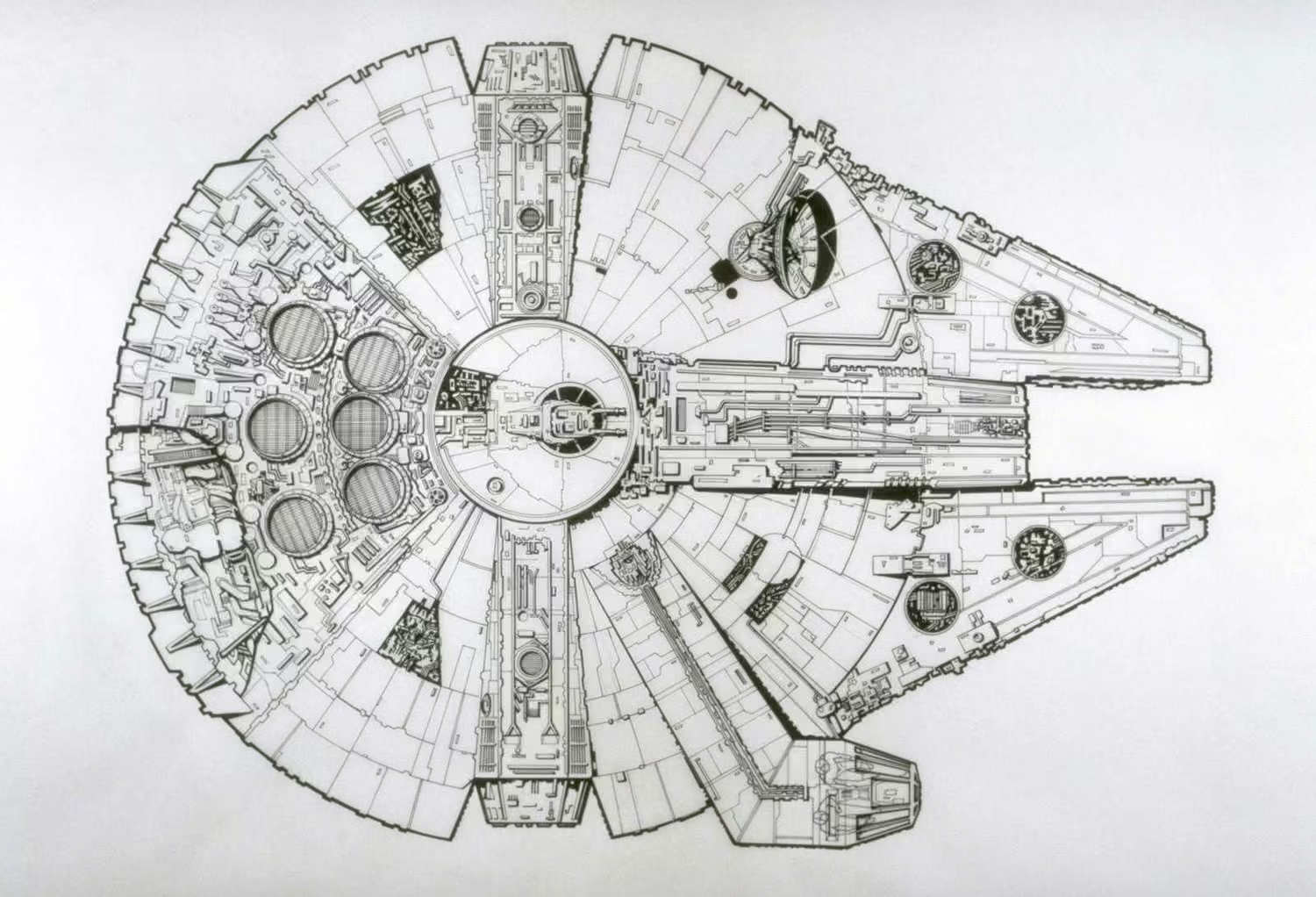
Johnston. Top view. Ink on vellum. 20 x 24. The shop’s map.
scope
Vellum takes ink without much forgiveness. Twenty by twenty-four is a desk sheet, not a mural. You can pin it over a bench. You can punch a diazo copy. Production art, in the museum’s classification, means the drawing existed to make another object. The other object was a flying pie with a gun dish and a cockpit that is not in the center.
Cantwell’s first Falcon and Johnston’s pirate-ship drawings still matter because they explain the speed. The model shop had already invested. Lucas changed the silhouette anyway. Johnston’s job was to give them a new plan that reused whatever logic could be reused and abandoned the Eagle profile. A top view is the fastest way to prove the new silhouette is a single animal, not a Blockade Runner with a lid.
McQuarrie could paint the pirate ship in space and make you want it. Johnston had to make you able to build the replacement. That split is why the vellum looks dry next to a McQuarrie production painting and why the dry sheet is the one the mill kept.
Johnston would design Boba Fett’s kit on Empire, art-direct the later films, then direct The Rocketeer, Jumanji, Captain America: The First Avenger. The Falcon top view sits at the start of that line: a young illustrator turning a panic into a plan view.
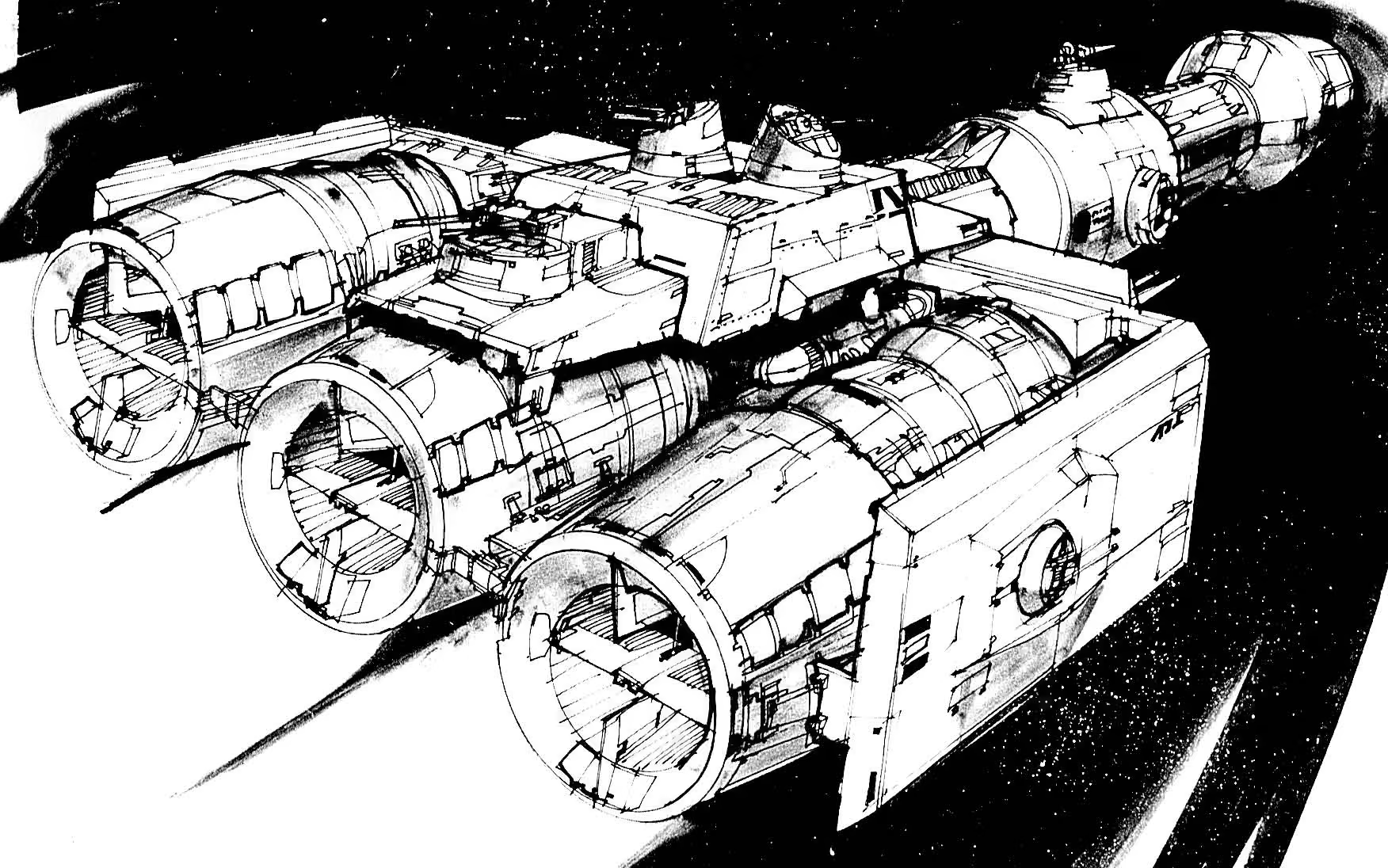
The earlier animal. Long pirate ship. Before the dishes in the kitchen.
hint
From above, the Falcon is a circle interrupted. Mandibles forward. Cockpit to starboard. Radar dish off-axis. Circular hatches and gun wells punched like a machine that has been opened too many times. That is the character. Han Solo’s ship looks repaired because the plan view is full of circles that do not share a center.
Elstree built half a Falcon for the hangar. The miniature flew. Both needed the same top view or they would not match in the cut. Johnston’s sheet is the agreement between those two scales.
The museum hangs it as narrative art. The narrative is short. A television ship looked too close. A young draftsman stayed up. A stack of dishes suggested a disk. Ink went onto vellum. The shop made the disk fly. 1977 put the disk on a screen. 2026 the disk is still the one people mean when they say Falcon.
Classification: production art. Medium: ink on vellum. Date range: the years the ship changed species. Dimensions: a board you can carry down a corridor at ILM. Copyright remains Lucasfilm. The drawing remains a top view. That is the whole job it was hired to do.
Related Articles
VARIEGATOR Spider-Man and Star Wars S/S Tee: Vintage-Style Prints That Capture the Soul of Classic Pop
In the crowded world of graphic tees, where fast fashion often delivers forgettable prints that […]